


- The iPhone 17e packs a 48MP Fusion camera with optical-quality 2x telephoto — the same sensor found in the iPhone 17, at $200 less.
- Portrait mode gets a major upgrade with automatic depth capture for people, dogs, and cats — plus the ability to adjust focus after the shot.
- The biggest tradeoff: no Ultra Wide lens, no Camera Control button, and a 12MP front camera vs 18MP on the iPhone 17. See full comparison.
- Best suited for budget-conscious photographers upgrading from an iPhone 14 or older, or anyone who primarily shoots with the main camera and doesn’t need ultra-wide. See if it’s right for you.
Apple just announced the iPhone 17e, and if you’re a photographer wondering whether it deserves a spot in your pocket, the answer depends entirely on what you shoot and what you’re willing to give up.
The iPhone 17e replaces the iPhone 16e as Apple’s budget-friendly option, starting at $599. It shares the same 48MP Fusion camera sensor as the more expensive iPhone 17 — but strips away the Ultra Wide lens, Camera Control button, and several features photographers might miss. Here’s what you need to know.
Camera Specs: What the iPhone 17e Offers
The headline feature is the 48MP Fusion camera — effectively two cameras in one lens. It captures at 48MP full resolution or defaults to 24MP, and includes an optical-quality 2x telephoto that lets you get closer to your subject without sacrificing image quality.
For portrait photographers, the 17e brings next-generation portrait capabilities. The camera automatically captures depth data whenever it detects a person, dog, or cat in the frame — no need to switch to Portrait mode first. You can then adjust the focus point after the shot in the Photos app, which is genuinely useful for candid moments you didn’t plan for.
Apple’s latest-generation HDR processing promises true-to-life skin tones, bright highlights, rich midtones, and deep shadows. Combined with the Photonic Engine, Deep Fusion, and Hybrid Focus Pixels, the computational photography pipeline is essentially the same one powering the standard iPhone 17.
Other camera highlights include:
- Night mode for low-light shooting
- 4K Dolby Vision video recording
- 10x digital zoom (not optical — keep expectations realistic)
- Natural bokeh with smooth depth-of-field transitions in portraits
The A19 chip running the show has one fewer GPU core than the iPhone 17’s version, but Apple says the camera processing capabilities remain comparable. For most photography workflows — including exposure adjustments and post-processing on the device — you shouldn’t notice a difference.
What’s Missing Compared to iPhone 17
Here’s where the $200 savings start to show. The iPhone 17e makes real compromises that matter to photographers, and it’s worth being honest about them.
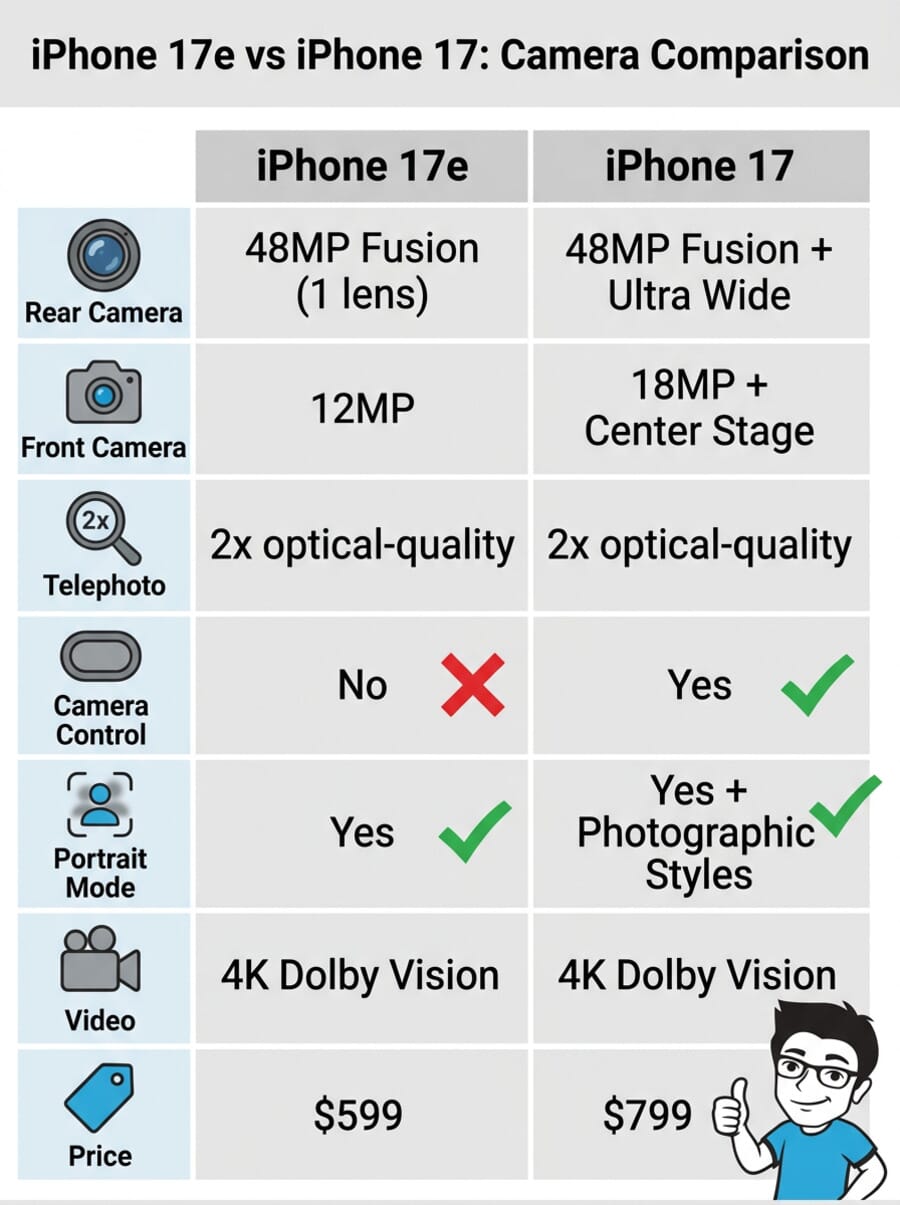
No Ultra Wide lens. This is the single biggest limitation for photographers. The iPhone 17e has one rear camera — period. No sweeping landscapes, no dramatic architectural perspectives, no fitting large groups into tight spaces. If you regularly shoot wide, this is a dealbreaker. Landscape and real estate photographers will feel this loss most acutely.
No Camera Control button. The iPhone 17 introduced a dedicated hardware button for quick camera access and settings adjustment. The 17e skips it entirely, so you’re stuck with the lock screen shortcut or the app icon.
12MP front camera vs 18MP. The iPhone 17 gets a sharper selfie camera with Center Stage (which keeps you in frame during video calls). The 17e’s 12MP TrueDepth camera is still fine for selfies and video calls, but content creators who rely on the front camera will notice the difference.
No latest-gen Photographic Styles. The iPhone 17 lets you customize the look of your photos with updated Photographic Styles. The 17e doesn’t get this feature, so you’ll need to rely on post-processing apps or manual camera apps for creative control over color and tone.
No Dual Capture. The iPhone 17’s ability to shoot with front and rear cameras simultaneously doesn’t make it to the 17e.
Other differences that affect the shooting experience:
- No 120Hz ProMotion display — the viewfinder and image review won’t feel as smooth
- ~25% less display brightness — harder to compose shots in bright sunlight
- Smaller 6.1″ screen vs 6.3″ — slightly less real estate for framing and editing
- Less advanced optical image stabilization — may matter for handheld video and low-light
- Notch instead of Dynamic Island — purely cosmetic, but the Island shows live activities
Who Should Consider the iPhone 17e?
The iPhone 17e makes the most sense for three groups of photographers:
Budget-conscious shooters who prioritize the main camera. If 90% of your iPhone photos come from the standard wide lens, you’re getting the same 48MP sensor and computational photography stack as the iPhone 17 — at $599 instead of $799. That’s a significant saving you could put toward external lenses or photography courses.
Upgraders from iPhone 14 or older. If you’re jumping from an iPhone 14, 13, or older, the camera leap is massive. The 48MP sensor, improved HDR, better night mode, and next-gen portraits represent a generational improvement. The missing Ultra Wide won’t feel like a downgrade if your current phone’s Ultra Wide was mediocre anyway.
Casual photographers who want Apple Intelligence. The 17e runs iOS 26 with full Apple Intelligence features, including advanced computational bokeh and on-device photo editing powered by AI. If you want a capable camera phone that also handles the latest AI features, this is the most affordable way in.
Who should NOT buy the iPhone 17e: Landscape photographers, architecture shooters, anyone who relies on ultra-wide framing, serious mobile videographers who need the Camera Control button, and content creators who use the front camera professionally. For those use cases, the standard iPhone 17 or iPhone 17 Pro is worth the extra investment.
Other Specs Worth Noting
A few non-camera specs that photographers will appreciate:
- 256GB base storage — double the previous generation. That’s room for thousands of 48MP photos and hours of 4K video before you need to offload.
- MagSafe support — new for the e-line (the iPhone 16e didn’t have it). This means compatibility with MagSafe mounts, grips, and tripod accessories.
- IP68 water resistance — 6 meters for 30 minutes. Useful for rain photography or shooting near water.
- USB-C fast charging — 50% in roughly 30 minutes with a 20W adapter. Handy for charging between long shooting sessions.
- Ceramic Shield 2 — 3x better scratch resistance protects that display you’ll be composing on.
Pricing and Availability
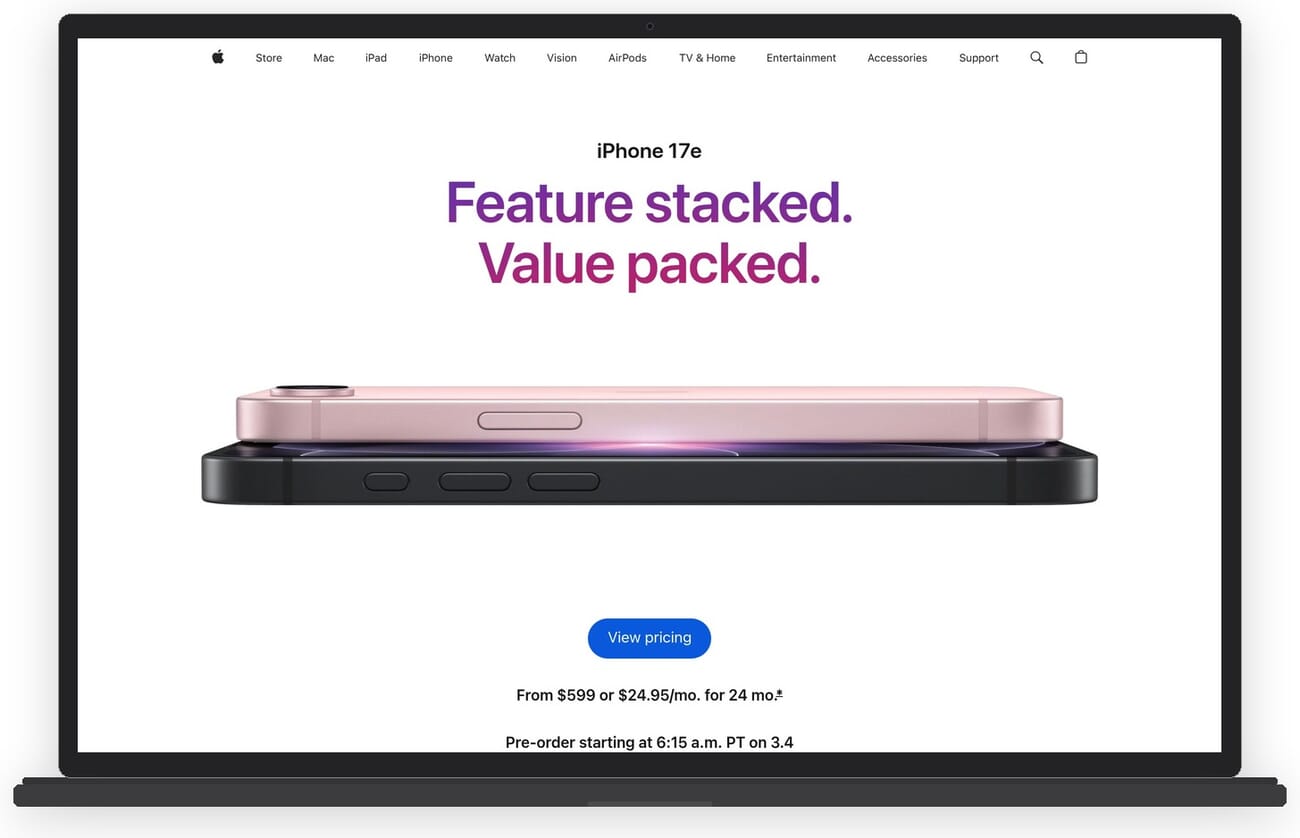
The iPhone 17e starts at $599 with 256GB storage — double the base storage of the iPhone 16e at the same starting price. It’s available in black, white, and soft pink.
- Pre-orders open: March 4, 2026
- Available: March 11, 2026
For comparison, the standard iPhone 17 starts at $799, making the 17e a $200 saving. Whether that $200 gap is worth the missing Ultra Wide lens and Camera Control button depends entirely on your shooting style.
Is the iPhone 17e camera the same as the iPhone 17?
The rear camera sensor is the same — both use a 48MP Fusion camera with optical-quality 2x telephoto. However, the iPhone 17e is missing the Ultra Wide lens, Camera Control button, latest-gen Photographic Styles, and Dual Capture. The front camera is also downgraded from 18MP to 12MP.
Can the iPhone 17e shoot professional-quality photos?
The iPhone 17e can produce excellent photos with its 48MP sensor, advanced HDR, and computational photography features. However, “professional quality” depends on context. For social media, web use, and prints up to about 16×20 inches, the results can be outstanding. For commercial work requiring maximum versatility (ultra-wide shots, precise camera control), the iPhone 17 or 17 Pro is a better choice.
Does the iPhone 17e have Night mode?
Yes. The iPhone 17e includes Night mode on its 48MP Fusion camera, allowing longer exposures in low light for brighter, more detailed nighttime photos. The Night mode processing uses the same Photonic Engine found in the iPhone 17.
Is the iPhone 17e worth upgrading to from the iPhone 16e?
For photography specifically, the upgrade from iPhone 16e to 17e brings a significantly faster A19 chip (better photo processing), the C1X modem, MagSafe support (which was missing on the 16e), and Ceramic Shield 2. The camera sensor remains the same 48MP Fusion system, so the photo quality improvement is primarily in processing speed and computational features rather than the hardware itself.
What’s the biggest camera limitation of the iPhone 17e?
The absence of an Ultra Wide lens. With only one rear camera, you can’t capture wide-angle shots for landscapes, architecture, or group photos in tight spaces. This is the most significant trade-off compared to the standard iPhone 17 and is the main reason photographers might want to spend the extra $200.
Featured image: Photo by Howard Bouchevereau on Unsplash.
Sources used for this article:
Related Posts
Get the Weekly Photography News Digest
Join photographers who get our top stories delivered every Monday morning. No spam, unsubscribe anytime.