

- Nikon’s corporate VP and GM of the Imaging Business Unit, Ikegami Hiroyuki, confirmed to PetaPixel that the company is open to making more retro-themed cameras in the Zf and Z fc family: ‘as long as the customer wants them, we really want to continue to develop those kinds of cameras.’
- Nikon’s analog heritage stretches back nearly 80 years — deeper than any other current camera manufacturer. The pool of designs Nikon could revive is genuinely huge, and the Zf / Z fc playbook (mirrorless guts in classic SLR body) has clearly worked commercially.
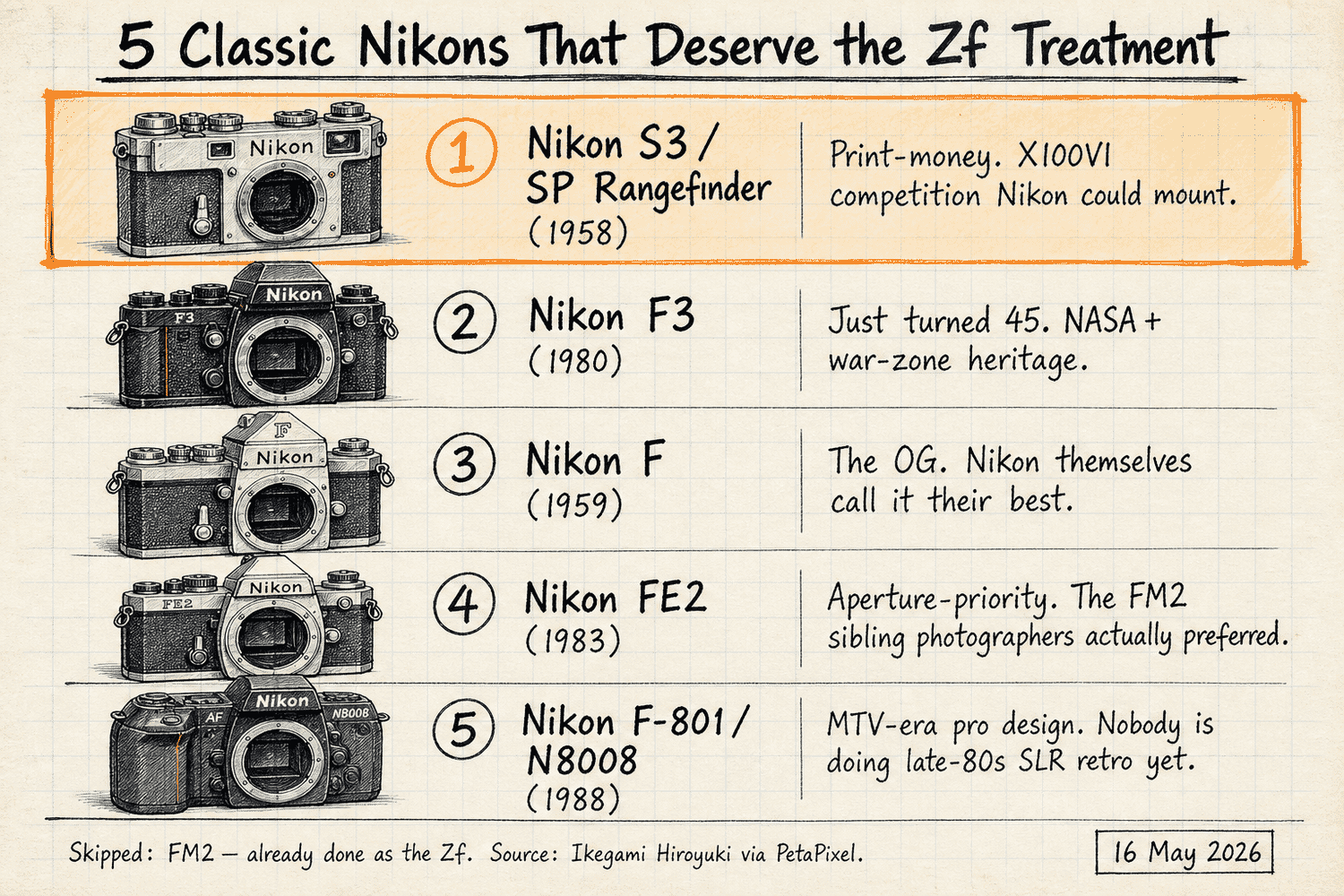
- The strongest revival candidate is a Nikon S3 / SP-style rangefinder — a direct competitor to the Fujifilm X100VI that Nikon has never offered in the digital era. It is the only one on this list with no current Nikon equivalent, and the X100VI’s perpetual sold-out status proves the demand.
- What Nikon should not do: ship another FM2 homage. The Zf and Z fc already pull from that vein. The next retro should explicitly target a different design era — the pro F-series, the late-80s electronic SLRs, or the rangefinder line — to widen the catalogue rather than rephrase the same idea.
Nikon isn’t ruling out more retro-themed mirrorless cameras. That’s the takeaway from a recent PetaPixel interview with Ikegami Hiroyuki, Nikon’s corporate vice president and general manager of the Imaging Business Unit, picked up this week by Digital Camera World. His exact words: “As long as the customer wants them, we really want to continue to develop those kinds of cameras because it is kind of a big hit right now.”
The Zf and Z fc have done their job. Both are commercial hits, both are still in active production, and both have built a customer base that thinks of Nikon as a serious retro-camera brand again for the first time since the 2013 Df. Now the question is what comes next — and Nikon has nearly 80 years of analog heritage to mine. Here are five classic Nikon film cameras most deserving of the next-gen mirrorless treatment, ranked.
When you buy through links on our site, we may earn a commission at no cost to you. We evaluate products independently. Commissions do not affect our evaluations.
Why FM2 Doesn’t Make the List
Before the rankings: a Nikon FM2 revival is the most obvious pick, and it’s the one almost every photographer asked about a Nikon retro mentions first. It’s also already happened. The Z fc and Zf are direct visual descendants of the FM2 — same compact pentaprism profile, same chrome-and-black aesthetic, same control dial layout. Nikon’s design team has explicitly cited the FM2 as the styling reference. Asking for an FM2 revival now is asking Nikon to ship the camera it just shipped.
That frees the next retro to push somewhere different. The picks below are explicitly chosen to extend the catalogue — different design eras, different body styles, different photographer use cases. None of them duplicate what the Zf already does.
#5 — Nikon F-801 / N8008 (1988)
The F-801 (sold as the N8008 in North America) is the bulgy, slightly-rounded enthusiast SLR that defines the late-80s Nikon look. It introduced 1/8000s shutter speeds, 3D matrix metering, and the first version of the modern autofocus system Nikon would keep refining through the F4 and F5. It is also the SLR aesthetic absolutely no manufacturer has tried to revive — every retro mirrorless on the market today copies pre-1985 designs. The F-801 era is wide open territory.
The case against: it doesn’t have the instant nostalgic appeal of the chrome-and-black FM/F2 era. The case for: that’s exactly why it would stand out. A Z-mount mirrorless body styled after the F-801, with a top-deck status LCD and the squared-off rubber-armored grip, would not look like any other camera on the shelf in 2026. That’s worth something.
#4 — Nikon FE2 (1983)
The FE2 is the FM2’s sibling — same chassis, same era, but aperture-priority auto exposure instead of full-mechanical operation. Among working film photographers, the FE2 was often quietly preferred to the FM2: the aperture-priority mode made street and reportage work faster, the 1/4000s shutter handled bright daylight at wide apertures, and the through-the-lens flash metering was best-in-class for its time.
A Zf-class body with the FE2 aesthetic — slightly thinner top plate, smaller prism housing, the trademark aperture-priority “A” position on the shutter dial — would give Nikon a second compact-retro mirrorless that doesn’t visually overlap with the existing Zf. Same design family, different specific reference. The Fujifilm X-series has half a dozen body styles drawing from related but distinct heritage references; Nikon could easily do the same.
#3 — Nikon F (1959)
The original Nikon F is the camera that made Nikon a globally serious brand. Released in 1959 with the interchangeable FTn finder, it became the dominant pro 35mm SLR through the 1960s — the camera of choice for combat photographers in Vietnam, the design that gave Nikon its identity in the same way the Leica M3 gave Leica its. Nikon’s own official rankings have repeatedly named the F as the company’s best camera ever.
A digital Nikon F is a halo-product opportunity. It would not need to outsell the Zf; it would need to anchor the high end of the retro lineup the way a hypothetical Leica M Edition Black Paint anchors theirs. Made in limited runs, priced at $4,000+, with the interchangeable-finder design preserved as a removable EVF module — this is the kind of camera Nikon could charge a serious premium for and Nikon collectors would line up to buy. The question isn’t whether it would sell; it’s whether Nikon is willing to commit to a low-volume halo SKU rather than chasing volume.
#2 — Nikon F3 (1980)
The Nikon F3 turned 45 this year. It is, by most working photographers’ accounts, the most beautiful pro SLR Nikon ever built — Giorgetto Giugiaro penned the body, the square HP prism finder gave it a distinctive silhouette no other SLR matched, and the small red accent stripe on the front grip became one of the most-copied design cues in camera history. NASA used it on the Space Shuttle. War photographers carried it through every conflict of the 1980s.
A Zf-platform F3 homage hits the same emotional notes the Zf hit for FM2 owners — instant recognition, photographer-credibility signaling, and a body style that no current manufacturer offers. It would also let Nikon do something the Zf cannot: position a retro mirrorless body as pro-grade, not just enthusiast. Stack a fully weather-sealed body, the IBIS and AF generations from the flagship Z-line, and the F3 silhouette, and you have a camera that pulls from the Df / Z9 buyer simultaneously. That’s a sweet spot the existing Zf doesn’t touch.
#1 — Nikon S3 / SP Rangefinder (1958)
The Nikon S3 is the standout pick because it solves a real product gap Nikon currently has, not just a nostalgia opportunity. The single most successful retro camera launch of the past five years is the Fujifilm X100VI — a fixed-lens, rangefinder-style, retro-bodied APS-C camera that has been perpetually sold out since launch and remains the bestselling compact camera in Japan. Nikon has no answer to it. The Z fc is the closest, but it’s an interchangeable-lens SLR-style body, not a rangefinder, and it doesn’t carry the same fixed-lens premium street-camera positioning.
A Nikon S3-styled mirrorless rangefinder would walk straight into the X100VI’s lane. Pick either path: an interchangeable-lens design competing with the Fujifilm X-Pro 3 and Leica M11 (priced $2,500-$4,500), or a fixed-lens 35mm-equivalent street camera explicitly hunting the X100VI ($1,800-$2,400). Either is a print-money proposition. Nikon already proved they can do this — the limited-edition S3 Year 2000 Millennium Model in 2000 and the SP 2005 Model both sold out instantly. Doing it again, with modern mirrorless internals, is the lowest-execution-risk retro Nikon could ship.
The case against is the same case Nikon has been making to itself for a decade: they don’t want to spread their R&D budget across too many body styles. The case for: every Fuji X100VI sold is a buyer Nikon could have had. The math is brutal.
What to Actually Expect
Nikon won’t ship five new retro cameras. They’ll likely ship one over the next 18-24 months. The most-rumored candidate based on supply-chain chatter is a rangefinder-style mirrorless — which would map to pick #1 here. Other recent Nikon design wins, plus the company’s stated commitment to the format, suggest they are actively considering the play.
The next major Nikon reveal window is mid-2026 alongside the rumored Z9 II. Watch for any teaser language about “heritage” or “design family expansion” in the lead-up — that’s typically how Nikon previews a Zf-class addition.
Frequently Asked Questions
Will Nikon actually make a rangefinder-style mirrorless camera?
Possibly. Ikegami’s quote is open-ended — Nikon has signaled willingness, not commitment. Industry chatter has consistently put a rangefinder-style retro near the top of speculation lists since the X100VI made the category profitable. No specific model, no specific timeline, and no leaked product code has surfaced publicly. The earliest realistic launch window is late 2026.
Why not just buy a vintage Nikon film body if I want the look?
You can — and used FM2, FE2, F3, and S3 bodies are still readily available in the $300-$2,500 range depending on condition. But the appeal of the Zf-class revival is the combination: classic mechanical-feeling body with digital sensor, modern autofocus, in-body image stabilization, and current Z-mount lens compatibility. If you want to shoot film, buy the original. If you want the aesthetic and the ergonomics with 2026 image quality, you want the revival.
What about the Nikon F6, the last film SLR?
The F6 (discontinued 2020) is a strong candidate the DCW piece mentions — last of the line, full pro spec, modern ergonomics. The reason it’s not in our top 5 is execution risk: an F6-styled mirrorless would look almost indistinguishable from a current Z8 or Z9. The retro positioning works best when the heritage reference is visually distinct from anything currently on shelves. The F6 isn’t quite far enough back in time to deliver that contrast.
What about the Nikomat / Nikkormat?
The Nikomat / Nikkormat FT/FT2/FT3 series were Nikon’s late-60s and 70s entry-level SLRs — same family as the FM lineup but positioned below it. A revival would essentially be a slightly more affordable Zf with a different chrome treatment. The market opportunity is real but smaller than any of the five picks above, and Nikon arguably already covers that price point with the Z fc. Stronger candidate for a later revival once the lineup is bigger; not the next one to ship.

Image credit: editorial composition and ranking sketch by PhotoWorkout. Source quote and reporting credit to PetaPixel (interview with Ikegami Hiroyuki) and Digital Camera World (revival shortlist framing). All sources cited in full below.
Reporting and prior coverage cited in this article:
Primary Reporting
- PetaPixel — Nikon Is Open to Making More Vintage-Inspired Cameras – Original interview with Ikegami Hiroyuki, Nikon's corporate VP and GM of the Imaging Business Unit, with the quote cited in this article.
- Digital Camera World — Nikon hasn't ruled out more retro cameras like the Zf and Z fc – DCW's revival shortlist piece that surfaced Ikegami's quote and triggered the current speculation cycle.
- Digital Camera World — The Nikon F3 turns 45 years old – Heritage context for the F3 ranking — NASA, war-zone use, Giugiaro design.
- Digital Camera World — Nikon's first full-frame compact camera rumored, retro design – Adjacent rumor strand: a separate retro-design full-frame compact in the pipeline.
Comparison Context
- Phototrend — CP+ 2026: Nikon teases a new feature for those nostalgic for the 2000s – Nikon's CP+ 2026 nostalgia-mode time-stamp prototype — a separate signal that the brand is actively investing in retro/nostalgia features.