


- Patterns are repeating visual elements — they create rhythm, structure, and visual interest in your photos. Learn to identify six pattern types.
- Find patterns everywhere: nature, architecture, macro close-ups, and even aerial drone shots.
- Breaking a pattern with one different element creates a powerful focal point — it’s one of the most effective composition techniques.
- Modern smartphones like the iPhone 16 Pro and Pixel 9 have excellent macro modes for capturing patterns without dedicated gear.
- Use Lightroom AI masking to isolate and enhance patterns in post-processing.
Patterns in photography are one of the most powerful — and most overlooked — composition tools available to you.
A repeating element draws the eye, holds attention, and transforms an ordinary scene into something visually magnetic. Whether it’s rows of windows on a skyscraper, petals spiraling on a flower, or tire tracks stretching across sand dunes from a drone — patterns are everywhere once you learn to see them.
This guide covers everything you need to know about using patterns in your photography: how to find them, how to compose with them, and how to break them for maximum impact.
What Are Patterns in Photography?
A pattern occurs when a visual element — a shape, color, line, or texture — repeats across your frame. Patterns can be:
- Tight and frame-filling — like a close-up of honeycomb or a brick wall
- Loose and scattered — like boats dotting a harbor or birds in formation
- Regular and geometric — like tiles, windows, or fences
- Organic and irregular — like tree roots, cloud formations, or ripples on water
The key is repetition. As long as some visual element recurs — even imperfectly — your brain reads it as a pattern.
Why Patterns Work in Composition
Patterns are effective for three psychological reasons:
- They hold attention. The eye moves across a pattern, tracing the repetition — this keeps viewers engaged longer than a single static subject.
- They create order. In a chaotic scene, a pattern gives the brain something to latch onto. This is why patterns work so well in urban photography and busy street scenes.
- They feel satisfying. Humans are wired to recognize repetition — it triggers a sense of harmony and balance, similar to symmetry.
Patterns also combine powerfully with other composition techniques like leading lines, the rule of thirds, and negative space.
Types of Patterns in Photography
Not all patterns are the same. Understanding the different types helps you spot them faster in the field.
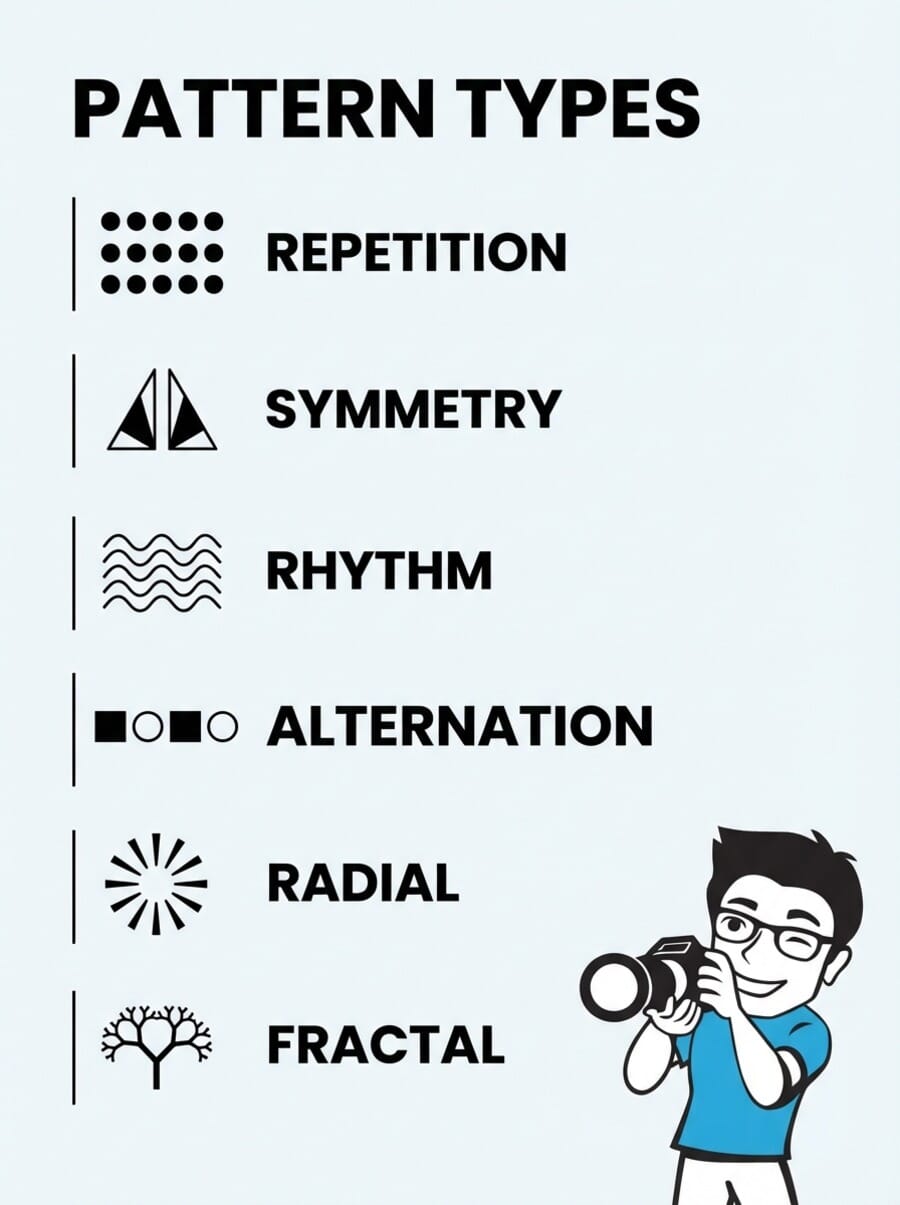
- Repetition — The same element appears multiple times (rows of chairs, columns of windows).
- Symmetry — Mirror-image patterns that reflect along an axis.
- Rhythm — Elements create a visual “beat” — think fence posts receding into distance.
- Alternation — Two or more elements alternate (checkerboard floors, striped patterns).
- Radial — Elements radiate outward from a center point (flower petals, spiral staircases, wheel spokes).
- Fractal — Self-similar patterns that repeat at different scales (fern fronds, river deltas, Romanesco broccoli).
Natural Patterns
Nature is the original pattern maker. Look for:
- Leaf arrangements — Fallen leaves, fern fronds, palm fan patterns
- Flower structures — Sunflower seed spirals, petal repetition in blooms, rows of tulips
- Tree bark and wood grain — Repeating textures at macro scale
- Water patterns — Ripples, wave crests, foam patterns on beaches
- Animal patterns — Butterfly wings, zebra stripes, fish scales

The beauty of natural patterns is their slight imperfection. Unlike man-made patterns, natural ones have subtle variations that make them feel organic and alive. A row of trees won’t be perfectly spaced — and that’s what makes it interesting.
Pro tip: Shoot in black and white to strip away color distractions and emphasize the pattern itself. Most mirrorless cameras let you preview black and white through the viewfinder.
Urban and Architectural Patterns
Cities are pattern goldmines. Architecture practically screams repetition — and urban pattern photography has exploded on social media for good reason.
Where to look:
- Building facades — Rows of identical windows, balconies, and fire escapes
- Floor tiles and pavements — Mosaic patterns, cobblestones, crosswalk stripes
- Staircases and escalators — Repeating steps create strong visual rhythm
- Parking lots and cars — Overhead views of uniform rows
- Market stalls — Repeating booth structures with colorful goods

Composition tip: Use a telephoto lens (or crop in post) to compress perspective and make patterns look denser. A 70-200mm lens aimed at a building facade can turn scattered windows into a wall-to-wall pattern.
Macro and Close-Up Patterns
Macro photography reveals patterns invisible to the naked eye. Magnify everyday objects and you’ll discover a hidden world of repetition:
- Mineral and crystal structures — Quartz veins, geode layers
- Insect wings — Butterfly scales, dragonfly wing cells
- Fabric and textile weaves — Thread patterns at close range
- Food cross-sections — Kiwi seeds, citrus segments, pomegranate cells
- Everyday objects — Keyboard keys, coin stacks, spiral notebooks

You don’t need expensive gear for this. A dedicated macro lens gives the best results, but extension tubes, close-up filters, or even reversing a standard lens can work. And modern smartphones have remarkably capable macro modes (more on that below).
Aerial and Drone Patterns
Some of the most striking pattern photographs come from above. A drone or elevated vantage point transforms ordinary scenes into abstract pattern compositions.
Patterns that shine from above:
- Agricultural fields — Crop rows, vineyard grids, rice paddies
- Beach umbrellas and sunbathers — Colorful repeating dots on sand
- City grids — Roads, rooftops, and parking lots form geometric mosaics
- Coastlines — Wave patterns meeting shore in repeating curves
- Forests — Tree canopy patterns, especially during color changes in autumn
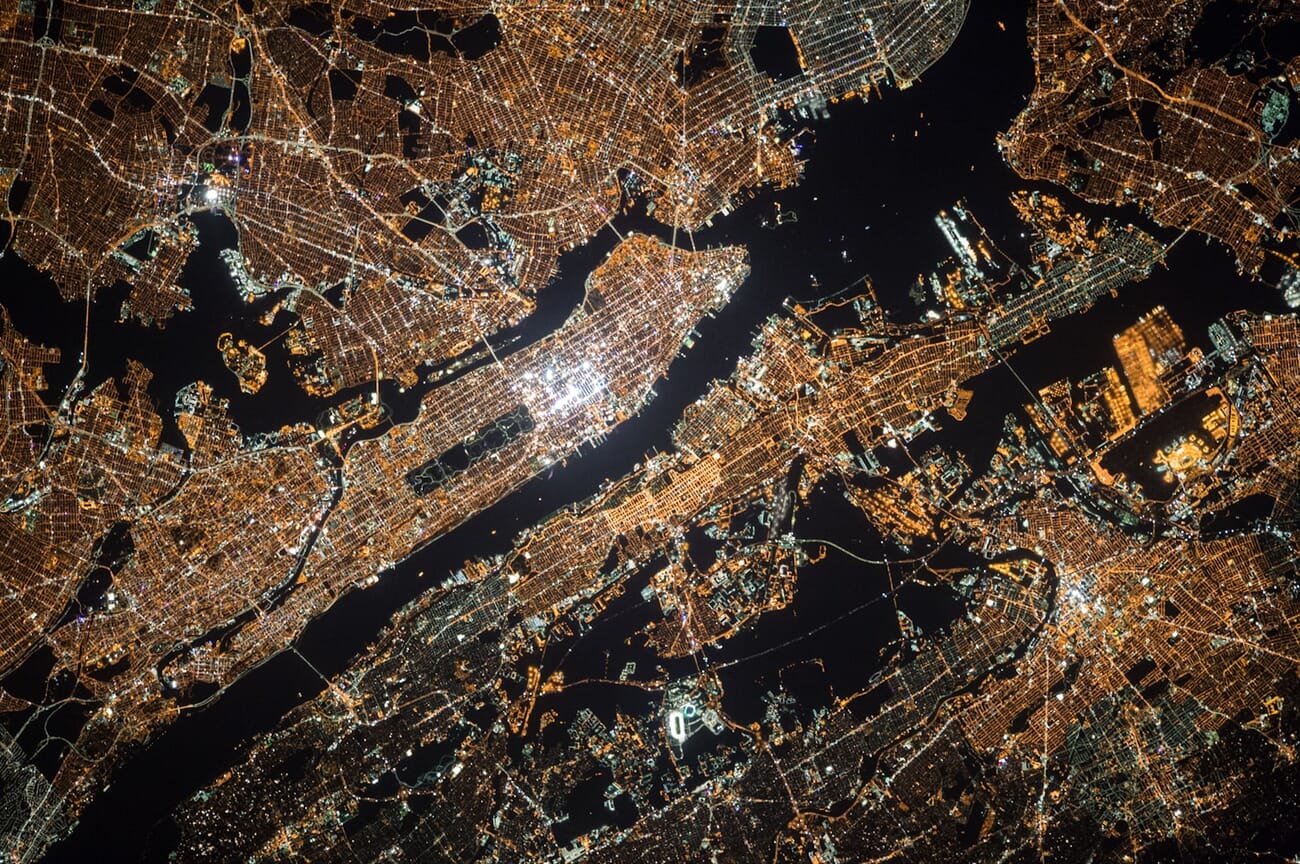
Key tip: Shoot straight down (nadir view) for the strongest pattern effect. Angled shots introduce perspective distortion that weakens the pattern. Most drones let you tilt the gimbal to point directly at the ground.
Breaking the Pattern
Here’s where pattern photography gets really interesting.
A broken pattern — where one element disrupts the repetition — creates an instant focal point. Your eye jumps straight to the “odd one out.” This is one of the strongest composition techniques available.
Examples of pattern breaks:
- One red umbrella among dozens of black ones
- A single person walking against a crowd
- One broken window in a uniform facade
- A wildflower growing through a crack in repeating pavement tiles
- One differently colored bowl in a row of identical place settings

The stronger and more consistent the original pattern, the more impactful the break. When composing, first establish the pattern clearly in your frame, then position the disrupting element using the rule of thirds for maximum visual weight.
Patterns and Negative Space
Patterns don’t have to fill the entire frame. Combining a pattern with negative space creates a completely different mood.
- Pattern fills frame → immersive, abstract, texture-like
- Pattern surrounded by empty space → isolated, dramatic, minimalist
- Pattern fading into negative space → creates depth and visual flow
Try positioning your patterned element off-center, leaving breathing room on one side. This adds tension and visual interest that a perfectly centered, frame-filling pattern can’t achieve.
Smartphone Pattern Photography
You don’t need a DSLR or mirrorless camera to capture compelling patterns. Modern smartphones are surprisingly capable pattern photography tools.
iPhone 16 Pro features a dedicated 5x telephoto (120mm equivalent) that’s excellent for isolating architectural patterns from a distance. Its macro mode switches automatically when you get close to a subject — perfect for capturing textures and small-scale patterns in leaves, fabric, or stone.
Google Pixel 9 offers an impressive macro focus mode that delivers sharp close-ups of tiny pattern details. The computational photography pipeline also handles high-contrast pattern scenes well, preserving detail in both highlights and shadows.
Smartphone tips for pattern photography:
- Lock focus and exposure — Tap and hold on the pattern to prevent the camera from hunting
- Use the grid overlay — Align geometric patterns with the grid lines for level shots
- Try the ultrawide lens — The distortion at edges can actually enhance radial patterns
- Shoot in RAW (ProRAW / DNG) — More editing flexibility for contrast and color adjustments
Editing Patterns with AI Tools
Modern editing software makes it easier than ever to enhance pattern photographs. Adobe Lightroom‘s AI masking tools are particularly useful for pattern work.
Lightroom AI masking for patterns:
- Select Subject / Select Sky — Quickly mask the pattern area to boost contrast or saturation independently from the background
- Brush + AI Detect — Paint a rough mask and let AI refine the edges — great for isolating repeating elements
- Color Range masking — Select all instances of a specific color within a pattern to adjust them uniformly
- Luminance Range masking — Target highlights or shadows within a pattern for tonal separation
Other useful edits for pattern photos:
- Increase clarity / texture sliders — Makes pattern details pop
- Convert to black and white — Strips color distractions, emphasizes form and repetition
- Crop tightly — Remove partial pattern elements at the edges for a cleaner look
- Straighten with Lens Corrections — Geometric patterns look best when perfectly aligned
Practical Tips for Better Pattern Photos
Ready to start shooting? Keep these techniques in mind:
- Fill the frame. Move closer or zoom in until the pattern dominates. Partial patterns with distracting edges weaken the effect.
- Use even lighting. Harsh shadows can break the visual rhythm of a pattern. Overcast days and diffused light work well.
- Shoot straight-on. For flat patterns (tiles, walls, floors), align your camera parallel to the surface to avoid perspective distortion.
- Try different focal lengths. Wide angles for environmental patterns, telephoto for compressing distant repeating elements.
- Look for color patterns. Repetition isn’t just about shape — repeating colors across a scene create their own visual rhythm.
- Change your perspective. Get low, shoot from above, or try an unexpected angle to reveal patterns others miss.
- Use a tripod. Precise alignment matters in pattern photography. Even a slight tilt can feel “off” with geometric patterns.
Frequently Asked Questions
What is pattern photography?
Pattern photography is the practice of composing images around repeating visual elements — shapes, colors, lines, or textures that recur across the frame. It’s a composition technique that creates rhythm and visual interest.
How do I find patterns to photograph?
Start by looking at everyday environments with fresh eyes. Architecture (windows, tiles, staircases), nature (leaves, petals, bark), and urban settings (fences, cars, market stalls) all contain patterns. Viewing through your camera’s viewfinder or switching to black-and-white preview mode helps isolate patterns from distractions.
What’s the best lens for pattern photography?
There’s no single best lens — it depends on the pattern. Telephoto lenses (70-200mm) compress distant patterns for a dense look. Macro lenses reveal tiny patterns invisible to the naked eye. Wide-angle lenses work for environmental patterns. Smartphone macro modes are also excellent for close-up patterns.
Why is breaking a pattern effective in photography?
A broken pattern creates an instant focal point. When one element disrupts an established repetition — like a single red object among identical gray ones — the viewer’s eye goes straight to the anomaly. It combines the satisfying rhythm of patterns with a surprise element that adds narrative interest.
What’s the difference between a pattern and a texture in photography?
A pattern involves clearly recognizable repeating elements with visible individual units (like rows of windows). A texture is a surface quality that feels consistent but doesn’t have distinct repeating units (like rough stone or smooth silk). They often overlap — a brick wall has both pattern (repeating bricks) and texture (the surface of each brick).
Featured image: Photo by Dmytro Yarish on Unsplash.


Comments are closed.