


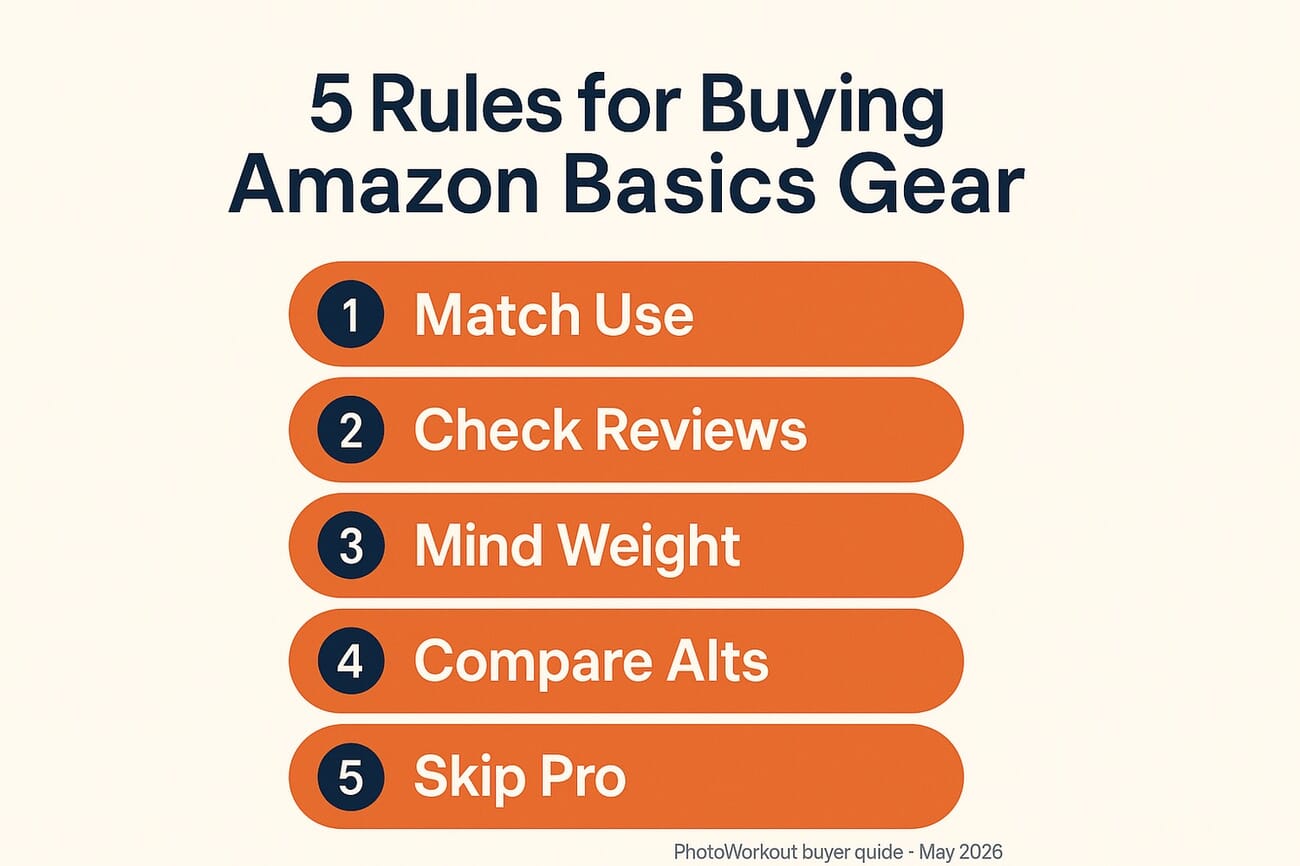
- Amazon Basics has quietly become a default budget tier across photography categories — these 10 picks each pull 4.5+ stars across thousands of reviews from real working photographers.
- The Amazon Basics 60-inch DSLR Tripod (Amazon Basics 60-Inch Lightweight DSLR Tripod) is the single most-bought first tripod in photography — 190,000-plus reviews and over a decade of sales.
- The Amazon Basics microSDXC A2 U3 64GB 2-pack matches SanDisk Ultra spec-for-spec on action cameras and drones at a lower per-gigabyte price.
- The Amazon Basics 24-pack microfiber cleaning cloths cost about 42 cents apiece — the highest-leverage gear-care purchase any photographer can make.
- Where Amazon Basics still loses: pro-grade lighting (color accuracy), pro-grade tripod stability over 6 lbs, and weather-sealed bodies. Stop reaching for the Basics line at those thresholds.
- Total category spend across all 10 picks: about $330 — less than a single mid-tier Manfrotto travel tripod.
Amazon Basics has quietly become a default budget tier across photography. Not the obvious budget tier — that’s still SanDisk, Manfrotto, K&F Concept — but the hidden one, the line that working photographers reach for when they need a tripod for a B-roll camera, a stack of microfiber cloths for the gear closet, or a hard case to keep a backup body safe in checked luggage. Across categories the rating signal is consistent: 4.5 to 4.7 stars across review counts in the thousands, sometimes hundreds of thousands.
The ten picks below were filtered down from a Rainforest API sweep of every Amazon Basics product in photography, video, and adjacent categories. Each pick had to clear three filters: a real photography use case (not a generic accessory), a 4.4-or-higher Amazon rating, and a review count substantial enough to vouch for long-term reliability. Pricing and ratings were pulled live from each Amazon listing on May 9, 2026.
Where Amazon Basics still loses: pro-grade studio strobes (the brand’s lighting line falls short on color accuracy and consistency), tripod stability above 6 pounds of camera-and-lens weight, and weather-sealed enclosures for working in actual rain. Past those thresholds, step up to Manfrotto, Profoto, or Pelican.
When you buy through links on our site, we may earn a commission at no cost to you. We evaluate products independently. Commissions do not affect our evaluations.
Top Picks




Amazon Basics 60-Inch Lightweight DSLR Tripod with Bag — Best Beginner Tripod

first-time tripod buyers and photographers who need a no-fuss backup that handles a DSLR or mirrorless body up to 6.6 lbs.
- Extends from 23 to 60 inches with a 3-way pan-and-tilt head
- Quick-release plate keeps swap times short between handheld and tripod shots
- Two built-in bubble levels for landscape and portrait orientation
- Weighs 2.7 lbs — light enough for a daypack
- Carrying case included at the $26 price point
- Center column wobbles slightly at full extension in any wind
- Plastic leg locks feel cheap compared to twist-lock travel tripods at 3x the price
190,000-plus reviews and a steady 4.5 stars over more than a decade of sales — this is the tripod most photographers buy first, then keep around forever as a backup. The 6.6 lb load rating handles every consumer DSLR and mirrorless camera made today.
For most photographers, the first tripod is also the cheapest one — and the Amazon Basics 60-Inch DSLR Tripod has occupied that slot in the buying funnel for over a decade. The 6.6-pound load rating covers every consumer DSLR and mirrorless body sold today, the 3-way pan-and-tilt head handles both stills and casual video, and the included carry case keeps the whole kit travel-ready.
Compare it against the entry tier of dedicated travel tripods and the trade-off becomes obvious: the Amazon Basics is heavier and stiffer-locking, but it costs a quarter as much. Photographers who want a serious upgrade typically skip past Amazon Basics and jump straight to a Peak Design or Gitzo — the middle ground is rarely worth the spend.
Amazon Basics 67-Inch Aluminum Monopod — Best for Events and Wildlife
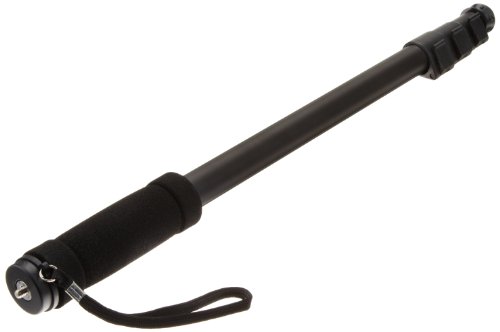
event, sports, and wildlife shooters who need a third point of contact without committing to a full tripod setup.
- Holds cameras and lenses up to 6.6 lbs — covers most full-frame setups
- Weighs less than a pound (15.7 oz) — disappears in a backpack
- Retractable spikes for grass and gravel; rubber foot for hardwood
- 1/4-inch universal thread mounts directly to any camera or ball head
- Cushion grip and adjustable wrist strap for one-handed shooting
- No built-in head — you supply your own ball head or screw the camera directly
- Twist-lock sections need an occasional tightening after heavy use
Under a pound of aluminum, four extending sections to 67 inches, and a non-skid rubber foot with retractable spikes. For monopod work — sidelines, backs of churches, long-lens wildlife — this is the only sub-$20 option that holds up over years of use.
Monopods are the workhorse third-leg solution for photographers who shoot weddings, sidelines, or wildlife — anywhere a full tripod is overkill but handheld stamina runs out after the first hour. The Amazon Basics 67-inch model weighs less than a pound, extends through four sections, and screws directly to any 1/4-inch camera mount or external ball head.
The 6.6-pound load rating means the Amazon Basics 67-inch monopod comfortably handles a full-frame body with a 70-200mm f/2.8 lens — the exact kit that benefits most from monopod use. The retractable spike on the foot is the detail that matters in real-world use: switch from grass to gravel without changing accessories.
Amazon Basics Mini Travel Tripod with Ball Head — Best for Vlogging and Tabletop
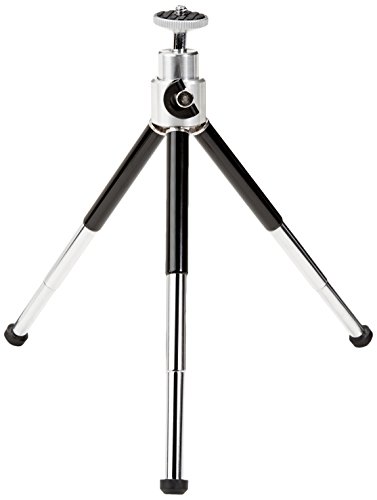
vloggers, content creators, and travel photographers who need a stable platform for a small mirrorless body, an action camera, or a smartphone rig.
- True 360-degree mini ball head with 90-degree tilt
- Folds to under five inches — fits a jacket pocket
- Sturdy enough for a webcam on a desk during conference calls
- Pairs perfectly with a smartphone tripod adapter for mobile reels
- 1.1 lb load limit means no DSLRs and no longer mirrorless lenses
- Plastic ball-head clamp can creep under heavier-than-rated loads
A pocketable 4.76-to-7.5-inch mini tripod with a 360-degree ball head. The 1.1 lb load limit rules out DSLRs but suits compacts, GoPros, and phones — the rigs most desk-shooters and travel vloggers actually deploy daily.
The mini tripod category exploded with vlogging, but the Amazon Basics Mini Travel Tripod predated it. Today the most common use is as a desktop platform for a webcam during conference calls, a stabilizer for a small mirrorless body during travel content, or a low-angle mount for a smartphone shooting reels.
The 1.1-pound load limit is the deal-breaker — any DSLR, any mirrorless body with a longer lens, any rig with a microphone or a light, exceeds the rating. For everything that fits inside that limit, though, the 360-degree mini ball head is genuinely useful.
Amazon Basics Aluminum Light Stand 2-Pack — Best Entry-Level Studio Stand

photographers building their first studio or off-camera flash kit who need two stands without spending $80 each on Manfrotto.
- Two stands for the price of one entry Manfrotto
- Adjustable from 2.8 to 6.7 feet — covers boom, hair, and key positions
- Folds to 2.4 feet for travel and storage
- Two carrying cases included — rare at this price
- 1/4-inch screw tip works with every speedlight bracket and modifier holder
- 1.1 lb top-section load limit — won’t hold a heavy strobe with a softbox without sandbagging
- Tighten-screw leg locks loosen over time and need periodic re-snugging
A 2-pack of 6.7-foot aluminum stands with carrying cases for under $33. Standard 1/4-inch screw tip handles speedlights, strobes, modifiers, and backgrounds. Not Manfrotto-grade, but at $16 per stand the value is hard to argue with.
The first studio purchase for most photographers building a flash kit is a pair of light stands. The Amazon Basics 6.7-foot light stand 2-pack solves that purchase for $32 — two stands, two carrying cases, both with the standard 1/4-inch screw tip that works with every speedlight bracket and modifier holder on the market.
They’re not C-stands. Photographers building a serious off-camera flash setup will eventually outgrow them. But for the first three years of a flash photographer’s career — the years where each gear purchase has to clear a real cost-benefit hurdle — these stands hit the ceiling of what an entry budget can buy.
Amazon Basics Foldable Photo Studio Box with LED Lights — Best for Product Photography
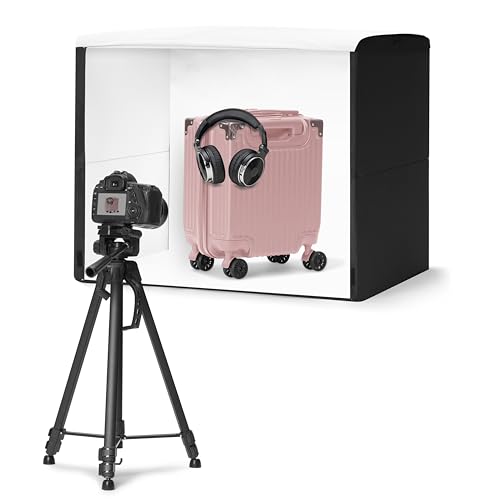
Etsy sellers, Amazon FBA listers, and anyone shooting small-product flat-lays or e-commerce catalog images on a desk.
- Sets up in under a minute — no assembly, no clamps
- 5600K daylight-balanced LEDs at high CRI built directly into the frame
- Three-door front system reduces unwanted reflections
- Top hole enables overhead shots for flat-lay-style content
- Compatible with the Amazon Seller app for direct catalog uploads
- 25 inches deep is too small for shoes, large bags, or tall product stacks
- LED CRI is good for catalog work but pros doing color-critical product photography will still prefer external strobes
A 25 x 30 x 25-inch foldable light tent with built-in 5600K daylight LEDs that collapses into a portfolio case in under a minute. The integration is the win — the LEDs are positioned for shadow-free product shots without needing separate strobes.
Etsy sellers, Amazon FBA listers, and small-business owners shooting their own product images will recognize the Amazon Basics Photo Studio Box immediately — it’s the integrated solution that has powered countless small-shop product catalogs since 2016. The 25-inch interior fits jewelry, watches, small electronics, books, and most kitchenware.
Pros doing color-critical product photography will still reach for external strobes, color-checker passport, and a dedicated tabletop kit. For everyone else, the built-in 5600K daylight LEDs are accurate enough for catalog work and remove the pain of building a lighting rig from scratch.
Amazon Basics Large DSLR Gadget Bag — Best Budget Shoulder Bag

second-shooter setups, students, and anyone who needs a $25 shoulder bag for a DSLR plus two lenses without the wear-and-tear cost of a Lowepro.
- Holds a DSLR body, two lenses, and a flash with room left over
- Slot fits an iPad Mini, Kindle Fire, or 7-inch tablet
- Bright orange interior makes finding gear inside fast
- Top handles plus adjustable shoulder strap for two-mode carry
- Multiple exterior zipper pockets for batteries, cards, and cleaning gear
- No padded laptop sleeve — pair with a separate laptop case for travel
- The polyester shell is water-resistant, not waterproof
A 12.75 x 8 x 9.75-inch shoulder bag in heavy black polyester with the signature orange interior that Amazon Basics camera bags have used for over a decade. Multiple compartments, an iPad Mini sleeve, and 18,000-plus reviews of people using it as their daily carry.
Camera bag buyers usually fall into one of two camps — the photographer who treats the bag as a fashion statement and pays $200 for it, and the photographer who treats the bag as a tool and buys the cheapest one that holds the gear safely. The Amazon Basics Large DSLR Gadget Bag is the default pick for the second camp.
At 12.75 by 8 by 9.75 inches it holds a body, two lenses, a flash, a tablet up to 7 inches, and accessories. The bright orange interior — a signature design choice across the Amazon Basics camera bag line — makes finding gear inside fast even in low light. It is not, however, padded for laptops or designed for security; for security-first travel see the dedicated anti-theft camera bag guide.
Amazon Basics Hard Camera Case (Small) — Best Pelican-Style Travel Case

travel photographers, drone pilots, and second-bodies-and-lenses gear that needs Pelican-grade protection without Pelican-grade pricing.
- Airtight and watertight pressure-equalization valve — same engineering pattern as Pelican
- Pre-cut foam squares cube out for a custom-sized layout in five minutes
- Carry-on legal at 12 x 10.6 x 5.6 inches
- Both fold-down side handle and extending top handle for two carry modes
- Padlock-ready latches for international travel
- Foam is denser than name-brand Pelican — small cube-cut precision suffers
- No wheels — at 12 inches the case is small enough that wheels aren’t needed, but heavier loads benefit from them
A 12 x 11 x 6-inch hard-shell case with airtight pressure-equalization valve, customizable pre-cut foam squares, fold-down side handle, and extending top handle. The TSA carry-on dimensions matter — this is the case that travels with the kit, not the case that sits at home.
Hard cases are the line that separates travel photographers from local photographers. The Amazon Basics Hard Camera Case delivers Pelican-style protection at one-third the price — airtight pressure-equalization valve, watertight latches, customizable pre-cut foam, and TSA carry-on dimensions at 12 by 10.6 by 5.6 inches.
The case is small, intentionally — small enough to actually count as carry-on luggage on every major airline. Larger Pelican-equivalent cases get checked, get dropped, get lost. For more thoughts on protecting gear in transit and at home, see the camera storage guide.
Amazon Basics microSDXC A2 U3 (64GB 2-Pack) — Best Budget Action-Cam and Drone Card
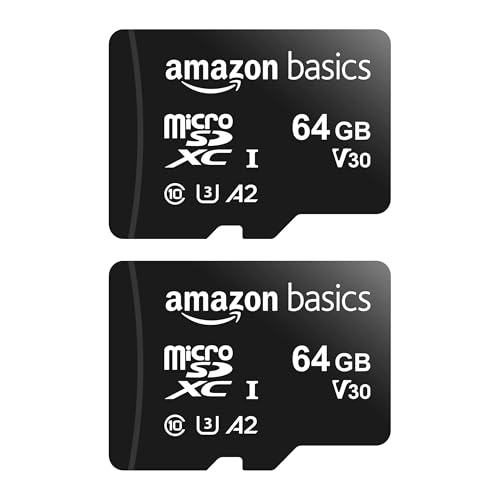
GoPro and DJI drone owners who burn through cards on every trip and want spares in their pocket without paying SanDisk Extreme Pro prices.
- A2 + U3 + V30 ratings handle 4K UHD recording without dropped frames
- IPX6 water-resistant, shock-resistant, and X-ray resistant
- Operating range -10 to +80 °C — covers desert and winter shoots
- Full-size SD adapter included for camera bodies that need it
- 2-pack at this price gives you a spare card from day one
- 100 MB/s read is slower than V60 and V90 cards needed for 4K cinema-grade workflow
- Not for Nintendo Switch 2 (which needs the newer microSD Express format)
A2 application class, U3 video class, V30 sustained-write rating, 100 MB/s read speed, and IPX6 water resistance. Spec-by-spec the card matches SanDisk Ultra at a lower price per gigabyte. 150K reviews vouch for the reliability on action cameras and drones.
Memory cards are the single product category where Amazon Basics most directly competes with the established names — and on this card it wins on per-gigabyte price while matching SanDisk Ultra spec-for-spec. The Amazon Basics microSDXC A2 U3 hits A2 application class, U3 video class, V30 sustained-write rating, and 100 MB/s read speed.
That spec sheet is enough for 4K UHD recording on every consumer drone, every action camera, and every mirrorless body that uses microSD or SD cards through a full-size adapter. Cinema-grade workflows that demand V60 or V90 sustained-write speeds will need to step up to SanDisk Extreme Pro or ProGrade — but for the 90% of working photographers who don’t, this card stretches the storage budget.
Amazon Basics Microfiber Cleaning Cloths (24-Pack) — Best Lens and Sensor Wipes Bulk Buy
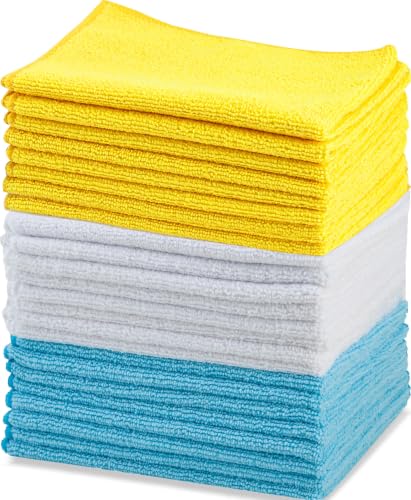
every photographer who has ever tried to wipe a lens with a t-shirt and regretted it the next sunny morning.
- Lint-free and non-abrasive — safe on coated lens elements
- Machine-washable and reusable hundreds of times
- 24 cloths means a fresh cloth every wipe — never re-use a dirty one on glass
- Soaks up 8x its weight in liquid for cleaning a soaking wet camera bag
- Cheap enough to leave one in every kit bag, every car, every studio
- Generic blue-and-white pattern — pros may prefer color-coded cloths to separate sensor and lens duties
- Not pre-moistened — pair with a dedicated lens-cleaning fluid for stubborn spots
Twenty-four 16 x 12-inch microfiber cloths for $10 — about 42 cents apiece. Lint-free, non-abrasive, machine-washable, and reusable hundreds of times. One in every camera bag, one on every desk, ten left in the closet — the cost of doing it right is trivial.
The microfiber cleaning cloth is the most under-purchased piece of gear in photography — most photographers own one, lose it, and then wipe lenses with a t-shirt for the next six months. The Amazon Basics 24-pack of microfiber cloths solves that problem permanently. Twenty-four cloths at $10 means a fresh cloth in every bag, every car, every studio.
Lint-free, non-abrasive, machine-washable hundreds of times — these are safe on coated front elements, screens, sensors (when paired with a dedicated cleaning fluid for sensor work), filters, and viewfinders. Pair them with a separate UV filter on every lens and most lens-care problems disappear.
Amazon Basics Rechargeable AA NiMH 8-Pack — Best Speedlight Power
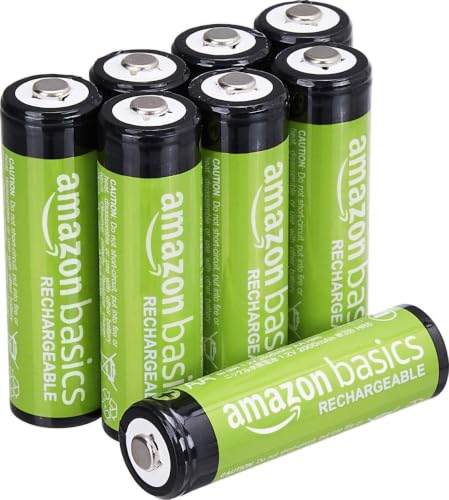
speedlight shooters and event photographers who burn through alkaline AAs on every wedding and want a rechargeable kit that pays for itself in two events.
- Pre-charged from the factory — usable on day one without setup
- Low self-discharge keeps 80% capacity for 2 years on the shelf
- Recharge cycle rated to 1,000 uses — pays for itself in 2-3 events
- 8-pack supplies two full speedlight loads with spares
- Ranked among Amazon’s all-time bestsellers in batteries (185K reviews)
- 1.2V NiMH is slightly under the 1.5V alkaline spec — a few finicky devices misread as low battery
- Need a NiMH-specific charger with independent channels — don’t pair with a basic timer-only charger
8-pack of 2,000 mAh low-self-discharge NiMH AAs that recharge up to 1,000 times and hold 80 percent of capacity for two years on the shelf. The pre-charged, ready-to-use spec is the differentiator — these go straight into the flash without an overnight cycle on the charger.
Speedlight photographers know the math: a 580EX II at full power burns through 4 AAs in roughly 100 flashes. A wedding shooter using off-camera flash through a reception will go through 24-32 batteries in a single event. Alkaline disposables get expensive fast — rechargeable NiMH AAs are non-negotiable past a certain volume.
The Amazon Basics 8-pack of 2,000 mAh NiMH AAs is the default kit. Pre-charged from the factory, low-self-discharge so they hold 80% capacity for two years on the shelf, and rated to 1,000 recharge cycles. Two 8-packs covers most flash photographers’ working weekend; the cost amortizes after 2-3 events.
When you buy through links on our site, we may earn a commission at no cost to you. We evaluate products independently. Commissions do not affect our evaluations.
When Amazon Basics Wins — And When It Doesn’t
Across the ten picks, three patterns emerge for when Amazon Basics is the right answer. First, when the use case is generic — microfiber cloths, AA batteries, a desk-top mini tripod — there is no premium-grade equivalent that justifies its price premium. The Amazon Basics version is the right answer because the category itself is commoditized.
Second, when the budget is the binding constraint. A photographer who needs a tripod today and has $30 to spend should buy the Amazon Basics 60-inch tripod and use it for the next year while saving for a real travel tripod. The tripod will work. It will not be as good as a Peak Design Travel Tripod, but it will not fail.
Third, when the use case is a backup. The hard case for the second body. The microSD card spare in the camera bag pocket. The mini tripod for a webcam during the off-season. Backup gear gets used 5% of the time but absolutely must work when called on — Amazon Basics products clear that bar at a fraction of pro pricing.
The cases where Amazon Basics is the wrong answer are also clear. Pro-grade lighting work demands color-accurate, high-CRI strobes — Profoto, Godox, Westcott. Heavy-load tripod work above 6 pounds demands carbon fiber and proper twist-locks — Gitzo, Really Right Stuff. Weatherproof field work demands sealed bodies and weather-rated bags — Lowepro Pro Trekker, Peak Design Outdoor. Don’t ask Amazon Basics gear to do work it wasn’t designed for.
Frequently Asked Questions
Are Amazon Basics products actually made by Amazon?
Amazon Basics is Amazon’s private-label brand, manufactured under contract by various third-party factories — many of the same factories that produce competing brands. The branding, packaging, quality-control specs, and pricing are set by Amazon. The line launched in 2009 starting with batteries and electronics accessories and has since expanded to thousands of SKUs across dozens of categories.
Is the Amazon Basics 60-inch tripod good enough for a DSLR?
For a consumer DSLR or mirrorless body up to 6.6 pounds total camera-and-lens weight, yes — the tripod is rated to that load and 190,000 reviews back up the spec. The center column will wobble in any wind at full extension, so for outdoor work in breeze, weight the tripod down with a sandbag or a hung camera bag from the center hook. For pro-grade landscape or long-exposure work, step up to a real travel tripod.
Are Amazon Basics SD cards reliable for shooting weddings?
The Amazon Basics microSDXC line meets U3 and V30 sustained-write specs, which are the minimum for 4K video and burst-mode RAW capture — meaning yes, technically reliable for wedding work. That said, most working wedding photographers stick with SanDisk Extreme Pro or ProGrade Cobalt for the irreplaceable file-write moment, and reserve Amazon Basics cards for B-roll cameras, drones, action cams, and overflow storage. Use the right tool for the right risk profile.
How does the Amazon Basics hard case compare to a Pelican?
The Amazon Basics hard case borrows the Pelican design pattern — airtight pressure-equalization valve, watertight latches, pre-cut foam — at roughly one-third the cost. The foam is denser and less precise than Pelican’s. The latches feel similar. For checked-luggage protection or storage in a damp basement, the Amazon Basics case is genuine protection at a fraction of the cost. For the kind of work where the case is the only thing standing between a $5,000 lens and a 6-foot drop, pay for the Pelican.
What’s the best single Amazon Basics purchase for a new photographer?
The 24-pack of microfiber cleaning cloths at $10. It’s the highest-leverage gear-care purchase any photographer can make and the one most photographers neglect to buy until something gets scratched. After that, the 60-inch tripod for $26 if the photographer doesn’t already own one, and the rechargeable AA 8-pack for $13 if they shoot speedlights.
The Bottom Line
The Amazon Basics line will not replace anyone’s premium gear, but it earns a spot in almost every photographer’s kit somewhere — the cleaning cloths, the spare batteries, the second tripod, the backup hard case. Total spend across all ten picks above runs to about $330 — less than a single mid-tier Manfrotto travel tripod. That’s the trade.
The smart play is to know which categories Amazon Basics genuinely competes in (commoditized accessories, generic storage, microfiber cleaning) and which categories it doesn’t (pro lighting, premium tripods, weather-sealed bags). For the first list, buy without hesitation. For the second, look elsewhere — and use the savings on the first list to fund the upgrade.
Image credits: All product specifications, ratings, and pricing sourced live from Amazon listings via the Rainforest API on May 9, 2026. Featured image and infographic generated for PhotoWorkout editorial.


Disclosure/Disclaimer: As an Amazon Associate, we earn from qualifying purchases. Certain content was provided "as is" from Amazon and is subject to change or removal at any time. Product prices and availability: Amazon prices are updated daily or are accurate as of the date/time indicated and are subject to change. Any price and availability information displayed on Amazon.com at the time of purchase will apply to the purchase of this product.