


- As of August 2, 2026, the EU AI Act’s Article 50 transparency rules are in force. Anyone publishing AI-generated or AI-manipulated images in the EU market must clearly label them, with narrow exceptions.
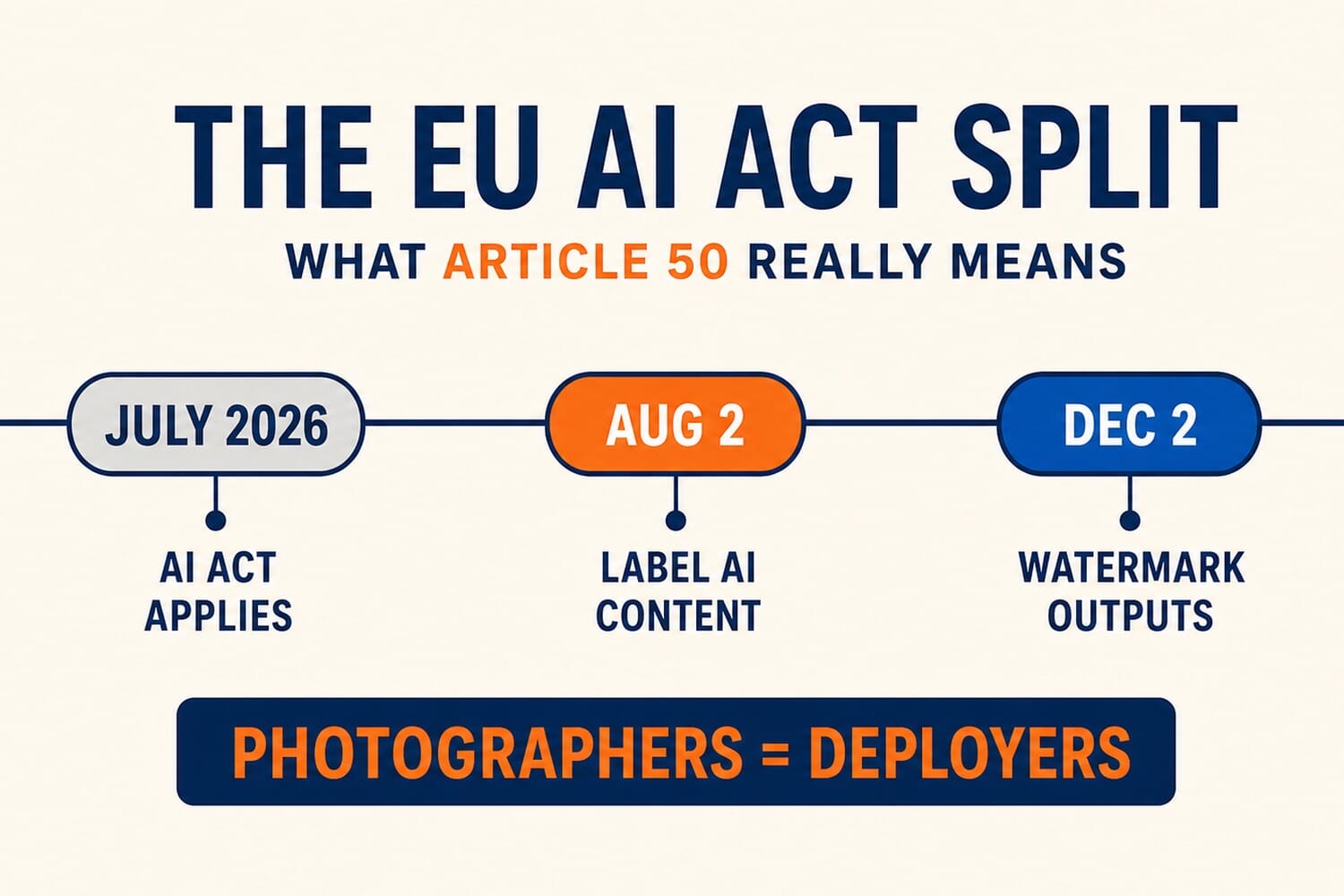
- Brussels quietly split the deadline on June 29: broad transparency (the deployer labeling rules that affect photographers) still starts Aug 2, but providers of generative AI now have until Dec 2, 2026 to bake in machine-readable marking of their outputs.
- Penalties for Article 50 violations cap at €15 million or 3% of global turnover per Article 99. Real enforcement will lag, but the compliance framework went live Aug 2, and the European Commission confirmed on July 31, 2026 that it would begin enforcing from that date.
- The practical path for working photographers is Content Credentials (C2PA) at capture: it gives you a defensible authenticity trail for real photos, and it satisfies the visible-labeling obligation for edited or AI-generated work.
Update (August 2026): Article 50’s transparency obligations are now in force. On July 31, 2026, the European Commission confirmed it would begin applying the rules from August 2, and it has since published its official Guidelines on transparency obligations for AI providers and deployers. Everything below still holds, the deadline is simply now the status quo.
The EU’s transparency rules for AI-generated content are no longer theoretical. Article 50 of the AI Act took effect on August 2, 2026, and it lands squarely on anyone who publishes photographs in the European market.
The story is more nuanced than the headline date suggests. On June 29, the Council of the EU gave final approval to the Digital Omnibus, a package of amendments that quietly split Article 50 in two: the labeling obligations that hit publishers still took effect on August 2, but the deeper technical marking that generative AI providers must build in gets a four-month reprieve to December 2. That is the version of the story working photographers need to understand.
What Article 50 Actually Requires
Article 50 has two audiences, and the difference matters for photographers. Providers of generative AI systems (OpenAI, Google, Stability AI, Midjourney and their peers) must make their outputs technically detectable as AI-generated, through watermarking or machine-readable metadata built into the tool itself. Deployers, everyone who publishes AI content in the EU, must visibly disclose deepfakes and AI-generated or manipulated media to the audience that sees it.
A working photographer or picture desk is almost always a deployer. If you use an AI image tool to remove a bystander, or replace a sky, or generate a wholly synthetic scene for editorial use, and that image is published into the EU market, Article 50’s visible-disclosure obligation applies. The law does allow narrow exceptions for editorial control over public-interest text and for AI systems used to prevent, detect, or investigate criminal offences, but “photographic manipulation” is not one of them.

What Changed on June 29
The Digital Omnibus on AI, formally adopted by the Council on June 29, 2026, was pitched as a “simplification” package. In practice it moved several dates in the AI Act’s implementation timeline. For creative professionals, the important shifts are two. First, high-risk AI system compliance deadlines moved out from August 2, 2026 to December 2, 2027 (a year and change of extra runway for regulated deployers). Second, the Council cut the grace period for providers to implement transparency solutions for generative AI content from six months down to three, with the deadline landing on December 2, 2026.
What the Omnibus did NOT change: the deployer obligations under Article 50 (the visible labeling of deepfakes and AI-generated content by whoever publishes them) still apply from August 2, 2026 as originally scheduled. White & Case’s legal analysis of the deal summarizes it bluntly: “enforcement of most of the transparency requirements set out in Art. 50 EU AI Act took effect on 2 August 2026, as originally scheduled.” The four-month reprieve went to the AI companies, not to the publishers of AI content.
The Omnibus also formally banned “nudifier” apps that generate synthetic intimate imagery from clothed source photos, with that prohibition set to bite by the end of 2026. The scope of that ban goes to the tool itself, not to consenting adult content, and it will be a real headache to enforce, but it removes any doubt that Brussels intends to regulate the specific fake-photo tools that keep making headlines.
Why This Beat Now Has a Legal Spine
The abstract case for AI-content transparency has been made for years. What is new is that a growing catalog of institutional fakery, produced by people who were not supposed to be capable of it, is what pushed Brussels to act. Every one of these headlines is a real one.
In late June, a Maine police department in Manchester posted an image of a drug-bust evidence table that turned out to be AI-altered. Days earlier, Westbrook Police Department in the same state publicly apologized for a similar edited-evidence photo. In academia, The Conversation and UPI both reported in June that peer-reviewed journals have accepted images generated by tools like Grok, some of which have since been retracted. Both incidents pre-date the Aug 2 deadline by weeks, and both are exactly what the law targets: not adversarial deepfakes, but institutional slop presented as documentary evidence.
The through line matters for photographers because it is the same trust crisis that has been calling real photos AI: PhotoWorkout’s coverage of AI detectors falsely accusing real work and the wider “is this real?” problem is not going away with Article 50. What Article 50 does is give the transparency toolkit a legal reason to exist. Missing labels are now a compliance risk; provable authenticity becomes a defensible position.
The Practical Compliance Path: Content Credentials at Capture
For working photographers the near-term answer is not a new plugin, it is a stack that already exists: Content Credentials, the branded implementation of the C2PA (Coalition for Content Provenance and Authenticity) standard. Cryptographic metadata gets baked into the file at capture, travels with the image through edits, and can be inspected by anyone who cares to check. It solves the deployer problem (label your AI content) and the authenticity problem (prove your real photos are real) with one mechanism.
The hardware and software pieces are landing quickly. Leica’s M11-P shipped as the first camera with Content Credentials built into the sensor pipeline, and Canon has followed with signed capture support in select bodies. On the generation side, OpenAI’s image tools now emit C2PA metadata in the ChatGPT pipeline, which PhotoWorkout tracked in the OpenAI Verify plus Canon C2PA coverage. Photoshop and Lightroom preserve credentials through the edit graph. Getty, Reuters, and the Associated Press are moving toward Content-Credentials-verified provenance in their delivery pipelines. This is what the compliant stack for editorial photography looks like, and Article 50 is what turns “nice to have” into “the professional default”.
The immediate action list is short. Enable Content Credentials on any camera that supports it (Leica M11-P, select Canon EOS bodies, several Sony bodies via firmware). Turn on the Content Credentials pane in Photoshop and Lightroom so edits are recorded. For AI-manipulated or AI-generated images destined for EU publication, add a visible disclosure line to the caption in addition to the metadata. That combination is what any reasonable enforcement authority will look at, and it is what every serious wire service and photo desk is already moving toward.
Penalties, Enforcement, and the Realistic Timeline
The headline penalty number is €15 million or 3% of global annual turnover, whichever is higher, per Article 99 of the AI Act (Article 50 violations fall under that non-prohibited tier). A €35 million or 7% cap sits above that for actively prohibited practices, which Article 50 is not. Realistically, no independent photographer will see the top end of that scale (national enforcement authorities will still be scaling up in H2 2026, and the first year of enforcement is very likely to focus on providers and large platforms rather than individual publishers).
The pragmatic risk lives elsewhere. Publications, agencies, wire services, and stock libraries have every reason to require compliant provenance from contributors starting well before enforcement bites, both to protect themselves and to stand behind their sourcing. The $10,000 “Ansel Adams” AI print case already gave a preview of what the market looks like when authenticity claims are contested and rights are unclear. Editorial buyers will not wait for the first €15 million fine to require a credential trail; they will require it because their own risk desks tell them to.

Frequently Asked Questions
What is Article 50 of the EU AI Act?
Article 50 is the AI Act’s transparency section. It requires two things: providers of generative AI must make their outputs technically detectable as AI-generated (usually via watermarking and metadata), and deployers of AI content must visibly disclose deepfakes and AI-manipulated media to the audience. It has applied since August 2, 2026 for deployer obligations, and applies from December 2, 2026 for the provider marking obligation, after the June 29 Digital Omnibus amendments.
Do the Article 50 rules affect photographers outside the EU?
They affect anyone publishing into the EU market, regardless of where the photographer is based. A US-based freelancer whose work runs on the website of an EU newspaper, or whose stock file is licensed to an EU buyer, is subject to the rules in the moment of that EU publication. This is the same extraterritorial pattern as GDPR.
What counts as AI-generated or AI-manipulated for Article 50?
The Act is broad. Content generated wholly by AI clearly qualifies. Substantial AI-based manipulation (generative sky replacement, generative removal or addition of subjects, generative fill of significant areas) also qualifies. Non-generative edits (exposure, color, standard denoise, mild sharpening) do not. The Code of Practice that the European Commission is finalizing will refine the boundary, but for now the safe frame is: if a generative model touched a substantive portion of the image, it counts.
How do I actually label an AI image on publication?
The Code of Practice envisions multilayered labeling: visible captions or on-image marks for humans plus embedded metadata (like C2PA credentials) for machine detection. In practice, a clear caption line reading “AI-generated” or “AI-manipulated” is the visible layer, and Content Credentials is the machine-readable layer. Doing both is defensible; doing neither is not.
Are the penalties real?
The €15 million or 3% turnover cap exists per Article 99, but sole practitioners are not the enforcement priority. The near-term risk for independent photographers is commercial, not administrative: publications and agencies are already starting to require compliant provenance in contributor terms because their own risk teams demand it, well before national regulators pursue individuals.
The Bottom Line
Article 50 was never really about individual penalties. It is about giving the professional world a legal reason to adopt provenance tools that were already necessary to hold the line against AI-slop and false-positive detectors. August 2 turns “nice-to-have” into the professional default, and December 2 forces the tool builders to catch up.
For working photographers the checklist is finite. Enable Content Credentials on capable cameras today. Turn on the credential trail in your editor. Add a caption-level disclosure to anything with meaningful AI touch. And for anyone whose work runs into EU publication channels, treat the compliant stack as table stakes rather than a competitive advantage. The reason your best real photographs keep getting called AI is the same reason Brussels moved: nobody trusts an image on its own anymore. Being able to prove provenance is starting to matter more than the pixels themselves.
Primary Coverage
- Council of the EU: Council gives final green light to simplify and streamline rules on AI – Primary source for the June 29, 2026 Digital Omnibus adoption and the December 2, 2026 provider deadline
- White & Case: EU agrees Digital Omnibus deal to simplify AI rules – Legal analysis confirming that most Article 50 transparency requirements still apply from August 2, 2026
- Responsible AI Platform: AI transparency labels, Article 50 AI Act by August 2026 – Practical breakdown of Article 50 obligations for providers and deployers
- HSF Kramer: Transparency obligations for AI-generated content under the EU AI Act – Detailed obligations for deepfake and AI-generated content publishers
- Herbert Smith Freehills: EU General-Purpose AI Code of Practice availability – Status of the Code of Practice that will implement Article 50 obligations
Institutional Fakery Incidents Cited
- Miami Herald: Controversy brews after AI use by Maine police in photo – Manchester and Westbrook police departments AI-edited evidence photos, June 2026
- The Conversation: Anyone can fake a scientific image with AI, tricking even academic journals – June 22, 2026 analysis of AI-generated images in peer-reviewed journals
- Guidelines on transparency obligations for AI providers and deployers – European Commission
Image Sources
- Photojournalist in the field: photo by Colin Lloyd – Via Unsplash, curated on SampleShots
- Featured illustration, timeline infographic, and vertical pin: PhotoWorkout illustrations – Editorial graphics created by PhotoWorkout