


- A new FCC proposal (an NPRM published in the Federal Register on August 3) would reverse the earlier promise that only new DJI drones were blocked, and pull already-approved models from the US market.
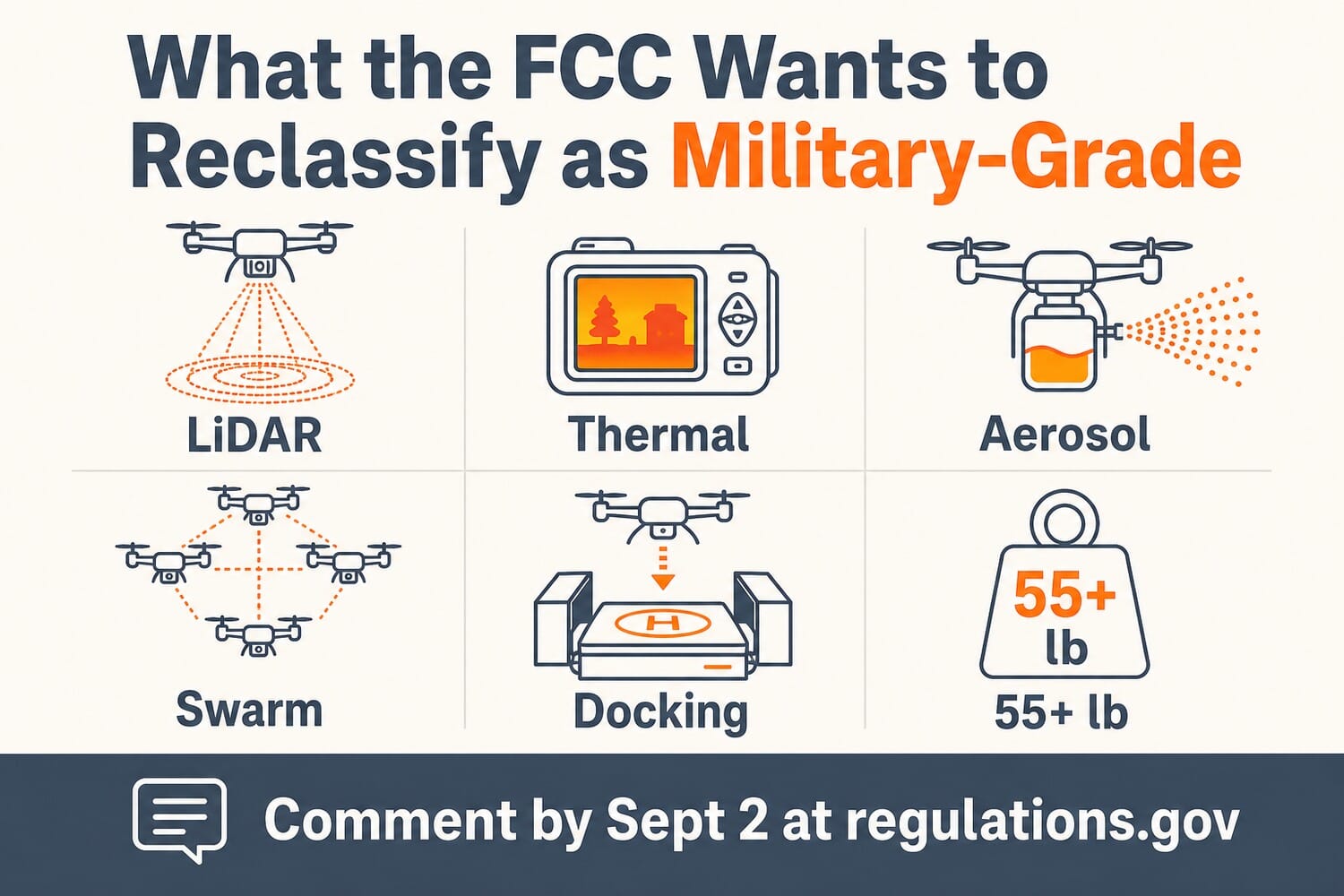
- It targets drones with capabilities the FCC wants to label military-grade: LiDAR, thermal imaging, aerosol-dispensing, swarm operation, docking stations, and any drone 55 lb or heavier. That sweeps in consumer flagships like the DJI Mini 5 Pro and Air 3S, mainly because of their LiDAR.
- This is a proposal, not a final ban. The public comment window is open until September 2 at regulations.gov, and the rule could still be narrowed or dropped.
- Drones you already own would not be grounded. The real owner risk is parts, repairs, and replacements getting scarce if US sales stop after a 180-day wind-down.
- It is one half of a vise: days earlier, on August 5, China retaliated against US trade moves by tightening its own drone-export controls and sanctioning US firms.
Update (August 14, 2026): The FCC ban is only one front. On August 13, President Trump also signed tariffs of up to 100% on imported drones, effective September 3, which puts a roughly 25% price bump on consumer DJI models. Read the full breakdown in Trump’s New Drone Tariffs.
Back in December 2025, when DJI landed on the FCC’s Covered List, there was one piece of reassurance for US pilots: the ban applied only to new equipment authorizations. Drones already approved for the US market could still be imported, sold, and flown. That reassurance is now on the table to be reversed.
A new FCC Notice of Proposed Rulemaking, published in the Federal Register on August 3, 2026, proposes to close that loophole and pull already-approved DJI flagships from US shelves. DJI calls it a “retroactive ban.” It is not a done deal, the public comment window is open until September 2, but it is a real shift in direction, and it is developing fast. Here is exactly what is proposed, which drones are affected, what it means if you already own one, and how to weigh in before the deadline.
From ‘New Only’ to Retroactive
The backstory matters. DJI was added to the Covered List after a congressionally-mandated security audit failed to happen, which meant the company was effectively banned without a chance to defend itself. Being “covered” blocked new DJI products from getting FCC authorization, which is why the DJI Osmo Pocket 4 and 4P never launched in the US. But anything already authorized could keep being imported and sold. The August 3 proposal asks whether the FCC should now prohibit the continued import and marketing of those previously-cleared drones too.
The ‘Military-Grade’ Label Is Broader Than It Sounds
The proposal does not single out obviously military hardware. Instead, it seeks comment on reclassifying a list of capabilities as military-grade or high-risk: LiDAR, thermal imaging, aerosol-dispensing systems, coordinated swarm operation, docking stations, and any drone weighing 55 pounds or more. The problem for consumers is that some of these are now standard on mainstream drones. The DJI Mini 5 Pro and Air 3S are not battlefield equipment, but they carry LiDAR for obstacle avoidance, and that alone is enough to sweep them into the proposed definition.
As DroneDJ put it, a drone you can legally buy today could become a drone you can no longer buy tomorrow, not because it changed, but because the category around it did.
Which DJI Drones Are in the Crosshairs
Coverage from PetaPixel, DroneDJ, and others points to consumer flagships being swept up, including the DJI Mini 5 Pro, the Air 3S, and the Avata 360. These are exactly the drones photographers and videographers reach for, small, camera-focused, and mainstream. If US sales stop, the knock-on effect is a thinner, pricier drone market, and it strengthens the case for the ban-driven alternatives we have covered, like the Xtra Muse workaround for creators who cannot buy DJI in the US.
The Timeline and the September 2 Comment Window
The mechanics matter if you want a say. The proposal was published in the Federal Register on August 3, and the public comment window runs until September 2, filed through the FCC’s ECFS system or regulations.gov. If a final rule follows, the FCC has floated a 180-day wind-down period after publication before sales would have to stop. Several categories would be exempt: Blue UAS-cleared hardware, Buy-American domestic products, federal-government imports, and test or development units.
DJI is not staying quiet. The company has published its position on its Viewpoints blog and is openly rallying US pilots to file comments, framing the move as an unfair reversal of an earlier assurance. Whatever your view, this is one of the rare moments where a public comment genuinely counts, and the clock is short.
What It Means If You Already Own One
Here is the part to keep in perspective. This proposal is about import and sale, not confiscation. A drone you already own would not be grounded by this rule, and you could keep flying it under the same FAA rules that apply today. The real, practical risk to owners is downstream: if US sales stop, official parts, batteries, and repairs get harder and more expensive to source, and resale values wobble. That is a genuine reason to care, but it is very different from “your drone is now illegal.” Frame it as direction of travel, not a grounding order.
The Other Half of the Vise: China’s Retaliation
The FCC proposal did not land in isolation. Days earlier, on August 5, China’s Ministry of Commerce hit back at recent US trade actions by tightening export controls on drones and their components, and adding several American firms to its countermeasures list. China is the world’s largest drone manufacturer, so its export levers are the mirror image of Washington’s import levers.
Put the two together and the picture is a squeeze from both ends: the US is moving to pull the DJI drones the company can still sell here, while China is tightening what it is willing to ship out. For US buyers and creators, the risk is not one policy but the combination, a supply chain being pinched from both sides at once. It is the same cross-border tension we have tracked through the DJI and Insta360 patent fight, now playing out at the level of national trade policy.
Frequently Asked Questions
Is the FCC banning DJI drones right now?
No. This is a proposal, a Notice of Proposed Rulemaking published August 3, 2026. It is open for public comment until September 2 and could be narrowed, delayed, or dropped. It is not a final ban.
Which DJI drones would be affected?
Reporting points to consumer flagships including the DJI Mini 5 Pro, Air 3S, and Avata 360, largely because they carry LiDAR, which the proposal would treat as a military-grade capability. The exact final list would depend on the rule that emerges.
If it passes, would my DJI drone be grounded?
No. The proposal targets import and sale, not drones already owned. You could keep flying yours under existing FAA rules. The practical risk is that parts, repairs, and replacements become scarce and pricey if US sales stop.
What counts as ‘military-grade’ under the proposal?
The FCC seeks comment on reclassifying capabilities such as LiDAR, thermal imaging, aerosol-dispensing, swarm operation, docking stations, and any drone 55 pounds or heavier. Several categories, like Blue UAS-cleared and Buy-American hardware, would be exempt.
How do I submit a comment?
File through the FCC’s ECFS system or regulations.gov before the September 2 deadline. DJI has also published guidance for pilots who want to weigh in on its Viewpoints blog.
The Bottom Line
The December 2025 assurance that only new DJI drones were blocked is now up for reversal. If the August 3 proposal becomes a rule, mainstream drones like the Mini 5 Pro and Air 3S could disappear from US shelves, not because they are weapons, but because their sensors fit a broad new definition. It is still a proposal, drones you own are safe to fly, and the comment window is open until September 2. But the direction of travel is clear, and with China tightening the other end of the pipe, the US drone market is being squeezed from both sides. If you fly DJI, this is the rare regulation worth reading, and commenting on, before the deadline.
Reference
- PetaPixel: The FCC Is Weighing a Retroactive Ban on DJI Drones it Previously Allowed – The reversal, DJI response, and the September 2 comment window.
- DroneDJ: FCC could soon ban DJI drones already approved and sold in America – The capability reclassification and affected models (Mini 5 Pro, Air 3S).
- CNN: China hits US with sanctions, drone export curbs ahead of Xi visit – The August 5 Chinese retaliation and MOFCOM drone-export curbs.
- Federal Register: FCC drone supply-chain NPRM – The official proposal and comment docket.
Image Sources
- DJI Mini 5 Pro product image – Featured image courtesy DJI.
- Reclassification infographic and pin – Stylized PhotoWorkout illustrations.