


- A UK government booklet and poster for asylum seekers states, in writing, that people should not photograph or film others in public and that doing so could lead to arrest.
- That is legally wrong. There is no UK law against taking photographs of people in public places, and police guidance says officers should not stop anyone from doing so.
- The likely intent was to warn against sharing intimate or sexual images without consent, which is a real crime. The blanket wording swept up ordinary, lawful photography with it.
- In the United States, the First Amendment protects photographing anything in plain view from a public place, including people, buildings, and police.
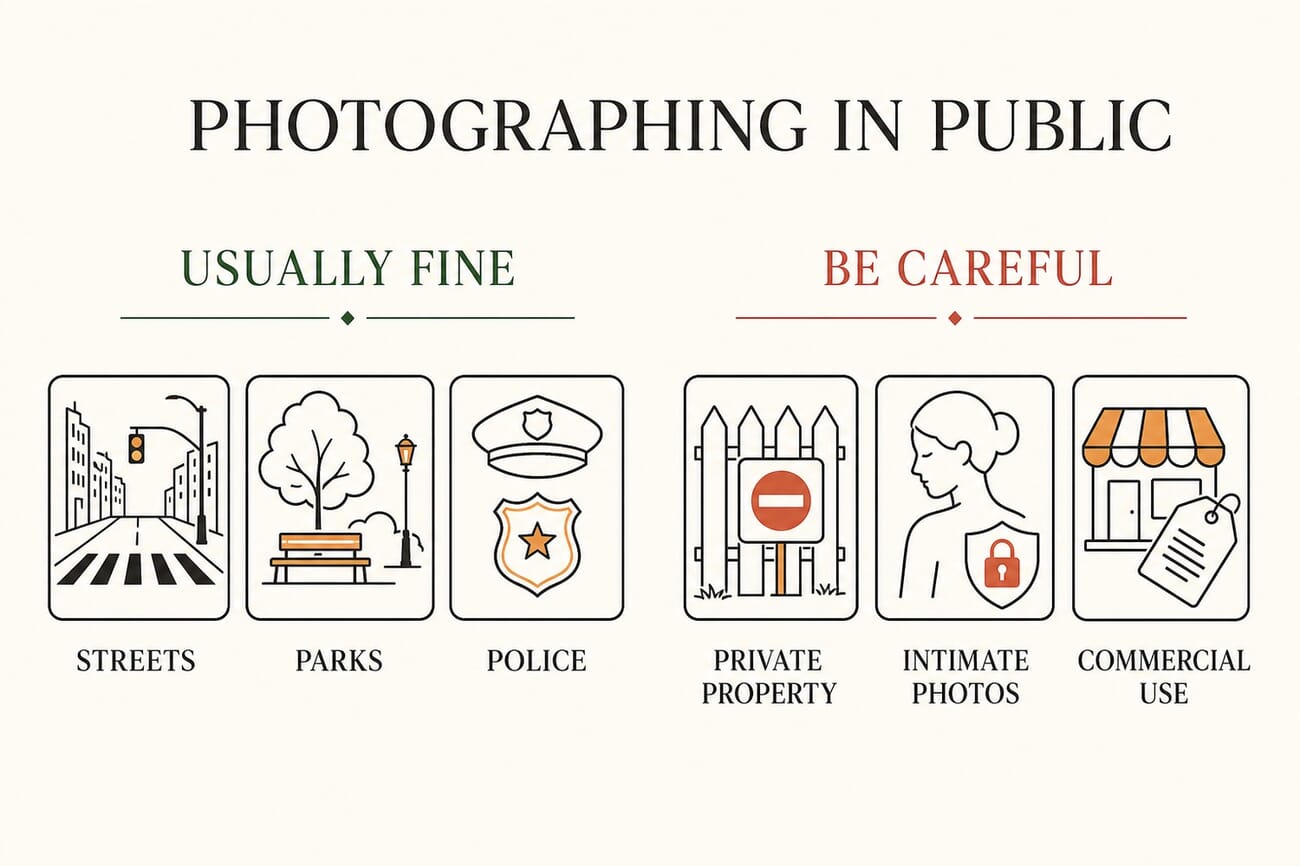
- The real limits are narrow and consistent across both countries: private property, intimate images, commercial use, and a few security-sensitive sites.
Imagine being told, by your own government and in plain print, that lifting a camera in a public park could get you arrested. That is roughly what a UK Home Office booklet and matching poster tell asylum seekers, and when photographers spotted the wording on August 22 it set off a fast, angry debate. The document does not just bend the law. On the central point, it states the opposite of what the law actually is.
The confusion is the story here, because the anxiety it feeds is not limited to one leaflet or one country. Plenty of hobbyists already believe, wrongly, that they need a stranger’s permission before pressing the shutter in public. So here is the clear version, for both the UK and the United States: what you can legally photograph in public, where the real limits sit, and what to do if someone tries to stop you.
This article is general information, not legal advice. Laws vary by country and situation, and if you are dealing with a specific dispute you should consult a qualified lawyer.
What the Government Leaflet Actually Says
The material is part of a Home Office “code of behaviour” package explaining to asylum seekers what is expected of them while living in the UK. One poster, published on GOV.UK, deals specifically with photography. Its wording is unambiguous, and that is the problem.
Do not photograph or film people in public. This includes taking pictures or videos in public spaces, like streets or parks… If you do these things, you could be arrested by the police. This could affect your asylum support and your asylum claim.
Home Office photography poster, GOV.UK
Read literally, that tells a whole category of people that ordinary street and park photography is grounds for arrest. It is not. Photographers, camera clubs, and journalists were quick to point out that the guidance contradicts the police, the Home Office’s own position elsewhere, and decades of settled law. Digital Camera World called it “Orwellian” and asked readers to imagine if a documentary great like Martin Parr had been prevented from working the streets.
Why It Is Legally Wrong
There is no law in the UK that bans photographing people in public places. That is not a loophole or an interpretation, it is the baseline. Guidance from the Association of Chief Police Officers, still cited by forces today, could not be clearer:
There are no powers prohibiting the taking of photographs, film or digital images in a public place. Therefore members of the public and press should not be prevented from doing so. Once an image has been recorded, the police have no power to delete or confiscate it without a court order.
ACPO guidance on photography in public
Nicholas Bowman, chair of the City of London and Cripplegate Photographic Society, told Amateur Photographer the Home Office wording is “both misleading and legally incorrect,” noting that there is a reduced expectation of privacy outdoors and that permission is not required for casual, artistic, or journalistic photography. On top of that, Article 10 of the European Convention on Human Rights protects freedom of expression, which courts have long read to include taking photographs. The leaflet, in other words, is not describing a real offence.
The Kernel of Truth Behind the Confusion
It is worth being fair about how this probably happened, because the mistake is instructive. The same poster warns that “sharing sexual pictures or videos of someone without their permission is a serious crime.” That part is completely correct. Taking or distributing intimate images without consent, and voyeurism, are genuine offences in UK law, and they are exactly the kind of harm a code of behaviour should flag.
The failure was collapsing two very different things into one instruction. “Do not share intimate images of someone without consent” is sound advice. “Do not photograph people in public” is not, and stapling them together under a single “you could be arrested” warning turns lawful, everyday activity into an implied crime. For an audience already nervous about contact with authorities, that chilling effect is not a small drafting slip.
What You Can Actually Photograph in Public (UK)
The working rule in the UK is simple: if you are standing somewhere you are legally allowed to be, you can generally photograph what you can see, including people, buildings, and events. That covers most street, travel, and documentary work. The genuine limits are narrow:
- Private property. A shopping centre, museum, or railway station is often privately owned. The owner or their staff can set their own rules and ask you to stop or leave, even though it feels public.
- Intimate images and harassment. Voyeurism, upskirting, and sharing sexual images without consent are crimes. Persistently following or targeting a specific person can cross into harassment.
- National security sites. Anti-terror law creates narrow offences around eliciting information on the armed forces, police, or intelligence services, and some military and government sites are genuinely restricted.
- Commercial and data use. Using a recognisable person’s image to sell something, or processing identifiable images commercially, can engage data-protection rules and may require a model release.
None of those turn casual public photography into a crime. They are edges, not the rule. If you want to get better at working within them confidently, our guide to the best cameras for street photography is a good next step.
And in the US: Your First Amendment Rights
For American readers the protection is, if anything, stronger. As the ACLU puts it, when you are in a public space where you are lawfully present, you have a First Amendment right to photograph anything in plain view, including federal buildings, transportation facilities, and police officers doing their jobs. There is no general expectation of privacy in public, so you do not need a stranger’s consent to photograph them on the street.
The US exceptions mirror the UK ones closely. You cannot trespass onto private property to get a shot, and a private owner can set rules on their own premises. Commercial use of someone’s likeness may require a model release. Voyeurism and recording people in genuinely private settings, such as bathrooms or changing rooms, are illegal. And a short list of secure federal or military sites carry real restrictions. Photographing police in public, notably, is protected, and officers cannot lawfully demand that you delete images or hand over your camera without a warrant.
What to Do If Someone Tries to Stop You
Knowing the law is only half of it. Handling the confrontation calmly is the other half, because most challenges come from security guards or members of the public who simply have the rules wrong.
- Stay calm and polite. A composed, matter-of-fact response defuses far more situations than an argument about statutes.
- Know where you are standing. On genuinely public land you are within your rights. On private property, the owner can ask you to leave, and refusing can become trespass.
- You generally do not have to delete anything. In both the UK and the US, police cannot force you to delete or surrender images without the proper legal process. A security guard has even less authority.
- You do not have to explain yourself. You are usually under no obligation to justify why you are taking photographs in a public place.
Once the legal fog clears, the creative questions are the fun part, from reading a scene to nailing your composition in a split second of street life.
Frequently Asked Questions
Can I legally photograph strangers in public?
Yes. In both the UK and the US, you can generally photograph people in public places without their permission, because there is no reasonable expectation of privacy in public. The main exceptions are private property, intimate images, and commercial use of someone’s likeness.
Can the police make me delete my photos?
No, not on the spot. UK police guidance states officers have no power to delete or confiscate images without a court order, and in the US police cannot make you delete photos or hand over your camera without a warrant. A security guard has no such power at all.
Do I need a model release to photograph people?
Not to take the photo, and not for editorial, artistic, or personal use. A model release generally becomes relevant when you use a recognisable person’s image commercially, such as in advertising or to sell a product.
Is it different on private property that feels public?
Yes. Shopping centres, museums, train stations, and stadiums are often privately owned even though the public uses them. The owner can set photography rules and ask you to stop or leave, so the “public place” freedoms do not automatically apply there.
Can I photograph police officers?
Yes. In both countries, photographing police carrying out their duties in a public place is lawful and, in the US, specifically protected by the First Amendment. You must not physically obstruct them, but recording itself is not a crime.
The Bottom Line
A badly worded leaflet does not change the law, but it can change behaviour, and that is why photographers reacted so strongly. The right to record public life is not a niche hobbyist concern. It is the same right that produced a century of street photography, documentary work, and citizen journalism. In both the UK and the US, that right is intact. The narrow limits are worth knowing, and everything outside them is yours to shoot.
Sources and further reading:
Reference
- Photography and filming: support for asylum seekers (official poster, PDF) – GOV.UK / Home Office
- Is the UK Government trying to stop photography in public spaces? – Amateur Photographer
- Orwellian UK government pamphlet contradicts police on photography law – Digital Camera World
- Photographers' Rights: know your rights when photographing in public – ACLU
Image Sources
- Street photographer in a public space (featured) – Stylized PhotoWorkout illustration
- Photographing in public quick-reference (infographic) – PhotoWorkout illustration
- Can you be arrested for taking a photo? (pin graphic) – Stylized PhotoWorkout illustration