


- Anthropic confirmed on August 11, 2026 that Claude models released on or after August 2 now embed an invisible watermark in generated text and attach signed C2PA Content Credentials to generated images (PNG, JPG, SVG), worldwide.
- That makes Claude the third major lab to mark its own AI output, after OpenAI and Google, and it adds a genuinely new axis the others have not pushed on: invisible watermarking of text, not just images.
- There is a catch: you can verify the image half today with free C2PA tools, but Anthropic’s text-watermark detector is not public yet. Google, meanwhile, just let users switch off the visible mark on its images (the invisible one stays).
- For photographers, none of this proves your real photos are real. These marks ride the AI output, not your camera captures. The burden of proving authenticity still sits on you, through camera-side C2PA.
- The marks are also brittle: a format conversion, a re-save in the wrong app, or a screenshot can strip them. The rules get teeth on December 2, 2026, when the EU’s machine-readable marking obligation kicks in.
The effort to mark AI content as AI has been building on two fronts we have tracked closely: cameras learning to sign real photos at capture, and the EU AI Act forcing disclosure into law. This week the third front moved. Anthropic, one of the top three AI labs, quietly started marking everything its Claude models produce, and in doing so it added a twist the others have mostly avoided: it is watermarking text, not just images. It is a small technical announcement with an outsized message for anyone who cares whether a picture is real.
What Anthropic Actually Did
In a help-center article confirmed on August 11, 2026, Anthropic detailed that Claude models released on or after August 2 now do two things automatically. They weave an imperceptible, machine-readable watermark directly into generated text, and they attach signed C2PA Content Credentials to generated image files in supported formats (PNG, JPG, and SVG). C2PA is the same open provenance standard the camera makers use, so the images carry a tamper-evident manifest describing how they were made.
Two details matter. First, this is global. Anthropic signed the EU AI Act’s transparency Code of Practice, and rather than build a Europe-only version, it applied the marking worldwide. Second, there is no opt-out on the text watermark. If Claude wrote it with a recent model, the mark is in there, whether you want it or not. Older models are being updated to follow.
The New Axis: Watermarking Text, Not Just Images
Image provenance is now familiar territory. What makes the Anthropic move notable is the text watermark. Until now, the generator side of the authenticity conversation was almost entirely about pictures and audio: OpenAI and Google both lean on C2PA and Google’s SynthID to mark visual and sound output. Baking an invisible signal into written text, at scale and with no way to turn it off, is a different and more sweeping commitment.
For photographers that axis is indirect, but it signals the direction of travel. The labs are converging on a norm where AI output announces itself, across every medium, and where that self-marking migrates from vendor to vendor, exactly the pattern we have watched play out on the camera side and the phone side.
You Can Only Verify Half of It, For Now
Here is the part most of the coverage got wrong. Anthropic’s provenance system splits cleanly into a half you can check and a half you cannot. The image half uses C2PA, a mature open standard, so you can drop a Claude-generated PNG into a free tool like Content Credentials Verify today and read its manifest. The text half is another story: Anthropic’s own documentation calls the text-watermark detector “forthcoming.” There is no public detector, API, or tool that lets you confirm whether a given paragraph came from Claude.
In other words, the most talked-about part of the announcement, catching AI writing, is the part you cannot actually verify yet. The part you can verify, image provenance, is the part that already existed. That gap is worth keeping in mind before treating any of this as a solved problem.
Google Went the Other Way, Sort Of
The same week, Google pushed in what looks like the opposite direction. On August 14 it added a Media Watermark toggle in Gemini’s settings that lets users remove the visible watermark from AI generations. Headlines framed it as Google letting people strip provenance, but that is a misread. Turning off the visible logo changes nothing underneath: the invisible SynthID signal and any C2PA metadata stay in place. The move only affects the badge you can see, not the marks a verifier reads. It is a useful reminder that visible and invisible marks are entirely different things.
How the Whole Wave Fits Together
Step back and the pattern is clear. OpenAI marks its images and audio with a SynthID-and-C2PA layer and offers a public Verify tool for content provenance. Google marks with SynthID plus C2PA. Anthropic now adds C2PA on images and an invisible watermark on text. Three of the biggest labs, converging on the same idea from slightly different angles, within weeks of each other. This is the “mark the fakes as fake” half of the authenticity stack, and it is maturing fast.
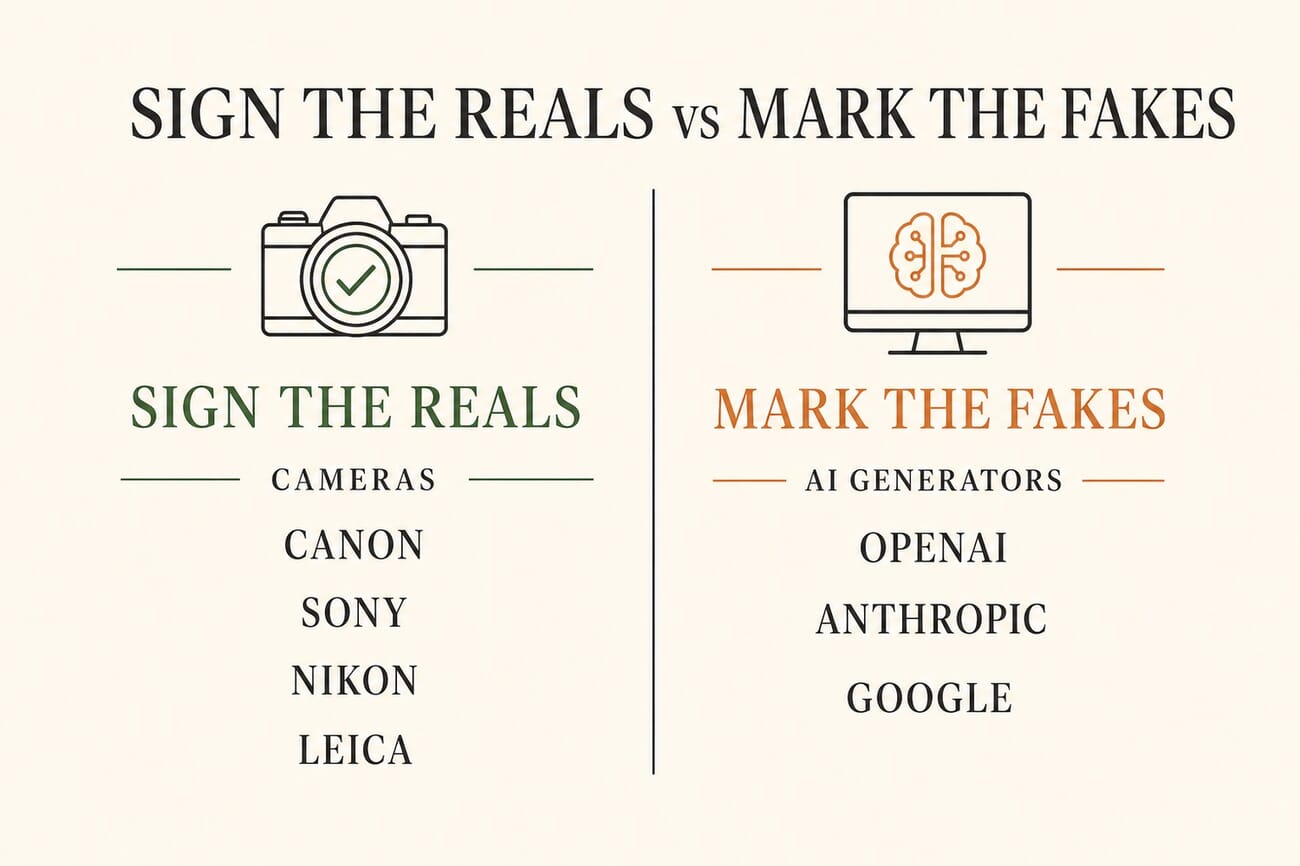
The other half is the one that matters most to you: cameras signing real photos at capture. Canon, Sony, Nikon, and Leica have all shipped or committed to in-camera C2PA signing, and Apple is building a “this is real” layer into the iPhone. The two halves are complementary, but they are not the same system, and that distinction is where the practical impact for photographers lives.
What This Actually Changes for Photographers
The blunt version: Anthropic marking Claude’s output does nothing to prove your real photograph is real. These marks travel on AI-generated content, flagging it as synthetic. They do not touch the files coming off your sensor. If you need to demonstrate that an image is a genuine capture, the burden is still entirely on you, and the tool for that is camera-side C2PA, not anything a generator does.
It gets more fragile from there. Every one of these marks, visible or not, is brittle. A format conversion can drop the C2PA manifest. Re-saving through an app that does not preserve credentials wipes them. And the oldest trick in the book, a screenshot, strips provenance entirely while producing a pixel-perfect copy. Anthropic itself says its marks “may persist through some editing,” which is a careful way of admitting they often will not. For working photographers, that means provenance is a chain-of-custody discipline, not a magic stamp: preserve the original signed file, and treat anything that has been through an unknown pipeline as unverifiable. It is the same care you already bring to navigating AI in your workflow.
The Deadline That Makes It Real: December 2, 2026
Right now, most of this is voluntary momentum. That changes soon. Under the EU AI Act’s Article 50, the transparency obligations for deployers took effect on August 2, 2026, and the deeper requirement, that providers of generative AI embed machine-readable marking in their outputs, becomes enforceable on December 2, 2026. That December date is why every major lab is racing to bake this in now. Anthropic, OpenAI, and Google are not being generous; they are getting ahead of a legal deadline that will make self-marking mandatory for anyone serving the European market.
Frequently Asked Questions
What did Anthropic announce?
That Claude models released on or after August 2, 2026 automatically embed an invisible watermark in generated text and attach signed C2PA Content Credentials to generated images (PNG, JPG, SVG). It applies worldwide, and there is no opt-out on the text watermark.
Can I detect whether text was written by Claude?
Not yet. Anthropic describes its text-watermark detector as forthcoming, and no public tool can confirm the mark today. You can, however, verify the C2PA metadata on a Claude-generated image right now using free tools like Content Credentials Verify.
Does this help me prove my photo is real?
No. These marks flag AI-generated content as synthetic; they do nothing for your camera captures. Proving a real photograph is genuine still relies on camera-side C2PA signing from makers like Canon, Sony, Nikon, and Leica, and on you preserving the original signed file.
Can these watermarks be removed?
Often, yes, unintentionally. Format conversion, re-saving in an app that ignores credentials, or simply taking a screenshot can strip them. Google also added a toggle to remove the visible watermark from its images, though the invisible SynthID signal underneath remains.
What happens on December 2, 2026?
The EU AI Act’s requirement that generative AI providers embed machine-readable marking in their outputs becomes enforceable. That is the deadline pushing every major lab to add self-marking now, ahead of the rule taking effect.
The Bottom Line
Anthropic joining the marking wave, text and all, is a real milestone: three of the biggest labs now sign or watermark what they make, and a new medium, written text, has entered the frame. But for photographers the takeaway is unchanged and worth repeating. The generators are marking their fakes; that is their job now. Proving your reals are real is still yours. Keep your original signed captures, understand how easily these marks break, and watch December 2, when the whole system stops being optional.
Sources and further reading:
Reference
- Anthropic to start watermarking Claude-generated text, images – SiliconANGLE
- Anthropic watermarks all Claude outputs globally with marks that may persist through some editing – The Decoder
- Google will now allow users to remove visible watermark from its AI generations – TechCrunch
- Content Credentials Verify (C2PA verification tool) – Content Authenticity Initiative
Image Sources
- Real photograph versus dissolving AI-generated version (featured) – Stylized PhotoWorkout illustration
- Sign the reals vs mark the fakes (infographic) – PhotoWorkout illustration
- AI now signs its own fakes (pin graphic) – Stylized PhotoWorkout illustration