


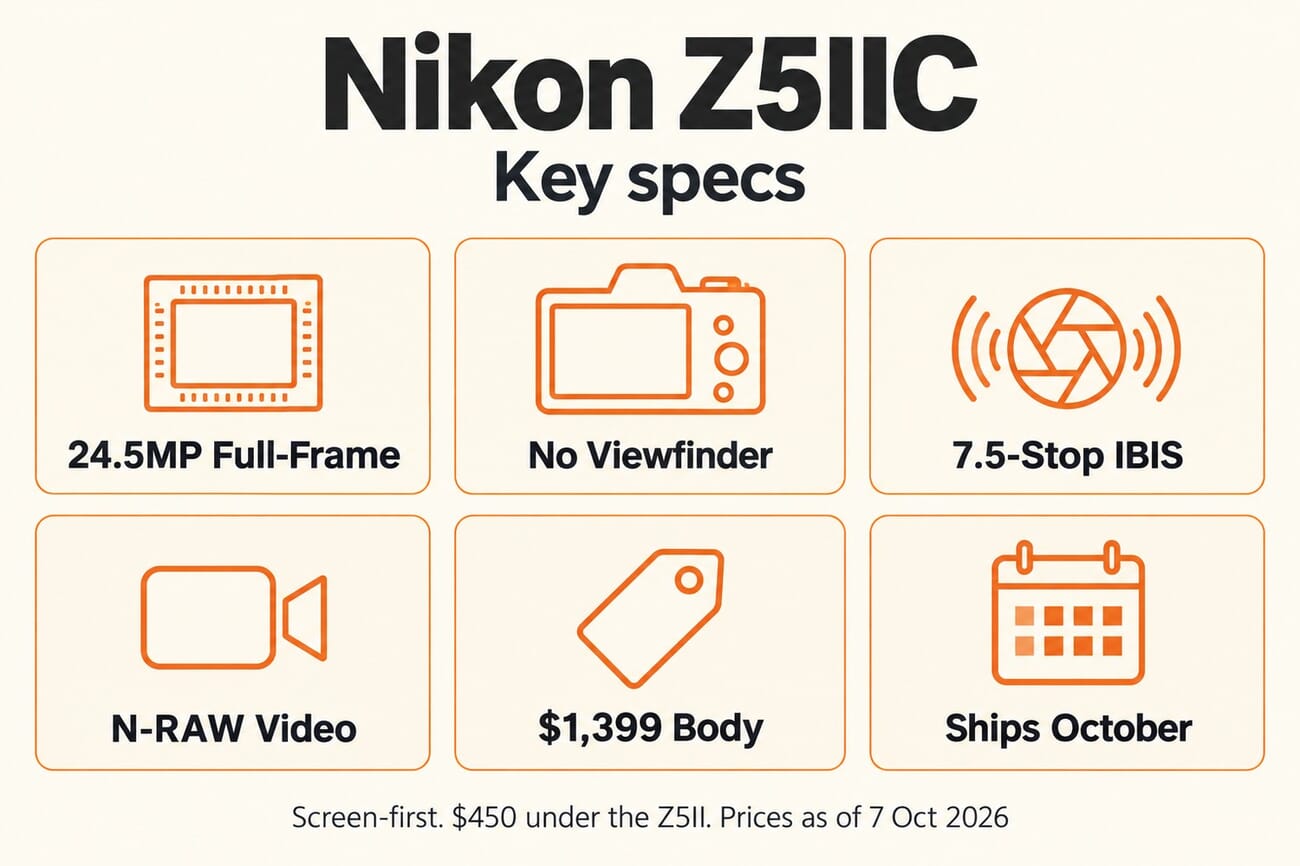
- Nikon has announced the Z5IIC, a ‘screen-first’ full-frame mirrorless camera that deletes the electronic viewfinder entirely. It is $1,399.95 body-only (or $1,699.95 with the 24-50mm lens) and ships mid-October 2026.
- Under the hood it is essentially a Nikon Z5II: the same 24.5MP full-frame BSI sensor, EXPEED 7 processor, 5-axis in-body stabilization rated up to 7.5 stops, and the same deep-learning autofocus. It even keeps internal 12-bit N-RAW video.
- The clever part is that it is a price cut, not a size cut. Removing the viewfinder shaves about $450 off the Z5II’s price while barely shrinking the body, so you are paying less for the same capability, minus one feature.
- It arrives as rivals zig the other way: the OM System PEN just added a viewfinder to stand out, and Canon’s R8 Mark II sits at $1,899. The Z5IIC is the cheapest route into a fully-featured full-frame Nikon, if you can live without a finder.
Nikon just made an unusual bet. The new Nikon Z5IIC, announced in late September and shipping mid-October, is a full-frame mirrorless camera that deliberately leaves out one of the features photographers treat as non-negotiable: the electronic viewfinder. In its place is a screen-first design built around the rear display, and a price that undercuts the camera it is based on by a meaningful margin.
At $1,399.95 body-only, the Z5IIC is the cheapest way into a genuinely capable full-frame Nikon. The catch, and the whole debate, is whether removing the finder is a smart way to cut cost or a step too far. The answer depends entirely on how you shoot, and the camera is sharper than a simple “stripped-down” label suggests.
What Nikon actually did
The simplest way to understand the Z5IIC is as a Nikon full-frame that is a Z5II minus the viewfinder. It uses the same 24.5-megapixel full-frame BSI CMOS sensor and EXPEED 7 processor, the same 5-axis in-body stabilization rated up to 7.5 stops, and the same deep-learning autofocus that detects and tracks people, dogs, cats, birds, vehicles, aircraft and even fish. You compose on a 3.2-inch vari-angle touchscreen of around 1.04 million dots, there is a single UHS-II SD slot, and both microphone and headphone jacks are on board.
Crucially for hybrid shooters, Nikon did not gut the video. The Z5IIC records internal 12-bit N-RAW to the SD card, uncropped 4K up to 30p, 4K/60 in a DX crop, and Full HD at up to 120 fps. It comes in black or silver, weighs about 620 grams, and can be bundled with the 24-50mm, a 26mm f/2.8 pancake or a 40mm f/2. This is not an entry-level sensor in a cheap shell; it is a near-complete enthusiast camera with one deliberate omission.
The clever part: it’s a price cut, not a size cut
Here is the detail that makes the Z5IIC interesting rather than just cheaper. Removing a viewfinder could have been used to shrink the camera dramatically, the way vlogging compacts do. Nikon did not do that. As DPReview put it, the Z5IIC is about “capability over compactness”: the body is only marginally smaller than the Z5II, keeps a proper grip and control layout, and retains the full feature set. What the missing EVF actually buys you is a roughly $450 lower price, not a pocketable size.
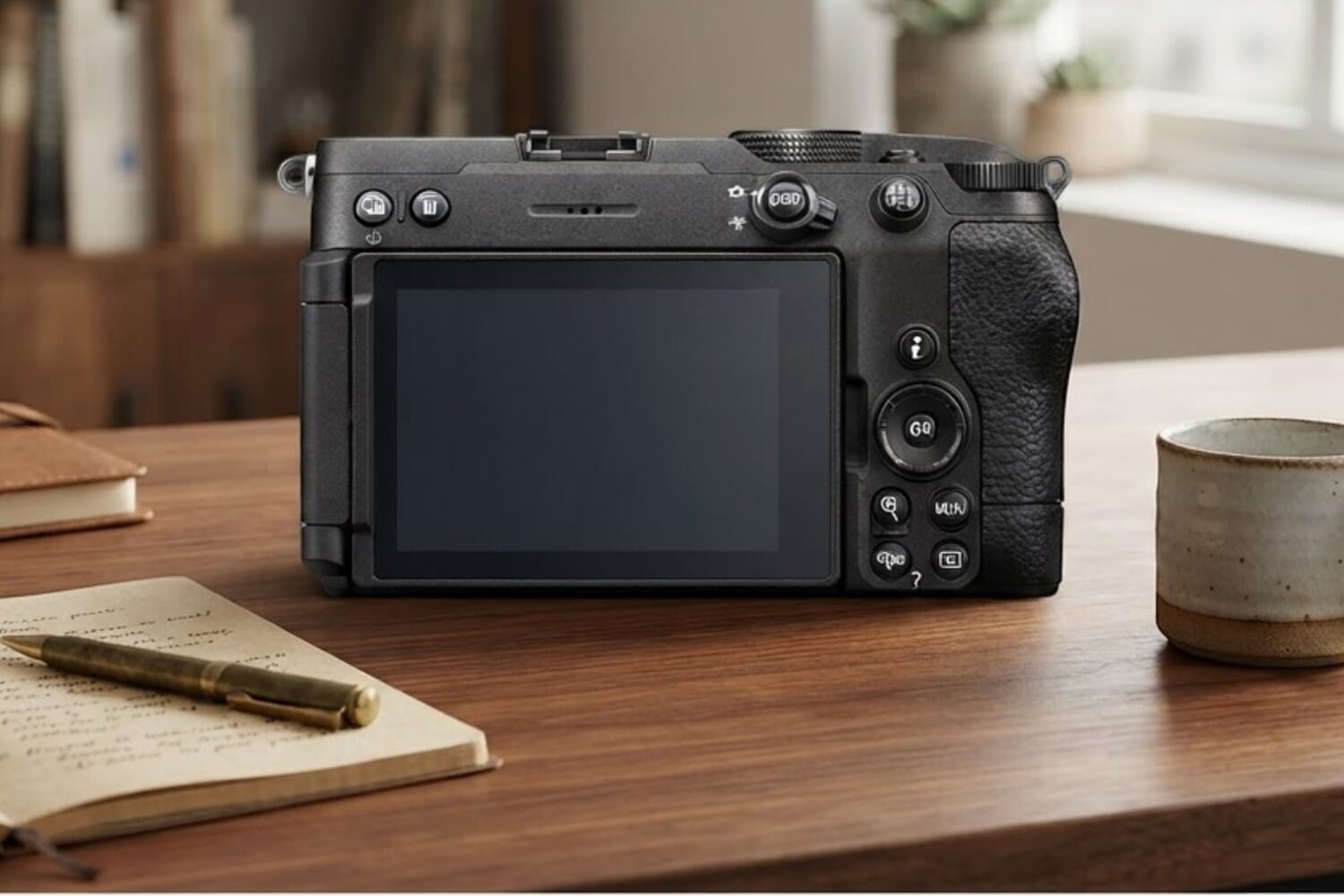
That reframes the whole camera. The Z5IIC is not asking “how small can full-frame get?” It is asking “how much is the viewfinder actually worth to you?” For a shooter who lives on the rear screen, that is $450 saved on otherwise identical hardware. For someone who shoots action, or in bright sun where a screen washes out, it may be $450 they would gladly have paid.
Two companies, opposite bets
The timing makes the Z5IIC a neat case study in how differently brands read the same market. Just days earlier, OM System revived the PEN by adding an electronic viewfinder to a compact body as its marquee selling point. Nikon is doing the exact opposite, betting that a chunk of buyers will happily trade the finder for a lower price. Both can be right, because they are chasing different people.
On price, the Z5IIC also lands squarely against the full-frame field. It undercuts Canon’s EOS R8 Mark II at $1,899 by a full $500, and the R8 II keeps its viewfinder but costs more. Against that backdrop, the Z5IIC is the most affordable way to get a stabilized, full-frame, N-RAW-capable Nikon body, which is a genuinely strong value argument for the right buyer.
Who it’s for, and who should skip it
The Z5IIC is aimed squarely at content creators and screen-first shooters: vloggers, hybrid shooters, and photographers who already compose on the back display and tilt it up for selfies and low angles. For them, the vari-angle screen, N-RAW video, full-frame look and jack ports are exactly right, and the missing EVF is weight and money they never used. It is Nikon’s answer to cameras like the Sony ZV-E1 and Panasonic S9, but with more conventional capability.
Skip it if you shoot in bright sunlight often, chase fast action, or simply steady the camera against your face with a finder, an EVF is not a luxury in those situations, it is the better tool. If that is you, the standard Z5II (or the R8 Mark II) is worth the extra money. The Z5IIC is not a compromised camera; it is a very deliberate one, and knowing which camp you are in makes the decision easy.

Frequently Asked Questions
How much is the Nikon Z5IIC and when does it ship?
It is $1,399.95 body-only, or $1,699.95 with the NIKKOR Z 24-50mm f/4-6.3 lens, and ships mid-October 2026. Soft bundles with the 26mm f/2.8 and 40mm f/2 are also offered, in black or silver.
What is different between the Z5IIC and the Z5II?
The main difference is the viewfinder: the Z5IIC removes it, while keeping the Z5II’s 24.5MP sensor, EXPEED 7 processor, 7.5-stop stabilization, autofocus and N-RAW video. Removing the finder lowers the price by about $450; the body is only slightly smaller.
Does the Z5IIC have in-body stabilization and RAW video?
Yes to both. It keeps 5-axis in-body image stabilization rated up to 7.5 stops and records internal 12-bit N-RAW to the SD card, plus uncropped 4K/30, 4K/60 in DX crop, and Full HD up to 120 fps.
Is a camera without a viewfinder worth buying?
It depends on how you shoot. If you compose on the rear screen, shoot video, or want full-frame for the least money, losing the EVF is a reasonable trade. If you shoot in bright sun or need a finder for action and stability, a model with an EVF is the better choice.
The bottom line
The Nikon Z5IIC is one of the more honest cameras in recent memory: it takes a proven full-frame body, removes the single feature a lot of modern shooters no longer use, and passes the savings on. It is not a gimmick and it is not crippled, it is a clear-eyed bet that for many creators the viewfinder was always optional. At $1,399 for Z5II capability, it is the cheapest serious full-frame Nikon you can buy, and the only real question is whether you are the kind of photographer who will ever miss the finder.
Primary Coverage
- Nikon USA — Nikon Releases the Z5IIC Mirrorless Camera – Official announcement, specifications, pricing and availability.
- DPReview — Nikon Z5IIC review: capability over compactness – Hands-on analysis of the no-EVF design and the price trade-off.
- Newsshooter — Nikon Z5IIC Announced – Video specs, autofocus and feature breakdown.
Image Sources
- Nikon Z5IIC product images (Nikon), staged via Photoroom – Official product renders composited into scene.
- Specs infographic and Pinterest pin — PhotoWorkout – Original PhotoWorkout editorial graphics.