


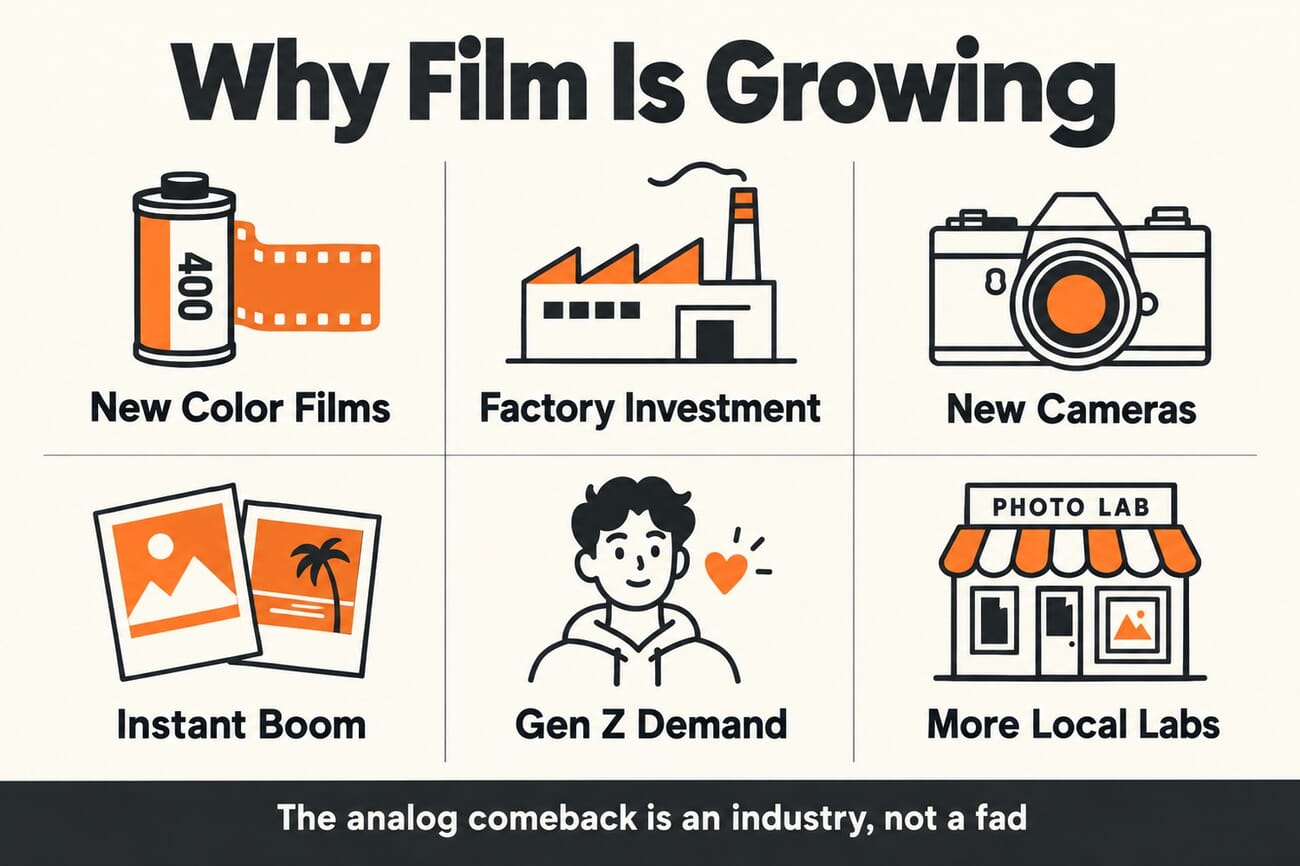
- Film photography is not just hanging on, it is growing, and this year the clearest proof is that manufacturers are investing real money in it rather than just riding nostalgia.
- Harman, the UK maker of Ilford film, has launched brand-new color emulsions (the Phoenix line) and says the sales fund further investment in coating and color technology. Kodak has poured money into its Rochester coating plant and taken back direct distribution of its film.
- Genuinely new film cameras are being built again, not just refurbished classics: the half-frame Pentax 17, the Rollei 35AF, Kodak’s reusable Ektar H35 line, and a steady stream of Lomography models.
- Young shooters are driving demand and instant film is booming, but the catch is cost: a roll of color film now runs roughly three times its 2016 price. The revival is real, and it is not cheap.
For years, “film is making a comeback” was the kind of line you could file next to vinyl records and fountain pens, true in spirit, small in scale. That framing is now out of date. Film photography has grown from a nostalgic niche into a genuine, reinvesting industry, with new emulsions, new factories, brand-new cameras, and a wave of young shooters who never owned a film camera the first time around.
You can feel it in person. At Imaging World in Nürnberg this year, one of the liveliest corners of the show was not the latest mirrorless flagship but an active analog community, with a table piled high with fresh Ilford black-and-white stock and a steady crowd around it. That scene, a mountain of new film selling briskly at a major trade show in 2026, is a fair snapshot of where analog actually is right now.
When you buy through links on our site, we may earn a commission at no cost to you. We evaluate products independently. Commissions do not affect our evaluations. As an Amazon Associate, we earn from qualifying purchases.
A wall of film, and a crowd around it
The Ilford display in Nürnberg was telling because of what it contained: not dusty old stock being cleared out, but current production across the whole range, HP5 Plus and FP4 Plus, the Delta professional films, niche stocks like SFX and Ortho Plus, even a football collectors edition. That breadth matters. A dying product line gets narrower every year; a healthy one keeps its catalog wide and adds to it. The crowd working through the boxes skewed young, which lines up with what every lab and retailer has been reporting.
The manufacturers are betting real money
The strongest evidence that this is more than a fad is where the money is going. Harman, the British company that makes Ilford film, has done something the industry had not seen in decades: engineered an entirely new color negative film from scratch, the Phoenix line, and it has been explicit that “sales from this film will allow us to further invest, refine, and improve our formulations, coating capabilities and color technology.” Building new color film is extraordinarily hard, and the fact that a maker best known for black-and-white is funding it speaks to real confidence in demand.
Kodak is making a similar bet. The company has reportedly invested tens of millions of dollars upgrading its historic Rochester film-coating facility to raise output, and has moved to take back direct distribution of most of its film stocks, a structural change that only makes sense if you expect to be selling film for a long time. These are not the moves of companies managing a graceful decline, they are capacity investments.
New cameras, not just old ones
For most of the revival, the hardware story was about used gear: hunting down a clean Canon AE-1 or an Olympus OM on the secondhand market. That is changing. Pentax re-entered film manufacturing with the 17, a modern half-frame point-and-shoot that doubles your shots per roll, a smart answer to high film prices. Rollei launched the autofocus 35AF compact, Kodak sells its reusable Ektar H35 half-frame line, and Lomography keeps releasing new bodies and quirky films. After years of only classics, there are now genuinely new film cameras you can buy with a warranty, which both signals and sustains the growth.
Who’s driving it, and the catch
The engine of all this is a younger audience. Labs and film makers consistently report that a large and growing share of new film buyers are under 25, shooters drawn to the deliberate pace, the physical negative, and a look that is hard to fake. Instant film is riding the same wave: the instant-print market is one of the fastest-growing corners of imaging, with Fujifilm’s Instax line and Polaroid both expanding. The brand mix is shifting too; in one recent survey we covered, Kodak overtook Fujifilm as the most-used film brand even in Japan, as Fuji’s price hikes pushed shooters elsewhere.
That price point is the real catch. The revival has a cost problem: a roll of color film now runs roughly three times what it did in 2016, as we charted in our look at how far film prices have climbed. The good news is that the same boom is creating cheaper ways in, from half-frame cameras that stretch a roll to budget stocks and reusable cameras. If you want the most fun, lowest-stakes entry, our guide to the Lomography gear worth buying is a good place to start.
Frequently Asked Questions
Is film photography actually growing, or just trendy?
It is genuinely growing. The clearest signal is supply-side investment: Harman has launched new color films and Kodak has put money into film-coating capacity. Companies do not expand factories for a passing trend. Demand, especially from younger shooters, has grown steadily since around 2020.
Are companies still making new film cameras?
Yes. Recent new models include the half-frame Pentax 17, the autofocus Rollei 35AF, Kodak’s reusable Ektar H35 line, and a rolling lineup from Lomography. You can now buy a brand-new film camera with a warranty, not only used gear.
Why is film so expensive now?
A mix of higher raw-material and manufacturing costs, limited production capacity, and strong demand. A roll of color film costs roughly three times its 2016 price. Half-frame cameras, which double the shots per roll, and budget black-and-white stocks are the main ways to shoot film affordably.
What’s the cheapest way to start shooting film?
A reusable half-frame camera (like Kodak’s Ektar H35 or the Pentax 17) paired with a budget black-and-white stock keeps per-shot costs down. Instant cameras such as Fujifilm Instax are another low-friction entry, and Lomography sells affordable films and cameras aimed squarely at beginners.
The bottom line
The film revival has quietly crossed a line. It is no longer a question of whether analog survives, but of an industry that is actively reinvesting, new color emulsions, upgraded factories, fresh cameras, and a young audience that treats film as a choice rather than a relic. The wall of Ilford in Nürnberg was not a nostalgia display; it was a storefront for a growing market. The one cloud is price, and even there the industry is responding with cheaper cameras and formats. Film is back, it is bigger than the “comeback” headlines suggested, and for once that is not just romance.
Primary Coverage
- Harman Photo — HARMAN Phoenix color film and ongoing investment statements – Maker of Ilford film on new color emulsions and reinvestment.
- Kodak — film-coating investment and distribution changes – Rochester facility upgrade and reclaimed film distribution.
- PhotoWorkout — Kodak Overtakes Fujifilm as Most-Used Film Brand – Survey data on shifting film-brand usage.
- PhotoWorkout — Film Costs 3x What It Did in 2016 – The 20-year film price curve and cheaper entry points.
Image Sources
- Ilford film display at Imaging World Nürnberg — PhotoWorkout – Photo taken by PhotoWorkout at the show.
- Why-film-is-growing infographic, lifestyle illustration and Pinterest pin — PhotoWorkout – Original PhotoWorkout editorial graphics.