


- A Santa Ana, California man triggered a real police and reptile-expert search of his neighborhood with an AI-generated photo of a venomous Gaboon viper. Residents kept kids indoors before he confessed the image was fake.
- The detail that matters for photographers: when Santa Ana PD checked the photo, Grok told them it was authentic. Other AI detectors disagreed with each other, so the force searched anyway, just in case.
- What actually exposed the fake was not a detector but real-world knowledge: a Gaboon viper is too heavy to climb, so a snake sitting in a tree made no sense to the herpetologist who showed up.
- It is part of a fast-growing cluster of AI-fake emergencies, from Newark’s AI ‘monkeys on the loose’ to a viral AI ‘homeless man’ prank flooding 911 lines across several states. One-click detectors are not a defense.
An AI-generated photo just sent an entire California neighborhood into a venomous-snake panic, and the tool the police reached for to check it told them the fake was real. On September 28, Santa Ana resident Joel Ciprian warned his neighbors and called the authorities about a Gaboon viper, a highly venomous African snake, in his backyard, backing up the claim with a photo. Police issued a community alert, reptile experts combed the neighborhood tree by tree, and parents kept their children inside. The snake never existed. The photo was generated by AI, and Ciprian later admitted the whole thing was a hoax.
For photographers, the uncomfortable part is not that someone made a convincing fake. It is what happened when the professionals tried to verify it. Santa Ana PD ran the image through an AI check, and according to CBS Los Angeles, Grok came back saying the photo was authentic. This is the exact failure mode we have been warning about: the one-click tools people now treat as lie detectors are not reliable, and leaning on them can make a bad situation worse.
What happened in Santa Ana
According to the Santa Ana Police Department, Ciprian alerted neighbors in the 1400 block of Cypress Avenue that his dogs had cornered a large snake, then sent police a photo he claimed to have taken. The department posted a public warning about a Gaboon viper, “highly venomous, about 4 to 5 feet long and not native to North America,” and deployed officers alongside reptile specialists. The search turned up nothing: no shed skin, no tracks, no snake.
What unraveled the story was not technology but biology. A Gaboon viper is one of the heaviest vipers in the world, a ground-dwelling ambush predator that does not climb. The photo showed one draped in a tree. “There were a couple of things out of place, and that type of snake in a tree, it just doesn’t make sense,” snake expert Thomas Munoz told CBS LA. Detectives followed up, interviewed Ciprian at his workplace, and after a long conversation he confessed the image was AI-generated. Police say he could face charges for filing a false report; his motive has not been released.
CBS Los Angeles covered both the scare and the reveal, including the AI-generated photo that set it off:
The detector said ‘authentic.’ That’s the whole problem
Here is the line every photographer should sit with. “Officers told CBS LA that they ran the photo through an A.I. detection system and it came back authentic. They later told CBS LA that they used Grok.” A separate NBC Los Angeles interview added that results were all over the map: “There were some AI generators that were saying it was not AI and then others that were saying it was.” Faced with contradictory verdicts, the department reasonably decided to search anyway. But the takeaway stands, the automated check did not resolve anything, and the one chatbot they named gave the wrong answer.
We have written before about why this happens: AI detectors routinely mislabel real photos as fake, with no meaningful way to appeal, and the reverse failure, waving a fake through as genuine, is just as common. These tools are pattern-matchers trained on yesterday’s generators; today’s models leave different fingerprints, and a confident green checkmark is not evidence. A general-purpose chatbot like Grok is even shakier, because it is not a provenance system at all, it is guessing from pixels and sounding sure while it does it.
It is not just a snake: a fast-growing cluster
The viper hoax is one of several AI-fake emergencies in quick succession. In Newark, New Jersey, apparently AI-generated photos of “monkeys on the loose” rummaging through a dumpster sent police on a city-wide search that found no animals; officials later judged the images likely AI-generated. Separately, a viral TikTok trend has people using AI to fabricate realistic photos and videos of a “homeless man” who appears to have broken into their home, then showing it to panicked family members. It has triggered a wave of 911 calls across at least four states, with police issuing warnings and asking people to stop.
News 12 New Jersey reported on the Newark “monkey manhunt,” showing the AI-generated images that triggered the search:
The common thread is that AI fakes have graduated from social-media mischief to wasting real public-safety resources, the digital cousin of a swatting call. When a fabricated image can redirect officers, specialists and an entire neighborhood’s attention, “can you spot the fake” stops being a parlor game and becomes a civic problem.
What actually catches a fake
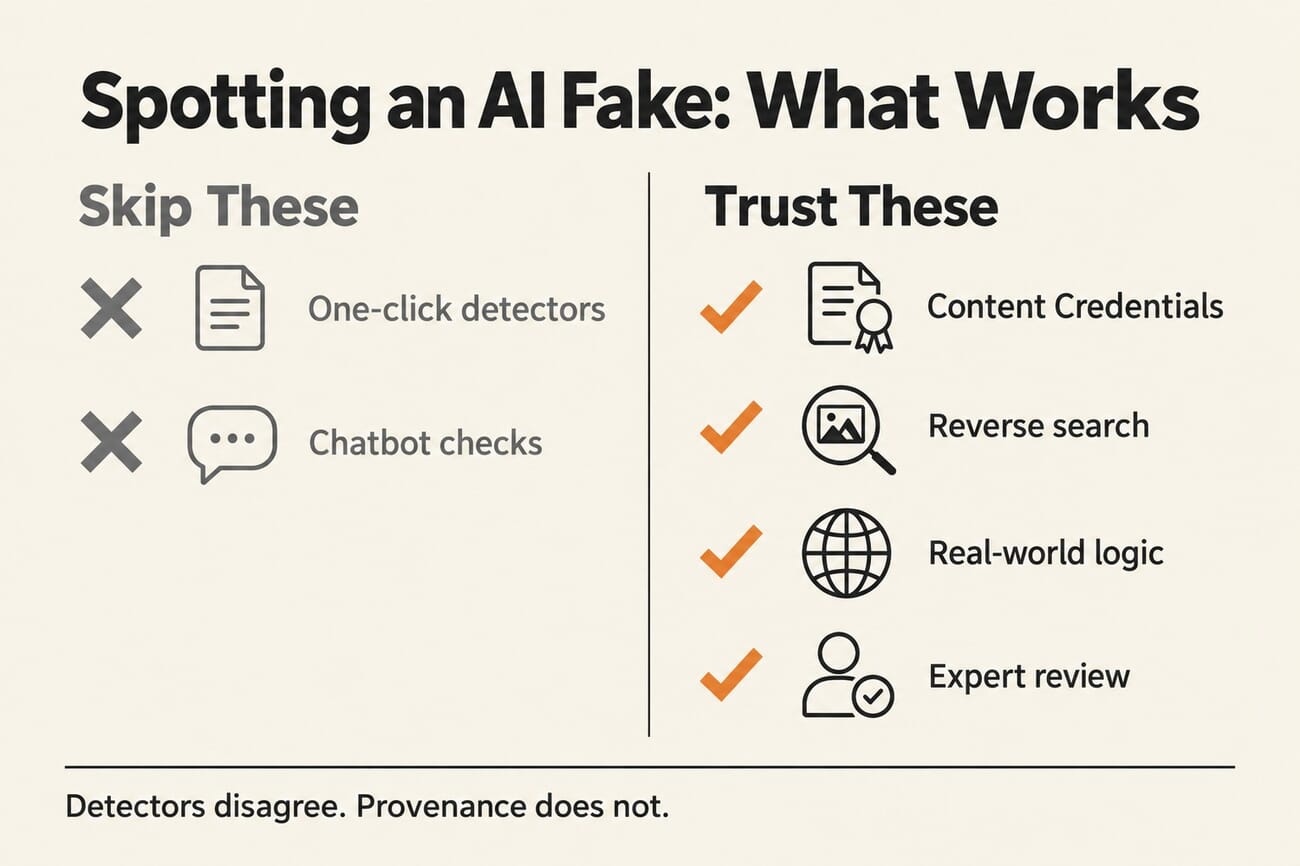
If a one-click detector and a chatbot both fall short, what works? The same layered approach we have argued for all along. First, provenance beats detection: cryptographic Content Credentials (C2PA) attached at capture, like the Canon and OpenAI authenticity stack and Apple’s upcoming “this is real” verification in iOS 27, prove where an image came from instead of guessing after the fact. Second, reverse image search and metadata checks catch recycled and freshly minted fakes alike. Third, and the one that saved Santa Ana, real-world logic: does the scene even make sense? And fourth, expert eyes, the herpetologist spotted in seconds what the software missed.
For the practical version of this, our guide on how to tell whether a photo is real or AI, and how to prove your own shots are genuine, walks through the checks step by step. The headline lesson from Santa Ana is simply this: do not hand your judgment to a tool that cannot actually see.

Frequently Asked Questions
Can AI image detectors reliably tell if a photo is fake?
No. Detectors are trained on known generators and frequently misjudge both ways, flagging real photos as fake and passing AI images as authentic. In the Santa Ana case different tools gave contradictory results, and Grok reportedly called the fake authentic. Treat any single detector verdict as a weak signal, not proof.
What is the most reliable way to verify an image?
Provenance. Cryptographic Content Credentials (C2PA) recorded at capture show an image’s origin and edit history, which is far stronger than after-the-fact detection. Combine that with reverse image search, metadata review, common-sense checks on the scene, and, when stakes are high, an expert opinion.
Is using an AI fake to trigger an emergency response illegal?
Filing a false police report is a crime in most jurisdictions, regardless of whether the “evidence” is an AI image. Santa Ana police said the man who reported the viper could face charges. Fabricating emergencies also diverts resources from real ones.
Why did Grok say the fake snake photo was authentic?
Grok is a general-purpose AI assistant, not a provenance or forensic system. It infers from pixels and tends to answer confidently even when uncertain. That makes it a poor authenticity checker, which is exactly why the one real-world clue, a Gaboon viper cannot climb trees, mattered more than the software.
The bottom line
The Santa Ana snake is almost funny until you picture the officers, the reptile team and the families who treated it as real. That is the point: AI fakes now carry real-world consequences, and the instinct to settle them with a quick detector check or a question to a chatbot is exactly backwards. The technology that lies convincingly in images is the same technology people are trusting to referee them. Until provenance is built into every camera and platform, the reliable tools remain the old ones, context, cross-checking, and expertise, and a healthy refusal to believe a green checkmark just because it sounds sure.
Primary Coverage
- CBS Los Angeles — Santa Ana neighborhood venomous snake sighting is a hoax, police say – Reports that officers ran the photo through Grok and it came back authentic. News report embedded above.
- NBC Los Angeles — Santa Ana PD had suspicions of AI-generated viper image – Officer account of conflicting AI-detector results and the confession.
- News 12 New Jersey — Apparent AI-generated photos send Newark police on monkey manhunt – The Newark AI 'monkeys on the loose' hoax. News report embedded above.
- The Hill — AI-generated 'homeless man' prank causes 911 overload – The AI 'homeless man' prank and its 911 impact across several states.
Image Sources
- Concept illustration, detector infographic and Pinterest pin — PhotoWorkout – Original PhotoWorkout editorial graphics.