


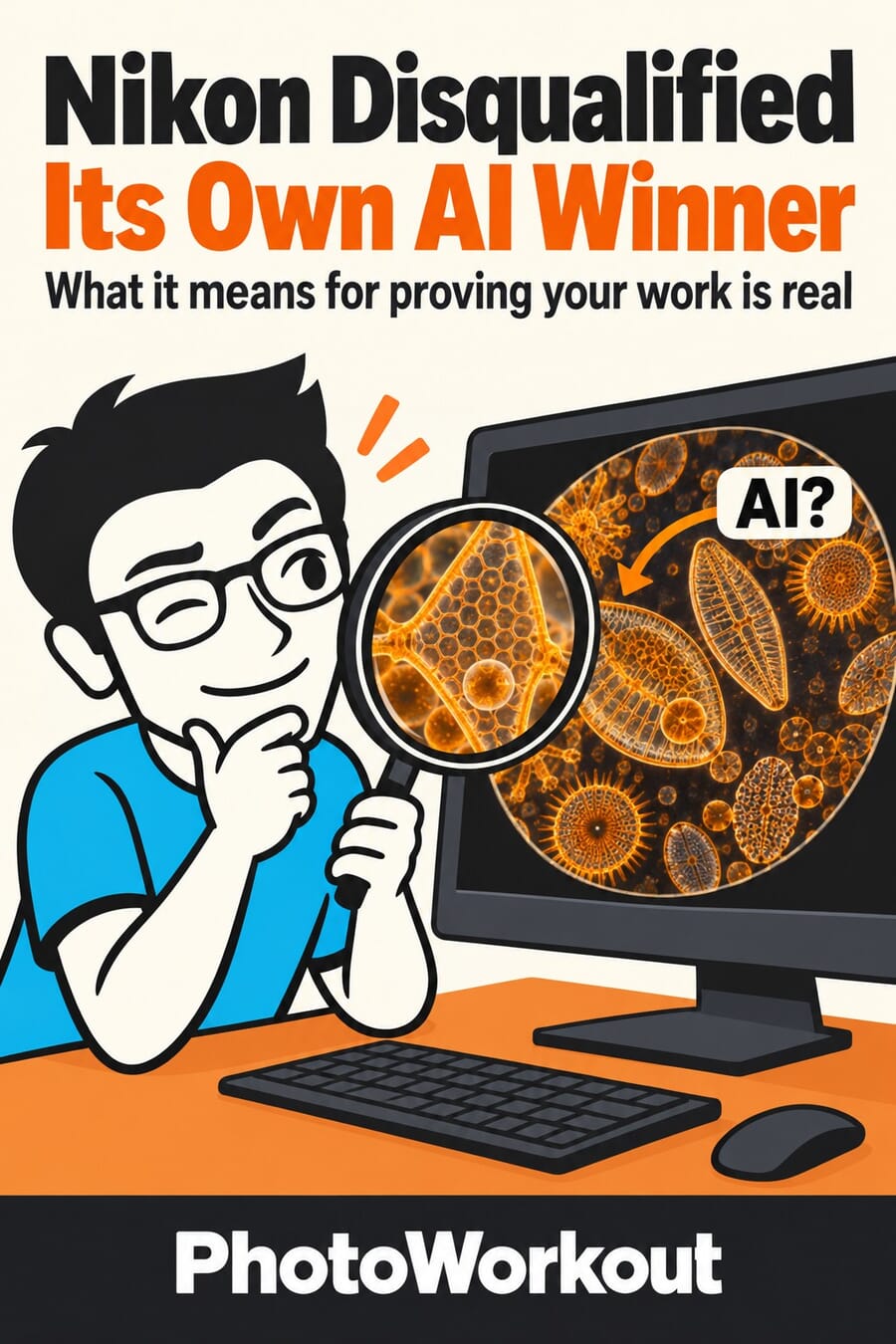
- On October 9, 2026, Nikon disqualified the first-place winner of its Small World in Motion microscopy-video competition, ruling the video did not comply with the contest’s rules on generative AI.
- It is a notable precedent: a major camera brand enforcing an AI ban in its own marquee contest and revoking a winner after public forensic scrutiny from the scientific community. Nguyen Nam Nhat is now first; the rankings were adjusted on Nikon’s official site.
- The winner, Dr Ning Xu of the National University of Singapore, admits using AI in post-processing to visualize and colorize grayscale microscopy data but denies generating the video. Nikon framed its call as ‘solely’ about rule eligibility, ‘not a judgment of intent.’
- One tool that helped flag it, Google’s SynthID watermark detector, went globally public just two days earlier. The real lesson for photographers is about what such detectors can and cannot prove, and why keeping your original files is the only reliable alibi.
A camera company just took back one of its own prizes over artificial intelligence, and how it happened is more instructive than the headline. On October 9, Nikon disqualified the first-place winner of its 2026 Small World in Motion competition, a prestigious showcase of microscopy video, after determining the winning entry broke the contest’s rules on generative AI. It is one of the clearest cases yet of a major imaging brand enforcing an AI ban in its own flagship contest, and revoking a winner once the scientific community raised the alarm.
For photographers, this is not just microscopy gossip. It is a live test of the questions the whole field is wrestling with: where the line sits between AI-assisted and AI-generated, what the new detection tools actually prove, and how you defend your own work if you are ever accused. The answers here are useful well beyond a petri dish.
What Nikon did
After PetaPixel reported in early October that Nikon was re-reviewing the entry, the company reached its verdict. “After thoroughly re-evaluating the video and supporting materials and consulting with members of our judging panel, Nikon has determined that the winning video did not comply with the competition rules regarding generative AI,” a Nikon spokesperson said, adding that it had “adjusted the competition rankings to reflect this decision.” Nikon was careful to narrow the scope: the ruling “is based solely on the submitted video’s eligibility under the rules,” and “should not be interpreted as a judgment of the entrant’s professional reputation, scientific contributions, or intent.”
With the disqualification, the standings shifted. According to Nikon’s official Small World in Motion page, Nguyen Nam Nhat is now first for his video of a tiny roundworm and a single-celled Dileptus, followed by Benedikt Pleyer in second, Andrew Moore in third, Patrick Hickey in fourth and Igor Adameyko in fifth. The disqualified entry has been removed from the winners’ gallery. Nikon acknowledged the episode shows a need to “revisit rules and evaluation procedures for future competition entries.”
The dispute: visualization versus generation
This is where fairness matters, because the entrant contests the framing. Dr Ning Xu, an optical-engineering researcher at the National University of Singapore, says he used AI in post-processing to visualize and colorize grayscale microscopy data, but denies generating the video or fabricating the motion it shows. His entry depicts the beating of cilia, the hair-like structures that line parts of the lungs, in tissue he says came from a child with primary ciliary dyskinesia, a rare genetic disorder. The competition’s rules are blunt on the point: “AI-generated videos are not permitted.”
The scrutiny came from scientists, not software. Edward Phelps, an associate professor at the University of Florida, publicly flagged what he called serious structural problems in the footage, such as cells that appear and disappear in physically implausible ways, and others pointed to possible AI watermarks in the source files. That is the crux of the “assisted versus generated” debate now written into regulation like the EU’s AI-labeling rules: coloring or denoising real data is one thing, synthesizing motion that was never captured is another. We are not in a position to declare which happened here, and neither, pointedly, did Nikon, which ruled on eligibility rather than intent.
The tool that caught it, and what a flag actually proves
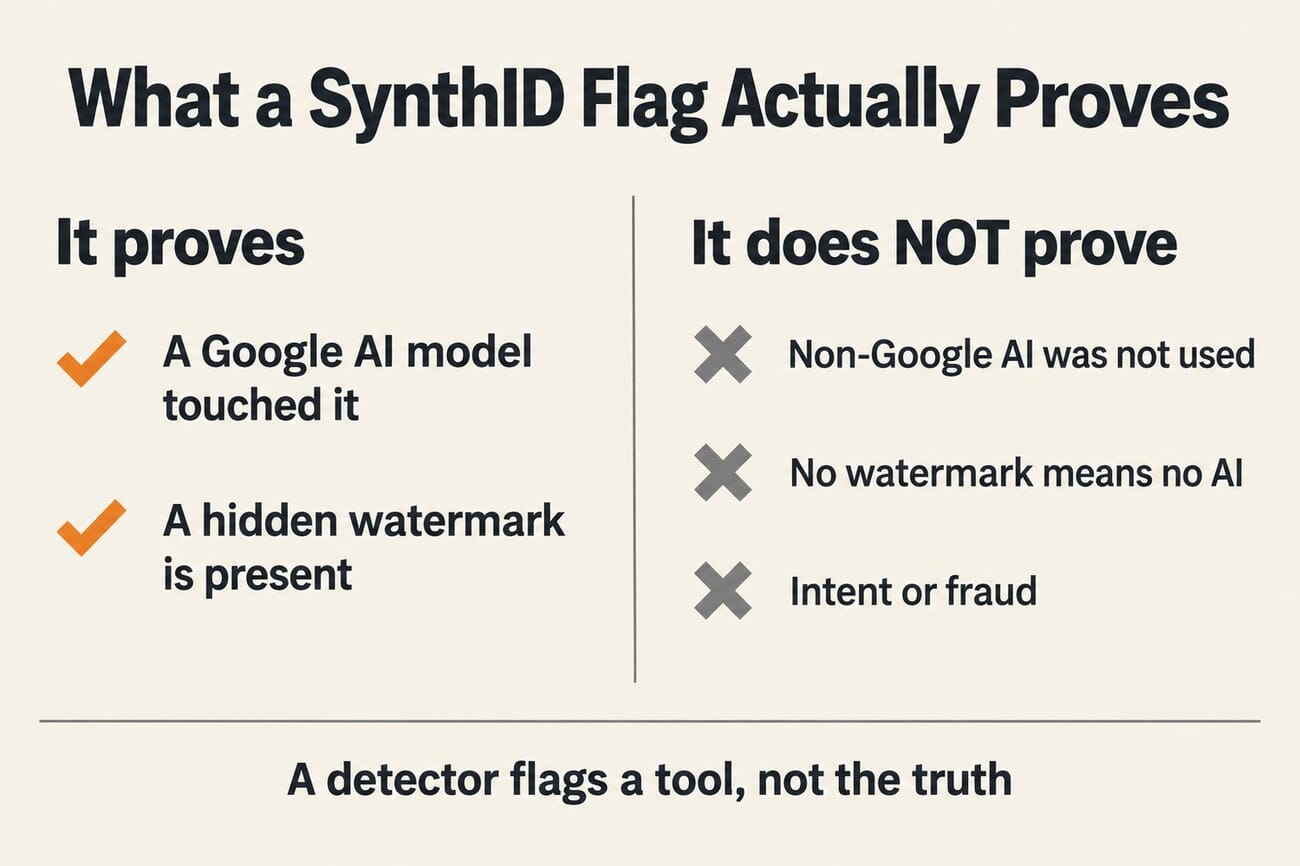
One detail doubles as a lesson. Among the evidence cited was a SynthID watermark, Google’s invisible marker embedded by its own AI models. The timing is almost too neat: Google opened its SynthID detector to the public globally on October 7, just two days before the disqualification, so anyone can now upload an image or video and check it for that watermark. But it is important to understand what such a flag does and does not mean. A SynthID hit indicates a Google AI model touched the content. It does not prove that non-Google AI was absent, and the lack of a watermark proves nothing at all, since most other generators leave none.
In other words, a detector is a lead, not a verdict, the same reality we saw when a one-click check waved a fake photo through to police as “authentic.” The durable fix is provenance recorded at capture, which is why Content Credentials that sign real photos at the sensor matter more than any after-the-fact scan.
The real takeaway for photographers: keep your raws
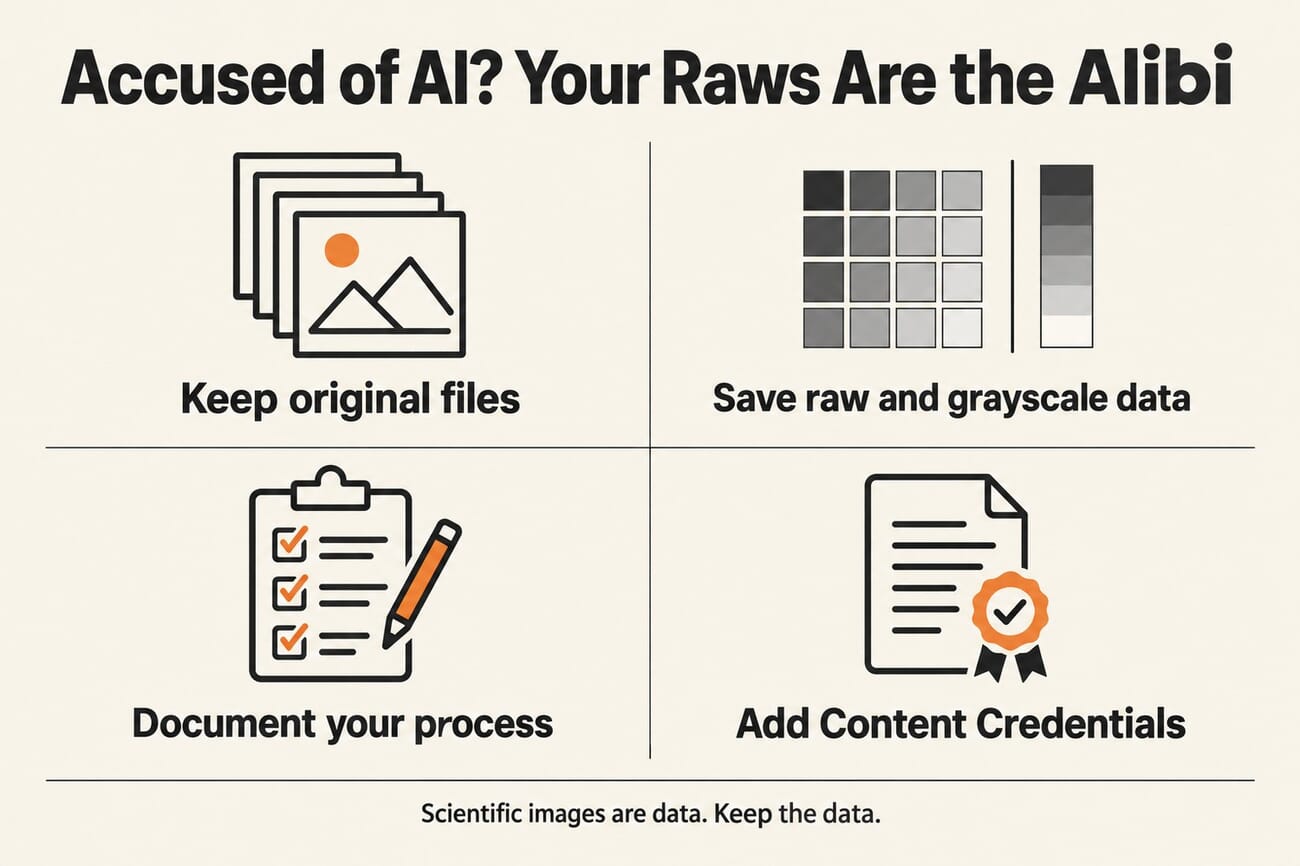
The most useful line in the whole episode came from the scientists themselves: several noted the dispute could have been resolved quickly if Dr Xu had simply shared the raw grayscale footage behind the final video. That is the entire lesson. Scientific images are data, and so, increasingly, are contest and editorial images in an age of AI suspicion. Your original acquisition files, the untouched raws, the capture metadata, the step-by-step record of your edits, are the only thing that reliably clears you. It is the same vulnerability we covered when AI-enhanced wildlife photos started quietly corrupting the scientific record.
If you shoot competitions, sell stock, or publish anywhere an “is this real?” accusation could land, treat your originals as evidence. Keep them, back them up, and where you can, attach Content Credentials. In a world where a plausible fake is cheap and a detector is fallible, the burden of proof has quietly shifted onto the creator, and your raw files are the receipts.
Frequently Asked Questions
Why did Nikon disqualify its Small World in Motion winner?
Nikon determined the winning video did not comply with the competition’s rules on generative AI, after re-reviewing the entry and consulting its judges. The company said the decision was based solely on rule eligibility, not on the entrant’s reputation or intent.
Who is the winner now?
Nguyen Nam Nhat, for a video of a roundworm and a single-celled Dileptus, is now first on Nikon’s official Small World in Motion page, followed by Benedikt Pleyer, Andrew Moore, Patrick Hickey and Igor Adameyko.
Did the photographer admit to using AI?
Dr Ning Xu says he used AI to visualize and colorize grayscale microscopy data in post-processing, but denies generating the video or fabricating the motion. He maintains he did not break the rules; Nikon disagreed on eligibility. Report it as a dispute, not a settled case of fabrication.
Does a SynthID watermark prove an image is AI?
A SynthID flag shows that a Google AI model was involved, because it embeds that watermark. It does not prove other AI tools were absent, and no watermark does not mean no AI. Detectors are leads, not proof; provenance and your original files are stronger evidence.
The bottom line
Nikon’s disqualification is a milestone: proof that a major imaging contest will actually enforce an AI rule and reverse a result under public, forensic pressure. But the lasting value for photographers is in the mechanics. The line between enhancing real data and generating fake data is now a competitive and legal fault line; detectors like SynthID are useful but partial; and the only airtight defense is the one creators control, your original files and a documented trail. Keep your raws. In 2026, they are not just backups. They are your alibi.
Primary Coverage
- PetaPixel: Nikon Disqualifies Winner of Small World in Motion Competition for Using AI – The disqualification, Nikon’s statement, and the entrant’s response.
- Nikon Small World: 2026 Small World in Motion Competition gallery – Official, updated standings used to confirm the new rankings.
- Google: SynthID Detector opens globally – The public watermark detector, launched October 7, 2026.
Image Sources
- Concept illustration and infographics: PhotoWorkout – Original PhotoWorkout editorial graphics.