


- The iPhone Duo is Apple’s first foldable, announced September 9, 2026, starting at $1,999. Its camera is a dual 48MP system (48MP Fusion Main plus 48MP Fusion Ultra Wide), not the full three-camera setup of the iPhone 18 Pro.
- For image quality, the Duo is excellent but not Apple’s best. It tops out at a 2x optical-quality zoom and skips the new variable aperture, both of which the iPhone 18 Pro Max keeps (8x telephoto, adjustable aperture).
- The real excitement for photographers is the form factor: the fold lets you shoot selfies and vlogs with the high-quality rear cameras while previewing on the outer screen, prop the phone up tripod-free, and use AI Smart Take to auto-capture.
- Verdict: get excited about the new ways to shoot, not about a spec leap. Reach-hungry photographers should still buy the 18 Pro Max; creators who value the foldable workflow will love the Duo. It went on sale October 23, 2026, and demand is so high it is already backordered into 2027.
Apple just did the thing it resisted for years: it made a foldable. The iPhone Duo, unveiled on September 9, 2026, is the first folding iPhone, and at $1,999 it is also one of the most expensive phones Apple has ever sold. Naturally, the question for anyone who cares about pictures is the one Apple’s keynote glossed over: how good is the camera, and should photography enthusiasts actually get excited?
The short answer is nuanced. The Duo’s camera is genuinely very good, but it is deliberately a step behind the iPhone 18 Pro Max that launched alongside it. Where it gets interesting is not the sensor spec sheet but what the folding body lets you do with the cameras you have. Now that the Duo has shipped and reviewers have put it through real-world use, the picture is clearer than ever, and the verdicts back up the honest breakdown below.
What is actually in the Duo’s camera
The iPhone Duo carries a two-camera system on its outer shell. The star is a new 48MP Fusion Main camera with a large sensor, a fast aperture, sensor-shift optical image stabilization, and a fresh computational pipeline. It shoots at 24MP by default for shareable files, can push to the full 48MP for detail, and includes an integrated 2x optical-quality telephoto that crops into the main sensor rather than using a separate lens.
Alongside it sits a 48MP Fusion Ultra Wide, the same unit Apple uses on the iPhone 18 Pro, which handles wide scenes and macro. Up front, a Center Stage camera can shoot in any orientation, and a second camera hides under the inner display for FaceTime. On paper, that is a strong, modern setup. What it is not is a complete pro kit.
Where it falls short of the iPhone 18 Pro
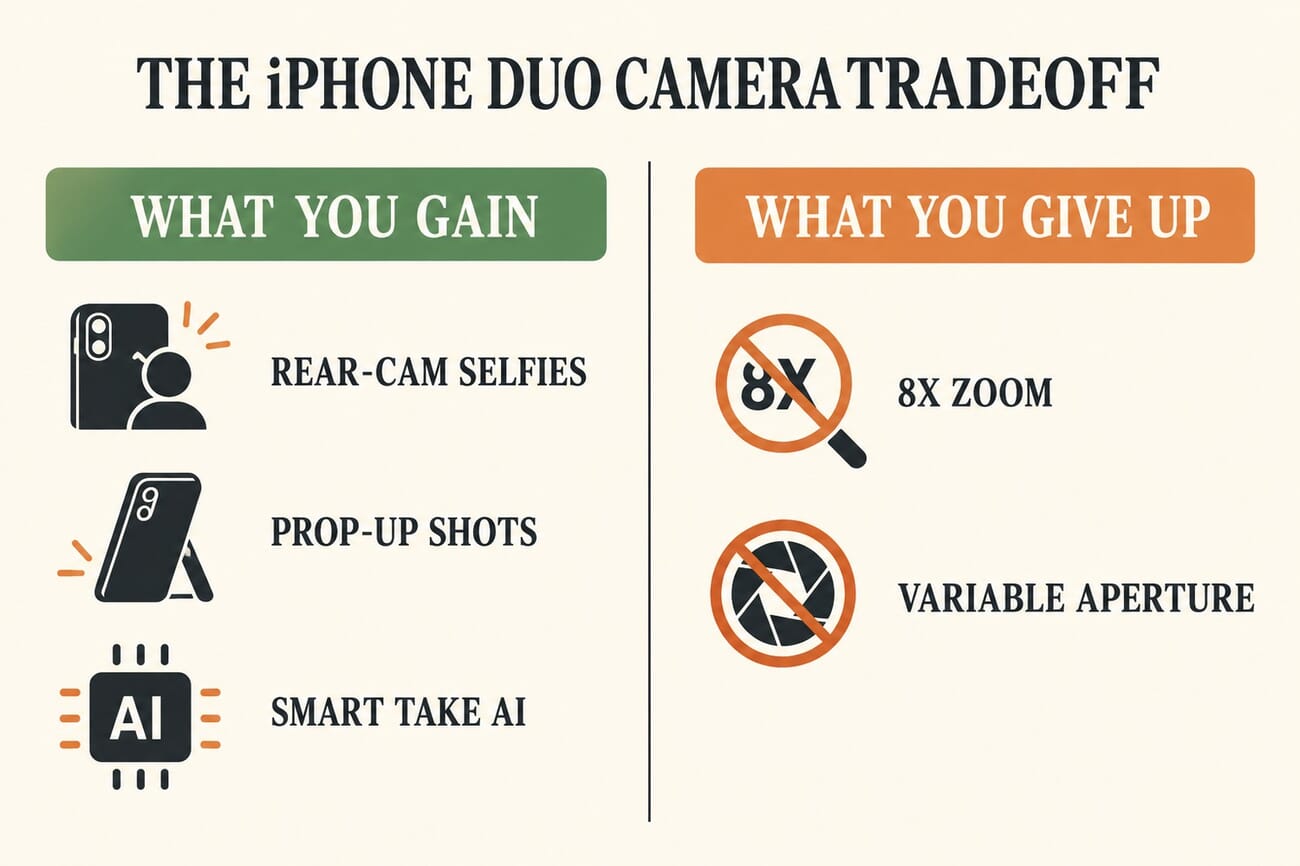
Two gaps matter to enthusiasts. First, reach. The Duo maxes out at a 2x optical-quality zoom, while the iPhone 18 Pro and Pro Max carry a dedicated telephoto that reaches 8x optical-quality across five focal lengths. If you shoot wildlife, sports, concerts, or anything you cannot walk closer to, that difference is enormous, and it is the single biggest reason a serious photographer would skip the Duo.
Second, aperture control. The headline trick on the 18 Pro this year is a new variable-aperture main camera, with six laser-cut blades that move between four aperture settings for real depth-of-field control, a first on iPhone. The Duo does not have it. For a photographer who wants creative control over background blur and sharpness, that omission stings. In short, the Duo trades away the two most photography-forward features of the 2026 lineup to fit into a folding body.
What genuinely is exciting
Here is where enthusiasts should perk up. Folding phones have always promised camera tricks that slabs cannot do, and the Duo finally delivers them on iOS. The best one: because the outer display works as a live viewfinder, you can shoot selfies and vlogs with the high-quality rear cameras instead of the weaker front camera, framing yourself on the cover screen. For creators, that is the feature that actually changes how you shoot, better selfie image quality has been the holy grail of every foldable.
The fold also turns the phone into its own tripod. You can prop the Duo open at an angle on any surface for hands-free long exposures, time-lapses, or group shots, no accessory required. Apple layered on AI-driven capture too: Smart Take uses on-device models to watch a scene and fire the shutter automatically when subjects are posed, and a Kid Cue mode plays animations on the outer screen to get children to look. None of this is possible on a regular iPhone.
On video, the Duo is no slouch. It records 4K at 120 fps in Dolby Vision on the main camera, supports Cinematic mode adjustments after capture, and adds an Audio Mix that can isolate music from a scene. Combined with the prop-up flexibility and rear-camera framing, it is arguably a more interesting video tool for solo creators than a standard iPhone, even if it is a weaker stills camera than the Pro.
So, should photographers get excited?
It depends entirely on what kind of photographer you are. If your priority is image quality and versatility, the answer is no: buy the iPhone 18 Pro Max, keep the 8x telephoto and variable aperture, and spend $2,000 on glass instead of a hinge. The Duo is not the camera phone to beat this year, and Apple did not design it to be.
But if you are a creator, vlogger, or someone who has always wanted proper-quality selfies and a phone that doubles as a tripod, the Duo is the most genuinely new camera experience Apple has shipped in years. The excitement is real, it is just about the workflow, not the sensor. For the bigger picture of Apple’s 2026 imaging push, our roundup of Apple products worth watching for photographers puts the Duo in context, and the new iOS 27 image-authentication tools ship across the whole lineup.
Now the reviews are in: what testers actually found
The Duo reached reviewers in October 2026, and the verdicts line up closely with the pre-release read above: a genuinely excellent camera whose real story is the folding body, not the sensor. The photography press is the most useful lens here. PetaPixel’s Jaron Schneider called it “a compromise, but not compromised,” praising the build quality and the glare-rejecting matte inner display while flagging honest first-generation friction: it is awkward one-handed, Touch ID is slow, and battery life is “just barely good enough.”
For photographers specifically, Austin Mann’s field review is the one to read. He kept the iPhone 18 Pro as his most powerful camera, but found the Duo shines at “everything around the photograph: planning, editing, and sharing.” His standout moment proves the point this article made back in September. Parked under a dancing aurora in southern Iceland with his tripod back at the hotel, he partially opened the Duo, set it on the roof of the car, and captured a 5-second Night mode exposure with no tripod at all (26mm, f/1.6, ISO 5000). “What a moment in iPhone photography history,” he wrote. The prop-up trick is not a gimmick, it genuinely replaces a tripod in the field.
Mainstream reviewers agree on the camera’s shape. Engadget called it “a first-class foldable” worth the wait, confirming the dual 48MP setup, a 26mm main and a 13mm ultra-wide, with a 2x optical-quality zoom and no dedicated telephoto. CNET was blunter, noting the missing telephoto “is mostly a bummer because of the phone’s high price,” which is exactly the reach gap that keeps the 18 Pro Max ahead for serious shooters. The common thread across every review: fantastic photos in most everyday scenarios and shooting tricks no slab can match, but not the camera to beat on pure capability.
PetaPixel’s full camera-focused video review walks through sample images and the folding-camera workflow in action:
Frequently Asked Questions
How many cameras does the iPhone Duo have?
The iPhone Duo has two rear cameras: a 48MP Fusion Main (with a 2x optical-quality crop zoom) and a 48MP Fusion Ultra Wide. It also has a Center Stage front camera and an under-display FaceTime camera on the inner screen.
Is the iPhone Duo camera better than the iPhone 18 Pro?
No. The iPhone 18 Pro and Pro Max have a more complete system, including a dedicated telephoto that reaches 8x optical-quality and a new variable-aperture main camera. The Duo is excellent but tops out at 2x zoom and has no variable aperture. For pure camera capability, the Pro Max is the better choice.
Can you take selfies with the rear camera on the iPhone Duo?
Yes, and it is one of the best reasons to buy it. Because the outer display acts as a live viewfinder, you can frame selfies and vlogs using the higher-quality rear cameras rather than the front camera, which meaningfully improves self-portrait quality.
How much does the iPhone Duo cost and when can I buy it?
The iPhone Duo starts at $1,999 in the US for 256GB, rising through 512GB, 1TB, and 2TB. It comes in star white and night sky. Preorders opened October 16 and it went on sale October 23, 2026, though strong demand and tight supply have pushed many new orders into 2027.
Does the iPhone Duo shoot RAW and pro video?
It records 4K Dolby Vision video up to 120 fps on the main camera, with Cinematic mode and an upgraded Audio Mix. It also supports Apple’s upgraded Photographic Styles with new texture and grain controls for more creative still-image control.
The bottom line
The iPhone Duo’s camera is very good, clearly a step below Apple’s best, and more interesting than either of those facts suggests. It sacrifices the long telephoto and variable aperture that make the 18 Pro Max a photographer’s phone, and in return it offers something no slab can: rear-camera selfies, tripod-free shooting, and AI capture built around a folding body. Enthusiasts chasing image quality should get the Pro Max. Creators chasing new ways to shoot should get excited about the Duo, just for the right reasons.
Based on Apple's official announcements from September 9, 2026, plus hands-on reviews published in October 2026. Verified as of October 22, 2026.
Image Sources
- Apple iPhone Duo product image (featured) – Featured image: iPhone Duo in star white and night sky. Credit Apple.
- PhotoWorkout tradeoff infographic and pin – Stylized PhotoWorkout illustrations.
- Video: PetaPixel iPhone Duo review (embedded) – Embedded camera review video, courtesy of PetaPixel on YouTube.