


- Confirmed: the iPhone 18 Pro and 18 Pro Max are the first iPhones with a true variable aperture on the 48MP Fusion Main camera, a mechanical iris of six laser-cut blades (each thinner than a hair) moved by a rotor, replacing the single fixed opening every earlier iPhone used.
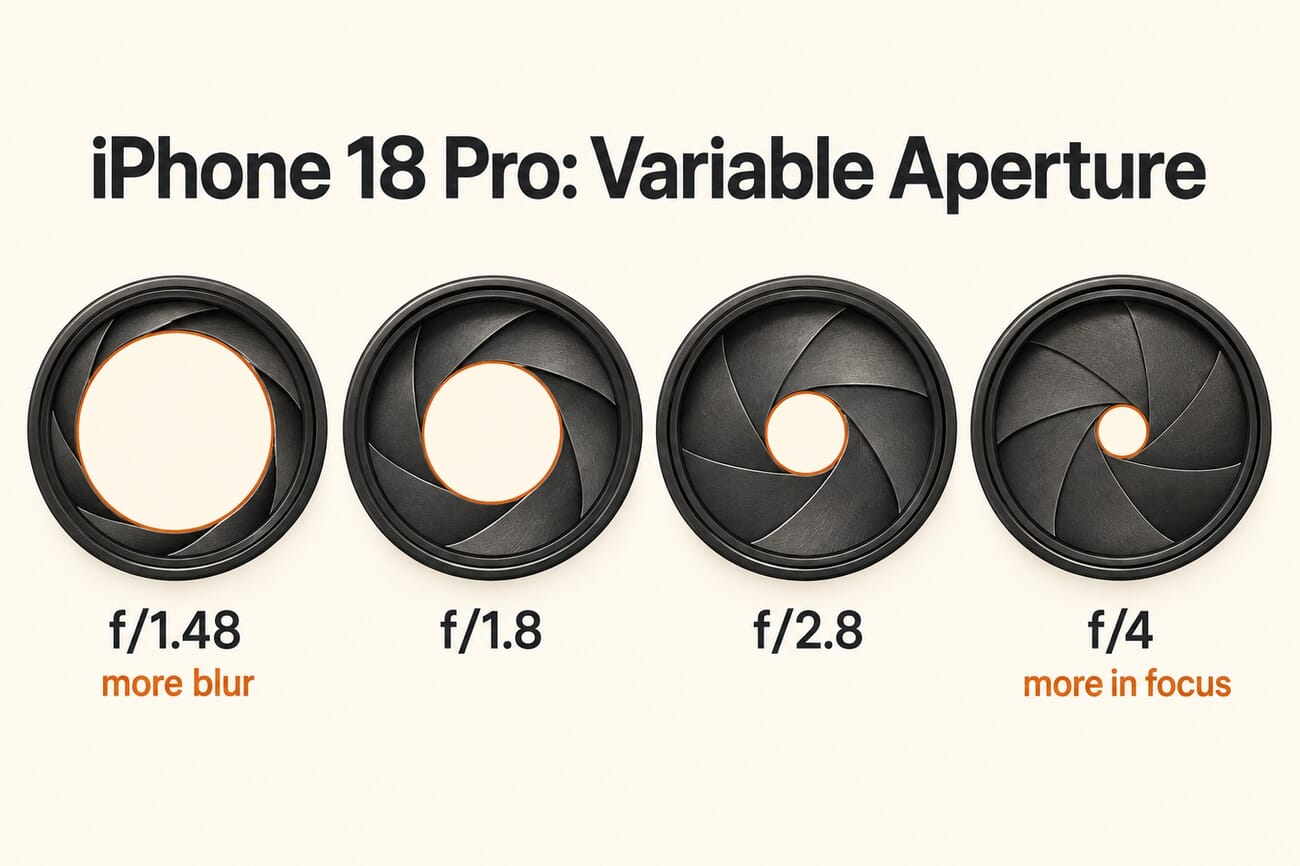
- It is not continuous. Apple uses four fixed stops, f/1.48, f/1.8, f/2.8, and f/4, on the main camera only (the ultra-wide stays at f/2.2). It opens wider than before (f/1.48 vs the old f/1.78) and can finally stop down to f/4.
- In reviews the bokeh is genuinely optical, not Portrait-mode fakery, but the depth-of-field effect is modest because the sensor is small. The practical wins are real low-light and exposure control plus automatic depth-of-field, not full-frame-style background blur.
- The rest is confirmed too: a 2nm A20 Pro chip, the longest-lasting battery in any iPhone, and prices up $100 to $1,199 (Pro) and $1,299 (Pro Max). It shipped September 18, 2026.
It is official, and it works. At its September 2026 event Apple gave the iPhone 18 Pro and 18 Pro Max the first true variable aperture ever put in an iPhone, and reviewers have now had weeks to shoot with it. The feature that matters most to photographers was never a bigger megapixel count or another AI trick. It is this genuinely mechanical change: an aperture that physically adjusts how much light reaches the sensor.
It is the most significant iPhone camera hardware change in years, and the first time an iPhone gives you real optical control over depth of field. Here is exactly what Apple shipped, what a variable aperture actually does for your photos, and, crucially, how well it holds up in real-world reviews.
The Big One: a Real Variable Aperture
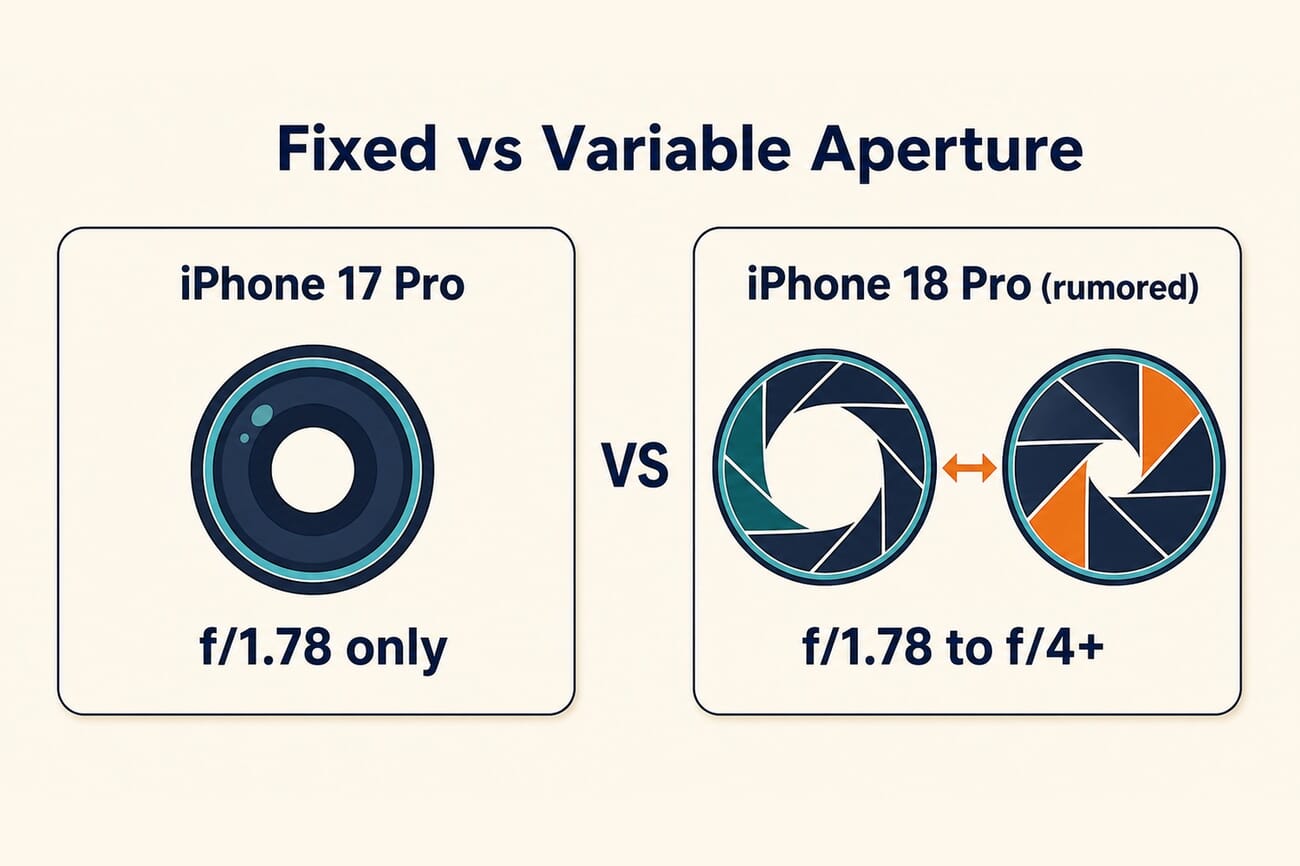
Every earlier iPhone used a fixed aperture. The iPhone 17 Pro main camera sat permanently at f/1.78 and could not close down no matter the light. Both the iPhone 18 Pro and Pro Max now add a mechanical variable aperture to the 48MP Fusion Main camera. Apple built it from six laser-cut blades, each thinner than a human hair, moved automatically by a tiny rotor behind the sapphire lens cover.
The mechanism is the same one inside every real camera lens: a multi-blade iris diaphragm. Overlapping metal blades expand and contract to form a larger or smaller opening, exactly like the pupil of an eye, controlling light physically before any software gets involved. Squeezing that into a phone is hard because of the space the tiny motors need, which is why it took this long. The important detail now that it is confirmed: Apple’s version is not continuous. It steps between four fixed settings, f/1.48, f/1.8, f/2.8, and f/4, on the main camera only. That is wider open than the old f/1.78 and, for the first time, able to stop down to f/4. The camera defaults to around f/1.8 for portraits and opens or closes automatically, and you can also set it by hand across the main camera’s 1x, 1.2x, 1.5x, and 2x framings.
What Variable Aperture Actually Does for Your Photos
This is where it gets genuinely exciting, because a variable aperture unlocks creative control that phones have only ever faked. Three things change.

Real depth of field. Wide open, the camera gives you shallow focus and genuine background blur. Stopped down, it keeps more of the scene sharp, front to back. Today’s iPhones simulate this with Portrait mode, which analyzes the scene and paints in blur, an effect that still stumbles on hair, glasses, and busy edges. An optical aperture does the real thing, with none of the tell-tale software artifacts. If depth of field is new to you, our guide to wide vs narrow aperture explains exactly what changes.
Better bright-light exposure. A fixed f/1.78 lens is always drinking in maximum light, which forces very fast shutter speeds and can clip highlights on a sunny day. Being able to stop down to f/4 gives cleaner daylight exposures and more flexibility, the same reason real-camera shooters close down outdoors. Our smartphone exposure guide covers how to think about this on a phone.
Rounder, softer bokeh. The six-blade iris shapes out-of-focus highlights into smoother, more circular bokeh “balls” rather than the harder polygonal shapes a cheaper iris produces. It is a subtle, aesthetic upgrade that serious portrait shooters will notice, though, as the reviews below make clear, the small sensor keeps the overall effect gentle.
The Rest of the Camera System
Around the headline feature, the rest of the camera system is a refinement of the iPhone 17 Pro rather than a teardown. It keeps three 48MP Fusion sensors, a main, an ultra-wide at f/2.2, and a telephoto that reaches up to 8x optical-quality across the usual focal-length range, plus macro. The variable aperture works across the main camera’s 24mm (1x), 28mm (1.2x), 35mm (1.5x), and 48mm (2x) framings, but not on the ultra-wide or telephoto. Together that makes the 18 Pro Max the most capable iPhone camera Apple has shipped, and the one the folding iPhone Duo deliberately steps behind.
Beyond the Camera: What Else Is Coming
The non-camera specs round out the picture, and here the pre-launch read held up well. A more efficient 2nm A20 Pro chip pairs with a power-sipping display, and in testing the Pro Max turned in the longest battery life of any iPhone to date, enough to win plaudits in lab reviews. The extra RAM feeds the on-device Apple Intelligence features in iOS 27, and the lineup arrived in a refreshed set of finishes.
The less welcome news is price, though it came in gentler than feared. Apple raised the Pro line by $100, not the $200 some analysts predicted: the iPhone 18 Pro starts at $1,199 and the Pro Max at $1,299, and the folding iPhone Duo sits well above at $1,999. The best iPhone camera is still the most expensive non-folding one, part of a broader pattern of climbing camera-gear prices we have tracked all year.
How It Actually Performs
Now the honest part, because the reviews are in and the verdict is more nuanced than the keynote suggested. The good news first: the bokeh is real. Shooting the 18 Pro at f/1.48, the Irish Examiner found that where the older iPhone’s background blur “is largely a digital trick through Portrait Mode,” the new optical aperture “provides a natural, optical bokeh” that “looks much more real.” That is the headline win, genuine in-glass falloff instead of software cutouts that stumble on hair and glasses.
The caveat is physics. A phone sensor is tiny, so even wide open at f/1.48 the depth of field is far shallower on paper than it is in practice. Luminous Landscape summed it up: the variable aperture is “a useful tool with some limits,” and “the same f-numbers mean far less blur than a full-frame shooter expects.” ZDNET was blunter, noticing a real depth-of-field shift only when the subject was close. In other words, do not expect the creamy separation of a 50mm f/1.4 on a mirrorless body. What you get is subtler.
So where does it actually earn its keep? Three places. Low light, where the camera can sit wide at f/1.48 and automatically manage depth of field for cleaner night shots and video. Bright daylight, where stopping down to f/4 tames highlights and gives you a slower, more cinematic shutter. And manual control, for the enthusiast who finally wants to choose an aperture on a phone rather than let an algorithm fake it. One footnote from hands-on coverage: the six-blade mechanism is hair-thin and intricate, so it is worth protecting the phone from hard drops. The variable aperture is a genuine, meaningful upgrade, it is just a photographer’s tool, not a magic bokeh button. It fits the broader camera-phone shake-up we covered around OnePlus leaving the US and the Xiaomi flagships Americans cannot easily buy.

Frequently Asked Questions
What is a variable aperture on a phone camera?
It is a mechanical system of overlapping metal blades (an iris diaphragm) that physically changes the size of the lens opening, controlling how much light reaches the sensor. Earlier iPhones used a fixed f/1.78 opening. The iPhone 18 Pro main camera now steps between f/1.48 and f/4, giving real optical control over exposure and depth of field.
Does the iPhone 18 Pro have variable aperture?
Yes. Both the iPhone 18 Pro and iPhone 18 Pro Max ship with a variable aperture on the 48MP Fusion Main camera, confirmed at Apple’s September 2026 event. It uses a six-blade iris and steps between four settings, f/1.48, f/1.8, f/2.8, and f/4. Only the main camera has it; the ultra-wide stays at f/2.2.
How would this be different from Portrait mode?
Portrait mode simulates background blur with software, analyzing the scene and painting in a blur that can struggle with hair, glasses, and complex edges. A variable aperture produces real optical blur in the lens itself, with no software artifacts, plus genuine exposure control that Portrait mode does not offer. In practice reviewers note the effect is subtler than a big-sensor camera because the phone sensor is small, so it is cleaner and more natural rather than dramatically shallower.
When does the iPhone 18 Pro come out and how much will it cost?
They were announced on September 9, 2026 and went on sale September 18. Apple raised prices by $100 over the previous generation: the iPhone 18 Pro starts at $1,199 and the iPhone 18 Pro Max at $1,299 in the US.
The Bottom Line
Strip away the spec-sheet noise and one feature stands out: the iPhone 18 Pro finally gives phone photographers a real, mechanical aperture, the single biggest step toward camera-like control an iPhone has taken. Now that the reviews are in, the honest verdict is that it delivers genuine optical bokeh and real exposure control, but the small sensor keeps the depth-of-field effect modest, so treat it as a serious tool rather than a magic bokeh button. The chips and batteries and prices are confirmed. The aperture is still the part worth caring about, and it is the right reason to choose the Pro over the folding Duo if image quality is your priority.
Based on Apple's official iPhone 18 Pro announcement and specifications from September 9, 2026, plus hands-on reviews published in September and October 2026. Verified as of October 22, 2026.
Primary Coverage
- Apple: iPhone 18 Pro and iPhone 18 Pro Max – Official variable-aperture 48MP Fusion Main camera, chip, battery, and pricing.
- AppleInsider – iPhone 18 Pro's variable aperture is incredible, but looks fragile – Six laser-cut blades, rotor mechanism, f/1.8 portrait optimization, durability note.
- Luminous Landscape – The iPhone 18 Pro Gets Real Aperture Blades – Photography verdict: a useful tool with limits, far less blur than full-frame.
- Irish Examiner – iPhone 18 Pro review: is the variable aperture worth it – Real-world note that f/1.48 gives natural optical bokeh versus Portrait mode.
- GSMArena – Apple iPhone 18 Pro review: Camera – Variable-aperture sample images at f/1.48 and f/1.8, confirmed stops and framings.
Image Sources
- Christopher Campbell – shallow depth-of-field portrait – Shot at f/1.8, 50mm. Via Unsplash, curated on SampleShots.
- PhotoWorkout – aperture concept image, comparison and spec-sheet infographics, and pin – Original PhotoWorkout editorial illustrations. The featured image is a concept illustration of an iris diaphragm.