


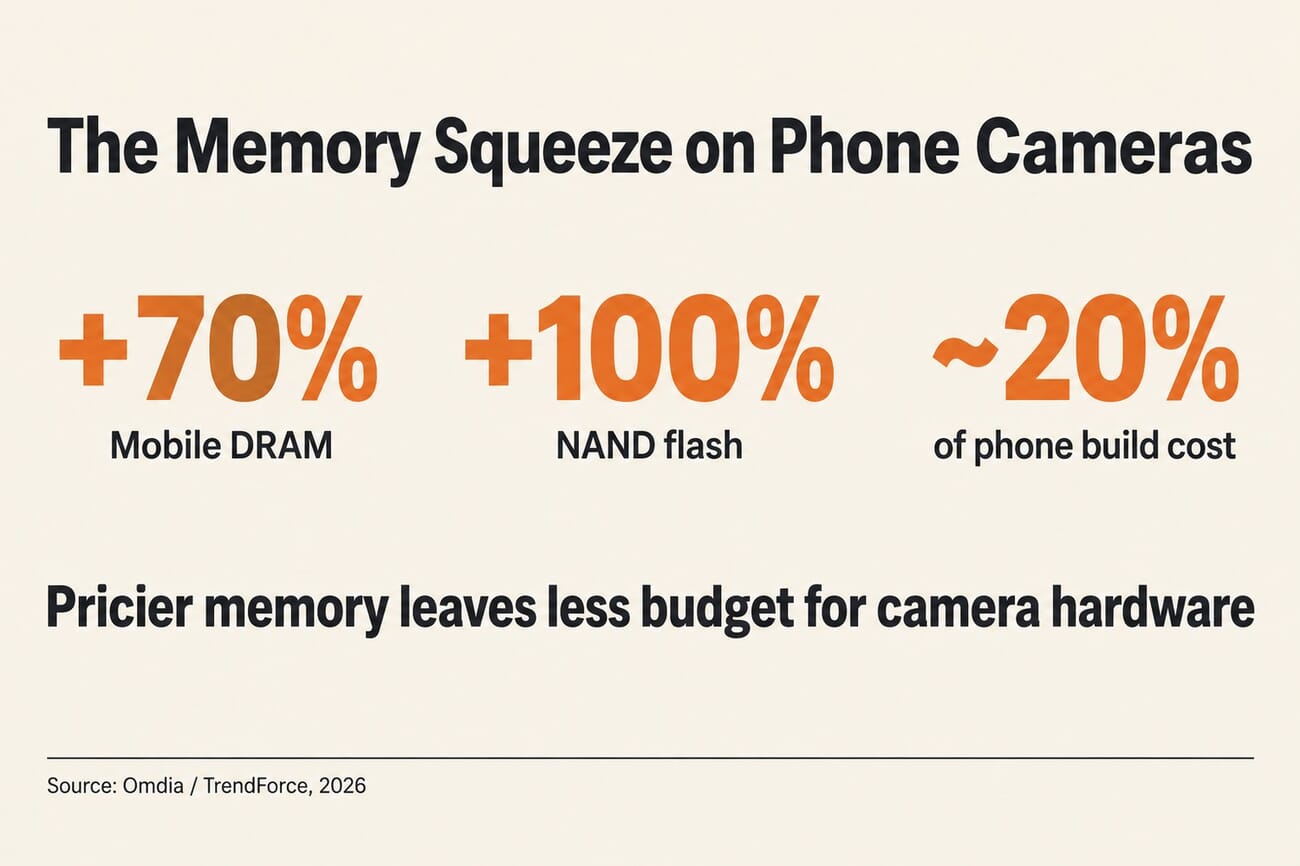
- The 2026 memory shortage has reached the camera. Mobile DRAM and NAND prices have jumped sharply, memory now accounts for roughly a fifth of a phone’s build cost, and that leaves less budget for expensive optical camera hardware.
- The brands are visibly splitting. Samsung is reportedly reshuffling the Galaxy S27 Ultra’s zoom cameras, while Google’s Pixel 11 Pro shipped with a physically larger 5x telephoto sensor, doubling down on real glass.
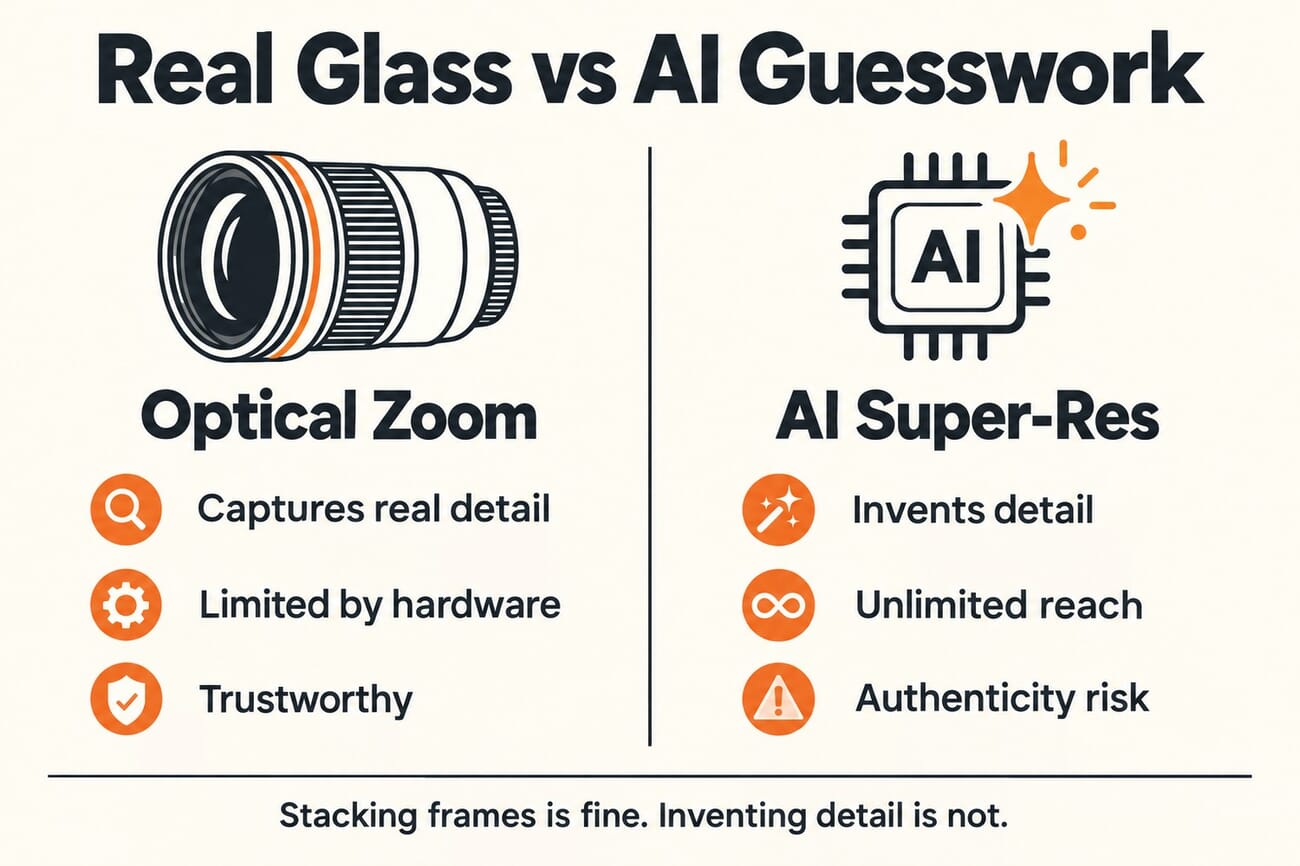
- To cover the gap, phones increasingly lean on AI super-resolution to fake reach. There is a real line here: stacking multiple frames to enhance captured light is fine; inventing detail that was never there, the ‘fake moon’ problem, is fabrication.
- That raises an authenticity question the spec sheets ignore: when does computational zoom cross into AI manipulation under rules like the EU AI Act, and could Content Credentials flag which detail was captured versus invented?
There is a quiet trade happening inside your next phone, and it affects how far you can really zoom. The global memory shortage of 2026 has pushed the price of the chips every phone needs through the roof, and that cost has to come out of something. Increasingly, it is coming out of the camera, specifically the expensive optical hardware that lets a phone zoom with glass instead of guesswork.
The result is a split screen across the industry. Some flagships are trimming their telephoto cameras and leaning harder on AI to reconstruct the detail that optics used to capture; others are spending more on bigger sensors and real glass. For photographers, that split points at an uncomfortable question: when your phone shows you a crisp faraway subject, are you looking at a photograph of what was there, or a confident AI guess about what probably was?
The memory crisis has reached your camera
The numbers are stark. According to market researchers Omdia and TrendForce, mobile DRAM prices have risen more than 70 percent and NAND flash more than 100 percent in a short span, and separate analysis puts memory at around 20 percent of a smartphone’s total manufacturing cost. One estimate has the typical phone’s bill of materials rising about 25 percent in 2026 because of the crunch, with some makers even weighing a return to 4GB RAM on entry-level models. We have tracked the same squeeze hit storage buyers directly, with memory-card prices leaping as NAND climbed.
When the memory bill balloons, the camera module is an obvious place to economize, because a large telephoto sensor and a periscope zoom assembly are among the priciest parts of a phone. It compounds a camera-supply picture already under strain from the upheaval in image-sensor manufacturing. The worrying version of this trend is a first for consumer tech: your next phone’s zoom could be optically worse than your last one’s, with software asked to paper over the difference.
Two flagships, two directions
Nothing illustrates the split better than the two biggest Android names heading opposite ways. Google’s Pixel 11 Pro shipped with a physically larger 5x telephoto: a 48-megapixel sensor that reportedly grew from a 1/2.51-inch to a roughly 1/1.95-inch size, gathering around 30 percent more light at the same f/2.8 aperture. That is a clear bet on real optics, more glass and more sensor to capture genuine detail at distance.
Samsung appears to be going the other way, though the picture is messy and worth stating carefully, because the Galaxy S27 Ultra is not expected until around January 2027 and everything here is a leak. Early rumors that Samsung would replace both the 3x and 5x telephoto cameras with a single new 4x, f/1.9 unit have since been debunked: the well-known leaker Ice Universe said the 4x sensor was an abandoned internal prototype, and that the S27 Ultra will keep the same 50MP 5x periscope as the S26 Ultra. The live report now, from outlets like Android Police and 9to5Google, is that Samsung may drop the older 3x telephoto entirely, taking the Ultra from four rear cameras to three. Critics frame that as losing the versatile mid-range zoom most people actually use for portraits while keeping the long reach, others argue a single stronger telephoto plus software is the smarter use of a tight budget. Either way, treat the specifics as provisional until Samsung announces.
When zoom stops being a lens
Here is where photographers should pay attention, and where it is easy to overstate the problem. Not all computational photography is suspect. Stacking several frames to reduce noise, aligning and merging exposures, demosaicing and sharpening, these all work on light the sensor genuinely captured, and they are the reason modern phone photos look as good as they do. That is enhancement, not fabrication.
The problem is the next step: generative super-resolution that invents detail the optics never resolved. The canonical example is Samsung’s “Space Zoom” moon controversy, when the phone was shown to paste convincing lunar texture onto a blurry blob rather than resolve it. As flagships cut optical reach and lean harder on AI to fill the gap, that fabrication risk grows, and the resulting image is less a record than a plausible reconstruction. It is the same authenticity fault line we covered when AI-generated images fooled millions and had to be told apart from the real thing, now baked quietly into the camera app.
The disclosure question nobody’s answering
This is the turn the spec-sheet coverage misses. If a phone reconstructs the detail in your zoom shot, is that an edited photo, or an AI-manipulated one? The distinction has teeth now: the EU’s AI-labeling rules require disclosure for certain AI-manipulated media, and it is genuinely unclear where aggressive on-device super-resolution lands on that line. The cleaner long-term answer is provenance: Content Credentials (C2PA) could, in principle, record how much of an image was optically captured versus computationally generated, letting a viewer see whether that crisp distant bird was photographed or inferred. Right now, no phone maker discloses that at the pixel level, and the memory crunch is pushing the industry toward more inference, not less.

Frequently Asked Questions
Is the memory shortage really affecting phone cameras?
Indirectly but meaningfully. Memory now accounts for roughly 20 percent of a phone’s build cost after DRAM and NAND price spikes, which squeezes the budget for expensive parts like large telephoto sensors and periscope zoom modules. Some makers are trimming camera hardware and leaning more on software to compensate.
Is the Galaxy S27 Ultra losing its zoom camera?
It is unconfirmed. The S27 Ultra is not expected until around January 2027. Current leaks suggest Samsung may drop the older 3x telephoto while keeping the 5x periscope; an earlier rumor about a single new 4x camera replacing both was debunked as an abandoned prototype. Treat all of it as provisional.
What is the difference between optical zoom and AI zoom?
Optical zoom uses lenses and sensor to capture real detail at distance. AI “zoom,” or super-resolution, uses software to upscale and, in some cases, invent detail the optics never resolved. Enhancing captured light is fine; generating detail that was never there is where it becomes a fabrication concern.
How can I tell if my phone’s zoom photo is real?
It is hard today, because phones do not disclose how much was computed. Extreme zoom (beyond the optical range), suspiciously crisp texture on far subjects, and identical detail across shots are red flags. Longer term, provenance standards like Content Credentials aim to record captured-versus-generated detail.
The bottom line
The memory crisis is doing something subtle and important: it is changing what a phone photo even is. As optical hardware gets squeezed out of the budget, the temptation to fake reach with AI grows, and the gap between a photograph and a reconstruction narrows. Google is resisting with bigger glass; Samsung, reportedly, is consolidating and trusting software to fill in. Neither approach is wrong on its face, but both make the same question more urgent. The spec sheets will keep advertising zoom in multiples. The honest number, how much of that reach is lens and how much is guess, is the one nobody is printing yet.
Primary Coverage
- Wccftech: Mobile DRAM and NAND prices up 70% and 100%; memory ~20% of smartphone cost – Memory price spikes and their share of phone manufacturing cost.
- Android Police: Galaxy S27 Ultra could lose its 3x zoom camera – The current S27 Ultra telephoto reshuffle leak.
- 9to5Google: Samsung Galaxy S27 Ultra telephoto camera report – Reporting on the Ultra's rumored camera changes.
- PhotographyTalk: Pixel 11 Pro camera upgrades – The Pixel 11 Pro's larger 5x telephoto sensor.
- The Verge: Samsung caught faking zoom photos of the Moon – The 'Space Zoom' moon-detail fabrication controversy.
Image Sources
- Concept illustration and infographics: PhotoWorkout – Original PhotoWorkout editorial graphics.