

- Germany’s Federal Court of Justice (BGH) will announce its decision in Kneschke v. LAION (I ZR 281/25) on December 17, 2026. It is the first time Germany’s highest civil court has taken up whether building an AI-training dataset from copyrighted photos is legal.
- Two Hamburg courts sided with LAION. The appeal court ruled that photographer Robert Kneschke’s opt-out did not count because he had not shown it was machine-readable when his photo was copied in 2021.
- December 17 is a decision date, not necessarily a verdict. Observers of the September hearing expect the BGH to send key questions to the EU Court of Justice, which could take another year or more.
- The law in question comes from an EU directive, so the eventual answer will shape AI training rules across all 27 member states. It is not binding in the US, where Andersen v. Stability AI is still heading to trial.
- Photographers can act now: reserve AI-training rights in machine-readable form on websites (robots.txt, TDMRep) and in files (IPTC Data Mining field, Content Credentials), and keep dated records.
Every photographer who has ever posted work online has asked the same question since the AI image boom began: can a company copy your photos to train its models without asking? In Germany, that question now has a date. On December 17, 2026, the Federal Court of Justice in Karlsruhe will announce its decision in the case of a Hamburg stock photographer against the group that built one of the best-known AI training datasets in the world.
The outcome may not be the clean answer photographers want. But the case has already exposed the detail that decides almost everything: an opt-out written for humans may not count when the reader is a machine. Here is what the case is about, what can realistically happen in December, and what you can do about your own photos today.
What Kneschke v. LAION Is About
Robert Kneschke is a German stock photographer. LAION is a non-profit association based in Hamburg that publishes open datasets for AI research. Its best-known product, LAION-5B, links about 5.85 billion images on the web to their text descriptions. Datasets like it were used to train image generators such as Stable Diffusion.
LAION does not host the images itself. To build the dataset, though, it downloaded images in 2021 to check automatically whether each picture matched its description. One of those images was a Kneschke photo, which a stock agency offered on its website with terms of use that reserved rights against automated use. Kneschke sued over that copy.
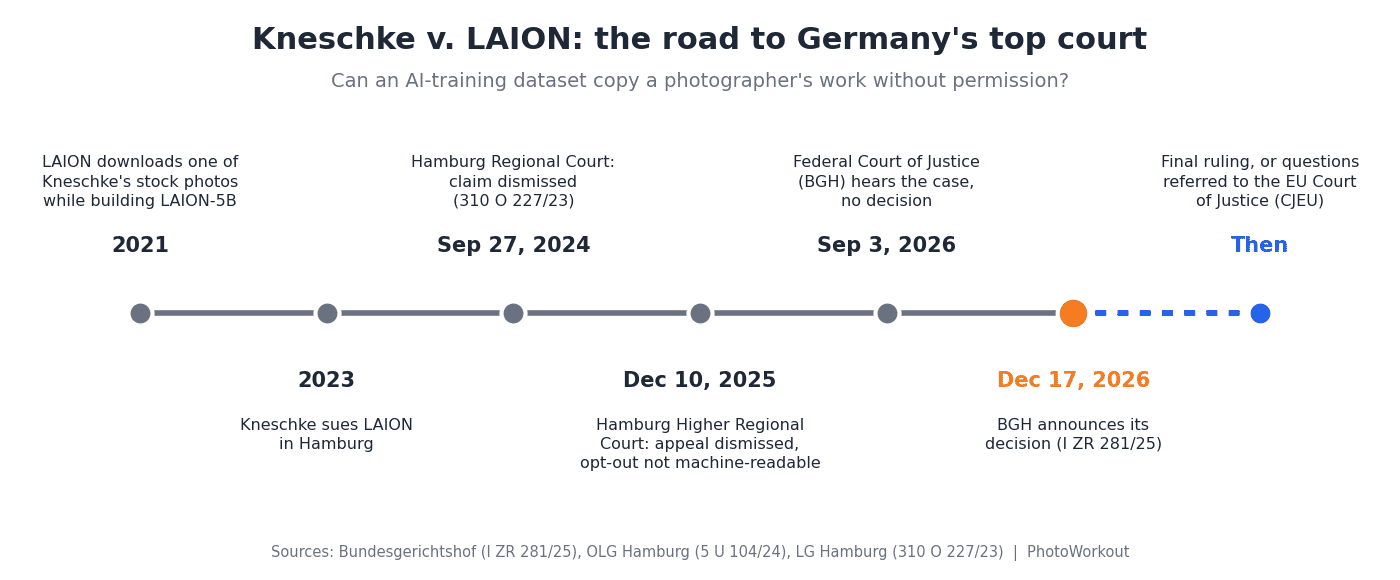
He lost twice. The Hamburg Regional Court dismissed the claim on September 27, 2024 (310 O 227/23). The Hanseatic Higher Regional Court in Hamburg rejected his appeal on December 10, 2025 (5 U 104/24), but allowed a further appeal because the legal questions are of fundamental importance. The Federal Court of Justice heard the case on September 3, 2026, and decided nothing that day. Its own case notice now lists December 17 at 8:45 a.m. for the announcement.
Why Machine-Readable Is the Whole Fight
German copyright law, implementing the EU’s 2019 Digital Single Market directive, contains two exceptions for text and data mining. The Hamburg appeal court applied both, and the difference between them matters for every photographer.
- Section 60d, for scientific research. Research organizations may mine works for research. Rights holders cannot opt out of this exception. The Hamburg court treated LAION as a research organization, even though commercial AI companies can use its free datasets.
- Section 44b, for everyone else. Anyone may mine lawfully accessible works, including commercial companies, unless the rights holder has reserved those rights. For works published online, the law says the reservation must be machine-readable.
That second rule is where Kneschke’s case faltered. According to the court’s case summary, the appeal court found he had not shown that his reservation was machine-readable when the copy was made in 2021. His terms of use were written in plain language, which a person can read but software cannot reliably understand. Heise reported that the judges also held that being able to match images with captions does not mean a program can interpret pages of legal terms.
LAION’s lawyer, Joerg Heidrich, said after the hearing that the question of whether a reservation must be understood by a machine to take effect is of particular practical importance for opt-out systems. The photographers’ association BFF, which followed the hearing, wants the opposite principle entirely. Its board member Ilan Hamra put it this way: consent is needed beforehand, not an objection afterward.
What Can Happen on December 17
A decision date at the Federal Court of Justice does not guarantee a final ruling. The court can do one of two things.
- Decide the case itself. It could confirm the Hamburg courts, or overturn them and send the case back. Either way, German law on AI training data would have its first top-court answer.
- Refer questions to the EU Court of Justice. Because both exceptions come from EU law, the court can ask the Court of Justice in Luxembourg how Articles 3 and 4 of the directive should be read, and pause the German case until it answers.
Reports from the hearing point to the second option. According to accounts based on FAZ and dpa coverage, published by the BFF and the Initiative Urheberrecht, the senate signaled that it is likely to refer questions to Luxembourg, because the law does not clearly answer them. LAION’s lawyers also noted that the presiding judge raised that possibility. Nothing is decided until December 17, but photographers should be prepared for a referral rather than a final word.
A referral would mean more waiting, typically well over a year. It would also raise the stakes: an answer from the EU Court of Justice would apply in every member state, not just Germany.
What It Means Beyond Germany
For photographers in the rest of Europe, this case is closer to home than it looks. The rules at issue come straight from the EU directive, and the EU AI Act already requires providers of general-purpose AI models to follow a copyright policy that respects machine-readable reservations. A ruling from Luxembourg would tell those companies, and the courts, what a valid reservation looks like.
For US photographers, the case is persuasive, not binding. American courts decide AI training under the fair use doctrine, and the most closely watched image case, Andersen v. Stability AI, is still in discovery after its trial date slipped into 2027. If you sell through agencies, the stock business is already under pressure, as the Getty Images restructuring shows, and AI training rights are increasingly part of licensing deals.
It is also a different question from the one decided in Düsseldorf earlier this year. That case was about whether an AI-restyled copy of a photo infringed copyright, covered in the German ruling on AI copies. Kneschke v. LAION is about the step before: whether your photo can be copied into a training dataset at all.
How to Reserve Your Rights Today
Whatever the court decides, the Hamburg ruling has already shown what a court looks for: a reservation that software can read, and proof that it existed at the time of copying. None of these measures forces an AI company to comply, but together they give you the strongest position the law currently recognizes.
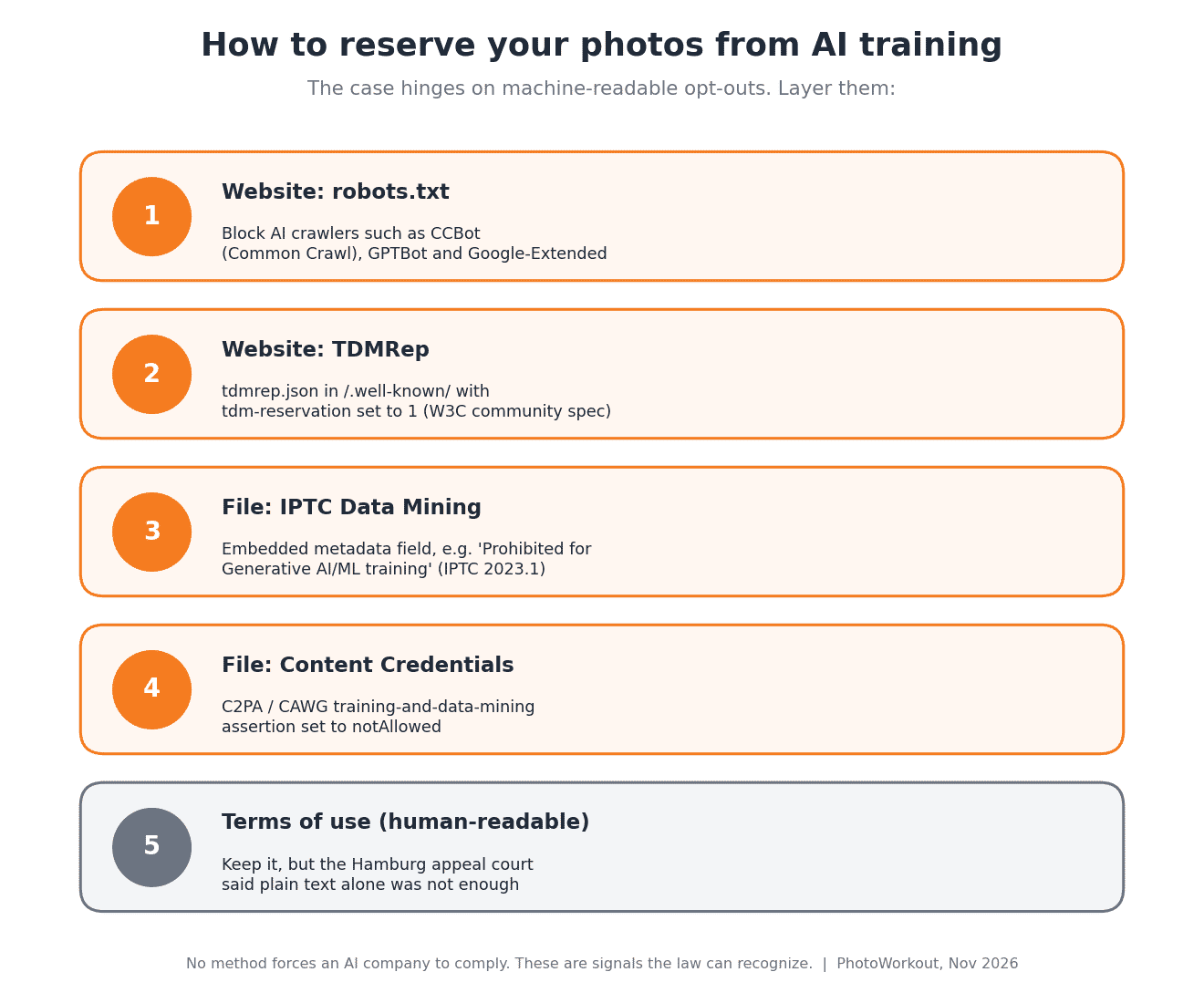
- Block AI crawlers in robots.txt. Add rules for crawlers such as CCBot (Common Crawl, the source of the web addresses behind LAION-5B), GPTBot and Google-Extended. This only stops future crawling, not copies already made.
- Publish a TDMRep file. The TDM Reservation Protocol lets you place a tdmrep.json file in your site’s /.well-known/ folder with tdm-reservation set to 1. It was written for exactly this European opt-out, though it is a W3C community specification, not an official standard.
- Set the IPTC Data Mining field. Since the IPTC Photo Metadata Standard 2023.1, files can carry a Data Mining value such as Prohibited for Generative AI/ML training. It travels with the file wherever it is copied, unless someone strips the metadata.
- Add Content Credentials. The C2PA and Creator Assertions Working Group format includes a training and data mining assertion that can be set to notAllowed, signed into the file. The same Content Credentials technology faces its own challenges, as shown in the C2PA forgery story.
- Keep your terms, and keep records. A plain-language notice is still useful, but on its own it may not be enough. Take dated screenshots or archive copies of your robots.txt, TDMRep file and terms, because in court you may need to prove when your reservation was in place.
Platforms matter too. Photographers have won some of these fights by public pressure rather than in court, as when Meta dropped its Instagram AI photo grab after three days. And if you publish in the EU, labeling rules for AI images are tightening as well, as explained in the EU AI Act Article 50 guide.
Frequently Asked Questions
When will the Federal Court of Justice decide Kneschke v. LAION?
The court has scheduled the announcement for December 17, 2026, at 8:45 a.m. in Karlsruhe, under case number I ZR 281/25. The oral hearing took place on September 3, 2026.
Will the court decide whether AI training is legal?
Not necessarily. Reports from the hearing suggest the court is likely to refer questions to the EU Court of Justice. In that case, December 17 would bring a referral rather than a final answer. The case is also narrower than AI training in general: it concerns building a dataset, not training a model.
Why did Robert Kneschke lose in Hamburg?
Both Hamburg courts found that LAION’s copying was covered by text and data mining exceptions. The appeal court held that his reservation of rights did not count because he had not shown it was machine-readable when the photo was copied in 2021, and that the research exception applied in any case.
Does a ruling in Germany affect photographers in the US?
Not directly. US courts decide these cases under fair use. A German or EU ruling could still influence how global AI companies handle opt-outs, because they operate in Europe too.
How can I stop AI companies from training on my photos?
No method guarantees it. The strongest current approach is to combine machine-readable signals: robots.txt rules for AI crawlers, a TDMRep file on your website, the IPTC Data Mining field in your files, and Content Credentials with a do-not-train assertion, plus dated records of when you set them up.
Bottom Line
December 17 is the most important date yet for photographers in the fight over AI training data, but probably not the end of it. Whether the Federal Court of Justice rules or hands the questions to Luxembourg, the lesson from Hamburg already stands: a reservation only a human can read may not protect you. Make your opt-out machine-readable now, keep proof of when you did it, and watch Karlsruhe in December.
Case details were checked against the Federal Court of Justice's own case notice and reporting from the September 3, 2026 hearing, as of November 8, 2026.
Court Sources
- Bundesgerichtshof: case notice I ZR 281/25 – Decision date December 17, 2026, lower court rulings and the legal questions
- Heise: Plain-language reservation not sufficient for OLG Hamburg – Reporting on the December 10, 2025 appeal ruling
Hearing Reports
- BFF: Kneschke ./. LAION e.V., what the BGH hearing showed – Photographers' association report and position
- Initiative Urheberrecht: Referral to the CJEU likely – Summary of dpa and FAZ hearing coverage
- Heidrich Rechtsanwälte: LAION press releases – Statements from LAION and its counsel
Opt-Out Standards
- W3C Community Group: TDM Reservation Protocol – tdmrep.json and the tdm-reservation property
- IPTC: Data Mining property – Embedded metadata field for AI training permissions
- Creator Assertions Working Group: Training and Data Mining Assertion – Content Credentials do-not-train assertion
Image Sources
- Sitacuisses via Wikimedia Commons (CC BY-SA 3.0 DE) – Federal Court of Justice building, front view
- Sitacuisses via Wikimedia Commons (CC BY-SA 3.0 DE), featured image – Federal Court of Justice building, cropped to 3:2
- Timeline and opt-out charts: PhotoWorkout – Built from the court records and standards listed above
- Pin illustration: created with GPT-Image-2.6 – Stylized PhotoWorkout illustration