


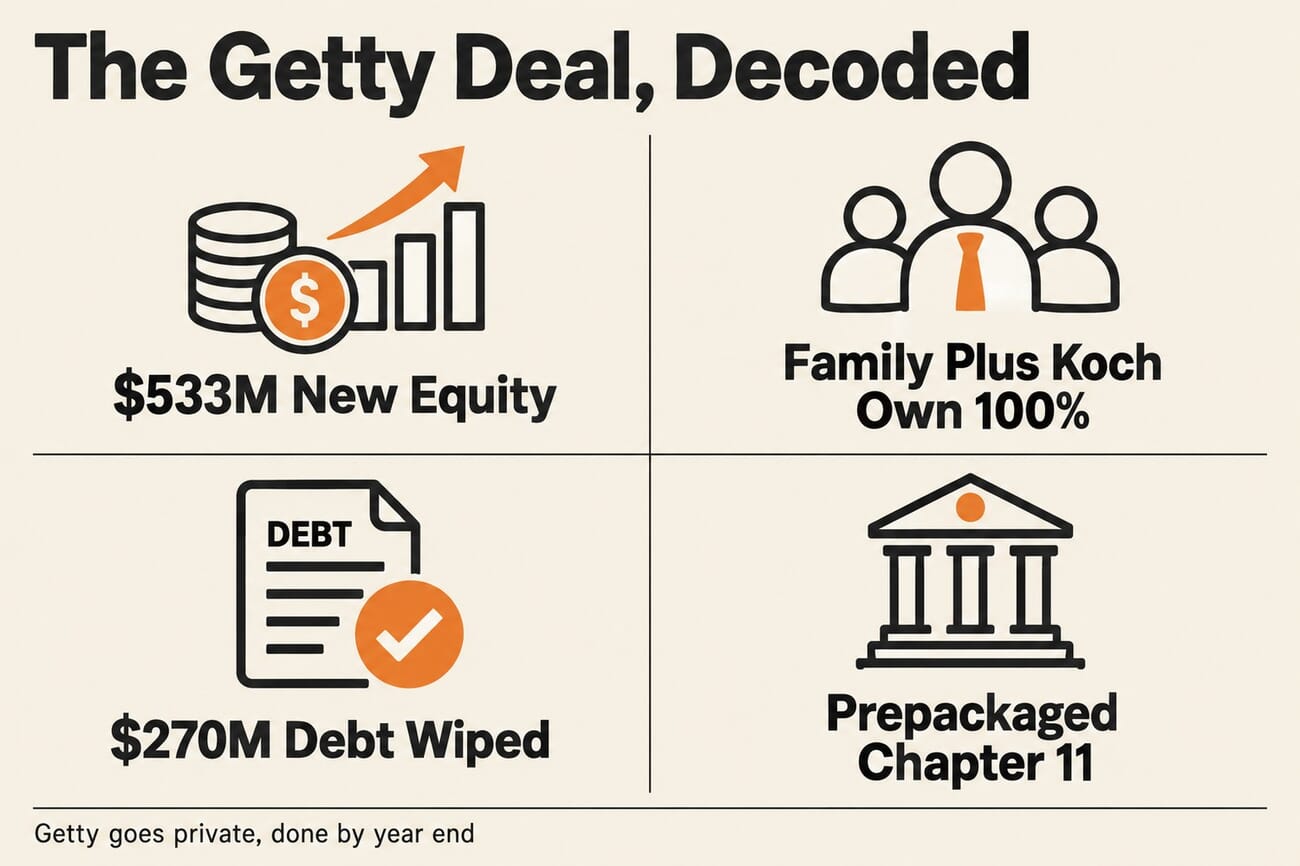
- Getty Images will go private through a prepackaged Chapter 11 restructuring, with the Getty family and Koch Equity Development committing up to $533 million in new equity to own 100 percent of the company.
- The filing covers certain US entities only and is designed to wipe about $270 million in unsecured notes and cut interest on secured debt. Getty says operations continue normally.
- Contributors, customers and vendors are unaffected and keep getting paid in the ordinary course, so photographers who license through Getty, iStock and Unsplash+ should see no change to payouts.
- This is a liquidity and legal-liability crunch, not a collapse. A failed Shutterstock merger, two large court judgments and thin cash reserves, not AI alone, pushed Getty to restructure.
Getty Images, the biggest name in licensed photography, is going private through bankruptcy. On October 12, 2026, Getty Images Holdings (OTCPK: GETY) said the founding Getty family and Koch Equity Development would commit up to $533 million in fresh equity to take the company fully private through a prepackaged Chapter 11 restructuring. The word “bankruptcy” sounds alarming for a company whose archive underpins a huge slice of the world’s commercial imagery. The reality is more mundane and more interesting at the same time.
For photographers who sell stock through Getty, iStock or Unsplash+, the headline question is simple: does this touch the money? The short answer is no. Getty says contributors, customers and vendors are unaffected and will be paid in the ordinary course of business. The longer answer, about what a debt-free, family-and-Koch-owned Getty signals for stock photography in the AI era, is where this story actually matters.
What Getty actually announced
Getty is using a prepackaged Chapter 11, which is the fast lane of US bankruptcy. Instead of filing first and negotiating with creditors afterward, the company lined up the deal in advance and will enter court with most of the agreements already signed. That is why Getty expects the process to be complete by the end of 2026 rather than dragging on for years.
The core terms are straightforward. The Getty family and Koch Equity Development (KED), the investment arm of Koch Industries, will put in up to $533 million of new equity and end up owning 100 percent of the business, which stops trading publicly and becomes a private company. Around $270 million in unsecured notes get retired, with roughly 83.5 percent of noteholders already backing the plan. Secured lenders, about 89 percent of them plus every revolving-credit lender, agreed to cut the interest Getty pays and push out the maturities so the company has breathing room. KED is also providing up to $143 million in financing to fund the company through the process.
Crucially, the filing is limited to certain US entities, and Getty has been explicit that day-to-day operations do not change. The websites stay up, licensing continues, and contributors, customers and vendors keep being paid on normal terms. Chief Executive Craig Peters framed it as cleaning up the balance sheet so the company can invest in the business. Co-founder and chairman Mark Getty and KED co-head Mike Harris both cast the move as a long-term commitment rather than a fire sale.
Why the cash ran low
It is tempting to write this up as “AI killed stock photography, so Getty went bust.” That is not what the filings show. Getty’s problem was liquidity, not demand. The company closed the second quarter of 2026 with only about $51.6 million in cash, a thin cushion for a business carrying debt left over from its 2022 return to public markets through a SPAC merger.
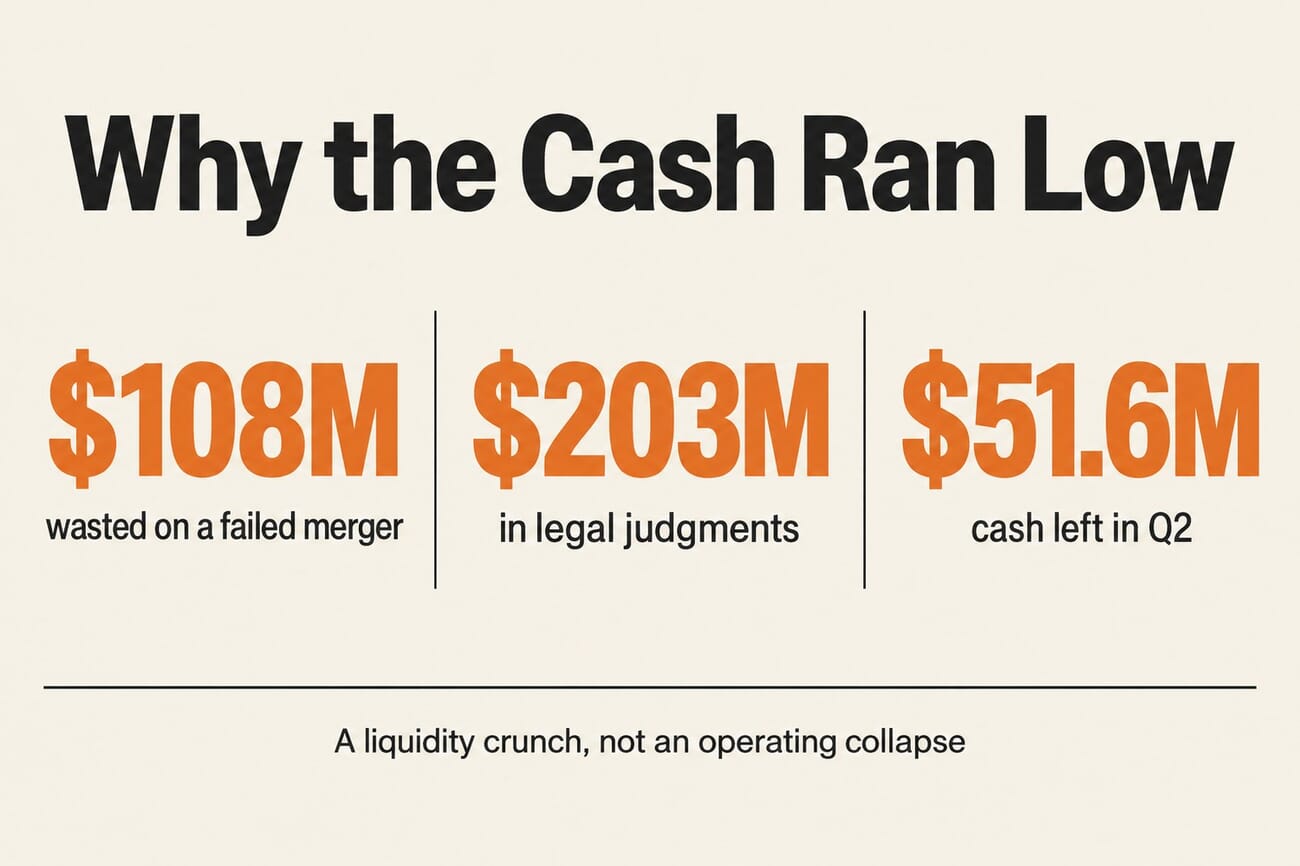
Three things drained that cushion. First, the proposed $3.7 billion merger with Shutterstock fell apart in July 2026 after the UK competition regulator required the sale of Shutterstock’s editorial business as a condition, and the companies walked away. Getty disclosed roughly $108 million in costs tied to that abandoned deal, money spent for no result. Second, Getty faced two large court judgments described in the announcement as “non-operating legal liabilities,” about $110.9 million paid in April 2026 and a further $92.3 million under appeal, roughly $203 million combined. Third, on top of those, the company has been spending to fight its high-profile copyright case against Stability AI in both the US and UK.
Put together, a failed merger, nine-figure legal bills and a slim cash balance left Getty short of runway. The $533 million equity injection and the debt reduction fix exactly that. It is a balance-sheet reset, not an operating collapse, which is why the company can promise contributors and customers that nothing changes for them.
The AI irony sitting underneath
There is a genuine irony here that is worth sitting with. Getty has positioned itself as the champion of licensed, rights-cleared, authentic imagery, the clean alternative to AI models trained by scraping the open web. It is the company that sued Stability AI for allegedly training its image generator on millions of Getty photos without permission. Yet in November 2025 the UK High Court largely rejected Getty’s claims in that landmark case, handing the AI side a significant win, while the US case continues. Now the same company is leaning on a family-and-Koch bailout to stay solvent.
None of that means licensed photography is finished. Getty has also cut licensing deals that pay rights holders when their work trains AI models, and a debt-free Getty has more room to invest in both sides of that equation, defending its library in court and monetizing it for AI training. But the episode is a loud reminder that the economics of stock imagery are under real pressure. When buyers can generate a passable hero image in seconds, the volume at the bottom of the market thins out, and even the dominant player feels it. If you want the bigger picture on how AI is reshaping the tools photographers rely on, our coverage of Adobe’s acquisition of Topaz Labs and the free AI-built Photoshop and Lightroom clones traces the same squeeze from a different angle.
What it means if you sell stock photos
Start with the reassurance, because it is real. In the short term, nothing changes for contributors. Getty, iStock and Unsplash+ keep running, uploads keep flowing, and royalty payments continue on the usual schedule. A prepackaged filing is specifically designed to keep the business operating while the balance sheet is reworked above the operating level, so your next payout should land as normal. There is no action for photographers to take today.
Longer term, read the signal rather than the panic. A Getty owned outright by the family and Koch, free of the public-market debt load and quarterly pressure, can make slower, bigger bets: enforcing licensing against AI firms, striking paid training deals that cut contributors in, and investing in the authenticity and provenance tooling that separates licensed work from scraped work. That is broadly good for serious contributors and bad for anyone relying on high-volume, low-value generic stock, which is exactly the tier AI generation is eating.
The practical takeaway is the one that was already true before this filing: do not build a photo income on one platform or on commodity stock. Diversify across agencies, lean into the distinctive, hard-to-fake work (real people, real places, authentic documentary and editorial imagery), and keep your own records and provenance clean so you can prove a shot is real. That last point is becoming a selling point in itself, as our guide to proving your photos are not AI explains.
Frequently Asked Questions
Is Getty Images going out of business?
No. Getty is using a prepackaged Chapter 11 to restructure its debt and go private, not to shut down. The Getty family and Koch Equity Development are putting in up to $533 million of new equity and will own the company. Getty says operations continue normally and expects the process to finish by the end of 2026.
Will contributors still get paid?
Yes. Getty has stated that contributors, customers and vendors are unaffected and will be paid in the ordinary course of business. The restructuring targets bondholders and lenders at the holding-company level, not the royalties owed to photographers who license through Getty, iStock or Unsplash+.
Did AI cause Getty’s bankruptcy?
Not directly. The immediate causes were a thin cash balance (about $51.6 million at the end of Q2 2026), roughly $108 million spent on the collapsed Shutterstock merger, and about $203 million in legal judgments. AI is a broader headwind on stock-image demand and on Getty’s legal costs, but the filing was driven by liquidity and debt, not by AI replacing its catalog overnight.
What is Koch Equity Development’s role?
Koch Equity Development is the principal investment arm of Koch Industries. Alongside the Getty family, it is funding the up-to-$533 million equity commitment and providing up to $143 million in financing to carry the company through the restructuring. Together they will own 100 percent of a now-private Getty Images.
The bottom line
Getty Images going private through bankruptcy reads worse than it is. This is a funded, pre-agreed reset that wipes debt, extends maturities and hands full ownership to the family and Koch, with operations and contributor payouts untouched. The company that built its brand on licensed, authentic imagery got squeezed by a failed merger, big court judgments and thin cash, not by AI alone. For photographers, the move itself is a non-event for this month’s royalties. The lesson underneath it is not: stock-photo economics are tightening, the distinctive and verifiable work is what holds value, and no single platform is a safe place to park your entire income.
Primary announcement and supporting coverage for this report.