


- Cheap third-party autofocus lenses are now a flood, not a trickle: by one count, third parties released 16 autofocus Fujifilm X lenses in 2026 against Fujifilm’s one.
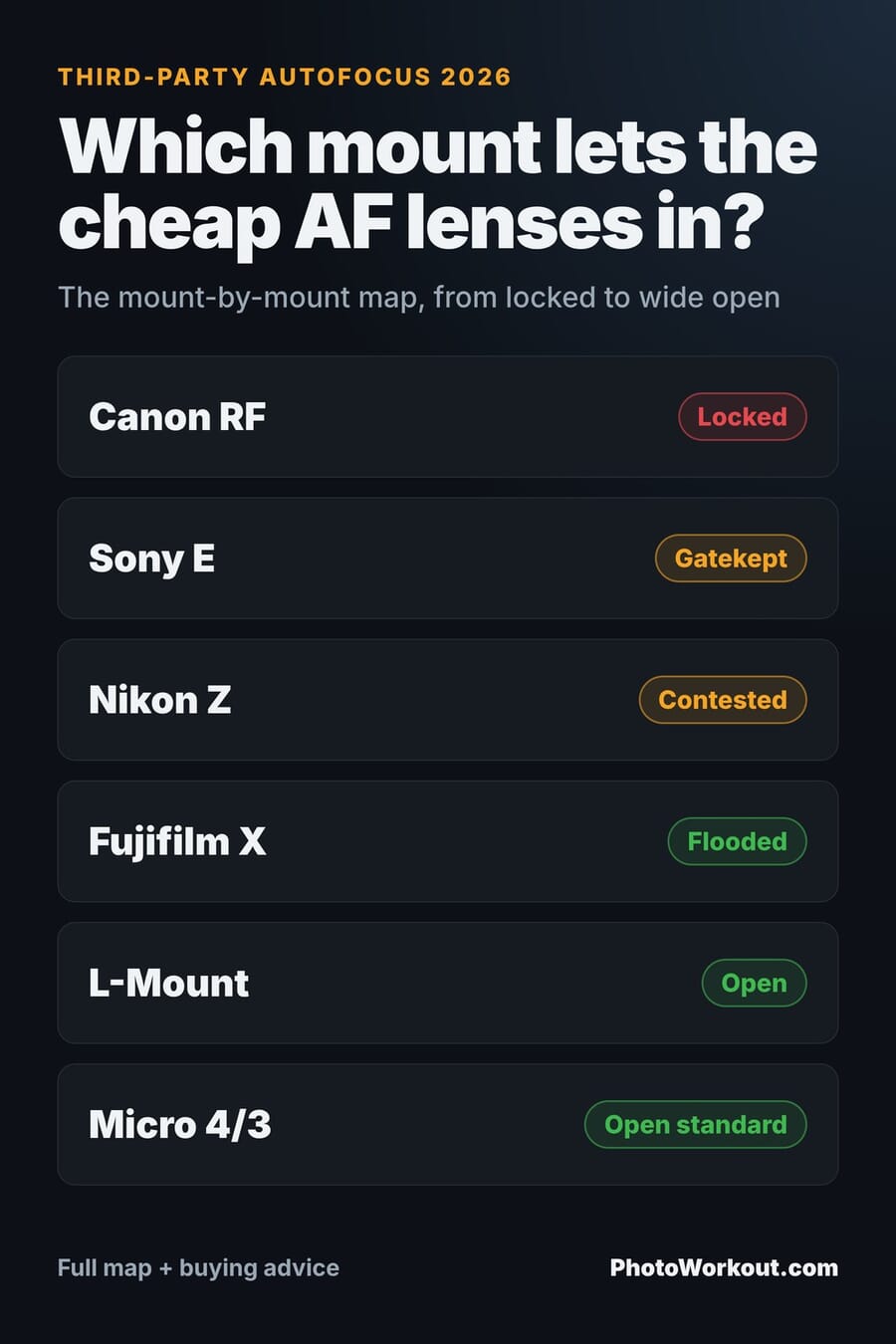
- Each mount has taken a different posture: Canon RF full frame stays locked, Sony gatekeeps with an official partner list, Nikon Z is legally contested, and L-Mount and Micro Four Thirds are open by design.
- Sony published its first official E-mount partner list in July 2026. Sigma, Tamron, Zeiss and Samyang are on it; Viltrox, Laowa, 7Artisans and TTArtisan are not.
- Licensed lenses are built against the official spec. Reverse-engineered ones can misbehave on new bodies until a firmware fix lands, as Viltrox lenses did on the Sony a7 V in December 2025.
- For lenses you plan to keep for years, L-Mount offers the safest legal footing and Sony E the biggest licensed catalog. Treat unlicensed bargains on any mount as shorter-term buys.
Five years ago, autofocus was the moat that kept third-party lenses either expensive or manual. In late 2026 that moat is gone. Viltrox, Thypoch, TTArtisan, 7Artisans and Meike now ship sharp, fast autofocus primes for a fraction of what the camera brands charge, and new ones arrive almost every week. By one count, third parties released 16 autofocus lenses for Fujifilm X this year alone, while Fujifilm released one.
What nobody lays out in one place is that the flood is not hitting every mount the same way. Each camera maker has picked a different posture toward these lenses, from Canon’s locked door to the L-Mount Alliance’s open invitation, and that posture decides how safe a third-party lens is as a long-term buy. This is the map, mount by mount, and what the difference between a licensed lens and a reverse-engineered one actually means for the photographer holding it.
This week added two fresh data points on the two most open mounts: Viltrox showed three native autofocus primes for L-Mount, and Thypoch’s first autofocus prime, the Sculptor 23mm f/1.4 for Fujifilm X, is now on pre-order. Neither lens is the story on its own. The pattern is. It also extends a thread PhotoWorkout has followed all year, from the 35mm Wars to the repair-vs-replace math on $200 lenses.
The 2026 map: six mounts, six postures
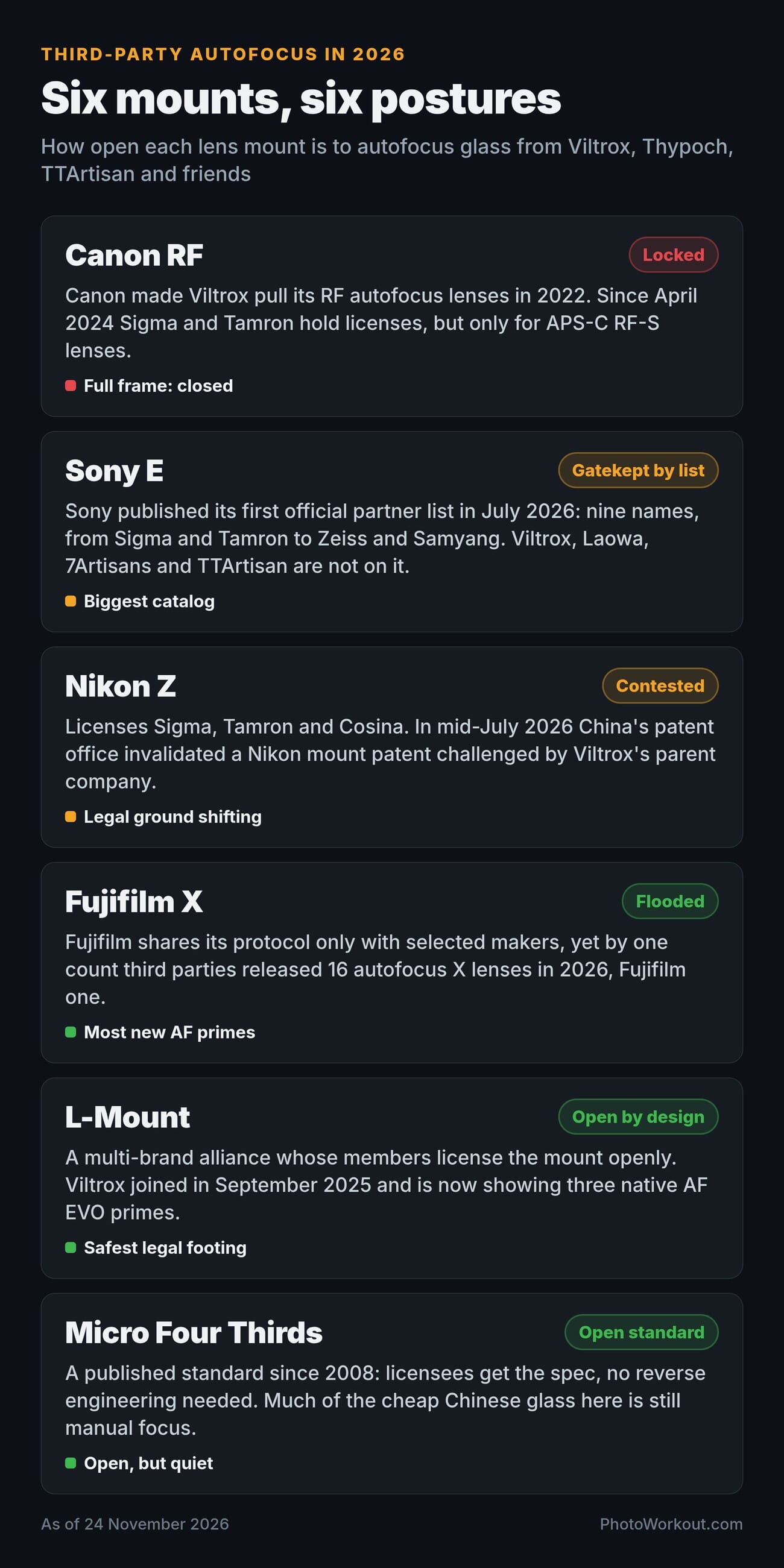
The short version: two mounts are closed or gatekept, one is in legal flux, and three are open, either by design or by sheer volume. The details matter, because “open” means something different on each.
Canon RF: still the most locked mount for full frame
Canon drew the hardest line first. In August 2022, Viltrox stopped making and selling its RF-mount autofocus lenses after Canon threatened legal action, and Canon confirmed the following month that it was pursuing lens makers it considered infringing. Canon never actually took Viltrox to court; the threat was enough.
Canon has opened a side door since. In April 2024 it licensed Sigma and Tamron to make autofocus lenses for its APS-C RF-S line, which is why a lens like Tamron’s 16-50mm f/2.8 can ship for Canon RF at all. Full-frame RF is a different matter: as of November 2026 there is still no licensed third-party full-frame autofocus lens for the mount, and Canon has not said whether that will change.
What it means for you: on a full-frame Canon RF body, your autofocus choices are Canon’s own lenses, licensed APS-C RF-S glass, or adapted EF lenses. A cheap full-frame RF autofocus prime from an unlicensed maker is a short-term bet in the mount where makers have already been forced to stop selling once.
Sony E: gatekept by an official list
Sony took the quietest route for years and then, in July 2026, put it in writing. Its first published list of official E-mount partners has nine names: Carl Zeiss, Cooke Optics, Cosina, Fujifilm, Kenko Tokina, LK Samyang, Sigma, Tamron and Thales LAS France, which makes Angénieux cinema lenses.
The list is as interesting for who is missing. Viltrox, Venus Optics (Laowa), 7Artisans and TTArtisan, the makers behind much of the cheap autofocus wave, are not on it. Their E-mount lenses work because the makers decode the protocol themselves, not because Sony signed off. Sony also signaled where it wants the market to go: in July 2026 Tamron confirmed it had received a non-binding proposal from Sony to make it a wholly owned subsidiary, a story PhotoWorkout covered in what a Sony-Tamron buyout would mean for third-party glass.
What it means for you: Sony E has the biggest third-party catalog of any mount, licensed and unlicensed. The partner list is now the simplest test of how much risk a lens carries. If the brand is on it, the lens was built against Sony’s spec.
Nikon Z: licensed partners, and a patent fight it lost in China
Nikon licenses its Z mount to Sigma, Tamron and Cosina (Voigtländer), and Sigma’s Z lenses say so on the box. It also went after Viltrox, whose own unlicensed Z lenses include the AF 35mm f/1.8 Z and the 35mm f/1.8 EVO APO from April 2026, the same lens family PhotoWorkout put up against Sigma and Nikon in the 35mm Wars. Nikon sued Viltrox in Shanghai in January 2026 over a Chinese patent covering the Z mount’s bayonet and electrical contacts.
Then, in mid-July 2026, China’s patent office ruled on a challenge from Viltrox’s parent company, Shenzhen Jueying, and declared that patent entirely invalid for lacking an inventive step. That decision is narrow: it covers one Chinese patent, Nikon’s other Z patents still stand, it was an administrative invalidation rather than a court verdict, and Nikon had a window to appeal that ran to roughly mid-October. No outcome of an appeal had been reported by late November. Nikon’s only public comment was that it would refrain from details out of respect for the judicial process.
What it means for you: the ruling is widely read as weakening Nikon’s main legal lever against unlicensed Z lenses in China, where most of them are made. It does not make those lenses licensed. For long-term Z buys, Sigma, Tamron and Voigtländer remain the sanctioned options.
Fujifilm X: the mount that flooded first
Fujifilm never published its X-mount protocol. Since 2020 it has said it shares it with selected makers, Sigma, Tamron and Tokina among them. In practice, the X mount has become the busiest destination for third-party autofocus primes of all. A November 2026 tally from the lens database CameraDecision counts 16 third-party autofocus X lenses released in 2026 against one from Fujifilm, the XF 400mm f/4.5, and 64 third-party autofocus X lenses against 11 from Fujifilm between 2022 and October 2026. Treat those as one source’s count, but the direction is not in doubt.
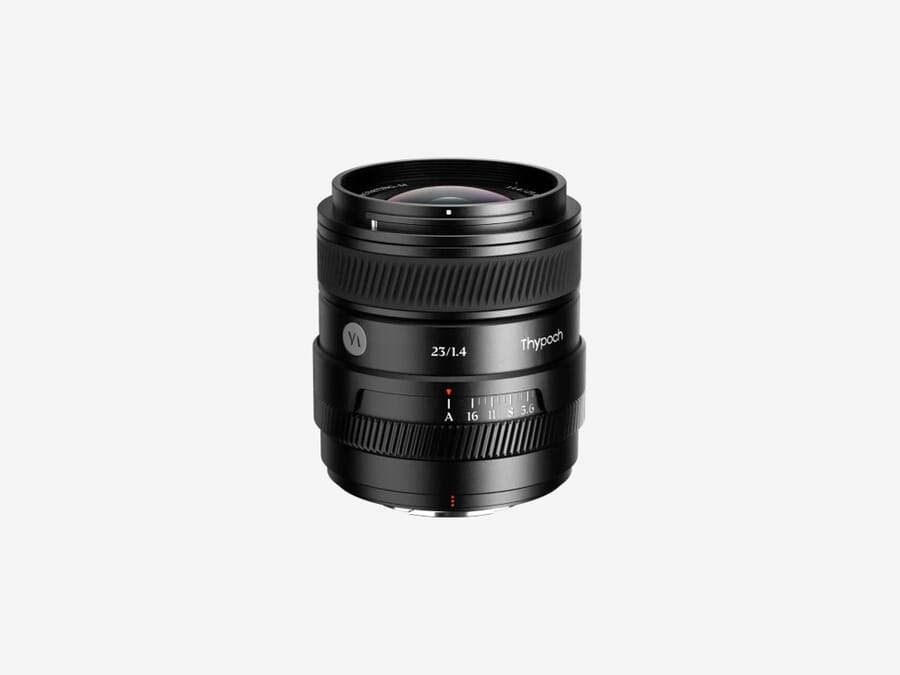
Thypoch’s Sculptor AF 23mm f/1.4 shows how crowded it has become. It is the company’s first autofocus prime (its first autofocus lens was the Voyager 24-50mm f/2.8 zoom for Sony E), it weighs 283 g with a 52 mm filter thread and a physical aperture ring, and it costs $349. By CameraDecision’s count it is the eighth autofocus 23mm at f/1.4 or brighter for the system. It was announced in late October and is on pre-order now, for example at B&H.
What it means for you: on Fujifilm X, choice is no longer the problem. Knowing which lenses come from a maker Fujifilm actually shares the protocol with is.
L-Mount: open by design, and Viltrox is now inside
The L-Mount Alliance was built to be shared: Leica licenses the mount to its members, which include Panasonic, Sigma, Leitz Cine, DJI, Blackmagic Design and Samyang. On September 1, 2025, Viltrox joined as the alliance’s tenth member, making it the first of the budget Chinese autofocus makers to get an official seat in any mount. That membership is over a year old; what is new is the first lenses. On November 19, 2026, L-Rumors reported that Viltrox showed three full-frame autofocus primes for L-Mount: a 35mm f/1.8 EVO, a 55mm f/1.8 EVO and an 85mm f/2.0 EVO. The 35 and 55 already launched for Sony E and Nikon Z in April, part of the lineup Viltrox first previewed at NAB 2026. There is no price or release date yet.
The same report says, citing unnamed sources, that Viltrox has official Leica authorization. Treat that as a rumor: neither Leica nor Viltrox has said so, although alliance membership already implies a mount license from Leica.
What it means for you: for Panasonic Lumix, Leica and Sigma shooters, a Viltrox L-Mount lens will be a licensed lens from a member company, not a reverse-engineered one. That is the cleanest legal footing any budget autofocus lens has had so far.
Micro Four Thirds: an open standard that the flood mostly skipped
Micro Four Thirds has been an open standard since Olympus (now OM System) and Panasonic launched it in 2008. Licensees receive the specification, so nobody has to reverse-engineer anything, and Sigma’s compact Contemporary primes are a long-running example. The budget Chinese makers have been slower to bring autofocus here, which is why Viltrox’s first-ever Micro Four Thirds autofocus lenses were news in July 2026. Much of the cheap glass for the system is still manual focus.
Licensed vs reverse-engineered: what the label actually buys you
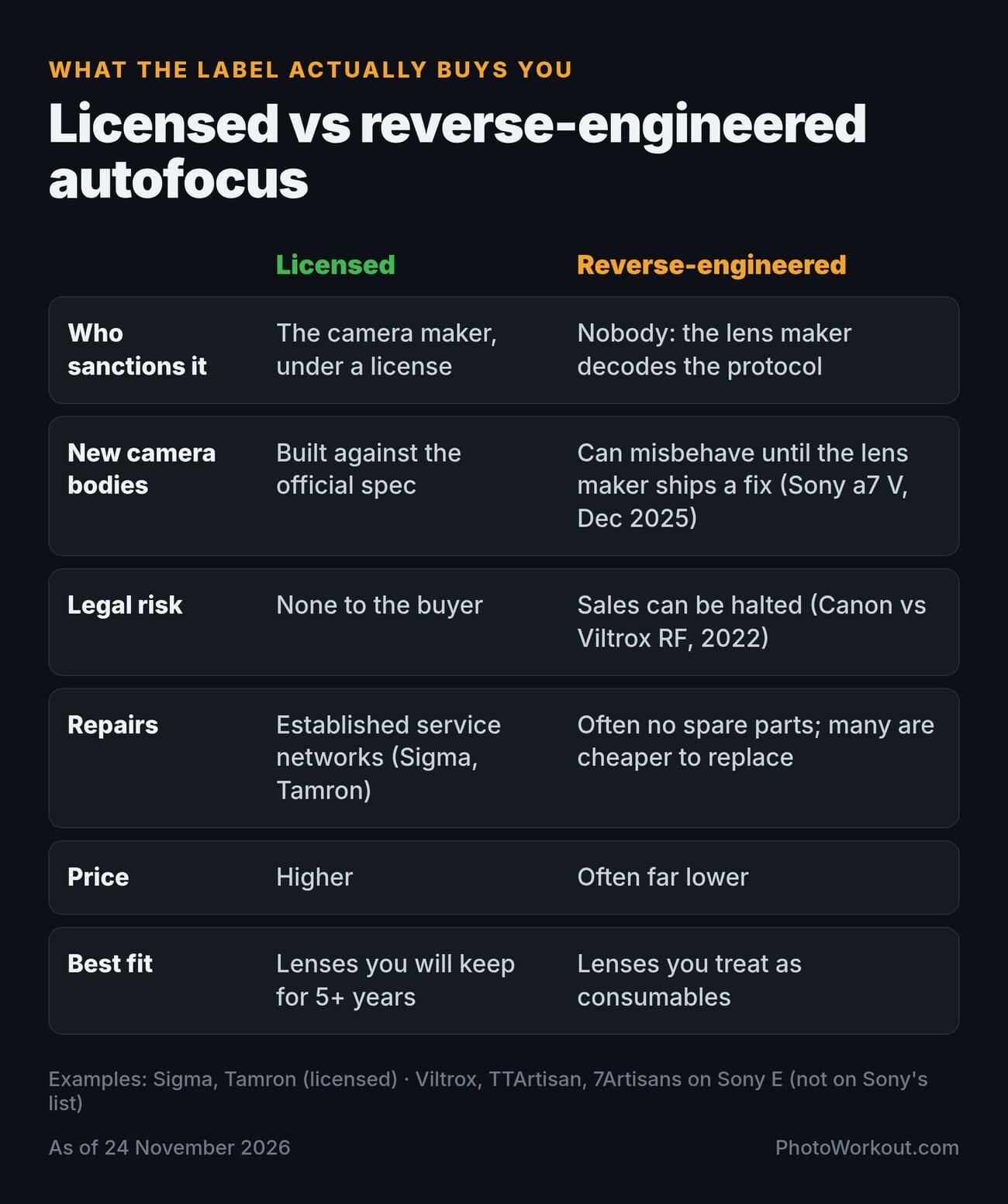
A licensed lens is built against the camera maker’s official specification. A reverse-engineered lens works because its maker decoded how the camera and lens talk to each other, and it keeps working only as long as that understanding holds. Most of the time, the difference is invisible. It shows up at three moments.
- When a new body launches. In December 2025, Viltrox and other Chinese lenses had problems on the newly launched Sony a7 V. Sony’s only comment was to contact each lens maker. Viltrox said Sony had not broken the lenses on purpose and shipped firmware fixes for its LAB, Pro and Air series; by February 2026 all of them were reported fixed. That is the normal pattern: the lens works again, but only after the lens maker catches up.
- When the lawyers get involved. Canon’s 2022 threat stopped Viltrox’s RF autofocus sales outright. Lenses already sold kept working, but owners lost the prospect of new models and firmware support in that mount.
- When something breaks. Licensed makers like Sigma and Tamron run real service networks. Many cheap unlicensed primes have no spare-parts channel at all, which is why a dead autofocus motor on a $200 lens usually means replace, not repair.
None of this makes reverse-engineered lenses a bad buy. A $99 to $350 autofocus prime that does 90% of what a $1,000 lens does is a genuine gift to photographers, as lenses like the $99 TTArtisan AF 85mm f/1.8 Neo and the $329 Viltrox 75mm f/1.8 EVO show. It means pricing in the risk: buy them as lenses you might replace in a few years, not as heirlooms.
So which mount is the safest home for third-party autofocus glass?
It depends on whether you value legal certainty, choice or price most, but the map points to a clear ranking for anyone buying into a system in 2027:
- Safest legal footing: L-Mount. An open alliance with a licensing route for any member, and now a budget Chinese autofocus maker inside it. The trade-off is a smaller body lineup and fewer cheap lenses today.
- Biggest catalog: Sony E. More licensed third-party autofocus lenses than anywhere else, plus the largest pool of unlicensed ones. The published partner list makes it easy to sort them.
- Most new primes: Fujifilm X. The flood is real and fast. Check whether a lens comes from a maker Fujifilm works with if you want it to last.
- In flux: Nikon Z. Strong licensed partners, and a legal landscape for unlicensed lenses that shifted in Viltrox’s favor in China this summer. Watch for any appeal outcome.
- Most restricted: Canon RF full frame. Great for Canon’s own lenses and licensed APS-C RF-S glass, but the mount where third-party full-frame autofocus is still effectively closed.
- Open, but quiet: Micro Four Thirds. The most open standard on paper, with fewer cheap autofocus options in practice.
Frequently Asked Questions
Are Viltrox lenses officially licensed?
It depends on the mount. Viltrox is not on Sony’s official E-mount partner list and has no license from Canon or Nikon, so its lenses for those mounts are reverse-engineered. On L-Mount, Viltrox has been an alliance member since September 2025, so its upcoming L-Mount lenses will come from a licensed member.
Can a camera firmware update break a third-party lens?
It can stop one from working properly until the lens maker responds. The clearest recent case was the Sony a7 V in December 2025, where Viltrox and other Chinese lenses had problems at launch; Viltrox fixed them with lens firmware updates. No sourced case shows Canon or Nikon deliberately breaking third-party lenses with a body update.
Did Nikon lose its patent case against Viltrox?
Not in court. In mid-July 2026, China’s patent office invalidated one Nikon Chinese patent covering the Z mount after a challenge by Viltrox’s parent company. Nikon’s other Z patents stand, the decision was appealable, and the separate infringement suit Nikon filed in Shanghai in January 2026 had no reported final outcome as of late November.
Which third-party lens makers are licensed on Sony E-mount?
Sony’s July 2026 list names nine: Carl Zeiss, Cooke Optics, Cosina, Fujifilm, Kenko Tokina, LK Samyang, Sigma, Tamron and Thales LAS France (Angénieux).
Is it safe to buy a cheap third-party autofocus lens?
For most photographers, yes, as long as the price reflects the risk. Expect it to need a firmware update now and then, buy from a seller with a clear return policy, and do not count on repairs. For lenses you plan to keep for many years, a licensed maker is the safer bet.
Bottom line
The cheap autofocus lens is no longer a novelty; it is a structural force in the lens market, and each camera maker has chosen how to respond. Canon keeps full frame closed, Sony draws a line with a published list, Nikon is fighting and losing ground in China, Fujifilm’s X mount has simply been flooded, and the L-Mount Alliance has invited a budget maker in. If you are choosing a system with third-party glass in mind, the mount’s posture is now as important as the camera body. Buy licensed lenses for the long haul, treat unlicensed bargains as shorter-term tools, and watch L-Mount: it is the first place where cheap and official may finally overlap.
Facts as of November 24, 2026. Rumors are labeled as such in the text.
Mount policy
- Sony: official E-mount licensee list – Sony's published list of E-mount partners, July 2026
- PetaPixel: Sony's list of official E-mount partners has some interesting exclusions – Which lens makers are missing from Sony's list
- PetaPixel: Sony is officially trying to acquire Tamron – Tamron confirms Sony's non-binding proposal, July 30, 2026
- PetaPixel: Canon is finally letting Sigma and Tamron make RF-mount lenses – APS-C RF-S licenses, April 2024
- PetaPixel: Thanks to Nikon, Canon's closed RF mount could be forced open – Analysis of the Nikon ruling's implications for Canon
- Nikon Rumors: Nikon lost the patent dispute against Viltrox in China – CNIPA invalidation decision details
- PetaPixel: Nikon loses its patent lawsuit against Viltrox – Coverage of the July 2026 decision
- PetaPixel: Viltrox has joined the L-Mount Alliance – Membership, September 1, 2025
- L-Rumors: New Viltrox L-mount lenses are coming soon – 35mm, 55mm and 85mm EVO primes; authorization rumor
Lenses and market data
- Imaging Resource: Thypoch announces Sculptor AF 23mm f/1.4 – Specs and pricing
- PetaPixel: Thypoch AF 23mm f/1.4 Sculptor – Price and availability
- CameraDecision: Fujifilm released one X-mount lens in 2026, third parties released 16 autofocus ones – Lens release counts used as one source's tally
- PetaPixel: Sony didn't intentionally brick third-party lenses on the a7 V – Firmware compatibility case, December 2025
- PetaPixel: Viltrox releases firmware updates for Sony a7 V compatibility – The fix
Image Sources
- Thypoch: Sculptor AF 23mm f/1.4 product images – Featured image and product render, manufacturer images
- Mount map, comparison table and pin – Infographics by PhotoWorkout