

- The U.S. Supreme Court struck down IEEPA tariffs on Feb 20, 2026, but new 15% tariffs were announced within hours under a different law — camera prices are not coming down.
- Sony, Canon, Nikon, and Fujifilm have all raised U.S. prices multiple times since April 2025, with some cameras up $400–$800 from launch.
- Smart strategies like buying refurbished, shopping used, renting, and considering last-gen models can save you hundreds.
- Budget-friendly alternatives from brands like Sony (a6700), Canon (R50), and Fujifilm (X-S20) still deliver excellent results under $1,500.
- The best time to buy is before the next price hike — prices are unlikely to drop anytime soon.
If you’ve been shopping for a new camera or lens lately, you’ve probably noticed the sticker shock. Camera gear prices in the United States have been climbing steadily since mid-2025, and just when photographers thought relief might be coming, the situation got worse.
On February 20, 2026, the U.S. Supreme Court struck down President Trump’s sweeping global tariffs in a landmark 6-3 ruling. For a brief moment, photographers celebrated. But within hours, new tariffs were announced — and raised to 15% the very next day. The result? Camera prices aren’t coming down. If anything, they’re going up again.
This guide cuts through the noise to help you understand exactly what happened, how it affects the gear you want, and — most importantly — what you can do about it. No political commentary, just practical advice for photographers trying to make smart buying decisions in a tough market.
What Happened: The 2026 Tariff Timeline
The tariff situation affecting camera gear has been unfolding for nearly a year. Here’s the timeline that matters:
April 2025 — “Liberation Day” tariffs take effect. President Trump implements sweeping reciprocal tariffs under the International Emergency Economic Powers Act (IEEPA), placing duties on imports from most countries. Japanese goods initially face a 10% tariff rate. Camera companies begin preparing for price increases.
May–June 2025 — First wave of price hikes. Nikon announces a 30-day warning before raising prices. Canon raises prices without warning. Sony follows suit quietly. Most increases are roughly 5–10% across the board.
July 2025 — U.S.-Japan trade deal raises tariffs to 15%. A new trade agreement between the U.S. and Japan includes a higher 15% tariff rate on Japanese goods, replacing the temporary 10% rate. Since Sony, Canon, Nikon, and Fujifilm are all Japanese companies, this hits the photography industry hard.
August–September 2025 — Second wave of price hikes. Fujifilm announces another round of increases. Nikon follows with September 1 price hikes. Sony raises prices again in late September — some cameras go up $400 in a single adjustment.
February 20, 2026 — Supreme Court strikes down IEEPA tariffs. In a 6-3 ruling, the Court declares that the president cannot use IEEPA to impose tariffs. Chief Justice Roberts writes that the power to impose tariffs belongs to Congress. Photographers and businesses celebrate — briefly.
February 20, 2026 (hours later) — New 10% tariffs announced. The president announces new global tariffs under Section 122 of the Trade Act of 1974, a different legal authority that allows tariffs up to 15% for 150 days without congressional approval.
February 21, 2026 — Tariffs raised to 15%. The new tariffs are immediately raised to the maximum 15% allowed under the Trade Act. For photographers, nothing has changed — the tariff rate on Japanese camera gear remains at 15%.
Which Camera Brands and Products Are Affected
Every major camera manufacturer is headquartered outside the United States, which means virtually all camera gear sold in America is subject to import tariffs. Here’s how the major brands are affected:
Sony
Sony has been hit particularly hard because the company manufactures cameras in both Japan and Thailand. The tariff rate on Japanese goods is 15%, but Thai imports face an even higher 19% rate. Sony has implemented at least two rounds of price increases, and notably does not give customers advance warning before raising prices.
The most affected Sony products include flagship and professional bodies like the a9 III, a1 II, a7R V, and a1, along with premium G Master lenses. The popular Sony mirrorless cameras in the mid-range have seen smaller but still noticeable increases.
Canon
Canon initially told customers to “expect virtually no impact,” then quietly raised prices across its lineup. The company has been the least transparent about specific price changes, declining to provide comprehensive lists. Canon’s RF L-series lenses and flagship R-series bodies have seen the biggest increases.
Nikon
Nikon has been the most consumer-friendly in its approach, giving photographers advance notice before price hikes. The company raised prices by roughly 10% in June 2025 and announced another round effective September 1, 2025. Many Nikon products are manufactured outside Japan (in Thailand, China, and elsewhere), so tariff impacts vary by model.
Fujifilm
Fujifilm was the last major brand to raise prices initially but has since implemented multiple increases. The company has been shifting production of popular X-Series cameras to Japan specifically for the U.S. market, since Japan’s 15% rate is lower than tariffs on some other Asian manufacturing hubs. Fujifilm has also provided advance notice to customers before price changes.
Leica and Sigma
German manufacturer Leica has raised prices by as much as 90% on some products. Sigma, a Japanese lens maker popular among budget-conscious photographers, announced price increases with advance notice in May 2025.
How Much Have Prices Actually Gone Up?
Here are real-world examples of how tariffs have impacted camera gear pricing in the United States. All prices are verified from manufacturer websites and major retailer listings:
Sony Price Changes
- Sony a9 III: Launched at $5,999 → now $6,800 (+$801, two $400 increases)
- Sony a1 II: Launched at $6,500 → now $7,000 (+$500)
- Sony a7R V: Increased by $400 in September 2025 alone
- Sony a1 (original): Up $300
- Sony a7S III / ZV-E1: Up $300 each
- Sony FX3 / FX30 / a7C R / a7C II: Up $200 each
- Sony FE 16-35mm f/2.8 GM II: Now $2,650 (+$350 from launch)
- Sony FE 50mm f/1.2 GM: Up $300
Canon Price Changes
- Canon EOS R1: Up $500 to $6,799
- Canon EOS R3: From $3,999 (discounted) → now $5,399
- Canon EOS R5 Mark II: $4,099 (with savings) → $4,299
- Canon EOS R6 Mark II: $1,999 → $2,199
- Canon RF 100-300mm f/2.8 L: Launched at $9,499 → now $10,199 (+$700)
- Canon RF 70-200mm f/2.8 L: Up to $2,999 from $2,599 promotional price
Nikon and Fujifilm
Both Nikon and Fujifilm implemented roughly 10% across-the-board increases in their first wave, followed by additional hikes after the 15% tariff rate took effect. Specific models vary, but expect popular bodies like the Nikon Z6 III, Z8, and Fujifilm X-T5 to be $150–$400 more than their original prices. Professional lenses have seen similar percentage increases.
The pattern is clear: the more expensive the gear, the bigger the dollar increase. A 15% tariff on a $2,000 camera body means $300 more at the register. On a $6,000 flagship, that’s $900.

Smart Buying Strategies to Beat the Price Hikes
Higher prices don’t mean you have to put your photography goals on hold. Here are proven strategies to get the gear you need without paying full tariff-inflated retail.
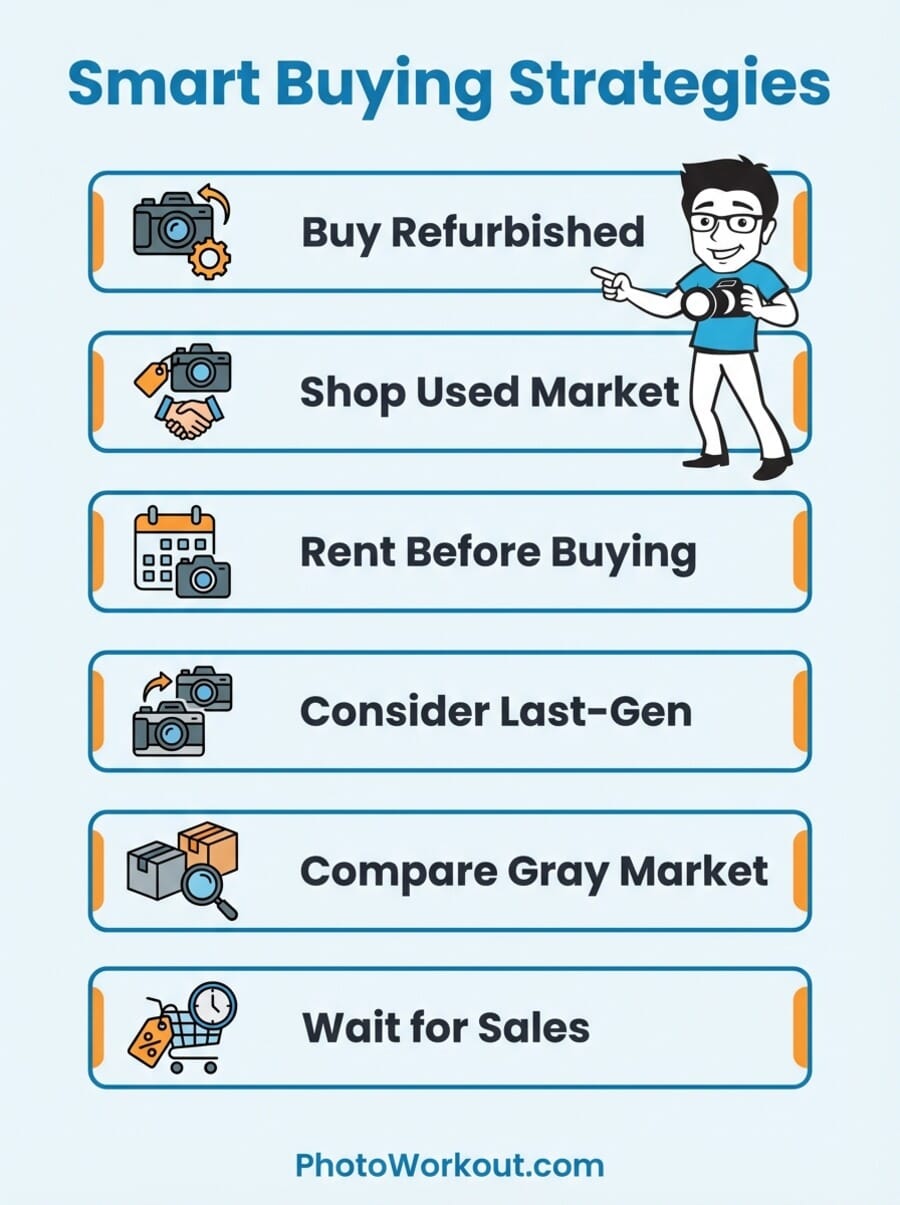
1. Buy Manufacturer-Refurbished Gear
This is the single best way to save money on camera gear right now. Manufacturer-refurbished cameras and lenses come directly from brands like Canon, Nikon, and Sony. They’ve been inspected, repaired if needed, and tested to meet original specifications. Most come with a manufacturer warranty (typically 90 days to 1 year).
Refurbished savings are typically 15–25% off current retail — which effectively cancels out the tariff-driven price increases. Check these sources regularly:
- Canon Refurbished Store (shop.usa.canon.com/refurbished) — extensive selection, 1-year warranty
- Nikon Refurbished (nikonusa.com/refurbished) — limited stock but great deals
- Sony Certified Refurbished — available through select retailers
2. Shop the Used Market
The used camera market is thriving, and for good reason. Modern mirrorless cameras are incredibly durable, and a well-maintained used body will perform identically to a new one. Popular platforms for buying and selling used cameras include:
- MPB — rated condition system, 6-month warranty, free shipping
- KEH Camera — the original used camera dealer, excellent grading system
- B&H Photo Used Department — trusted retailer with used section
- Facebook Marketplace / r/photomarket — peer-to-peer deals (buyer beware)
When buying used, always check the shutter count (for cameras with mechanical shutters), inspect for sensor dust, and test autofocus performance. Buying from reputable dealers with return policies is worth the slight premium over private sales.
3. Rent Before You Buy
If you’re not sure which camera or lens is right for you, renting is smarter than ever. Rental prices haven’t increased nearly as much as purchase prices, making it an excellent way to try before you buy — or to access expensive gear for specific shoots without the full investment.
Services like LensRentals, BorrowLenses, and Lensrentals.com offer weekend and weekly rates. A $3,000 lens might cost $75–$150 for a weekend rental. If you only need a specialized lens a few times a year, renting saves thousands.
4. Consider Last-Generation Models
Camera technology improves incrementally. The difference between the current generation and the previous one is often marginal for most photographers. With tariff-inflated prices making new flagship cameras even more expensive, last-gen models offer tremendous value:
- Sony a7 III instead of a7 IV — still an excellent full-frame camera for portraits and events
- Canon EOS R6 instead of R6 Mark II — superb autofocus, great low-light performance
- Nikon Z6 II instead of Z6 III — capable all-rounder at a significant discount
- Fujifilm X-T4 instead of X-T5 — IBIS, flip screen, proven workhorse
Used previous-gen flagships are often available for 40–60% less than the current model’s new price. That’s a massive saving that far exceeds any tariff impact.
5. Understand Gray Market Pros and Cons
Gray market (also called “import” or “international”) cameras are legitimate products sold outside their intended market. A gray market Sony camera might be intended for the Asian or European market but sold to a U.S. buyer at a lower price. The savings can be significant — sometimes 10–20% below U.S. retail.
However, there are real trade-offs:
- No U.S. manufacturer warranty — repairs must be paid out of pocket or handled by third parties
- Different firmware/menus — some models may have region-specific differences
- Return complications — harder to return if something goes wrong
- Resale value — gray market gear typically sells for less on the used market
Gray market can make sense for lenses (fewer things can go wrong) and for experienced buyers who are comfortable with the risk. For camera bodies — especially expensive ones — the lack of warranty is harder to justify.
6. Use Financing and Watch for Sales
Major retailers like B&H Photo, Adorama, and Amazon regularly offer interest-free financing through services like Affirm or PayBright. Camera financing options let you spread the cost over 6–24 months while locking in today’s price — which may be lower than tomorrow’s if another round of increases hits.
Key sale periods to watch: Memorial Day (May), Prime Day (July), Black Friday/Cyber Monday (November), and end-of-year clearance events. Manufacturers sometimes offer instant savings or cashback that effectively offset tariff increases. Check trusted camera stores regularly for deals.
Budget-Friendly Camera Alternatives Worth Considering
If tariff-inflated prices have pushed your dream camera out of budget, there are excellent alternatives that deliver outstanding results for less. These picks offer the best value for money in the current market:
Under $1,000
- Canon EOS R50 (~$679 with kit lens) — Compact, lightweight APS-C mirrorless with excellent autofocus and 4K video. Perfect for beginners stepping up from smartphones.
- Nikon Z50 II (~$859 body only) — Nikon’s latest APS-C offering with subject-detection AF and a comfortable grip. A smart entry into the Nikon Z system.
- Fujifilm X-S10 (used, ~$600–$700) — In-body stabilization, flip screen, and Fujifilm’s beloved film simulations. A fantastic deal on the used market.
Under $1,500
- Sony a6700 (~$1,398 body only) — The APS-C king. AI-powered autofocus, 4K 120p video, and access to Sony’s massive lens ecosystem. For many photographers, this delivers 90% of what a full-frame camera can do.
- Fujifilm X-S20 (~$1,299 body only) — Versatile all-rounder with 6.2K video, IBIS, and those gorgeous Fujifilm colors. A strong choice for content creators and hobbyists alike.
- Canon EOS R10 (~$979 body only) — Fast burst shooting (23 fps electronic), Canon’s excellent Dual Pixel AF, and compatibility with RF and adapted EF lenses.
Remember, APS-C cameras with good lenses routinely outperform full-frame cameras with mediocre lenses. If tariffs are stretching your budget, investing in a quality APS-C system is a smarter move than compromising on lens quality to afford a full-frame body. Check out our guide to the best compact mirrorless cameras and compact cameras under $300 for even more budget-friendly options.
Should You Buy Now or Wait?
This is the question every photographer is asking. Here’s the honest assessment:
Prices are unlikely to drop soon. The new 15% tariffs under Section 122 can remain in effect for 150 days without congressional approval, and the administration has signaled it will pursue additional tariff authority beyond that period. Even if tariffs were reduced tomorrow, camera companies are unlikely to lower prices quickly — it took months for increases to roll out, and reversal would likely take even longer.
Another round of increases is possible. If the administration secures additional tariff authority or if trade negotiations result in different rates, prices could adjust again — in either direction, but history suggests upward.
If you need gear now, buy now. Waiting for prices to drop is a gamble with poor odds. If you have a specific need — a wedding season approaching, a trip planned, a project deadline — buy the gear you need today. The best camera is the one you have when you need it.
If you can wait, watch for sales. Manufacturers still offer promotional pricing during major sale events. Black Friday, Prime Day, and brand-specific promotions can temporarily offset tariff increases. Sign up for price alerts on CamelCamelCamel or use the Honey browser extension to track price history.
Consider your total kit investment. Rather than spending all your budget on a flagship body at inflated prices, you might get better results investing in quality lenses — which hold their value better and have a bigger impact on image quality. Pair a mid-range body with an excellent lens and you’ll often outshoot someone with a flagship body and a kit lens. Our photography equipment guide for beginners can help you prioritize your purchases.
How to Future-Proof Your Kit
In uncertain economic times, making smart long-term gear decisions matters more than ever:
- Invest in lenses over bodies. Camera bodies depreciate faster and get replaced more often. A great lens lasts decades and can be adapted to future bodies. Put your money into glass.
- Stick with one lens mount. Switching systems means buying all new lenses at tariff-inflated prices. If you’re already invested in Sony E-mount, Canon RF, or Nikon Z, stay the course.
- Learn to maintain your gear. Proper care extends the life of your equipment. Store cameras and lenses properly to avoid costly replacements.
- Invest in skills, not just gear. A photography course or tutorial costs a fraction of a new camera and will improve your images more than any gear upgrade. The tariffs can’t touch your creativity.
Will camera prices go back down after the tariffs end?
It’s unlikely prices will return to pre-tariff levels quickly, even if tariffs are reduced or eliminated. Camera manufacturers typically absorb price increases slowly and are reluctant to lower prices once the market has adjusted. However, promotional pricing, sales events, and refurbished deals may offset some of the increases over time.
Are used cameras a good alternative during tariff price hikes?
Yes, the used camera market is one of the best ways to avoid tariff-inflated prices. Used cameras weren’t subject to the new tariff rates when originally purchased, so their prices reflect pre-tariff or lower tariff values. Reputable dealers like MPB and KEH offer warranties and return policies on used gear.
Which camera brands have been affected most by the 2026 tariffs?
All major camera brands are affected since none are manufactured in the United States. Sony, Canon, Nikon, and Fujifilm — all Japanese companies — face a 15% tariff on goods imported from Japan. Sony is additionally impacted because some of its products are made in Thailand, which faces a 19% tariff rate. German manufacturer Leica has seen some of the steepest percentage increases.
Is it worth buying a gray market camera to save money?
Gray market cameras can save 10-20% off U.S. retail, but they come without a U.S. manufacturer warranty. This trade-off is more reasonable for lenses (which have fewer failure points) than for complex camera bodies. If you’re comfortable handling potential repair costs yourself, gray market can be a viable option — especially for less expensive gear where the warranty risk is lower.
How much have camera prices gone up because of tariffs?
Price increases vary by brand and model, but most camera gear has gone up 10-15% since tariffs began in April 2025. Some specific examples: the Sony a9 III increased by $801 (from $5,999 to $6,800), the Canon EOS R1 went up $500, and the Canon RF 100-300mm f/2.8 L lens increased $700. Budget and mid-range cameras have seen smaller dollar increases but similar percentage hikes.
Featured image: Photo by Jonathan J. Castellon on Unsplash.
Related Articles
Get the Weekly Photography News Digest
Join photographers who get our top stories delivered every Monday morning. No spam, unsubscribe anytime.