

Editor’s Key Takeaways: How to Make Money with Stock Photography in 2026
Stock photography has changed dramatically. AI-generated imagery has flooded microstock platforms, earnings per download have dropped, and the Getty-Shutterstock mega-merger is reshaping the entire industry. But real photographers who adapt to the new landscape can still earn meaningful supplemental income – if they know where to focus. This guide covers the current state of stock photography, which niches remain profitable, updated platform recommendations with realistic earning expectations, and alternative monetization strategies for 2026.
Key Points:
- AI’s Impact on Stock Photography: AI image generators have made generic stock photos nearly worthless, but human-shot authentic imagery remains in demand.
- AI-Proof Niches: Authentic lifestyle, diverse representation, local/cultural content, editorial news, and video clips are where real photographers still dominate.
- Realistic Earnings: Hobby contributors earn $10-100/month, part-time photographers make $100-1,000/month, and top full-time contributors can earn $1,000-10,000+/month – but it takes years and thousands of images.
- Platform Recommendations: Updated breakdown of Shutterstock, Adobe Stock, iStock/Getty, Alamy, and newer platforms like Wirestock.
- Beyond Microstock: Direct licensing, print-on-demand, and video clips offer better margins than traditional microstock alone.
Stock Photography in 2026: Is It Still Worth It?
Let’s get the uncomfortable truth out of the way first: stock photography is harder than it was five years ago. The market has been disrupted by AI image generators, per-download earnings have declined, and over 2.5 million contributors are now uploading roughly 58 million new assets every year to the major platforms.
And yet – the global stock photography market continues to grow. Demand for visual content keeps rising as businesses, e-learning platforms, social media marketers, and content creators need more imagery than ever. The difference is that what sells has fundamentally shifted.
Stock photography – in case you’re new to the concept – refers to photographs that are licensed for commercial use. Instead of shooting for specific clients, you create images and make them available through microstock platforms (like Shutterstock or Adobe Stock) that act as a middleman between you and buyers. When someone licenses your image, you earn a commission.
The appeal has always been passive income: upload once, earn repeatedly as different buyers license the same image. That fundamental model still works. What’s changed is the competitive landscape – and who (or what) you’re competing with.
The AI Elephant in the Room
Since 2023, AI image generators like Midjourney, DALL-E, and Stable Diffusion have been able to produce generic stock-style imagery in seconds. The impact on traditional stock photography has been significant – but it’s more nuanced than the doom-and-gloom headlines suggest.
Here’s what actually happened:
- Generic imagery got commoditized. Simple business photos, abstract backgrounds, and conceptual illustrations – the bread and butter of many stock photographers – can now be generated by AI for pennies. A major UK photography survey found that 58% of professionals have lost commissioned work to AI, with average losses of $44,000 per photographer.
- Per-download earnings dropped. On high-volume platforms like Shutterstock, contributors report average earnings of around $0.78 per download in 2025, with some images earning as little as $0.02 per month. That’s down from the $1+ averages of a few years ago.
- Volume exploded. The flood of AI-generated content (before platforms started restricting it) saturated many popular categories, making it harder for any single image to get discovered.
- Platforms responded. Shutterstock now explicitly bans AI-generated contributor uploads. Adobe Stock requires AI content to be labeled. Getty Images banned AI-generated submissions entirely. This is actually good news for real photographers.
The takeaway? If you were planning to make money uploading generic “businessman shaking hands” photos, that ship has sailed. But if you can shoot what AI can’t generate – authentic moments, real people, real places – there’s still opportunity. More on that below.
The Getty-Shutterstock Merger: What It Means for Contributors
In January 2025, Getty Images and Shutterstock announced a merger of equals, creating a combined entity with a $3.7 billion enterprise value and a library of over one billion assets. The deal received U.S. Department of Justice clearance in early 2025 and is expected to close in mid-2025, with the merged company trading under Getty’s ticker symbol (GETY).
For contributors, this is a seismic shift. The two largest microstock platforms – which together also control iStock, Pond5, and several other brands – are becoming one company. What does that mean in practice?
- Reduced competition between platforms. With fewer major platforms competing for contributors, there’s less pressure to offer better commission rates. The merged entity controls a massive share of the stock imagery market.
- Larger audience for your work. On the flip side, the combined customer base is enormous. If you’re a contributor on either platform, your images may eventually reach more potential buyers.
- AI training implications. The merger creates the world’s largest curated image database – a goldmine for AI training. Both companies have already licensed content for AI development. Contributors should pay attention to how their work is used and compensated in AI training deals.
- Business as usual – for now. Both companies have stated that contributor terms remain unchanged during the transition. But history suggests that post-merger “synergies” often mean reduced payouts. Watch for changes in 2026 and beyond.
Editor’s Note: The Getty-Shutterstock merger is still finalizing as of early 2026. We’ll update this section as contributor terms and platform changes are announced.
AI-Proof Niches: Where Human Photographers Still Dominate
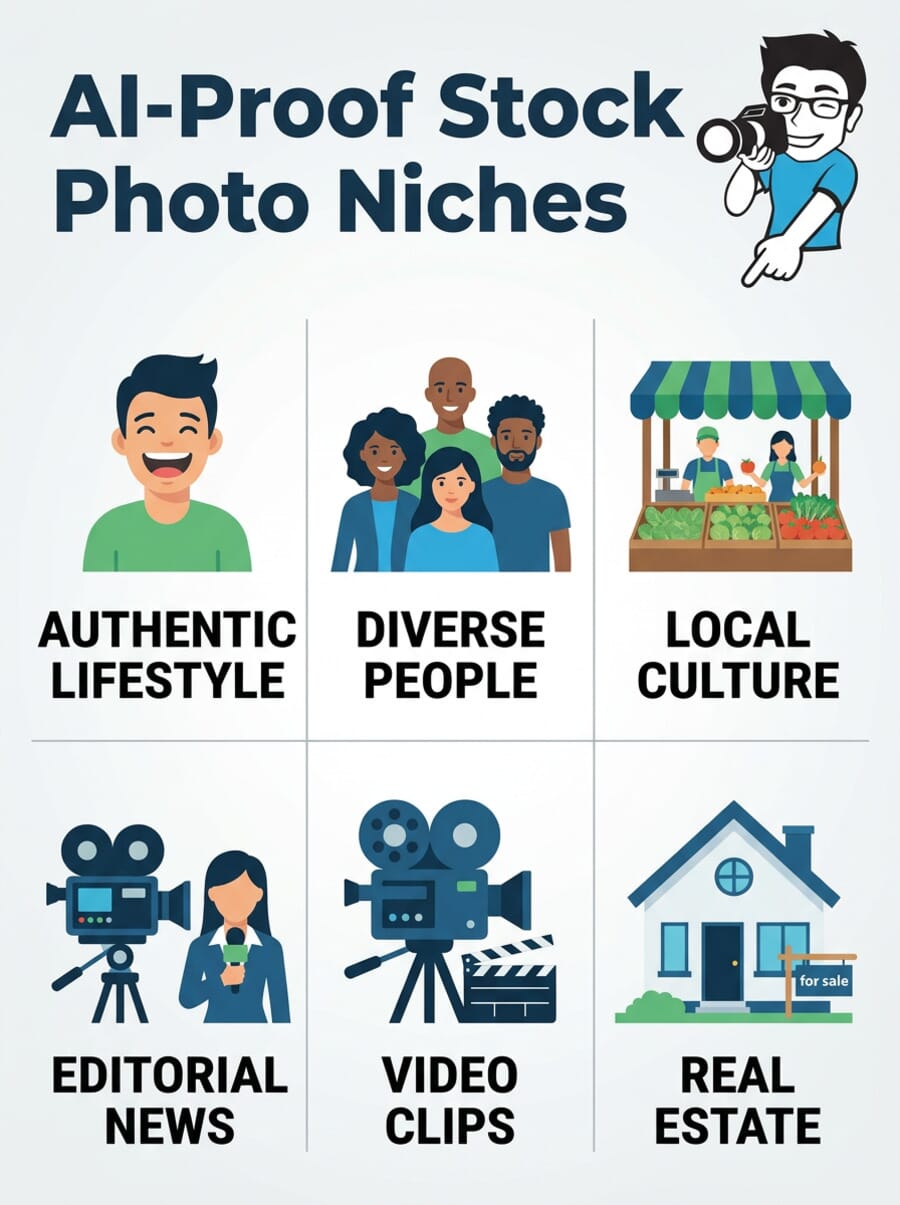
This is the most important section of this article. If you’re going to invest time in stock photography in 2026, you need to shoot content that AI cannot replicate. Here are the niches that remain profitable because they require physical presence, cultural access, or documentable authenticity:
1. Authentic Lifestyle Photography
AI can generate people, but it struggles with genuine human emotion, natural body language, and the subtle imperfections that make a photo feel real. Candid shots of real people in real situations – families cooking together, friends laughing at a cafe, professionals collaborating in an office – remain in high demand.
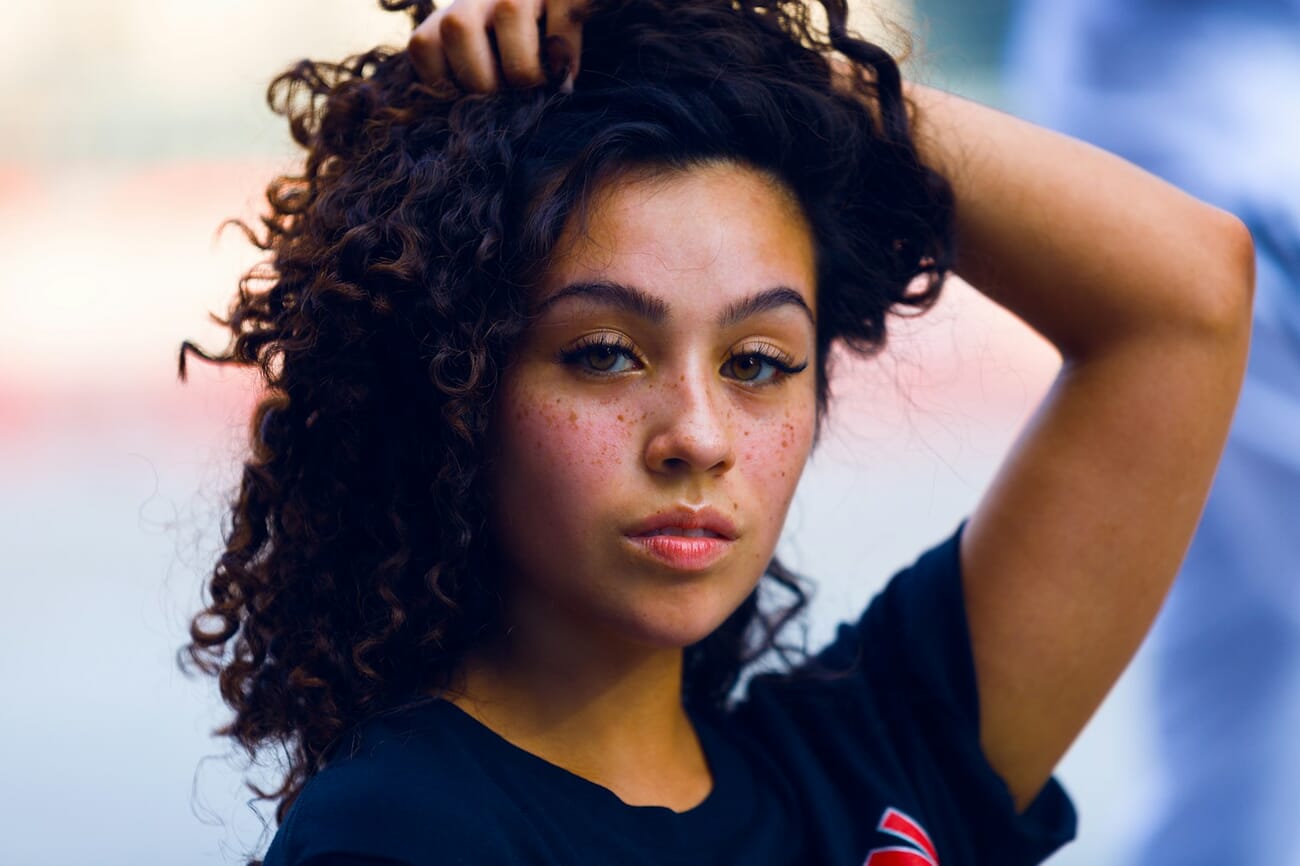
Buyers know the difference. Brands increasingly want imagery that feels genuine because consumers have developed “stock photo fatigue” – they can spot overproduced, artificial-looking imagery instantly. This works in your favor as a real photographer.
2. Diverse Representation
There’s a growing demand for imagery that authentically represents different ethnicities, body types, ages, abilities, and cultures. AI models trained predominantly on Western imagery often produce homogeneous results. If you can photograph real diversity in real settings, you’re filling a gap the market desperately needs.

3. Local and Cultural Content
AI can’t visit a farmers market in Oaxaca, a street food stall in Bangkok, or a Christmas market in Munich. Images of specific real-world locations, local businesses, regional food, traditional crafts, and cultural events have built-in authenticity that AI simply can’t replicate. If you travel or live in a photogenic area, you have a built-in advantage.

4. Editorial and News Imagery
News events, protests, conferences, sports, and cultural moments require a photographer to be physically present. Editorial stock – images that document real events for journalistic use – is inherently AI-proof because it requires verifiable authenticity. Platforms like Getty Images and Alamy pay premium rates for editorial content.
5. Stock Video Clips
This might be the single best opportunity for stock contributors in 2026. AI can generate still images, but generating convincing, high-quality video footage remains much harder. Stock video clips command significantly higher prices per download – often $20-100+ compared to $0.25-2 for photos. If you can shoot quality B-roll, lifestyle clips, or aerial drone footage, video is where the money is moving.
6. Real Estate and Architecture
Specific properties, interiors, neighborhoods, and architectural details need to be photographed on-site. Real estate agencies, tourism boards, and architects buy these images regularly. As with local culture content, you can’t AI-generate a photo of a real building that actually exists.
Realistic Earnings in 2026
Let’s kill the “passive income” myth once and for all. Yes, stock photography can generate passive income over time – but only after significant upfront effort. Here’s what realistic earnings look like based on current contributor data:
- Hobby contributors (under 500 images): $10-100 per month. You’re essentially earning coffee money while learning the ropes.
- Part-time contributors (500-5,000 images): $100-1,000 per month. With a focused portfolio in the right niches and good keywording, some contributors hit this range within 2-3 years.
- Full-time professionals (5,000+ images): $1,000-10,000+ per month. These are contributors who have been at it for years, have massive portfolios, often shoot video content, and distribute across multiple platforms. A contributor survey found that top earners average about $8.72 per image per year across their library.
The math is straightforward: if your average image earns $5-9 per year across all platforms, you need 1,000-2,000 consistently selling images to make $5,000-18,000 per year. That’s a meaningful portfolio that takes years to build.
One contributor documented earning $1,900 USD in his first full year with a focused effort, after which his images continued generating income even when he stopped uploading. That’s a realistic first-year benchmark if you’re disciplined about it.
Key factors that affect your earnings:
- Portfolio size. More images = more potential sales. There’s a direct correlation.
- Keywording quality. An image that buyers can’t find is an image that doesn’t sell. Spend as much time on metadata as you do on editing.
- Niche selection. Shooting in demand categories with low AI competition (see above) dramatically improves per-image earnings.
- Platform selection. Commission rates vary from 15% to 50%+ depending on the platform and your contributor level.
- Content type. Video clips earn 5-50x more per download than still photos.
The Best Stock Photography Platforms in 2026
The platform landscape has shifted. With the Getty-Shutterstock merger and the rise of aggregator services, choosing the right platforms matters more than ever. Here’s a breakdown of the major options for contributors:
Shutterstock
Shutterstock remains one of the largest microstock platforms with over 450 million images and massive buyer traffic. To get accepted, you submit 10 images and just one needs to pass review. Commission rates range from 15% to 40% based on a tiered system tied to your annual download count. Shutterstock explicitly bans AI-generated contributor uploads, which is a positive signal for real photographers.
The reality: Shutterstock pays at the lower end of the spectrum. Contributors report average earnings of around $0.78 per download, and at the starting tier you’ll earn just 15% of sale price. The minimum payout is $35. It’s a volume game – Shutterstock works best when you have hundreds or thousands of images generating consistent downloads.
Adobe Stock
Adobe Stock benefits from being integrated directly into Adobe Creative Cloud – meaning your images appear in front of every Photoshop, Illustrator, and InDesign user. The commission rate is a flat 33% for photos and vectors, 35% for footage. Payment tiers boost per-download earnings slightly: $0.33 at the entry level, $0.36 after 1,000 downloads, and $0.38 after 10,000.
The reality: The commission rate is not great, but the buyer base is enormous thanks to Creative Cloud integration. No exam or approval process is needed – just an Adobe ID. The $25 minimum payout is the lowest of the major platforms. Adobe requires AI-generated content to be labeled but hasn’t banned it outright, so you will be competing with AI submissions in some categories.
iStock / Getty Images
iStock (owned by Getty Images) is the platform to consider if you’re willing to go exclusive. Non-exclusive rates are unimpressive – just 15% for photos, 20% for vectors and video. But the exclusive contributor program offers up to 45% commission, which is among the best in the industry.
The reality: iStock has the highest barrier to entry. You need to pass a test on legal and technical aspects of stock photography, then submit sample images for review. Going exclusive means you can’t upload those images anywhere else, but the higher commission and access to Getty’s premium editorial market can be worth it for serious contributors. Getty Images has completely banned AI-generated submissions.
Alamy
Alamy takes a different approach from the microstock giants. It offers higher commissions (up to 50% for exclusive content, 40% non-exclusive), accepts editorial content without model releases, and has a large editorial buyer base including newspapers and publishers. There’s no review process or exam – anyone can sign up and start uploading.
The reality: Alamy has lower sales volume than Shutterstock or Adobe Stock, but individual sales tend to pay more. It’s particularly strong for editorial and documentary photography. If you shoot news events, travel, or documentary-style content, Alamy should be in your platform mix.
Wirestock (Aggregator)
Wirestock is an aggregator platform that distributes your images to multiple stock agencies (including Shutterstock, Adobe Stock, Getty/iStock, Alamy, Dreamstime, and others) from a single upload. Instead of managing accounts on 6+ platforms separately, you upload once to Wirestock and they handle distribution.
The reality: Wirestock takes a 15% cut on top of whatever the agencies pay, which means lower per-sale earnings. But the time savings can be significant, especially for contributors who would otherwise skip smaller platforms. Wirestock has also pivoted toward AI training data licensing, which is a separate revenue stream. If you’re starting out and don’t want to manage multiple platform accounts, Wirestock is worth considering as a launchpad.
Other Platforms Worth Considering
- Pond5 – now owned by Shutterstock. Strong for video clips, music, and sound effects. Contributors set their own prices.
- Depositphotos – solid mid-tier platform with a growing buyer base.
- Dreamstime – one of the oldest microstock sites, with commission rates from 25-50%.
- 500px – offers licensing through its marketplace, with higher commissions for exclusive content.
Related Posts
How to Get Started: The Stock Photography Workflow
If stock photography still interests you after reading the earnings reality check, here’s a step-by-step workflow to get started the right way:
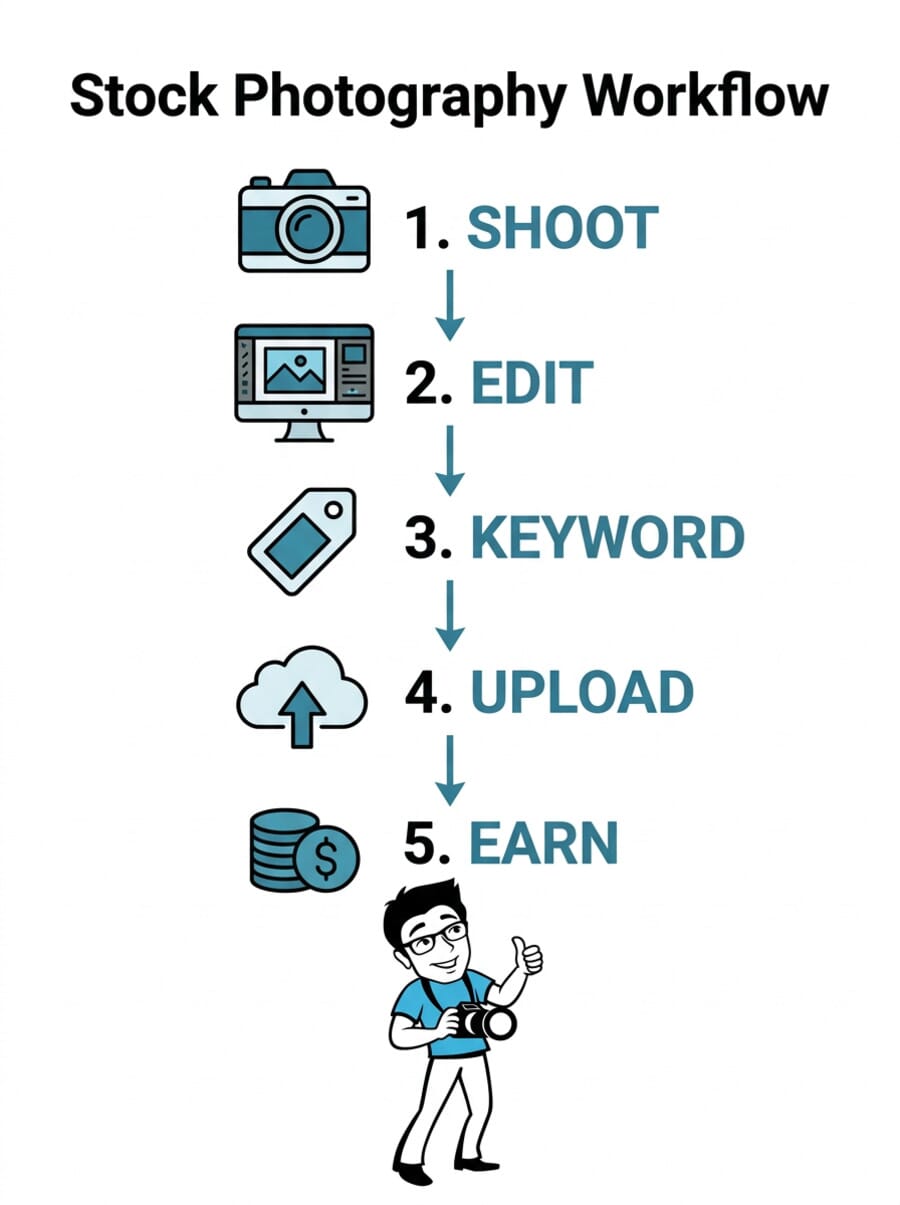
Step 1: Research Before You Shoot
Don’t upload your vacation photos and hope for the best. Before shooting, research what’s actually selling. Most major platforms publish trend reports and creative briefs. Study what buyers search for, identify gaps in popular categories, and look for niches where AI-generated content is scarce.
Your biggest source of photoshoot ideas should be market research data that stock companies publish. They spend significant resources identifying trends – use that free intelligence.
Step 2: Shoot with Commercial Intent
Stock photography is commercial photography without a specific client. Think about who would buy your image and what they’d use it for. A beautiful sunset photo might get likes on Instagram but won’t sell well on stock sites because there are millions of sunset photos already. A photo of a diverse team collaborating in a modern workspace? That has clear commercial application.
Focus on quality over quantity. Major platforms reject technically flawed images (noise, poor focus, artifacts). Your images need to be sharp, well-exposed, and professionally processed. You don’t need the most expensive gear – any modern camera for beginners can produce stock-worthy images if you nail the fundamentals.
Step 3: Edit and Prepare
Process your images to a professional standard. That means proper white balance, exposure correction, and clean retouching where needed. Don’t over-process – stock buyers generally prefer clean, natural-looking images they can further customize.
Technical requirements vary by platform but generally include: minimum 4MP resolution, JPEG format, sRGB color space, and no visible watermarks, logos, or trademarks in the image.
Step 4: Keyword Like Your Income Depends on It
Because it does. Keywording is arguably the most important – and most underrated – step in stock photography. Buyers search using specific terms. If your beautiful lifestyle photo is tagged with generic keywords like “woman” and “happy,” it’ll be buried under millions of similar results. Use specific, descriptive keywords that match how buyers actually search. Most platforms allow 30-50 keywords per image – use them all.
Tools like Xpiks (free, cross-platform) can help batch-keyword your images efficiently and submit to multiple platforms.
Step 5: Distribute Across Multiple Platforms
Unless you’re going exclusive with one platform, upload your images to multiple agencies. Each platform has a different buyer base, and an image that doesn’t sell on Shutterstock might perform well on Alamy or Depositphotos. More platforms = more exposure = more potential sales.
The Legal Side of Stock Photography
Stock photography has legal requirements that you need to understand before making your first sale. Getting this wrong can lead to rejected submissions, account suspension, or even legal liability.
Model Releases
If your stock image features a recognizable person, you need a signed model release. This is a legal document where the subject consents to having their likeness used commercially. Without it, reputable stock agencies will reject the image for commercial licensing. Most stock platforms provide their own model release templates that you can use.
The model release protects everyone: the photographer from future legal claims, the subject from unauthorized use, and the buyer from licensing complications.
Property Releases
A property release is required when photographing recognizable private property, certain landmarks, or unique architectural designs. This includes interior shots of private homes, distinctive building facades, and branded products. Even pets are considered property for release purposes. When in doubt, get a release – it’s far easier to have one you don’t need than to need one you don’t have.
Licensing Types
Understanding license types helps you make informed decisions about how to sell your work:
- Royalty-Free (RF): The most common license type in microstock. Buyers pay once and can use the image multiple times across different projects. Despite the name, it’s not “free” – the buyer still pays a licensing fee. RF images generate volume sales at lower per-image prices.
- Rights-Managed (RM): A more restrictive license where usage is specified by purpose, geography, duration, and print run. Rights-managed images command significantly higher fees but sell less frequently. This model is more common on premium platforms like Getty Images.
- Exclusive vs. Non-Exclusive: Exclusive images are available on only one platform. They carry higher price tags and commissions but limit your distribution. Non-exclusive images can be sold on multiple platforms simultaneously, generating more total sales at lower per-image rates. Most new contributors start non-exclusive.
Beyond Microstock: Alternative Monetization Strategies
Relying solely on microstock platforms means accepting their commission structures and pricing decisions. Smart contributors in 2026 are diversifying their income streams:
Direct Licensing
Selling directly to buyers – through your own website or platforms that let you set your own prices – means keeping a much larger share of each sale. If you’ve built a recognizable body of work in a specific niche (say, aerial photography of European architecture), direct licensing to architecture firms, tourism boards, or publishers can be far more lucrative than microstock.
Print-on-Demand
Services like Fine Art America, Redbubble, and Society6 let you sell your photographs as prints, canvas wraps, phone cases, and other products – with no upfront costs. You upload your images, set prices, and the platform handles printing and shipping. This works best for images with strong aesthetic appeal: landscapes, abstract compositions, nature, and architecture.
If you’re interested in selling prints, we have a detailed guide on the best fine art papers for photography if you want to handle printing yourself.
Video Content Creation
As mentioned earlier, stock video commands significantly higher prices. A 10-second 4K clip can earn $20-100+ per sale compared to $0.25-2 for a still photo. If you already own a camera that shoots quality video, adding video clips to your portfolio is one of the highest-impact moves you can make.
AI Training Licensing
This is controversial but worth mentioning. Some platforms – including Wirestock and Shutterstock – have begun licensing contributor content specifically for AI training purposes, with separate compensation. Whether you’re comfortable with this is a personal decision, but it’s an emerging revenue stream that some contributors are taking advantage of. Always read the terms carefully and understand what rights you’re granting.
Is Stock Photography Worth It in 2026?
Here’s our honest take: stock photography is not the easy passive income opportunity it was marketed as in the 2010s. The market is more competitive, per-download earnings have decreased, and AI has permanently changed the landscape.
But it’s not dead, either. Real photographers who focus on AI-resistant niches, build substantial portfolios over time, distribute across multiple platforms, and supplement still photos with video content can absolutely build a meaningful income stream. Think of stock photography as a long-term investment in a visual library that pays dividends over years – not a get-rich-quick scheme.
If you have photos sitting on a hard drive doing nothing, you have nothing to lose by uploading them to a few stock platforms. If you’re considering stock photography as a serious income stream, explore the highest-paying photography jobs to see where it fits in the bigger picture, and go in with realistic expectations, focus on what makes you irreplaceable (authenticity, location access, niche expertise), and commit to the long game.
The photographers who are thriving in stock photography in 2026 aren’t the ones with the biggest libraries – they’re the ones who adapted to what the market actually needs. And right now, the market needs what AI can’t make: real moments, real people, real places.
Related Posts