


- The little Fujifilm camera reportedly topping Google’s camera searches right now is the XQ1 — a pocket compact Fujifilm launched back in November 2013 for $499.
- It pairs a tiny 2/3-inch X-Trans CMOS II sensor (12MP) with a 25–100mm f/1.8–4.9 zoom and Fujifilm’s beloved film simulations — the same color science people chase in the $1,800 X100VI.
- The surge is part of the wider “digicam” revival: TikTok nostalgia, intentional shooting, and X100VI shortages are all pushing buyers toward cheap, older Fuji compacts.
- You can still buy an XQ1 used for roughly $350–$500 — a fraction of a new premium compact, though the small sensor means real trade-offs in low light and dynamic range.
- It’s not alone: the X10, X20, X30 and early X100 bodies are all climbing the same nostalgia wave.
Every so often the internet collectively rediscovers a camera nobody was talking about a month ago. Right now, according to The Phoblographer, that camera is a small, decade-old Fujifilm compact that quietly climbed to the top of Google’s camera-related searches — in the US and worldwide. It isn’t a new flagship, a leaked mirrorless body, or the perpetually sold-out X100VI. It’s the Fujifilm XQ1, a pocketable point-and-shoot that launched in 2013 and was discontinued years ago.
That a 12-megapixel compact from the year of the first Sony A7 is outsearching cameras ten times its price says less about the XQ1 itself and more about where photography’s mood has landed in 2026. Here’s what the XQ1 actually is, why it’s suddenly everywhere in search data, and whether the hype is worth acting on.
Wait — the Fujifilm XQ1? What Is It?
The XQ1 was Fujifilm’s stab at a premium pocket compact, released in November 2013 at $499. On paper it’s modest: a 2/3-inch X-Trans CMOS II sensor at 12 megapixels, a fixed 25–100mm-equivalent f/1.8–4.9 zoom, ISO up to 12,800, 1080/60p video and a fixed 3-inch LCD with no viewfinder. It weighs just 206 grams and slips into a jacket pocket. The headline number that matters, though, isn’t the resolution — it’s the sensor family.
That X-Trans CMOS II chip is the same generation Fujifilm put in the X100S and X-E2, and it ditches the anti-aliasing filter for the punchy, film-like JPEG rendering Fuji shooters obsess over. Crucially, the XQ1 carries Fujifilm’s film simulations — Provia, Velvia, Astia, plus monochrome and sepia — baked into a body you can buy for the price of a nice dinner-for-two budget. The 2015 follow-up, the XQ2, is nearly identical hardware but adds the popular Classic Chrome profile and slightly better autofocus; one reviewer fairly called it “an XQ1 with a firmware update.”
Why a 2013 Compact Is Trending in 2026
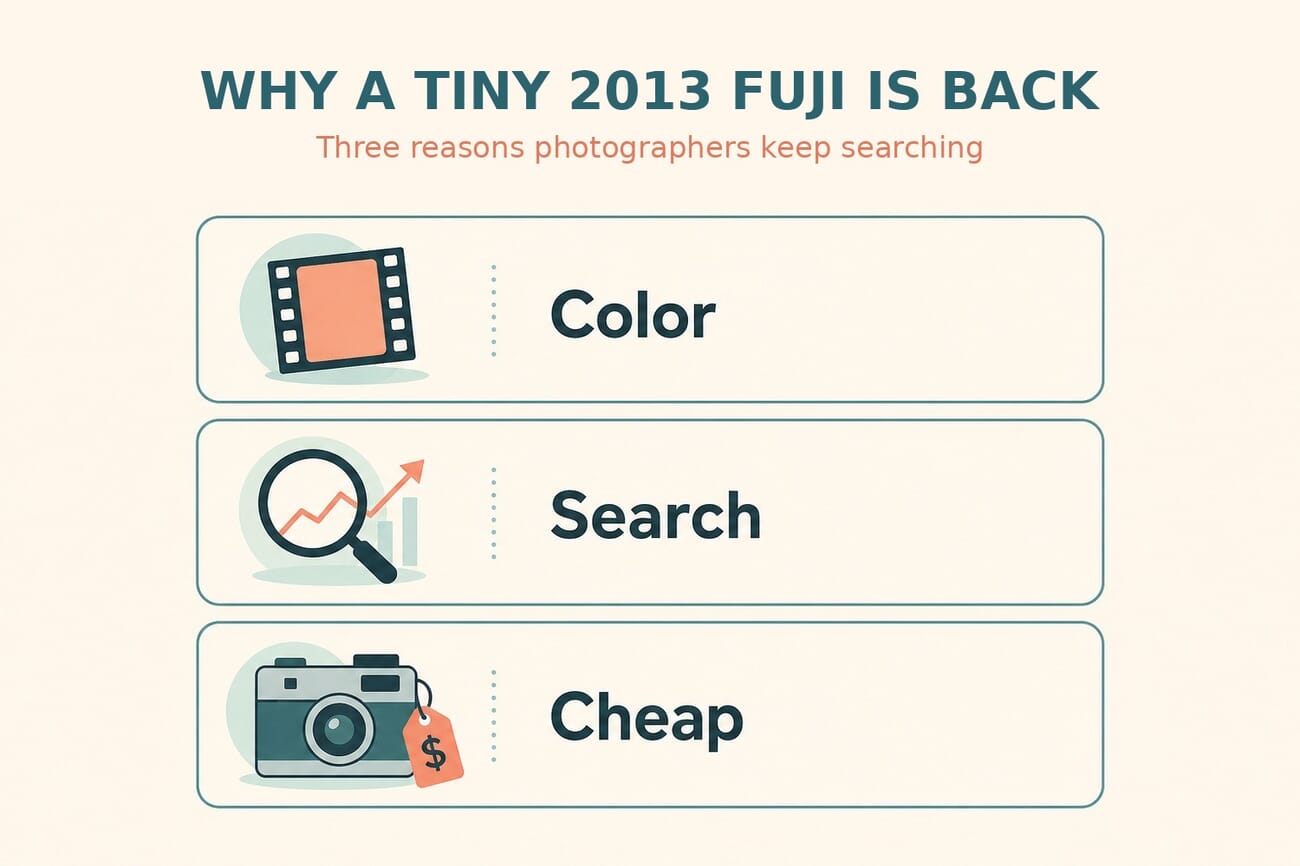
The XQ1 spike isn’t happening in a vacuum. It’s riding the same wave that has dragged dedicated compact cameras back into fashion after a decade of smartphone dominance. Three things are converging.
The color. Fujifilm’s film simulations are the single biggest reason anyone reaches for an old Fuji. They deliver a finished, shareable look straight out of camera — no editing, no presets — and the XQ1 has them in the cheapest body Fujifilm ever shipped them in. For creators raised on filters, that’s a feature, not a relic.
The trend. The TikTok “digicam” and Y2K aesthetics have billions of views, and they’ve made small, slightly-imperfect digital cameras genuinely cool again. It’s the same nostalgia current that has Nikon reviving its retro bodies and turned compacts like the Insta360 GO 3S retro bundle into talking points. A camera with physical dials and no notifications fits the “slow, intentional” shooting people say they want.
The price. The camera most associated with this look — Fujifilm’s X100VI — is still backordered into 2026 and reselling for $1,900–$2,200. When the obvious choice is unavailable and overpriced, demand spills downhill to the cheaper Fuji compacts that share the same color science. The XQ1 is about as far downhill (and as affordable) as that wave reaches. It’s the broader contraction we covered in our 2025–2026 camera market breakdown, viewed from the secondhand shelf.
What You’re Actually Getting — and Giving Up
Romance aside, the XQ1 asks for compromises. That 2/3-inch sensor is roughly 84% smaller than APS-C, so dynamic range and high-ISO performance are limited; this is a bright-light, daytime camera that gets noisy after dark. There’s no viewfinder, which matters more than you’d think in sun — a fair reminder of the EVF-versus-LCD trade-off that shapes how you shoot. And it’s a 12-year-old used purchase, so condition is everything; the same used-camera diligence you’d apply to any secondhand body applies here.
What you get in return is real: a genuinely pocketable camera with Fuji color, a bright f/1.8 wide end, and a tactile shooting experience that a phone can’t replicate — ideal for street and everyday carry. You can still find used XQ1 listings on Amazon for roughly $350–$500 depending on condition. That’s not the bargain it was at launch, but it’s a fraction of a new premium compact, and it explains why so many people are typing “Fujifilm XQ1” into Google instead of joining an X100VI waitlist.
The Bigger Picture: A Whole Class of Tiny Fujis Is Back
The XQ1 is the search-trend headline, but it’s really a stand-in for an entire era of Fujifilm compacts that are all appreciating at once. The X10, X20 and X30 (2011–2014) share the same 2/3-inch sensor lineage, add proper zoom rings and, on the X30, a built-in EVF — the X30 in particular is treated as a cult classic. The fixed-lens X70 and the earlier X100 bodies (X100S, X100T, X100F) are climbing too, often pitched as “most of the X100VI for a third of the money.” If the XQ1 is your entry point into that world, you’re early to a wave that’s still building — and unlike the X100VI, there’s no waitlist.
Frequently Asked Questions
Which Fujifilm camera is topping Google search right now?
Per The Phoblographer, it’s the Fujifilm XQ1, a premium pocket compact released in 2013. It has reportedly climbed to the top of camera-related Google searches in the US and globally.
Is the Fujifilm XQ1 a good camera in 2026?
For bright-light, casual and street shooting it’s charming and pocketable, with Fujifilm’s film simulations. But its small 2/3-inch sensor limits low-light and dynamic-range performance, and it has no viewfinder. Treat it as a fun second camera, not a primary one.
How much does a used Fujifilm XQ1 cost?
Roughly $350–$500 depending on condition and seller, versus its original $499 launch price. It’s discontinued, so all sales are on the used market.
Why are old Fujifilm compacts suddenly popular?
A mix of the TikTok “digicam” nostalgia trend, demand for Fujifilm’s film-simulation color, and the X100VI’s ongoing shortage and high resale price pushing buyers toward cheaper Fuji compacts.
What’s the difference between the XQ1 and XQ2?
The XQ2 (2015) uses the same sensor and lens but adds the Classic Chrome film simulation and slightly improved autofocus. They’re very similar; the XQ1 is usually cheaper used.
The Bottom Line
A 12-megapixel pocket compact from 2013 topping global camera searches is a strange headline — until you remember what people are actually searching for. They want Fujifilm’s color, a real camera in their pocket, and a price that isn’t four figures. The XQ1 happens to sit at the exact intersection of all three. It won’t out-shoot a modern body, but it doesn’t need to. In 2026, “good enough, characterful, and cheap” is exactly the camera a lot of photographers are looking for — and for now, this curious little Fuji is the one they’ve found.
Primary Coverage
- The Phoblographer — The Curious Little Fuji Camera Dominating Search – The report identifying the XQ1 as a top camera search
- Fstoppers — The Compact Camera Comeback Is Real – Why dedicated compacts are trending again in 2026
- Fujifilm XQ1 — specifications – Sensor, lens, film simulations and launch details
Image Sources
- Fujifilm XQ1 photo — Jnn / Wikimedia Commons (CC BY 2.1 JP) – Featured product photo, used under Creative Commons Attribution
- PhotoWorkout original illustrations – The infographic and vertical pin are original PhotoWorkout graphics (generic camera, no brand devices)
This post contains an affiliate link. If you buy through it we may earn a small commission, at no extra cost to you.