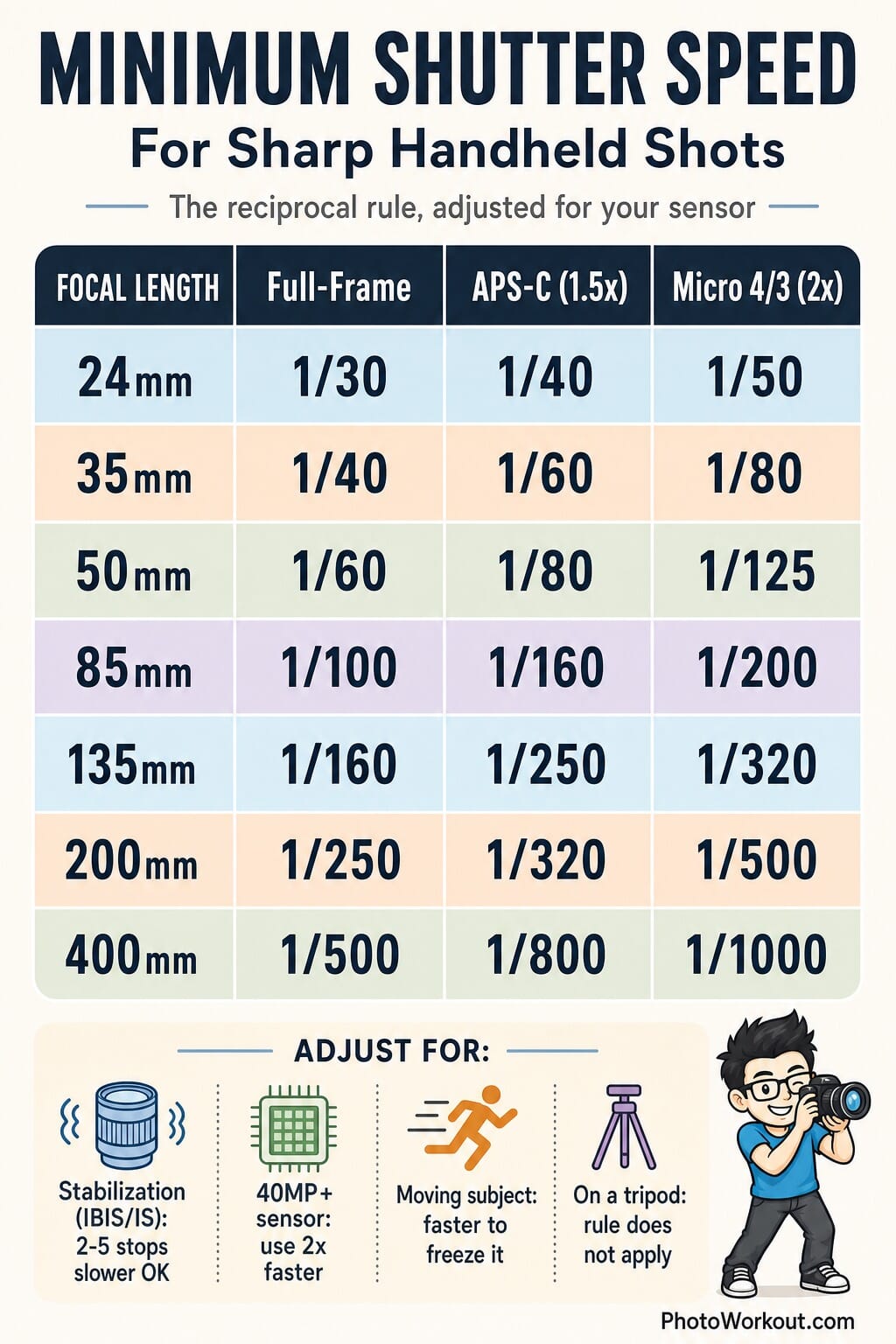


- The reciprocal rule: when handholding, keep your shutter speed at least 1/(focal length). A 200mm lens needs about 1/250s, a 50mm about 1/60s.
- That rule assumes full-frame. On APS-C multiply the focal length by 1.5 (1.6 on Canon) and on Micro Four Thirds by 2 before you do the math — crop sensors need a faster shutter.
- Image stabilization (IBIS/IS) buys back 2–5 stops, so you can shoot slower than the rule; high-resolution sensors (40MP+) need roughly 2× faster because shake shows at the pixel level.
- The rule only fights camera shake. A moving subject needs a fast shutter regardless of focal length — 1/500s and up to freeze action.
- Grab the cheat sheet below: every focal length mapped to full-frame, APS-C and Micro Four Thirds minimums, with the modifiers that change them.
You nailed the focus, the light was good, the moment was perfect — and back on the computer the shot is just slightly soft. Not out-of-focus, not obviously blurry on the phone screen, just not sharp. Nine times out of ten the culprit is the same: the shutter was open a hair too long, and tiny hand movement smeared the image while the sensor was still recording.
There is a simple rule that prevents almost all of it, and a more complete version of that rule that accounts for the gear people actually shoot in 2026 — crop sensors, in-body stabilization, and high-resolution files. This guide covers both, with a cheat sheet you can save to your phone. It pairs naturally with our guide to how focal length frames your subject, because focal length is the number this whole rule turns on.
What a too-slow shutter actually does
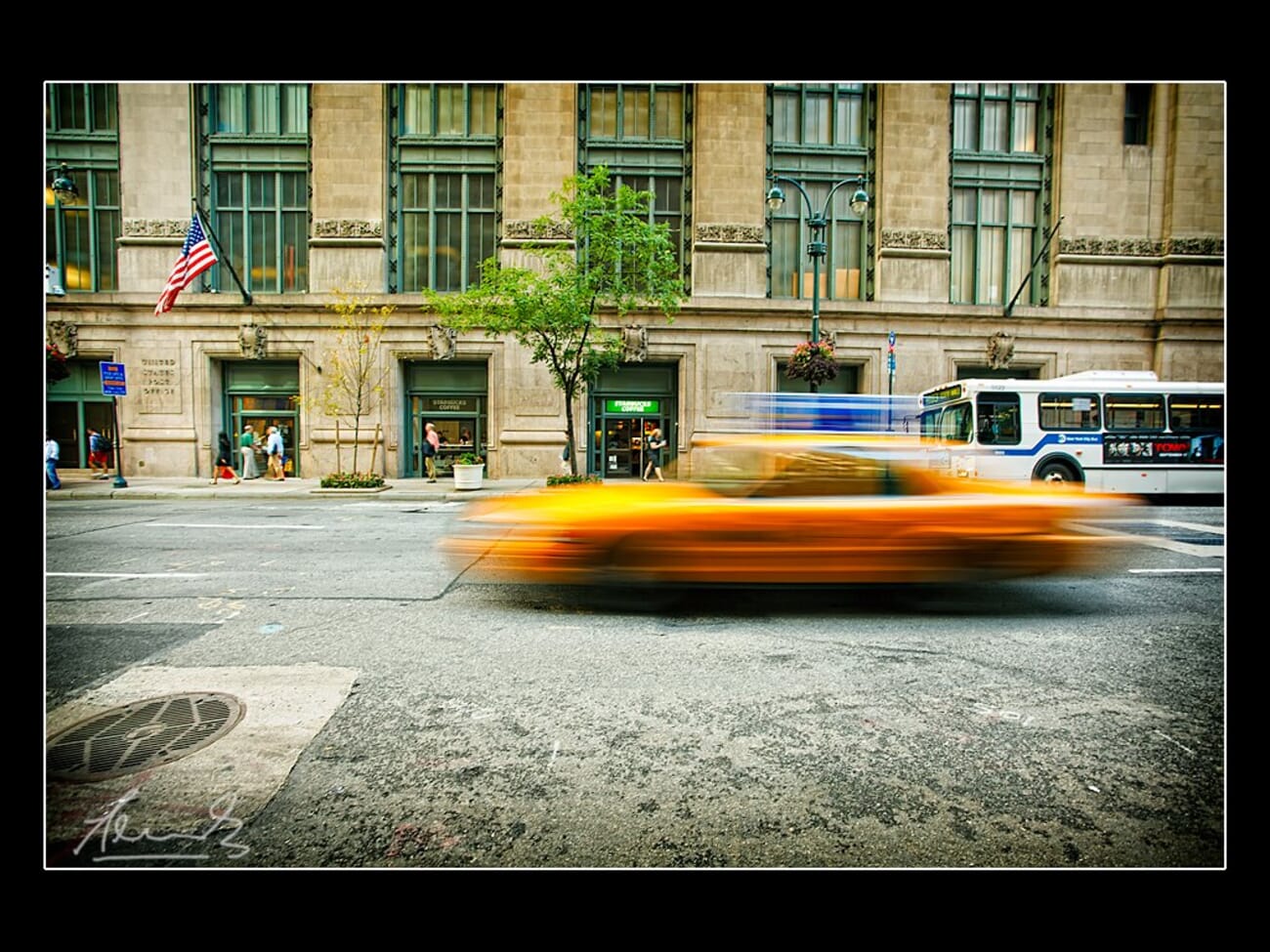
A photograph is a time exposure, however brief. While the shutter is open, the sensor records everything that happens — and if the camera moves during that window, every point of light is dragged into a short streak. The result is camera shake: a uniform, directional softness across the whole frame, distinct from a subject that is simply out of focus. The longer the lens and the slower the shutter, the more obvious it becomes, because a telephoto magnifies your hand tremor just as much as it magnifies the subject.
That is the problem the reciprocal rule solves. It gives you a floor — the slowest shutter speed you can hand-hold at a given focal length and still come away sharp.
The reciprocal rule: your shutter-speed floor

The rule is as simple as it gets: your minimum hand-held shutter speed equals 1 divided by your focal length. Shooting at 50mm? Stay at 1/50s or faster. At 200mm, you want 1/250s or quicker. At 500mm, do not drop below about 1/500s. Round up to the nearest shutter speed your camera actually offers and you have a reliable safety net.
Why does focal length set the limit? Because a longer lens magnifies everything in the frame, including the small, involuntary movements of your hands and the act of pressing the shutter. At 24mm a tiny wobble is invisible; at 400mm that same wobble is enough to turn a pin-sharp eye into a soft smear. The rule simply scales your shutter speed to keep pace with that magnification.
Crop factor changes the math (the part most charts skip)
Here is where the classic version of this rule quietly fails a lot of photographers: it assumes a full-frame sensor. If you shoot APS-C or Micro Four Thirds, your sensor crops the scene, which has the same effect as using a longer lens — and that magnified view also magnifies shake. So you have to convert to the full-frame equivalent focal length first.
- APS-C (Sony, Nikon, Fuji): multiply focal length by 1.5. A 50mm lens behaves like 75mm, so the floor is about 1/80s, not 1/60s.
- Canon APS-C: multiply by 1.6 — a touch more.
- Micro Four Thirds (OM System, Panasonic): multiply by 2. That same 50mm needs roughly 1/125s hand-held.
The cheat sheet near the end does this conversion for you across every common focal length, so you never have to run the multiplication in the field. If sensor sizes and crop factors are still hazy, our guide to mirrorless mounts and formats lays out which camera uses which.
Image stabilization buys back stops — so you can break the rule
Modern in-body image stabilization (IBIS) and lens-based stabilization (IS, VR, OSS) physically counteract hand movement, and they are remarkably good now. A system rated for five stops, in theory, lets you shoot a 50mm shot at 1/2s instead of 1/60s. In the real world, claim a more conservative 2 to 4 stops of usable benefit — technique, breathing, and the lens all play a part — and you can confidently drop two to four stops below the reciprocal floor.
One crucial caveat: stabilization fights camera shake, not subject motion. It will let you hand-hold a static landscape at a shockingly slow speed, but it does nothing to freeze a walking person or a moving car. For that, see the section below.
High-resolution sensors need more speed, not less
The flip side of progress: today’s 45MP, 60MP, and 100MP sensors resolve so much detail that they expose camera shake the classic rule used to hide. The same physical wobble now blurs across more pixels, so it shows clearly when you zoom to 100%. The widely used fix is to treat a high-resolution body as if it needs roughly double the shutter speed — shoot a 50mm at 1/125s rather than 1/60s. If you routinely pixel-peep or make big prints, lean toward the faster end of every figure in the cheat sheet.
When the rule does not apply: moving subjects and creative blur

The reciprocal rule and stabilization both address one thing only: keeping a static scene sharp from a hand-held camera. The moment your subject moves, a new limit takes over, and it is usually far faster. A walking person needs around 1/250s; a running child or a dog mid-zoomies wants 1/500s or more; birds in flight and field sports often demand 1/1000s to 1/2000s. None of that has anything to do with focal length — it is purely about how fast the subject crosses the frame. Our dog-photography settings guide works through these action speeds in detail.
And sometimes blur is exactly what you want. Panning — using a deliberately slow shutter (often 1/30s to 1/125s) while you swing the camera to track a moving subject — keeps the subject sharp and turns the background into streaks that scream motion. It breaks the rule on purpose, and it is one of the most satisfying techniques to master.
Common sharpness mistakes to avoid
- Forgetting the crop factor. A 200mm on APS-C needs ~1/320s, not 1/250s. Always convert to full-frame equivalent first.
- Trusting Auto ISO to pick a safe shutter. Many cameras default to a shutter that is too slow for a long lens — set a minimum shutter speed in the Auto ISO menu.
- Leaving stabilization on while on a tripod. On older systems IS can hunt and actually add blur on a locked-off tripod. When in doubt, turn it off when the camera is supported.
- Jabbing the shutter button. A firm press, a steady stance, elbows tucked, and an exhale before the shot do as much for sharpness as any shutter speed.
- Blaming focus for shake. If the whole frame is uniformly soft in one direction, that is camera shake — raise the shutter speed, not the focus point.
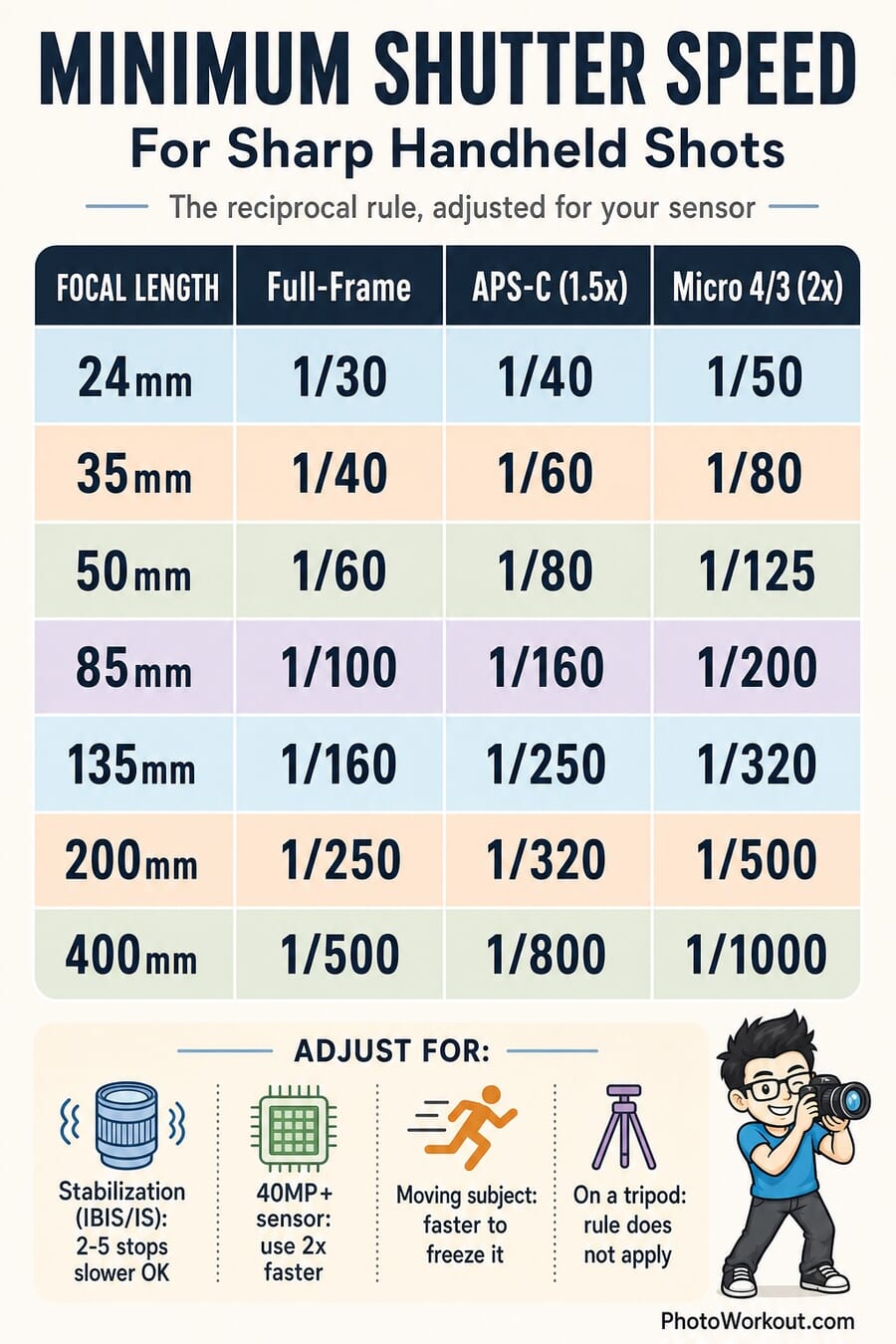
Keep the whole rule — and its modern modifiers — in one place. Save the cheat sheet below and pull it up whenever a shot has to be sharp.
Frequently Asked Questions
What is the reciprocal rule in photography?
It is a guideline for the slowest shutter speed you can hand-hold without camera shake: set your shutter speed to at least 1 divided by your focal length. A 100mm lens needs about 1/100s, a 300mm lens about 1/320s. It assumes a full-frame sensor, so crop-sensor shooters convert to the full-frame equivalent first.
Does the reciprocal rule work with crop sensors?
Yes, but you must adjust it. Multiply your focal length by the crop factor before applying the rule: 1.5 for most APS-C, 1.6 for Canon APS-C, and 2 for Micro Four Thirds. A 50mm lens on APS-C frames like 75mm, so its hand-held floor is about 1/80s, not 1/60s.
Can image stabilization let me shoot below the rule?
Yes. In-body or lens stabilization counteracts hand movement and typically buys back two to four usable stops, so a stabilized 50mm shot can be sharp at 1/15s or slower. But stabilization only fights camera shake — it will not freeze a moving subject, which still needs a fast shutter.
Why are my photos blurry even at a fast shutter speed?
If the whole frame is uniformly soft, it is likely still camera shake — try an even faster shutter or better support. If only the subject is blurred while the background is sharp, that is subject motion (use a faster shutter) or missed focus. High-resolution sensors also reveal shake that lower-resolution bodies hid, so use roughly double the shutter speed on 40MP+ cameras.
What shutter speed freezes action?
It depends on the subject, not the focal length. Roughly: 1/250s for a walking person, 1/500s for running or pets, 1/1000s for field sports, and 1/2000s or faster for birds in flight. When in doubt, go faster — you can always raise ISO to compensate.
The bottom line
Sharp hand-held photos are not luck — they are a number. Start with the reciprocal rule (1 over your focal length), convert for your sensor’s crop factor, then bend the floor slower if you have stabilization or faster if you have a high-resolution sensor or a moving subject. Internalize that and the slightly-soft shot becomes a thing of the past. Save the cheat sheet, set a minimum shutter speed in your Auto ISO menu, and let the camera keep you honest.
References
- Cambridge in Colour — Camera Shutter Speed – How shutter speed controls exposure and motion, with the reciprocal-rule rationale.
- Wikipedia — Camera shake – The cause of hand-held blur and the reciprocal-of-focal-length guideline.
- Wikipedia — Image stabilization – How IBIS/IS works and the stops of hand-holding benefit it provides.
- Wikipedia — Shutter speed – Background on exposure time and standard shutter-speed values.
Image Sources
- Featured — sharp 200mm cheetah, Mark Dumont via SampleShots – A tack-sharp telephoto frame.
- Motion-blurred taxi — sachman75 via SampleShots – Illustrates motion blur from a long exposure.
- Sharp handheld portrait — Peter Grifoni via SampleShots – Illustrates a sharp hand-held frame.
- Panning mountain biker — Trevor_Page via SampleShots – Illustrates panning / creative motion blur.
- Minimum shutter speed cheat sheet — stylized PhotoWorkout illustration – Original PhotoWorkout graphic.