


- Code in the iOS 27 beta 5 privacy disclosure points to “Apple Reference Image,” a system to verify that a photo was actually captured by an iPhone camera. It is not live, and Apple has not confirmed it.
- An opt-in “Reference mode” in the Camera app would embed provenance data, and tapping a Reference badge sends the image and its sensor signatures to Private Cloud Compute for a hardware-backed check.
- By design, Apple would receive sensor data, a hash, and the verdict, but never the raw photo itself. Apple could also revoke a sensor’s past authentications.
- The catch: as read from the beta, Apple’s approach does not use C2PA / Content Credentials, the open standard Leica, Sony, Nikon, Canon, and Google’s Pixel 10 already adopted. That risks a walled-off authentication silo.
- If it ships, roughly 1.5 billion iPhones gain a “shot on a real camera” proof, right as the EU AI Act’s provenance rules take effect. Whether it interoperates with everyone else is the open question.
The last major consumer camera brand without a photo-authenticity play is Apple, and that may be about to change. References to a feature called “Apple Reference Image” were spotted in a privacy disclosure buried in the iOS 27 beta 5, describing a system that verifies whether a photo was genuinely captured by an iPhone camera. It is not live, Apple has not announced it, and the details could shift before release. But the signal is specific enough to be worth taking seriously.
The interesting part is not just that Apple is joining the fight against AI fakes. It is how. Based on the beta code, Apple appears to be building its own hardware-backed verification path rather than adopting the open industry standard that the rest of the camera world has rallied around. For a company that ships more cameras than anyone on Earth, that choice matters.
What the iOS 27 Beta Revealed
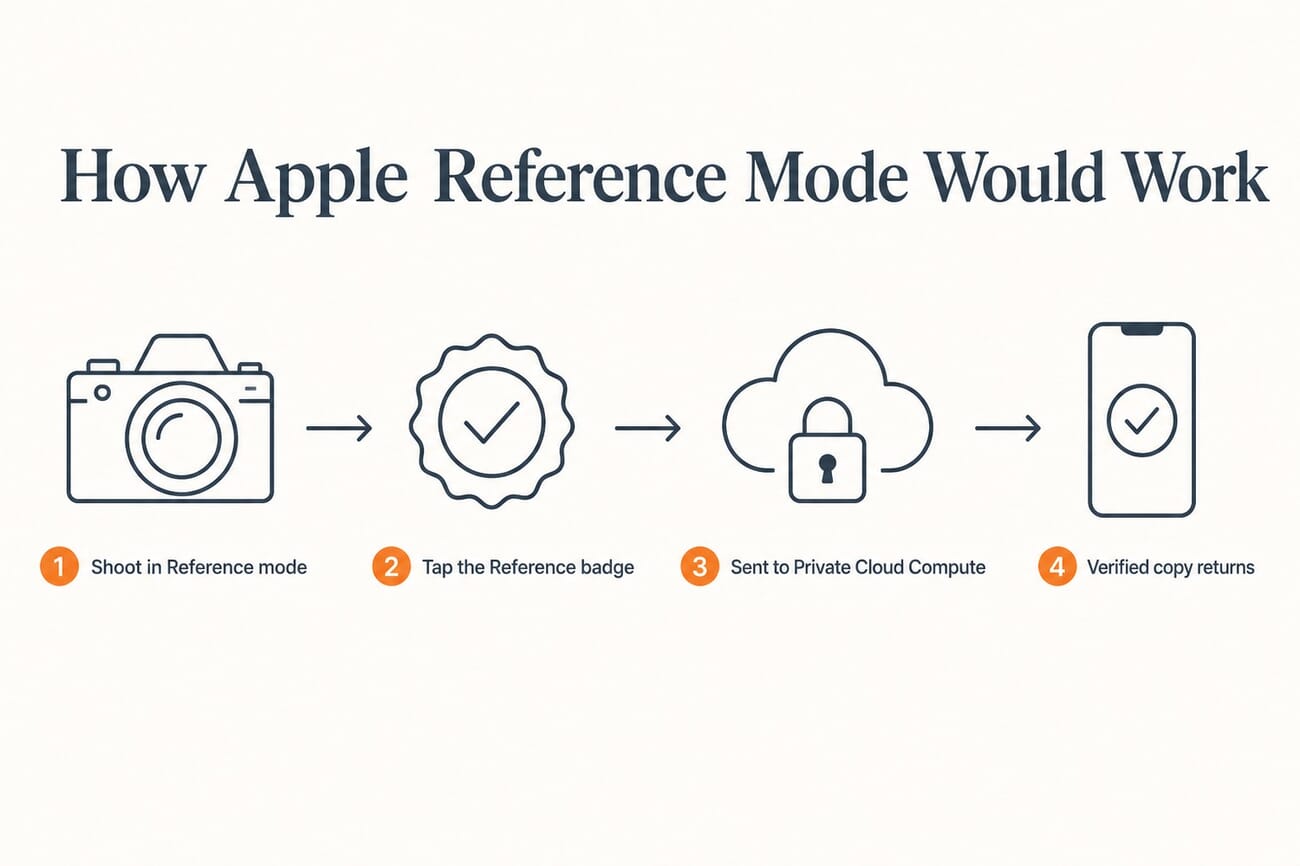
According to the disclosure, first reported by 9to5Mac and MacRumors, the Camera app would gain an opt-in “Reference” mode. Shooting in that mode embeds provenance data into the image’s metadata. Later, tapping a “Reference badge” on the photo triggers an authentication check that confirms the shot came from a genuine iPhone sensor. Because it is opt-in and per-shot, this reads as a feature aimed at professionals, photojournalists, and anyone who needs to prove an image is real, rather than something switched on for every casual snapshot.
Apple’s disclosure reportedly mentions “photos or videos” and “uncropped footage,” which hints that video could be covered too. Remember the caveat throughout: this is a beta privacy string, not an announced product, so treat the specifics as a well-substantiated signal rather than confirmed fact.
How Apple Reference Mode Would Work
The mechanism is where Apple’s privacy engineering shows. When you tap to authenticate, the system sends the raw image, the sensor’s signatures, the capture time frame, and the unique hardware identifiers of that specific sensor to Apple’s Private Cloud Compute servers. Those servers decide whether a real camera captured the photo, assign it a unique ID, and send an authenticated version back to your device.
Here is the subtle but important detail: although the raw image travels to Private Cloud Compute for the check, Apple the company only ever receives the sensor data, a hash, and the assessment result, never the raw photo itself. That is consistent with Apple’s broader Private Cloud Compute promise that user data is not stored or made visible to Apple. The system can also refuse to authenticate images from a sensor it believes is compromised, and it can retroactively revoke a sensor’s past authentications, which is a powerful and centralized lever to keep in mind.
The Catch: It May Not Speak the Same Language as Everyone Else
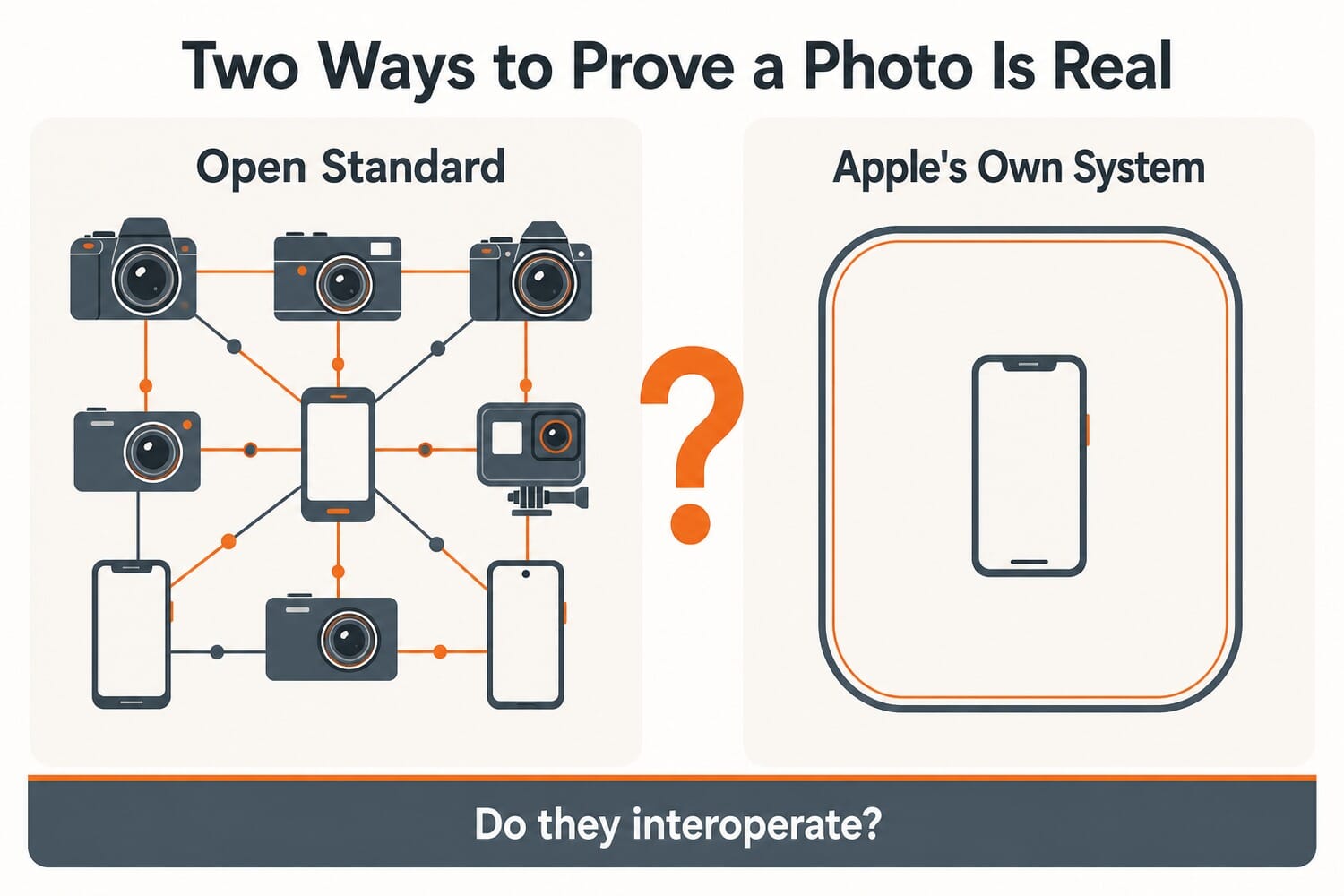
Across the camera industry, authenticity has been converging on one open standard: C2PA, better known through its Content Credentials label. Leica, Sony, Nikon, and Canon now sign photos at the moment of capture, and Google’s Pixel 10 bakes C2PA straight into its camera app, making it the cheapest way to capture a cryptographically signed “real” photo. We tracked that camera-side momentum in our look at how OpenAI watermarks its fakes while Canon signs real photos.
As read from the beta, Apple Reference Image does not appear to be built on C2PA. That is the uncovered story here. If Apple launches a proprietary scheme that only Apple devices can read and verify, the world’s most-used camera would sit inside its own authentication silo. A newsroom, a stock agency, or a rival platform that already checks Content Credentials would not automatically be able to validate an Apple-authenticated photo, and vice versa. An authenticity mark that only works inside one ecosystem solves half the problem and creates a new one.
Why Photographers Have Been Asking for This
Demand for exactly this is real and recurring. Working photographers keep running into the same wall: their genuine, lightly edited images get accused of being AI, while actual AI fakes spread freely. Threads like “AI proof watermark solution, I sell photos, not shoots” and the steady drumbeat of “how do I prove I didn’t use AI” posts show a market that wants a trustworthy “shot on a real camera” mark. We dug into that anxiety in why your best shots keep getting called fake.
Apple putting a verification badge in the hands of roughly 1.5 billion iPhone users would be the single biggest distribution of photo authentication ever. That is genuinely good for photographers, provided the mark actually travels with the image and means something outside of Apple’s own apps.
Where This Fits: Provenance Is Becoming Law
The timing is not a coincidence. Provenance is shifting from a nice-to-have to a legal expectation. The EU AI Act’s transparency rules, including Article 50, push toward machine-readable marking of synthetic and manipulated media, with key provisions landing later this year. We broke down what that means for shooters in our guide to the EU AI Act and photographers. In that climate, every major platform wants a provenance story, and Apple was the conspicuous holdout.
Frequently Asked Questions
What is Apple Reference Image?
It is an unannounced feature referenced in the iOS 27 beta 5 privacy disclosure. It would let an iPhone verify that a photo was actually captured by its camera, using an opt-in Reference mode plus a hardware-backed check in Apple’s Private Cloud Compute. Apple has not officially confirmed it.
Is Apple Reference Image available now?
No. It was only spotted in beta code and is not live. If it ships, the most likely window is the iOS 27 public release in the fall of 2026, but the feature and its details could change or be pulled.
Does Apple see my photo when it authenticates it?
Based on the beta, no. The raw image is sent to Private Cloud Compute for the check, but Apple only receives sensor data, a hash, and the result, not the raw photo. This matches Apple’s Private Cloud Compute privacy design.
Does it use C2PA or Content Credentials?
As read from the beta, it does not appear to use C2PA, the open standard adopted by Leica, Sony, Nikon, Canon, and the Pixel 10. That is the current interpretation of a beta string, and it is the main open question, because a proprietary system may not interoperate with everyone else’s tools.
Will this prove my photo is not AI?
It would provide hardware-backed evidence that a real iPhone sensor captured the image in Reference mode. It would not vouch for photos shot normally, and it may only be verifiable inside Apple’s ecosystem unless Apple adds interoperability.
The Bottom Line
If Apple Reference Image ships as the beta describes, it is a big deal: hardware-backed proof-of-real, built with Apple’s usual privacy care, handed to well over a billion people right as provenance becomes a legal expectation. The worry is interoperability. Authenticity only works if a mark means something everywhere, not just inside one company’s apps. The camera industry spent years agreeing on an open standard. The open question for the fall is whether the world’s biggest camera maker will join it, bridge to it, or wall itself off. We will know when iOS 27 ships.
Reference
- MacRumors: iOS 27 Hints at 'Apple Reference Image' Photo Authentication – Detailed reading of the beta disclosure and the authentication flow.
- 9to5Mac: Apple is working on a way to authenticate that a photo came from an iPhone – Original beta-5 code finding and privacy context.
- Engadget: Apple may introduce a photo authentication tool in iOS 27 – Coverage of the surfaced feature.
- Lumethic: Every Camera That Supports C2PA Content Credentials in 2026 – Reference for the C2PA camera adopter list.
Image Sources
- Concept illustration, flow diagram, comparison infographic, and pin – Stylized PhotoWorkout illustrations.