


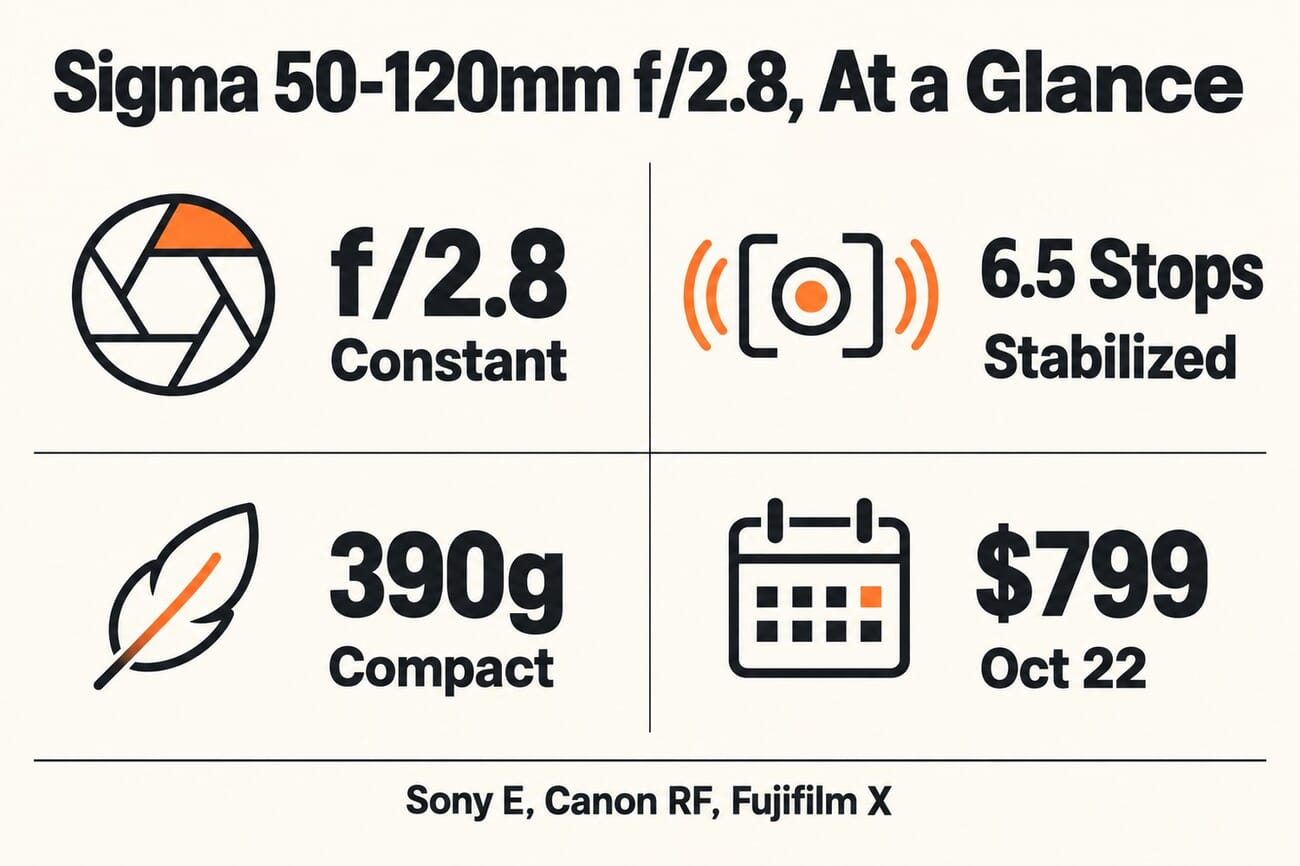
- Sigma announced the 50-120mm f/2.8 DC OS Contemporary, a compact constant-aperture telephoto zoom for APS-C mirrorless, going on sale October 22, 2026 for $799.
- It gives roughly a 75-180mm full-frame reach (about 80-192mm on Canon RF), with constant f/2.8, built-in optical stabilization rated up to 6.5 stops, an aperture ring, fast HLA linear autofocus, and minimal focus breathing.
- It weighs just ~390g and is ~99mm long, taking affordable 55mm filters. It launches in Sony E, Fujifilm X, and Canon RF mounts.
- This completes Sigma’s lightweight f/2.8 APS-C trio, joining the 10-18mm and 18-50mm, so one small kit can cover roughly 15-180mm equivalent at a constant f/2.8.
Sigma just gave APS-C shooters the telephoto they have been waiting for. The 50-120mm f/2.8 DC OS Contemporary, announced this week, is a compact constant-f/2.8 zoom that reaches into portrait and short-telephoto territory while staying small enough to carry all day. It goes on sale October 22, 2026 for $799 in Sony E, Fujifilm X, and Canon RF.
What makes this one matter is not just the lens itself, but what it finishes. With the 50-120mm, Sigma now offers a complete set of lightweight constant-f/2.8 zooms for crop-sensor cameras. Here is what it does, how it stacks up against the brand-new Tamron 16-50mm, and why Canon RF owners should take note.
What Sigma announced
The 50-120mm f/2.8 DC OS covers a 50-120mm zoom range, which works out to roughly a 75-180mm full-frame equivalent on Sony and Fujifilm bodies, and closer to 80-192mm on Canon RF, where the crop factor is 1.6x. That is a genuinely useful telephoto span for portraits, events, sports, and detail work, all at a bright, constant f/2.8.
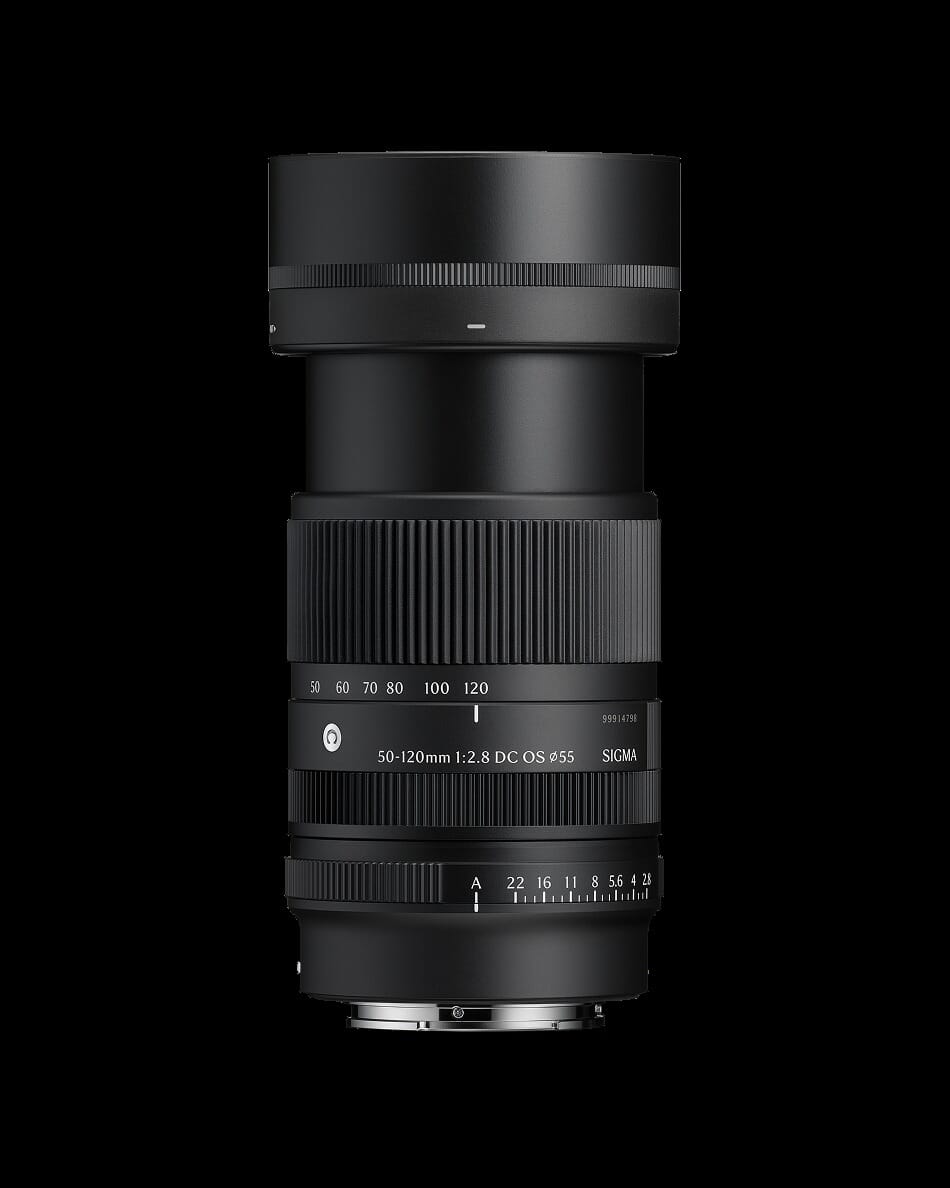
For a lens like this it is remarkably small: about 390g on the scale, roughly 99mm long, and threaded for inexpensive 55mm filters. Sigma packed in features that punch above the price. There is built-in optical stabilization rated up to 6.5 stops, a dedicated aperture ring, an HLA (High-response Linear Actuator) autofocus motor for fast, quiet focusing, and a design that keeps focus breathing to a minimum, which matters for video. In other words, this is not a stripped-down budget zoom; it is a properly specified telephoto in a compact body.
The lens that completes Sigma’s APS-C f/2.8 trio
The headline story is the set, not the single lens. Sigma already made two small constant-f/2.8 zooms for crop-sensor mirrorless: the 10-18mm f/2.8 for wide-angle and the ever-popular 18-50mm f/2.8 for the standard range. The 50-120mm slots in on top as the telephoto. Put all three in a bag and you cover roughly 15-180mm full-frame equivalent at a constant f/2.8, in three lenses that together weigh about as much as a single full-frame zoom.
That is a big deal for anyone who bought into APS-C for size and weight and then felt stuck with slow kit glass. For the full lineup and where each one fits, our guide to the best Sigma lenses walks through the Contemporary range in detail. Notably, the 50-120mm is the most feature-rich of the trio, it is the only one with optical stabilization and an aperture ring, which makes sense given that long focal lengths are where stabilization earns its keep.
How it compares to the new Tamron 16-50mm
Tamron announced its own compact APS-C constant-f/2.8, the 16-50mm f/2.8, just a day earlier, so it is natural to compare them. In truth they are complementary rather than competing: the Tamron is a wide-to-standard zoom, while the Sigma is the telephoto. Pair the two and you have a lightweight two-lens f/2.8 kit covering roughly 24-180mm equivalent.
Where they do differ is features. The Sigma 50-120mm has optical stabilization and an aperture ring; the Tamron 16-50mm has neither and leans on in-body stabilization instead. The Sigma also costs more ($799 versus around $529 for the Tamron), which tracks with the longer reach, the stabilizer, and the extra controls. Both are small, both are bright, and both are great news for APS-C shooters.
The Canon RF angle
Canon RF is again the most interesting mount on the list. For years Canon kept RF closed to third parties; now the 50-120mm joins a growing shelf of native RF-mount options for APS-C R-series cameras like the R7, R10 and R50. The same caveat we raised in our best 24-70mm lenses for Canon roundup still applies, though: this opening is for APS-C only. There is still no native RF full-frame third-party standard zoom, so on a full-frame R5, R6 or R8 the 50-120mm would operate only in cropped mode. On an APS-C Canon body, it is a welcome addition to a once-barren third-party shelf.
Early hands-on impressions
Early reviewers are enthusiastic, with several framing the 50-120mm as one of the lenses that justifies choosing APS-C in the first place. In the hands-on below, Pav SZ walks through how it handles, how the stabilization performs, and where this focal range fits in a real shooting kit.
You can watch for pre-orders and current pricing at retailers like B&H Photo ahead of the October 22 on-sale date.
Frequently Asked Questions
Does the Sigma 50-120mm f/2.8 have image stabilization?
Yes. It includes Sigma’s optical stabilization (OS) rated up to 6.5 stops, which is especially valuable at the longer end of the zoom range. That stabilization is one of the main things separating it from the new Tamron 16-50mm f/2.8, which has no built-in OS.
What is the full-frame equivalent focal length?
On Sony E and Fujifilm X (1.5x crop) it is roughly a 75-180mm equivalent. On Canon RF (1.6x crop) it is closer to 80-192mm. Either way it behaves like a short telephoto zoom, well suited to portraits, events and sports.
Will it work on a full-frame Canon R5 or R6?
Only in cropped mode. The 50-120mm f/2.8 DC OS is an APS-C (DC) lens. Mounted on a full-frame RF body it forces a crop, using a fraction of the sensor. It is designed for APS-C Canon cameras like the R7, R10 and R50.
When does it go on sale and how much is it?
It goes on sale October 22, 2026 at $799, in Sony E, Fujifilm X, and Canon RF mounts.
The bottom line
The Sigma 50-120mm f/2.8 DC OS is the lens APS-C shooters have been missing: a compact, stabilized, constant-aperture telephoto that finally lets a crop-sensor kit go long without going heavy. On its own it is a strong portrait and events lens. As the final piece of Sigma’s 10-18, 18-50 and 50-120 trio, it is something more, proof that you can build a complete, lightweight f/2.8 system on APS-C. For Canon RF crop-sensor owners especially, it is another option that simply did not exist a couple of years ago.
Specs, pricing and availability verified against Sigma's official announcement at the time of publication.