

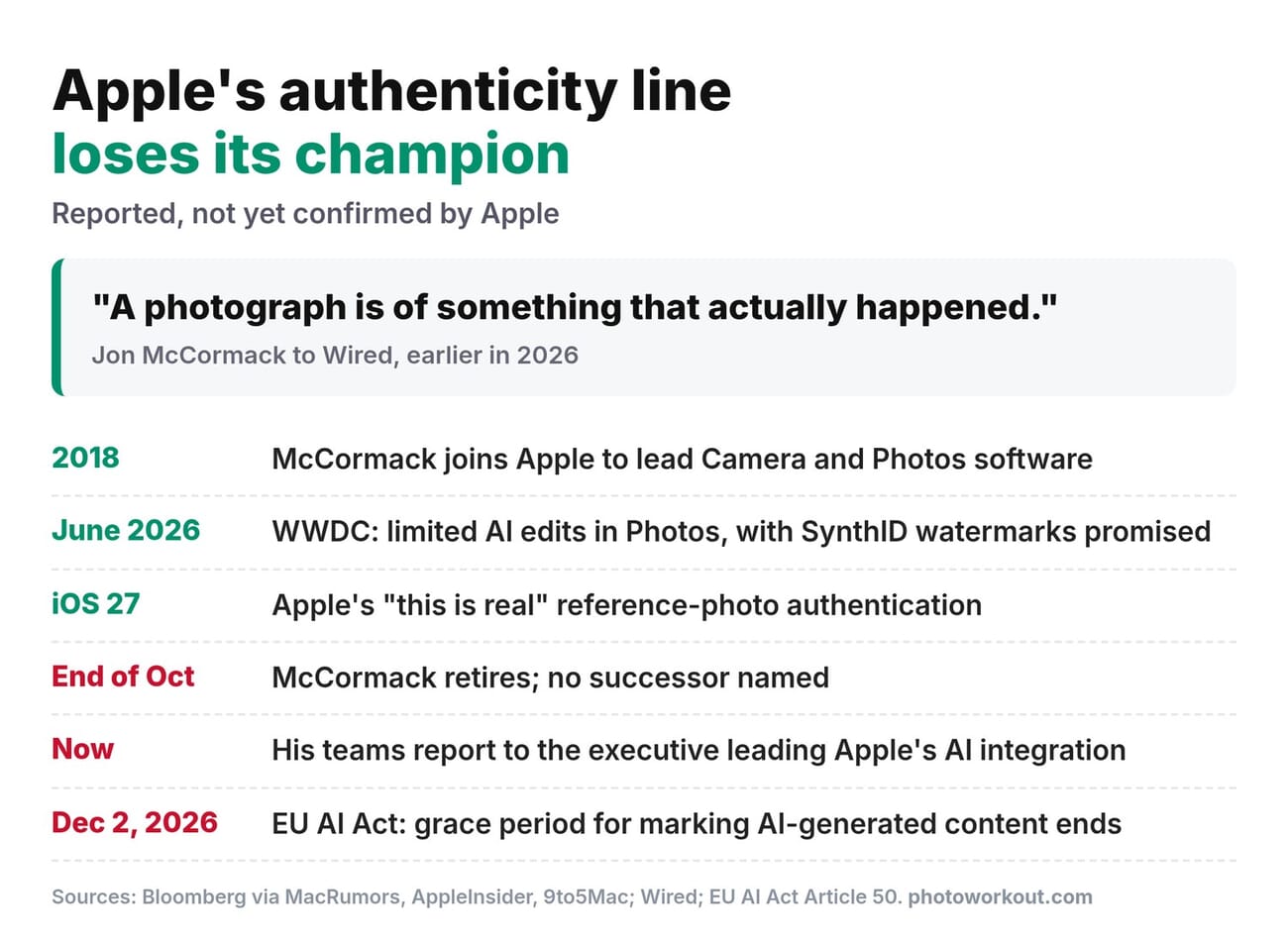
- Jon McCormack, Apple’s vice president of Camera and Photo Software Engineering since 2018, retired at the end of October, Bloomberg’s Mark Gurman reported on November 19. Apple has not publicly confirmed it.
- McCormack was Apple’s best-known voice against letting generative AI invent or alter photos. “A photograph is of something that actually happened,” he told Wired earlier this year.
- According to Bloomberg’s sources, the retirement was not a dispute over Apple’s AI strategy. No successor has been named.
- His teams now report to Sebastien Marineau-Mes, the executive leading AI integration across Apple’s operating systems. That is a structural shift, not a policy change: Apple’s stated camera philosophy has not changed.
- The timing matters: Apple is building “this is real” photo authentication into iOS 27, and the EU’s grace period for marking AI-generated content ends on December 2, 2026.
Every major phone maker has spent the last three years teaching its camera to invent things: moons with more detail than the lens captured, faces swapped from another frame, whole backgrounds filled in by a model. Apple was the conspicuous holdout, and the person most associated with that restraint has now left.
Jon McCormack, who ran the software behind the iPhone’s Camera and Photos apps, retired at the end of October after more than eight years at Apple, according to a November 19 report by Bloomberg’s Mark Gurman. The news itself is a personnel story. What it means for the photos in your camera roll is the more interesting question.
What Was Reported
McCormack joined Apple in 2018 from Amazon, after earlier years at HP, as vice president of camera and photo software engineering. His organization owned the software that determines how iPhone owners capture, view and edit their pictures and video: the Camera app, the Photos app, and the processing pipeline in between. A photographer and conservationist himself, he gave the occasional interview but mostly stayed out of the spotlight.
Three details from the reporting matter, and each comes with a caveat. First, the retirement is reported, not confirmed: Apple and McCormack had not commented publicly when the story ran. Second, Bloomberg’s sources say it was not a disagreement over Apple’s AI direction, so there is no evidence this was a protest exit. Third, Apple has not named a new vice president for the role. McCormack’s deputies are taking over his responsibilities and now report to Sebastien Marineau-Mes, who oversees the integration of AI features across Apple’s operating systems.
The Philosophy He Stood For
McCormack put Apple’s position into one sentence when Wired interviewed him around this year’s WWDC: “A photograph is of something that actually happened.” He went on to describe the camera roll as “authentic journalism to your own life”, and said Apple wanted tools that “keep the sanctity of that moment.”
That stance shaped real product decisions. When Apple did add generative edits to Photos at WWDC 2026, they were narrow and fenced in: the new reframe and extend tools can only expand an image once, and Apple said edited images would carry Google DeepMind’s SynthID watermark so platforms can flag them. Compare that with rivals that let you change a sky to match your memory or assemble the perfect group shot from several frames. Apple’s restraint was a choice, and McCormack was its most visible defender.
Why the Reporting Line Matters
Org charts usually make poor news. This one is worth a paragraph because of where the camera software teams landed. Under McCormack, the Camera and Photos organization had a leader whose public identity was authenticity. Now it sits under the executive whose job is to push AI into every part of Apple’s software. Nothing about that is sinister, and it may simply reflect that the camera has become Apple’s most important AI surface. But the internal advocate whose title and reputation were tied to restraint is no longer in the room, and his replacement has not been chosen.
There is a counter-argument worth stating plainly: Apple’s authenticity stance was never one person’s hobby. It is also a product strategy, and arguably a growing one. Apple is building a “this is real” reference-photo feature into iOS 27, and it is betting that provenance becomes a selling point as AI fakes become indistinguishable. A policy embedded in product roadmaps can outlive its loudest champion.
The “Prove It’s Real” Moment
The departure lands at an awkward moment for the whole industry. On December 2, 2026, the EU AI Act’s grace period ends for providers of generative AI that were already on the market: from then on, AI-generated content must be marked in a machine-readable way, with fines of up to 15 million euros or 3 percent of turnover. At the same time, the provenance standards meant to carry that marking are proving fragile, as PhotoWorkout reported when researchers forged C2PA camera credentials in October.
In that world, a phone maker that treats “this actually happened” as a feature has a real differentiator. The open question is whether Apple keeps funding and defending that differentiator now that its strongest internal voice has retired, or whether the gravitational pull of AI integration slowly reshapes what the iPhone camera is willing to invent.
What to Watch
Three signals will answer the question faster than any statement. Who Apple names to run camera software, if anyone, and whether that person comes from the imaging side or the AI side. Whether iOS 27’s authentication features ship as announced and work across platforms. And whether WWDC 2027 introduces generative capture features, the kind that alter a photo at the moment it is taken rather than in a clearly labeled edit. Until then, the honest summary is simple: nothing has changed in your iPhone camera, but the person who most often explained why it would not change has left.
Frequently Asked Questions
Who is Jon McCormack?
Jon McCormack was Apple’s vice president of Camera and Photo Software Engineering from 2018 until his reported retirement at the end of October 2026. He oversaw the software behind the iPhone’s Camera and Photos apps and was known for opposing generative AI that creates or alters photographs.
Did Jon McCormack leave Apple over AI?
No evidence suggests that. Bloomberg’s sources said his retirement was not related to a disagreement over Apple’s AI strategy. Apple had not publicly commented at the time of reporting.
Will the iPhone camera start using generative AI now?
Nothing has been announced. Apple’s stated camera philosophy is unchanged, and its existing generative edits in Photos are limited and watermarked. The change is structural: the camera software teams now report to Apple’s AI integration lead, and no successor has been named.
What is the EU’s December 2, 2026 deadline?
It is the end of the EU AI Act’s grace period for providers of generative AI systems already on the market before August 2, 2026. From December 2, AI-generated content must be marked in a machine-readable format, with fines of up to 15 million euros or 3 percent of global turnover.
Bottom Line
Apple’s camera did not change on November 19. What changed is who is left inside Apple to say no. The authenticity stance McCormack articulated is now a product strategy without its founding spokesperson, sitting inside the AI organization, two weeks before Europe starts demanding that AI images identify themselves. Watch who Apple appoints, and watch what the iPhone camera is allowed to invent.
The retirement is reported by Bloomberg and not yet confirmed by Apple; all details were checked against the outlets below on November 21, 2026.
Reporting
- MacRumors: Apple's camera app VP retires (Bloomberg report) – Bloomberg's Mark Gurman report, end-of-October retirement
- AppleInsider: iPhone camera chief Jon McCormack has retired – Career background: Amazon, HP, joined Apple 2018
- 9to5Mac: Apple head of camera software retires – Bloomberg: not related to a disagreement over AI strategy
- Free Press Journal: no direct successor named – Deputies now report to Sebastien Marineau-Mes
- Wired: Apple's camera chief thinks AI can give you superpowers – The "actually happened" quote and the SynthID plan
Regulation
- EU AI Act, Article 50 transparency obligations – Marking of AI-generated content; grace period ends December 2, 2026
Image Sources
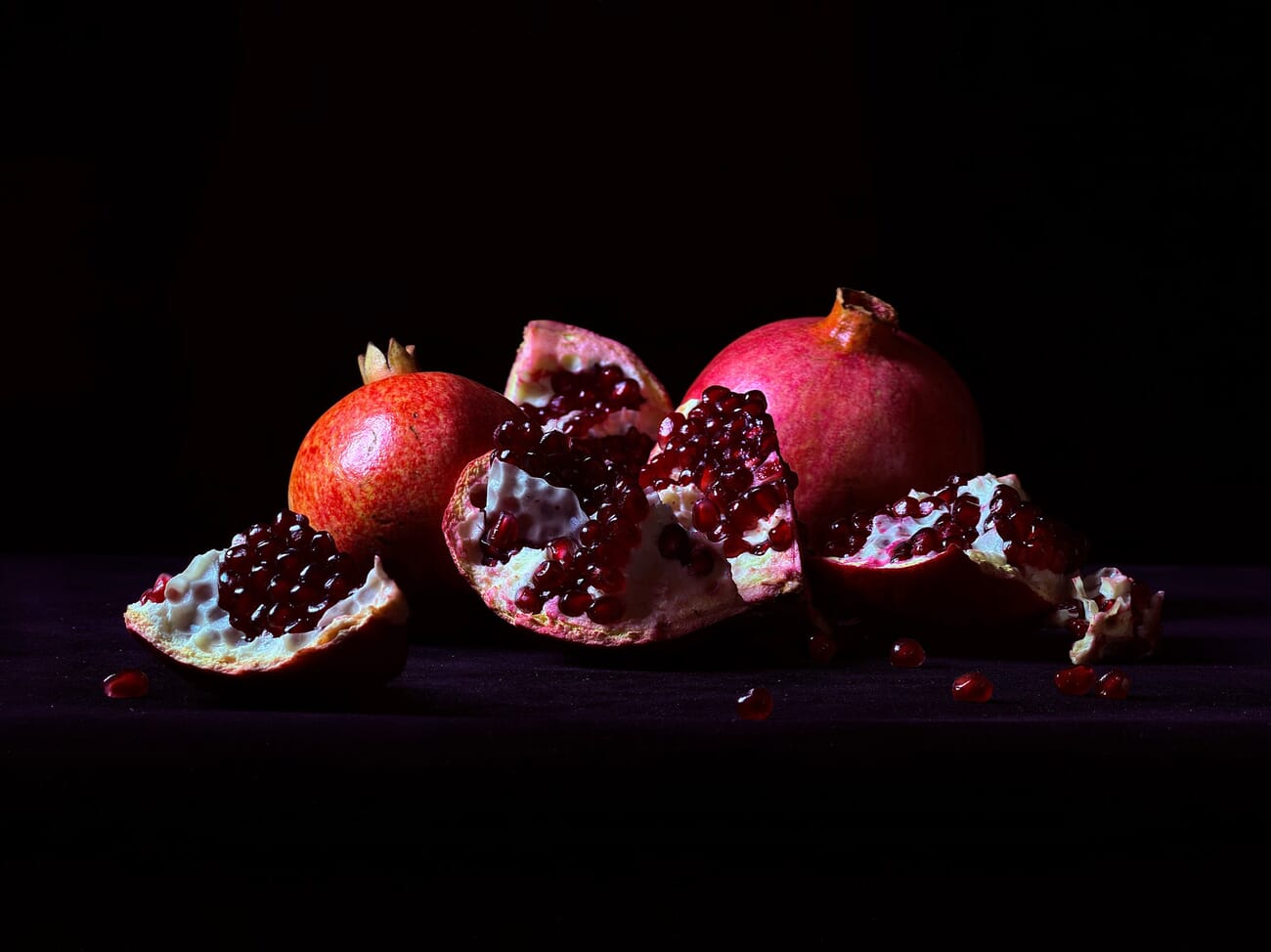
- Featured image and iPhone 17 Pro sample photo: Apple – Official Apple Newsroom press images
- Timeline infographic – Infographic by PhotoWorkout
- Pinterest graphic – PhotoWorkout graphic using an Apple press image