


- Best overall: the Portkeys LH5P III ($399) pairs a 2,200-nit, per-unit calibrated 5.7-inch screen with wired and wireless camera control and touch focus tracking.
- Best value: the NEEWER F700 gives you a 2,000-nit 7-inch screen, full scopes and two batteries for $215.59, sold by Amazon.
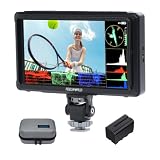
- Brightest for the money: the Viltrox DC-A1 hits 2,800 nits with 4K60 loop-through for $222.40; the FEELWORLD FW568 PRO is the pick under $150.
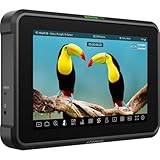
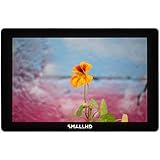
- SDI and pro crews: the Atomos Shinobi 7 RX ($799) and Portkeys BM7 II DS ($809) add SDI; the SmallHD Indie 7 ($995) is the PageOS crew standard.
- New since April: Atomos Shinobi 7 II (2,800 nits, $499), Portkeys LH5P III and SmallHD Focus 504. All picks rechecked for stock and price on November 27, 2026.
The midday sun washes out your camera’s rear screen, peaking disappears, and a Log image looks gray and flat. A field monitor fixes all three: a bigger, brighter screen to judge focus and exposure, scopes that tell you the truth, and a LUT preview of what your footage will look like after grading.
The short answer: the best field monitor for most prosumer and indie filmmakers is the Portkeys LH5P III, a bright, calibrated 5.7-inch screen that also controls your camera. If you want a 7-inch screen on a budget, buy the NEEWER F700. If you shoot in full sun, the 2,800-nit Viltrox DC-A1 costs about the same. If your camera speaks SDI, look at the Atomos Shinobi 7 RX or Portkeys BM7 II DS.
This guide was rebuilt on November 27, 2026 for the Black Friday and Christmas sales. Every Amazon listing was checked for stock, seller and price, three picks were replaced, two specification errors from the April version were corrected, and new sections cover brightness, camera control, setup and the monitors launched since spring.
Top Picks


When you buy through links on our site, we may earn a commission at no cost to you. We evaluate products independently. Commissions do not affect our evaluations.
Field Monitors Compared
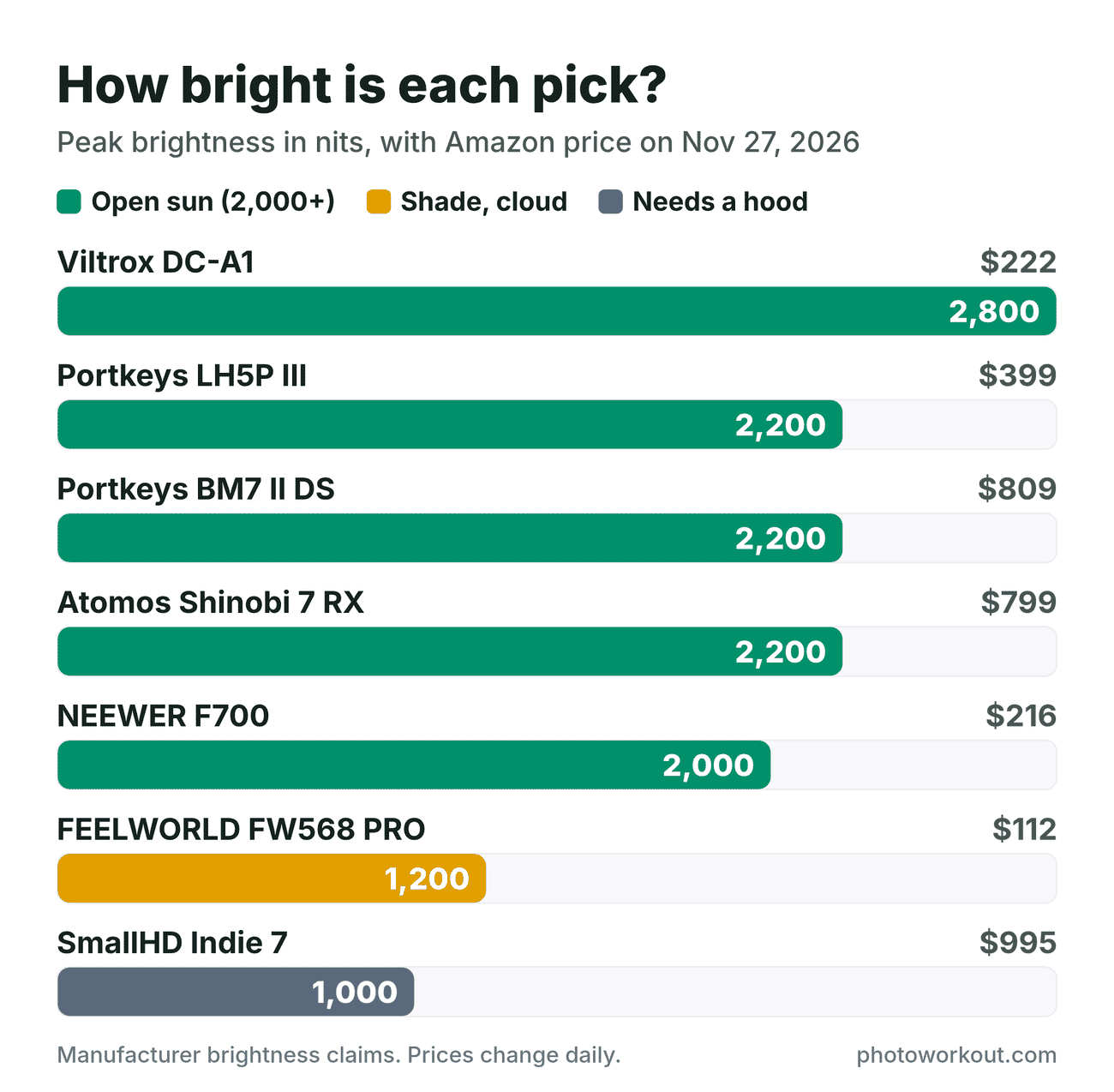
The table lines up all seven picks on the specs that decide this purchase: screen size, brightness, inputs and outputs, SDI, camera control and power. Brightness decides whether you can see the image outdoors; SDI decides whether the monitor fits a cinema camera; camera control decides whether you can work the camera from the monitor. The chart below shows how bright each pick is against its price.
Best Field Monitors 2026: 7 Picks Side by Side
| Specifications | |||||||
|---|---|---|---|---|---|---|---|
| Rating | 93/100 | 90/100 | 88/100 | 87/100 | 86/100 | 84/100 | 82/100 |
| Screen | 5.7-inch | 7-inch | 7-inch | 7-inch | 7-inch | 7-inch | 6-inch |
| Resolution | 2160 x 1080 | 1920 x 1080 | 1920 x 1080 | 1920 x 1080 | 1920 x 1080 | 1920 x 1200 | 1920 x 1080 |
| Brightness (nits) | 2,200 | 2,000 | 2,800 | 2,200 | 2,200 | 1,000 | 1,200 |
| Panel | 10-bit, Calman calibrated per unit | IPS, auto backlight sensor | IPS, 8-bit, Rec.709 | IPS, 85% DCI-P3 | HDR, 10+ stops | IPS | IPS |
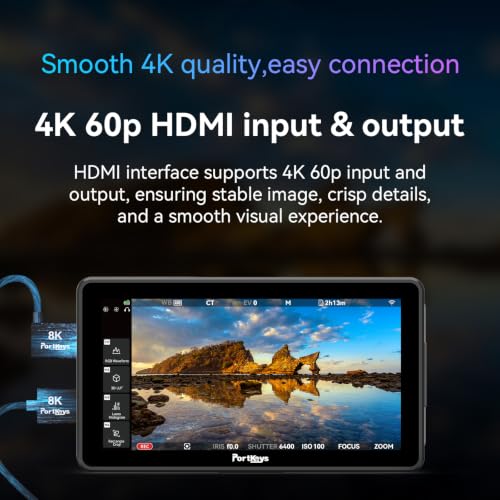
| HDMI | HDMI 2.0 in/out (4K60) | HDMI in/out (4K30) | HDMI 2.0 in/out (4K60) | HDMI in, 2x 3G-SDI in, 1x SDI out | HDMI 2.0 in/out (4K60) + 3G-SDI in/out | HDMI in/out | HDMI 2.0 in/out (4K60) |
| SDI | No | No | No | Yes (2 in, 1 out) | Yes (in/out, cross-conversion) | Yes (3G-SDI in/out) | No |
| Camera control | Wired and wireless, touch focus tracking | No | No | Wired and wireless | Wi-Fi camera control | Optional (RED licenses) | No |
| Power | NP-F plate, USB-C PD | 2x NP-F750 included, USB-C, DC | NP-F (NP-F550 included), USB-C 9V, DC | NP-F, DC | 2x L-series slots, USB-C PD | Battery brackets, DC | NP-F, USB-C 5V; 8.4V DC out |
| Amazon price Nov 27 | $399 | $215.59 | $222.40 | $809.10 | $799 | $995 | $111.99 |
The 7 Best Field Monitors
The picks are ranked for prosumer and indie shooters working on mirrorless and small cinema cameras: run-and-gun, gimbal, interview and short-film work. Each box shows the live Amazon price, and each review ends with who should buy it.
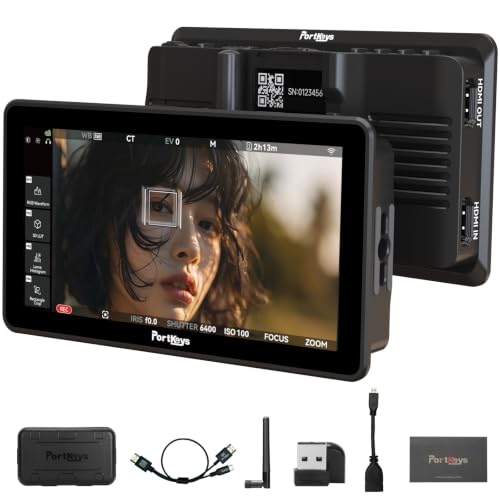
Portkeys LH5P III 5.7-Inch: Best Field Monitor Overall
hybrid shooters on Sony, Canon, Nikon, Panasonic or Blackmagic bodies who want a bright, compact monitor that also controls the camera
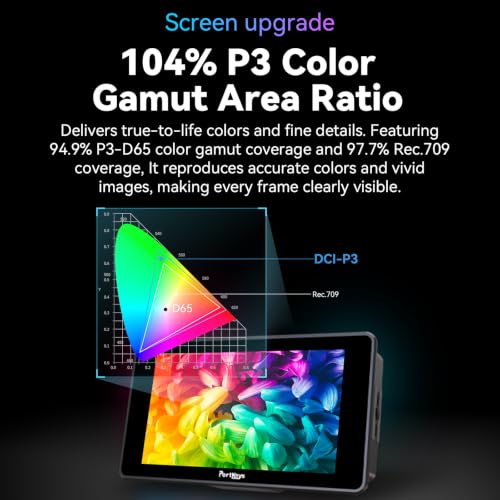
- 2,200 nits on a 5.7-inch panel, readable in daylight without a hood
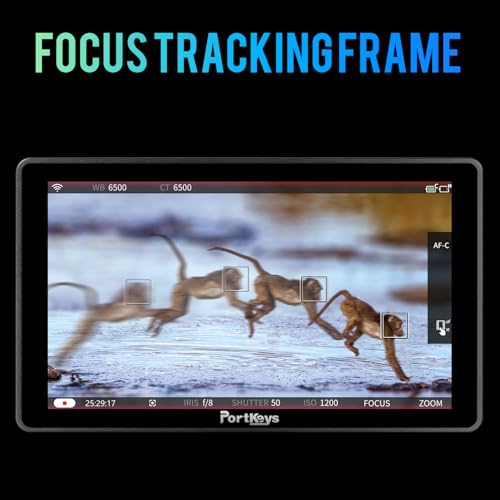
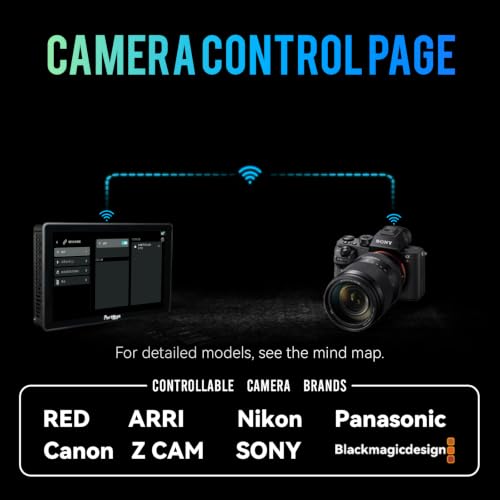
- Wired and wireless camera control (ISO, shutter, aperture, record) with touch focus tracking on supported Sony and Canon bodies
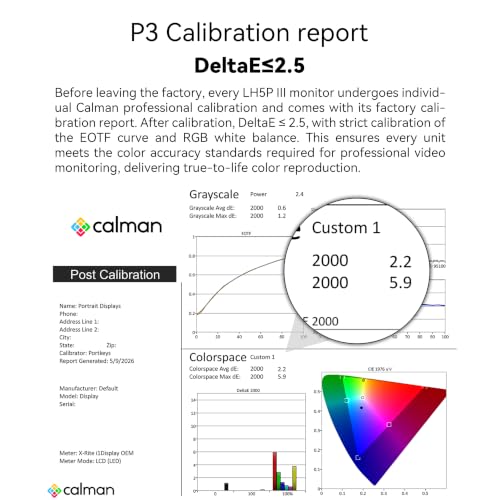
- Every unit is Calman calibrated and ships with its own report; Portkeys quotes Delta E 1.1 or better in Rec.709
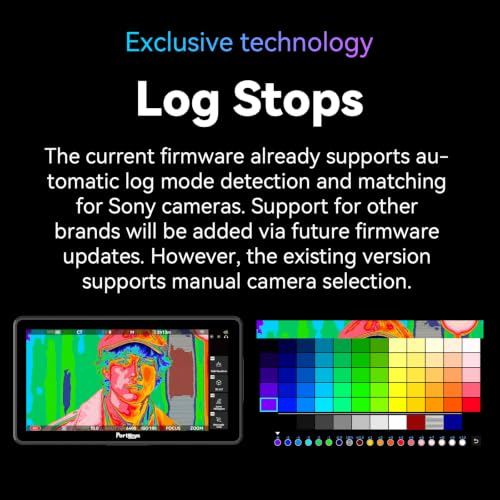
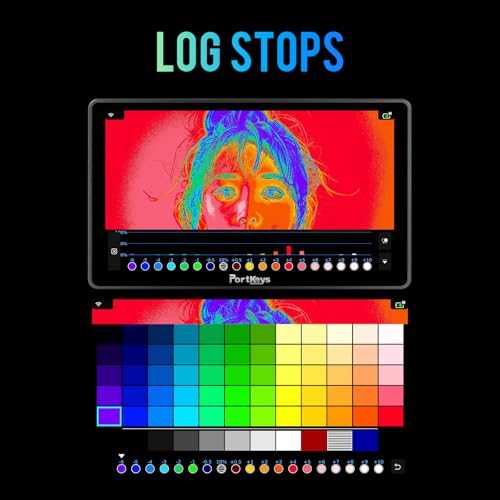
- Log Stops tool reads a Log signal in 13 or more exposure zones and shows them in stops, not IRE
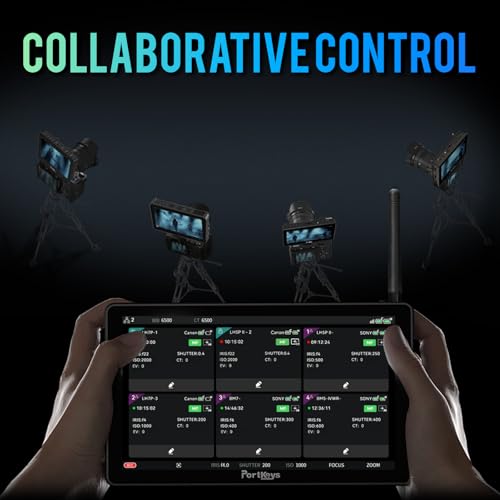
- One-to-many mode controls up to four other Portkeys-equipped cameras from one monitor, within about 50 m
- HDMI only: no SDI for cine bodies or long cable runs
- Log auto-detection works with Sony Log for now; other brands are selected manually
- The Amazon listing carries over reviews from earlier LH5P generations, so its 224 ratings say little about the Mark III
The best all-round field monitor for one-person crews in late 2026: bright, accurate, small, and it turns into a camera remote.
Why it leads:
Most prosumer shooters need three things from a monitor: see focus and exposure in daylight, preview Log footage with a LUT, and change settings without reaching around a gimbal or cage. The LH5P III does all three for $399. Portkeys showed it at IBC in September 2026 as the third generation of its HDMI camera-control monitor, with a wider 2160 x 1080 panel that keeps the full 16:9 image visible next to a strip of touch controls.



Camera control that works:
Over the bundled split HDMI plus USB-C cable, the monitor changes shutter, aperture, ISO and record on a long list of Sony, Canon, Panasonic and Nikon bodies, and on Sony cameras a tap on the screen starts AF tracking on that subject. Wireless control runs over Wi-Fi or Bluetooth depending on the camera, including the Nikon Z8 and Z9, Canon R5 and R6 bodies and Blackmagic cinema cameras. It controls the camera; it does not transmit video.
Exposure tools:
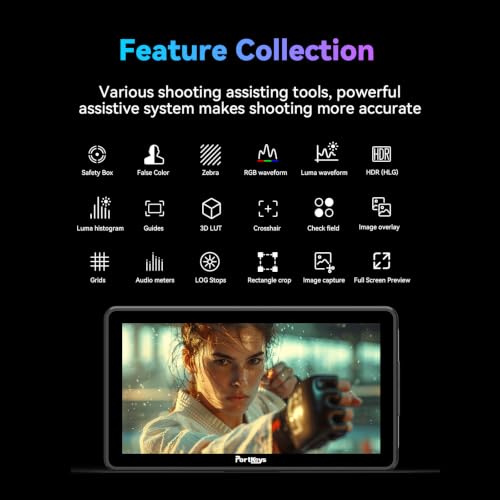
Besides false color, waveform, zebras, peaking and 3D LUTs loaded from USB, the Log Stops view divides a Log image into zones and labels them in stops over or under, which is easier to act on than an IRE number on a small screen.
Verdict:
Choose the LH5P III unless you need SDI or a 7-inch screen. It was $399 from the Portkeys Official Store on Amazon on November 27, 2026. Also at B&H Photo.
NEEWER F700 7-Inch: Best Value 7-Inch Field Monitor
solo creators, wedding videographers and YouTubers who want a big, bright 7-inch screen and complete scopes on a small budget
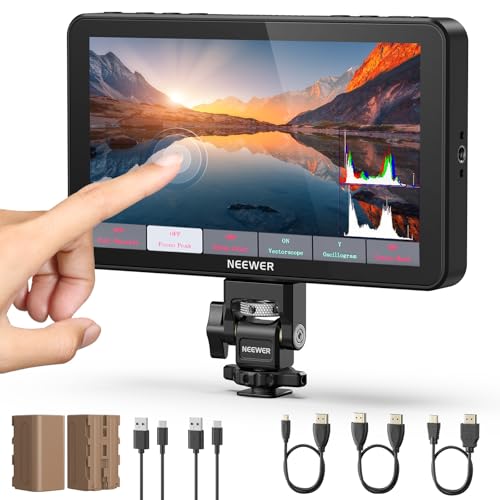
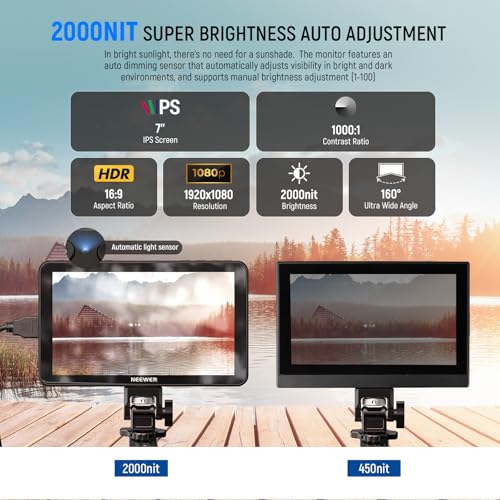
- 2,000-nit 7-inch touchscreen with an ambient light sensor that adjusts brightness for you
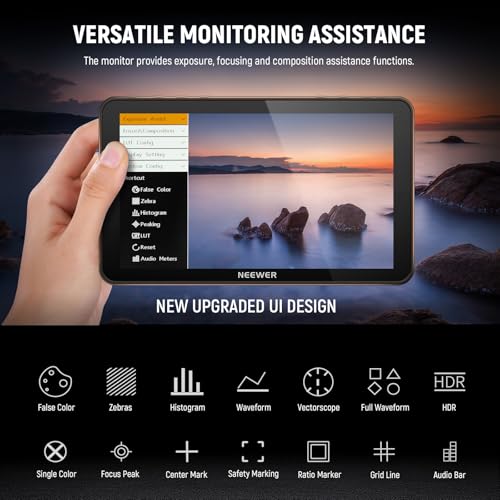
- Full toolset: false color, zebras, waveform, vectorscope, histogram, peaking and HDR preview
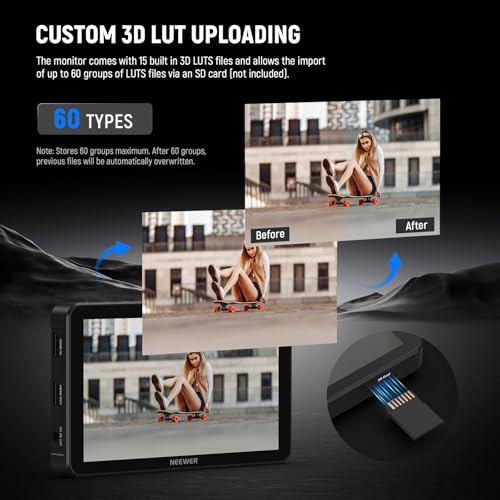
- 15 built-in 3D LUTs plus up to 60 custom LUTs from an SD card
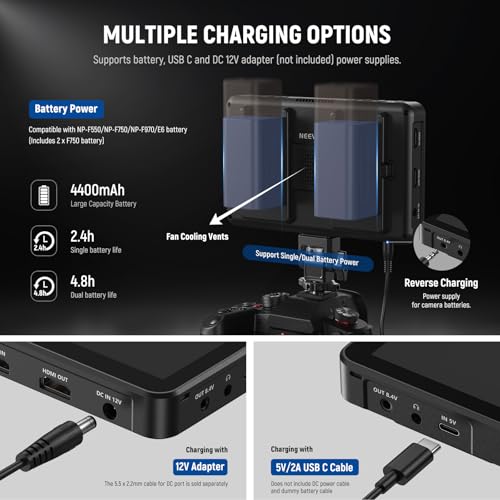
- Two NP-F750 batteries in the box, plus an 8V DC output that can power the camera through a dummy battery
- Sold and shipped by Amazon with 564 ratings at 4.4 stars, the most proven pick here
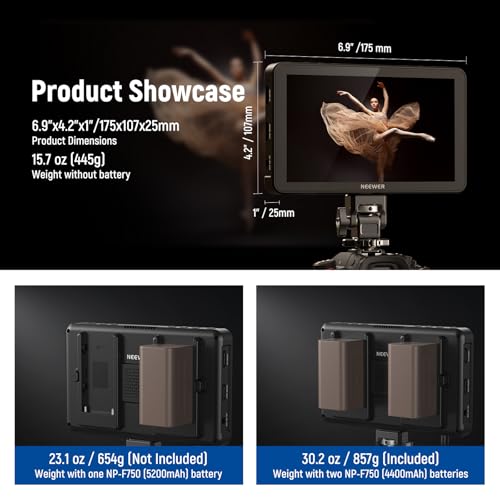
- 445 g without batteries and about 857 g with both: happiest on a tripod or cage, not a small gimbal
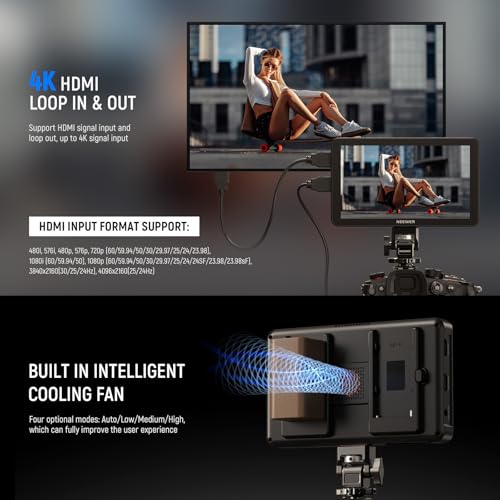
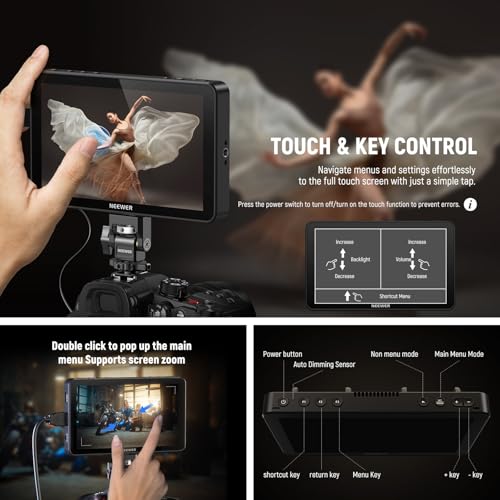
- HDMI loop-through tops out at 4K30; no SDI and no camera control
- Built-in cooling fans
The default answer for anyone who wants a 7-inch monitor that does everything competently and leaves money for lenses.
Why it is here:
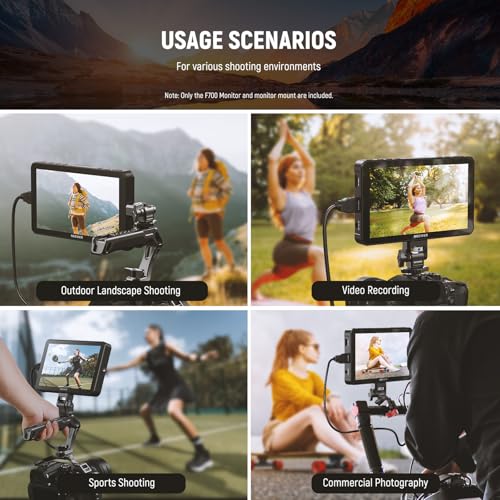
A 7-inch panel is easier to judge focus on than a 5-inch one, and at 2,000 nits the F700 stays readable outdoors. Fstoppers’ 2026 guide picked it for creators who film themselves, because the screen reads from across a room and the light sensor keeps it at the right brightness between indoor and outdoor takes.
What you give up:
Weight and connectivity. With two NP-F bricks on the back it weighs nearly 860 g, so put it on a cage or tripod rather than a hot shoe on a light gimbal. The HDMI loop-through caps at 4K30, and there is no SDI or camera control.
Price check:
Amazon had it at $215.59 (sold by Amazon) on November 27, 2026, below the $242.99 it cost in April.
Verdict:
Choose the F700 for the most screen per dollar. Also at B&H Photo.
Viltrox DC-A1 7-Inch: Brightest Field Monitor Under $250
outdoor shooters who work in open sun and want the brightest screen they can buy for about $220
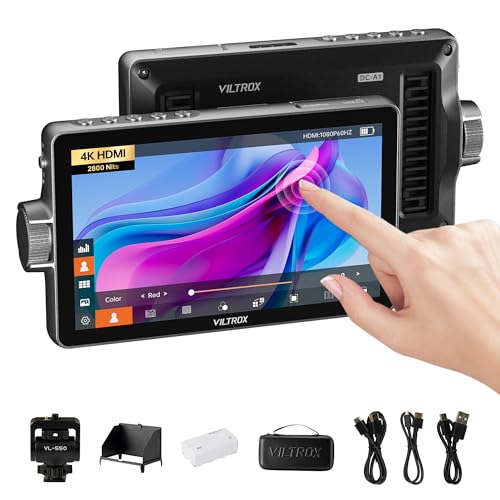
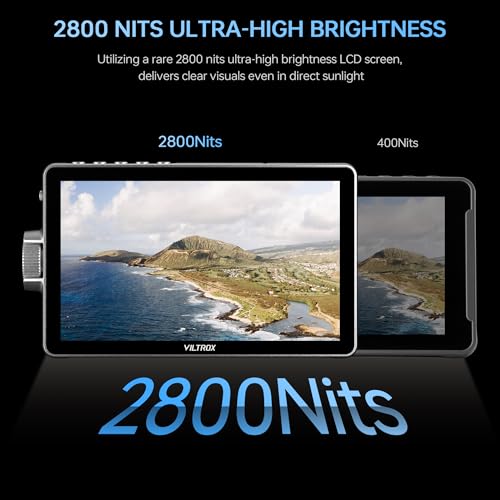
- 2,800 nits: brighter than every other pick here, readable in direct sun
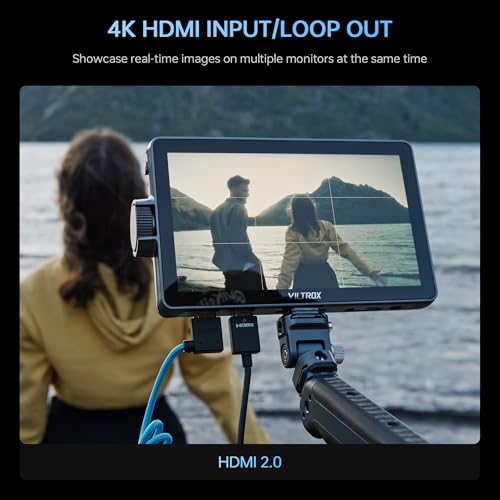
- HDMI 2.0 input and output at 4K60, so you can loop a full-rate 4K signal to a recorder or client screen
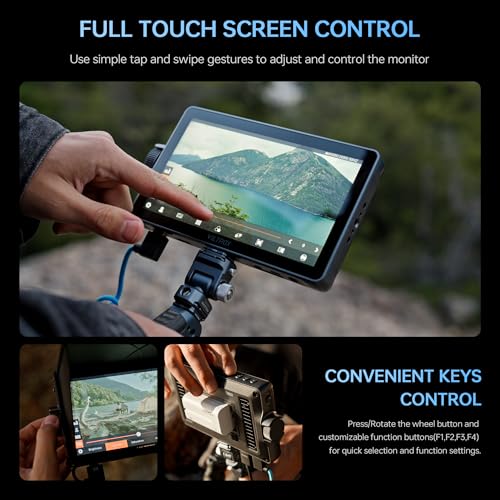
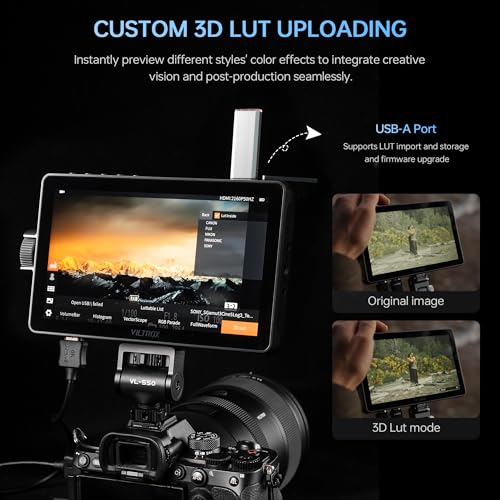
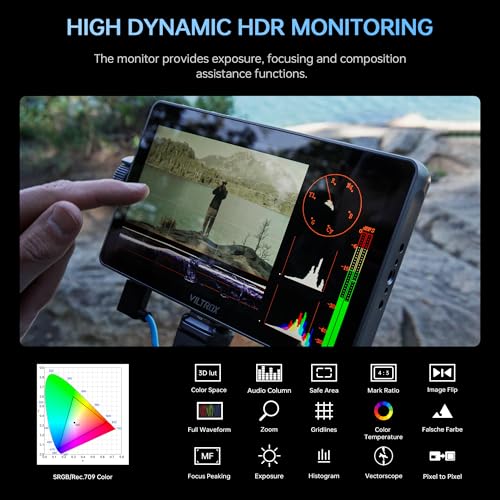
- Waveform, RGB parade, vectorscope, false color, zebras, peaking, anamorphic de-squeeze and custom 3D LUTs via USB
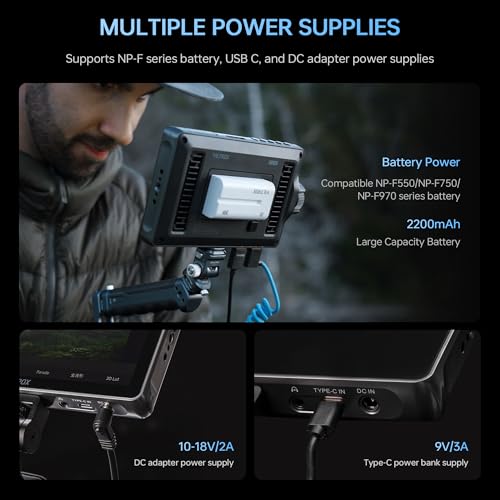
- Sun hood, NP-F550 battery and hard case in the box; four assignable buttons plus a control wheel
- 8-bit sRGB/Rec.709 panel: a tool for focus and exposure, not for judging final color
- Active cooling fan gets loud at maximum brightness, enough to reach an on-camera microphone
- The included 2,200 mAh battery runs about an hour at full brightness; buy bigger NP-F packs
The budget pick for bright sun: nothing under $250 matches its brightness and 4K60 loop-through.
Why it is here:
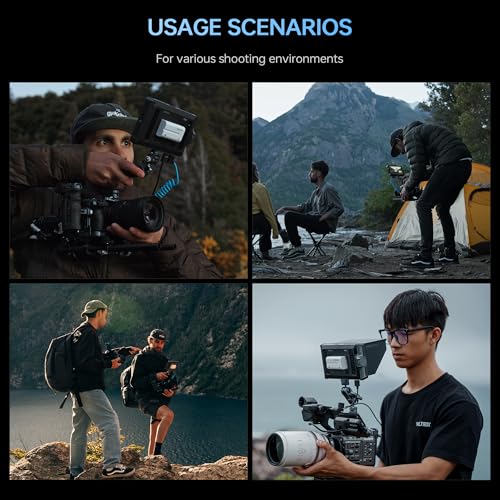
Brightness is the spec most buyers try to save on and then regret on their first sunny shoot. The DC-A1 solves it for $222.40: 2,800 nits on a 7-inch panel. Fstoppers’ reviewer described the eye strain of working outdoors as simply gone once the DC-A1 and its hood were on the camera.

Mind the fan and the mic:
To keep a 2,800-nit backlight cool, Viltrox fitted a fan that varies with temperature. On low it is barely audible; at full brightness it is loud enough to show up on a shotgun mic mounted next to it. Record audio on a lavalier, or drop the brightness indoors.
Verdict:
Choose the DC-A1 if you shoot outdoors most of the time. The listing sold by Ninephoto had 299 ratings at 4.5 stars on November 27, 2026. Also at B&H Photo.
Portkeys BM7 II DS 7-Inch: Best 7-Inch Monitor With SDI and Camera Control
small crews running a cine body or two cameras who want SDI, a 7-inch screen and camera control in one aluminum box
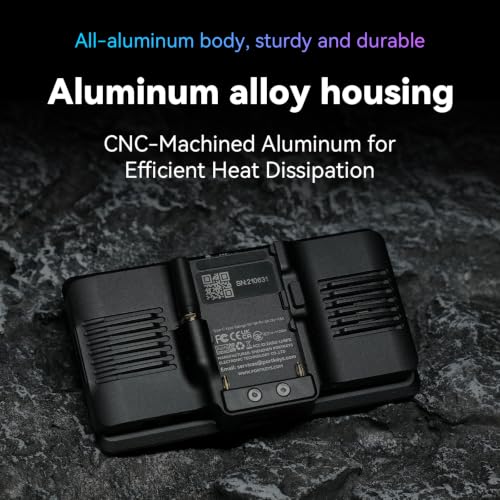
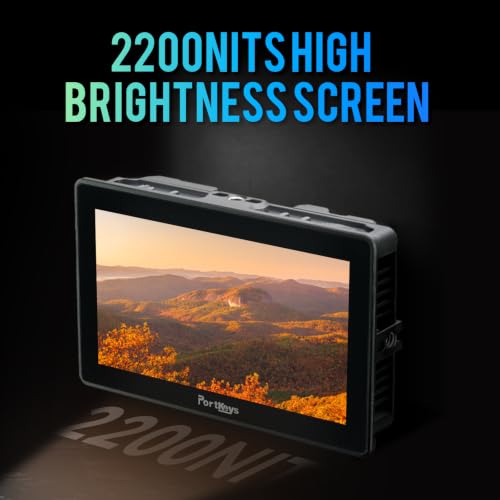
- 2,200-nit 7-inch touchscreen in a CNC aluminum housing
- Wired and wireless control for a long list of Sony FX and Alpha, Canon Cinema EOS and EOS R, Panasonic Lumix, Nikon Z8/Z9, Z CAM and Blackmagic cameras
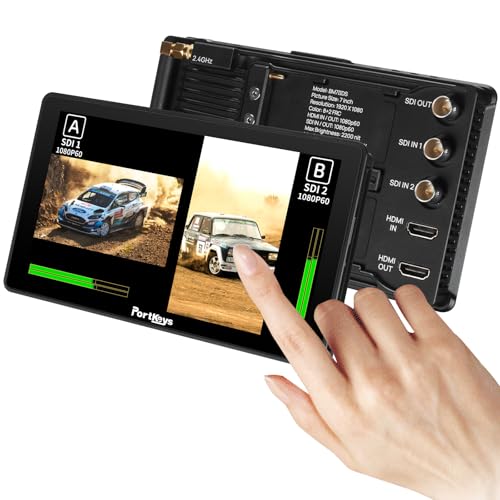
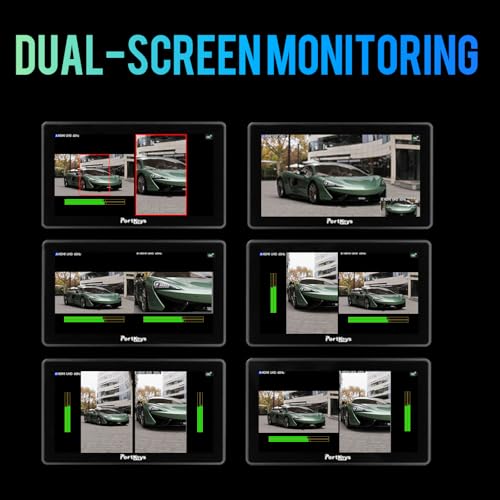
- Two SDI inputs plus HDMI: split-screen monitoring of two sources or two crops of one source
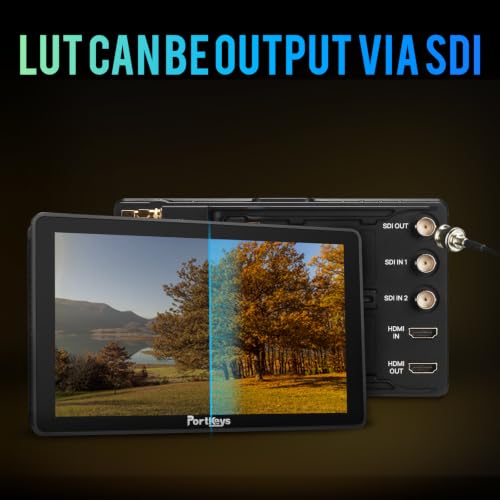
- SDI output can carry the 3D LUT and peaking downstream; freeze-frame overlay for matching shots
- No HDMI output: loop-through is SDI only
- $809 is double the LH5P III, so buy it for SDI and the second input
- Fan-cooled
The step up for SDI and two-camera work, with the same Portkeys camera control as the LH5P III.
Why it is here:
If your camera has SDI, or you run a two-camera interview, the BM7 II DS gives you inputs the HDMI-only picks lack. The split screen can show two SDI sources side by side, and its SDI output can pass the LUT-applied image to a director’s monitor or a wireless transmitter.
Collaborative control:
Like the LH5P III, one BM7 II DS with wireless control can adjust up to four other Portkeys-equipped cameras on set within about 50 m. Portkeys keeps adding camera protocols via firmware, so update before your first shoot.
Verdict:
Choose the BM7 II DS for SDI and multicam control. It was $809.10 from the Portkeys Official Store on Amazon on November 27, 2026. Also at B&H Photo.
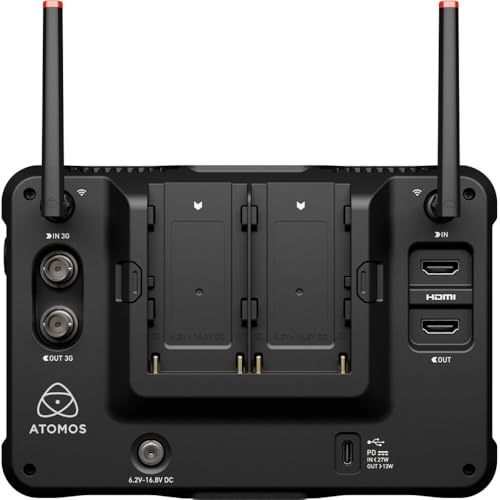
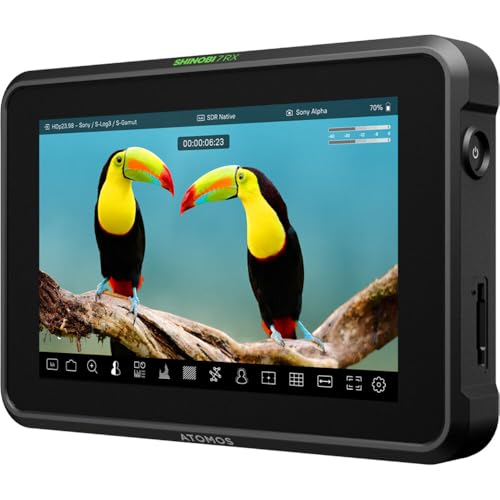
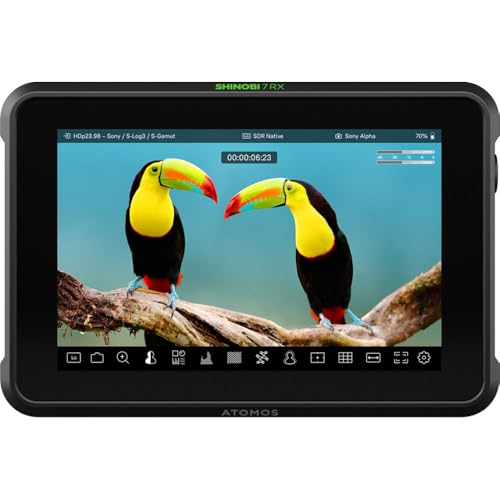
Atomos Shinobi 7 RX 7-Inch: Best for HDMI and SDI Cross-Conversion
hybrid and cine shooters who need to convert between HDMI and SDI, plus Wi-Fi control and streaming from a 7-inch HDR screen
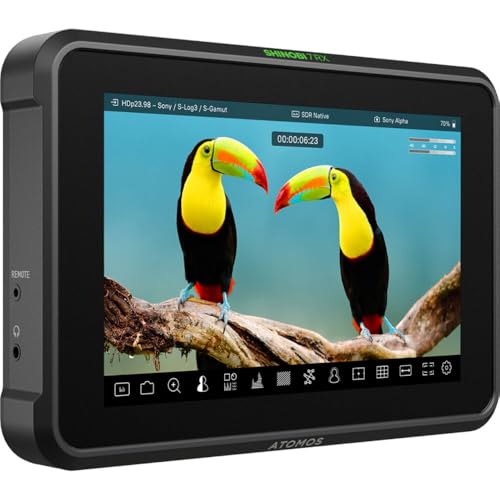
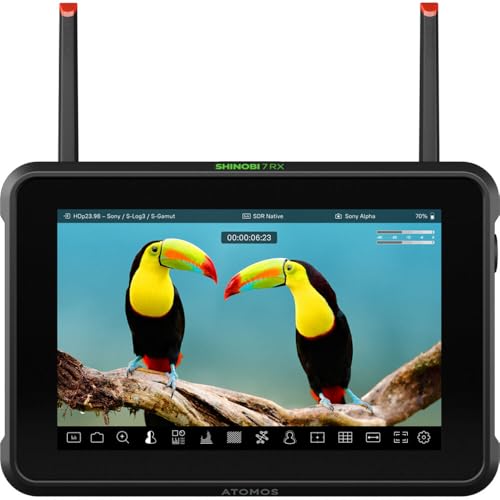
- 7-inch 2,200-nit HDR display with Log, PQ and HLG monitoring
- HDMI 2.0 (4K60) and 3G-SDI inputs and outputs with cross-conversion in both directions
- Wi-Fi camera control, focus and streaming features, plus LANC control
- Dual L-series battery slots and USB-C PD input for hot-swapping on long days
- Only 2 units left on Amazon (Adorama) on November 27, 2026; check B&H if it sells out
- Monitor only: no recording, unlike Atomos’ Ninja models
- SDI is 3G (HD), not 12G
The bridge between mirrorless and cinema rigs: one monitor that turns an HDMI camera into an SDI feed.
Why it is here:
Cross-conversion is the feature that sets the 7 RX apart. Feed it HDMI from a mirrorless camera and send SDI to a wireless transmitter or video village, or the other way round. Atomos’ AtomOS gives you false color, waveform, vectorscope and 3D LUTs on a 2,200-nit HDR panel.

Who should wait:
If you only use HDMI, the newer Atomos Shinobi 7 II covered below is brighter (2,800 nits) and cheaper ($499), and adds USB-C camera control with touch-to-focus.
Verdict:
Choose the Shinobi 7 RX when SDI is part of your workflow. It was $799 on Amazon on November 27, 2026. Also at B&H Photo.
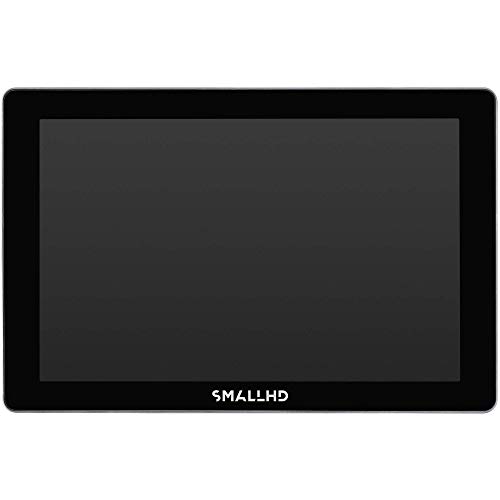
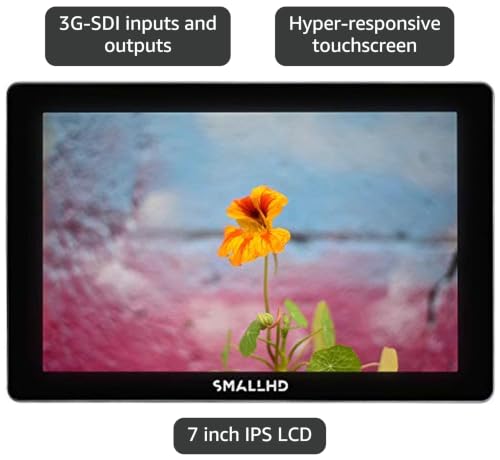
SmallHD Indie 7: Best Pro Monitor for Focus Pullers and DPs
1st ACs, DPs and crews who value the fastest, most customizable monitoring software over raw brightness
- PageOS lets you build swipeable pages (peaking and punch-in on one, waveform with a LUT on the next)
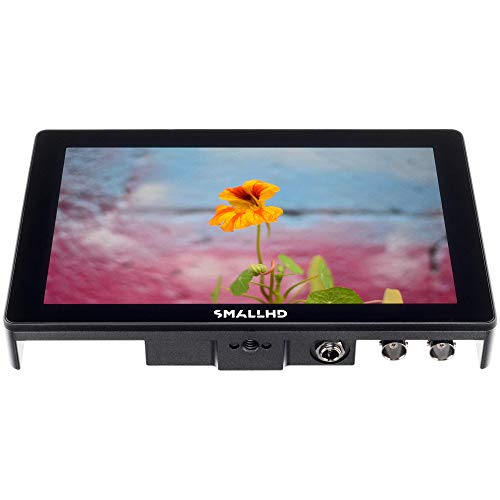
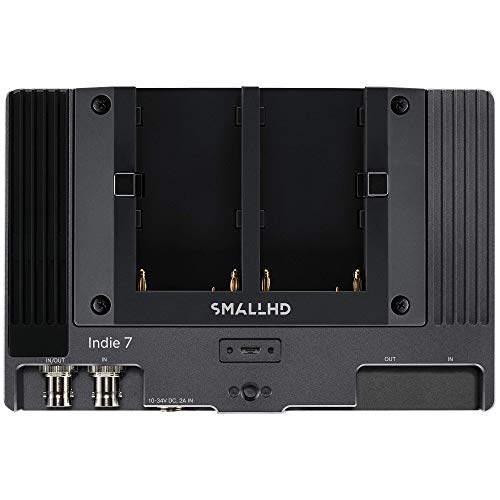
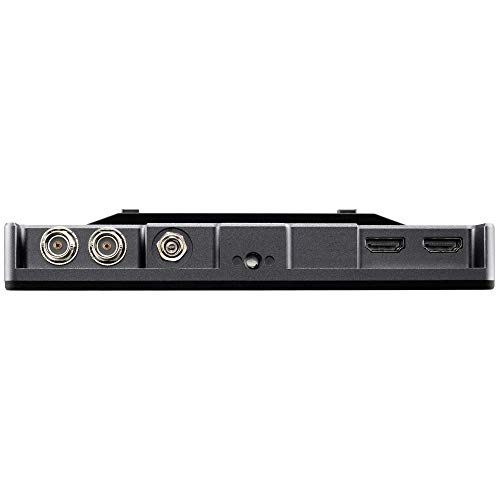
- 3G-SDI and HDMI inputs and outputs in a thin, milled aluminum chassis just over 1 lb
- 1920 x 1200 resolution on a 7-inch touchscreen
- Optional wired camera control for RED KOMODO and DSMC2 via Ethernet (license and cable sold separately)
- 1,000 nits: needs a hood in direct sun, where the $222 Viltrox does not
- A 2020 design at $995; batteries mount via brackets sold separately
- Only 5 left on Amazon (Adorama) on November 27, 2026
Buy it for the software and build. SmallHD remains the crew standard, but you pay for it.
Why it is here:
On professional sets the monitor’s software matters as much as its panel. SmallHD’s PageOS is still the benchmark: you set up pages for each job and swipe between them, so the focus puller and the DP can work from the same monitor without digging through menus. The Indie 7 is the most affordable 7-inch way into that system.

Correction:
Our April version said the Indie 7 was HDMI only. It is not: it has 3G-SDI and HDMI inputs and outputs.
Brighter SmallHD options:
The SmallHD Ultra 7 adds 2,300 nits for $2,299 on Amazon, and the new Focus 504 (October 2026, $999) packs PageOS, 3G-SDI and HDMI 2.0 into a 20 mm thin 5-inch body at 1,000 nits.
Verdict:
Choose the Indie 7 if PageOS and SmallHD build quality are worth $995 to you. Also at B&H Photo.
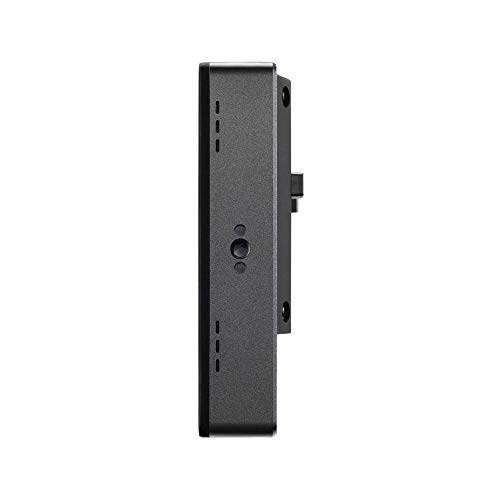
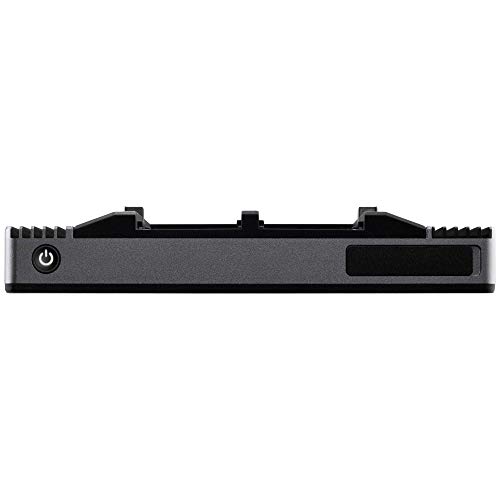
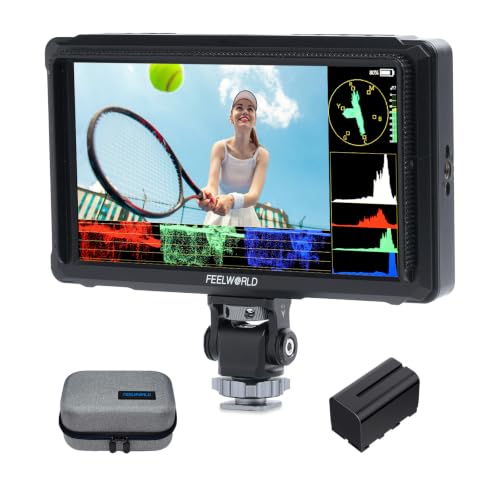
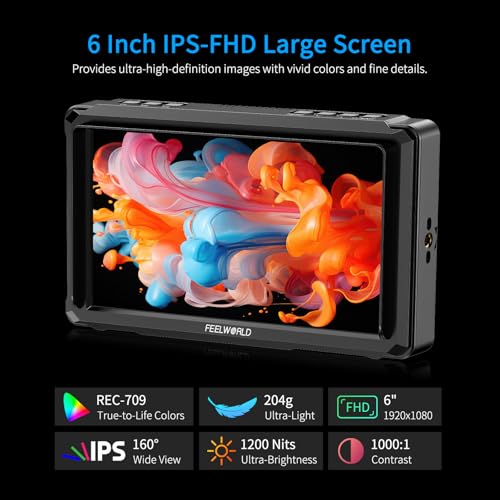
FEELWORLD FW568 PRO 6-Inch: Best Field Monitor Under $150
photographers moving into video and gimbal users who want a light first monitor with real scopes for about $110
- Only 204 g, light enough for a small gimbal
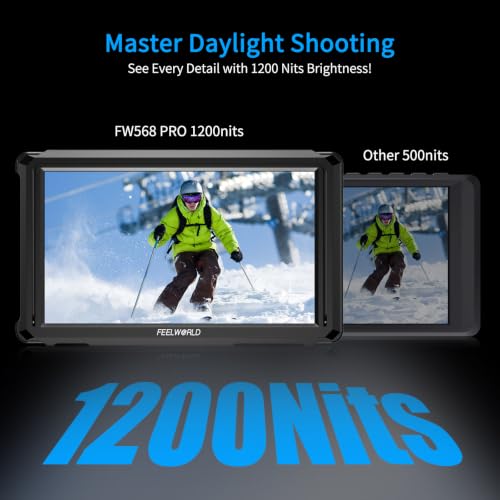
- 1,200 nits and a removable sun hood for outdoor work
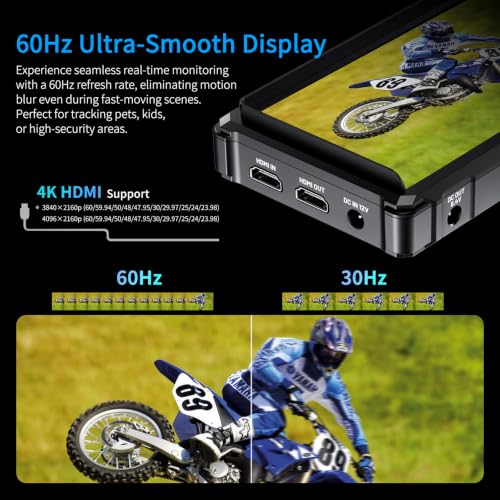
- HDMI 2.0 in and out at 4K60 for passing a full-rate signal downstream
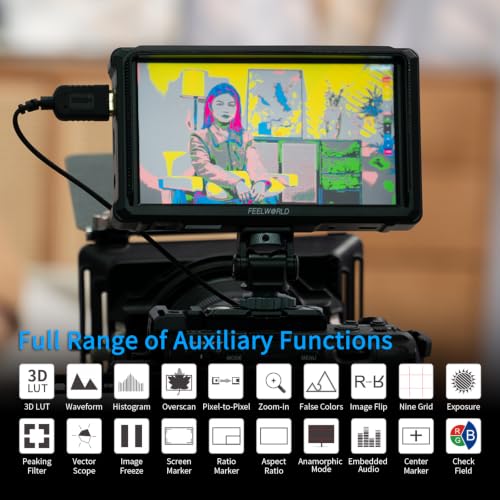
- Waveform, vectorscope, RGB histogram, false color, focus assist and custom 3D LUTs
- 1,200 nits needs the hood in direct sun
- Narrow 80-degree stated viewing angle: the image shifts when you look from above or below
- No SDI, no camera control
The cheapest monitor worth buying: it makes focus and exposure visible for the price of a filter.
Why it is here:
It replaces the FEELWORLD F7 PRO from our April list, which turned out to be a 500-nit panel (FEELWORLD’s own spec), too dim for outdoor work. The FW568 PRO costs less, is more than twice as bright, and adds 4K60 pass-through. Fstoppers picked it as the best budget monitor of 2026.

Who it suits:
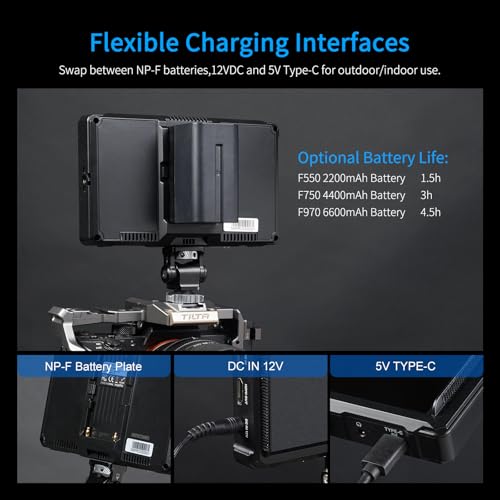
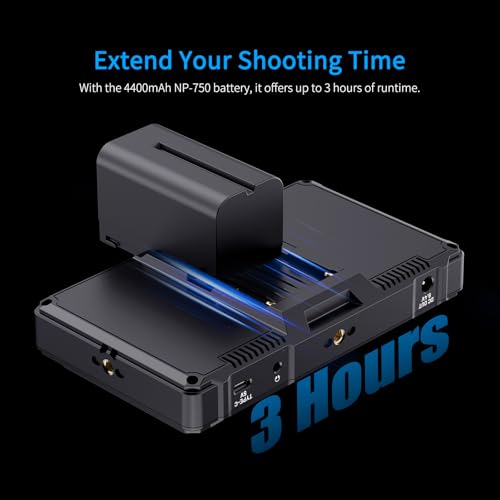
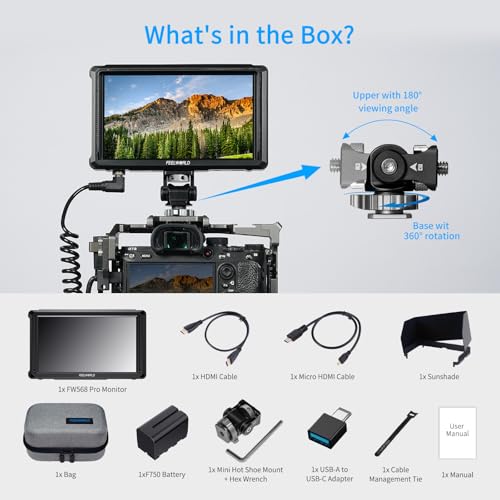
At 204 g it barely changes a gimbal’s balance, and peaking on a 6-inch 1080p screen is far more reliable than on a 3-inch camera LCD. The listing from the FEELWORLD Official Store includes an F750 battery and a bag.
Verdict:
Choose the FW568 PRO as a first monitor or a light gimbal screen. It was $111.99 on Amazon on November 27, 2026. Also at B&H Photo.
Also Worth Knowing: New and Hard-to-Find Monitors
These monitors are good, but were not boxed because the Amazon listing was out of stock, available only as a reseller bundle, or outside this guide’s price range on November 27, 2026.
Atomos Shinobi 7 II ($499). Announced at IBC on September 11, 2026, it is the brightest Shinobi yet: a 7-inch, 2,800-nit, 1920 x 1200 HDR touchscreen with HDMI input and output, USB-C camera control with touch-to-focus for most Canon, Fujifilm, Nikon, Panasonic and Sony mirrorless bodies, an L-series battery slot, 36W USB-C PD and probe calibration with a Calibrite Display Pro HL or Plus HL. It would be a top-three pick here, but the body-only Amazon listing was out of stock on November 27, 2026 and the in-stock listing is a third-party battery bundle. Buy it from B&H Photo or another authorized Atomos dealer.
Atomos Shinobi II ($379 to $399). Our April number one is still a great 5.2-inch monitor for gimbals: 210 g, 1,500 nits and USB-C camera control. Two limits matter, though: its HDMI 1.4 input caps at 4K30 and it has no HDMI output. On Amazon it is now sold mainly in reseller bundles, so we moved it out of the boxes. It is available body-only at B&H Photo.
NEEWER F700U ($303.99). The OLED sibling of the F700, shown at NAB 2026: 1,200 nits, 100,000:1 contrast, 3G-SDI in and out plus 4K HDMI, and two NP-F750 batteries. Out of stock on Amazon on November 27, 2026; check B&H Photo.
FEELWORLD LUT7S PRO ($360.99). A 2,200-nit 7-inch with 3G-SDI and a 1920 x 1200 panel, on our April list. Amazon was down to one unit, so it is no longer boxed; the Shinobi 7 RX and BM7 II DS cover SDI.
SmallHD Focus 504 ($999) and Ultra 7 ($2,299). The Focus 504, launched in October 2026, is SmallHD’s thinnest monitor at 20 mm, with PageOS, 3G-SDI, HDMI 2.0 and 1,000 nits. The Ultra 7 is the daylight version of the Indie 7 at 2,300 nits.
Sony RM-DP7 ($3,099.99) and RM-DP5 ($2,299.99). Sony’s new 7-inch and 5-inch control monitors put the BIG6 interface on a factory-calibrated 2,000-nit panel for the FX5, FX3, FX2 and FX30, with FX6 and BURANO support promised later. They ship in January 2027. The Portkeys LH5P III does much of the same for a fraction of the price.
Monitor-recorders. If you need to record ProRes RAW from a mirrorless camera’s HDMI output, look at the Atomos Ninja TX or Ninja TX GO; for SDI cameras and Blackmagic RAW, the Blackmagic Video Assist 12G HDR. A recorder roughly triples the price of a monitor-only screen, so buy one only if your camera cannot record what you need internally. Fast media matters too: see our external SSDs for video guide.
What Changed in This Update
All seven Amazon listings from the April 2026 version were still live on November 27, 2026, but the guide changed on merit and on accuracy.
New number one: Portkeys LH5P III. Launched in September 2026 at $399, it adds a 10-bit, per-unit calibrated 2,200-nit panel and wired plus wireless camera control to a 5.7-inch body. The Atomos Shinobi II moved to the section above because its Amazon listing is a reseller bundle with a battery and charger, and its HDMI 1.4 input lacks loop-through.
FEELWORLD F7 PRO replaced by the FEELWORLD FW568 PRO. The April version called the F7 PRO a 1,200-nit monitor. FEELWORLD rates it at 500 nits, too dim for outdoor work. The FW568 PRO is brighter, lighter and cheaper.
FEELWORLD LUT7S PRO replaced by the Viltrox DC-A1. The LUT7S PRO was down to one unit on Amazon; the DC-A1 is the brightest monitor under $250 at 2,800 nits.
Corrected: the SmallHD Indie 7 has 3G-SDI and HDMI inputs and outputs (April said HDMI only). Prices moved too: the NEEWER F700 fell to $215.59, while the Shinobi II bundle rose from $312.99 to $379.
How Many Nits Do You Need?
Brightness, measured in nits (candela per square meter), is the single most important spec on a field monitor. A typical camera LCD is far dimmer than any of these screens, which is why it washes out in sun. Use this as a guide:
| Brightness | Works for | Picks in this range |
|---|---|---|
| Under 1,000 nits | Indoors and studio; hood needed outside | FEELWORLD F7 PRO (500), Portkeys PT6 (600) |
| 1,000 to 1,500 nits | Shade, overcast days, interiors with windows | SmallHD Indie 7, FEELWORLD FW568 PRO, NEEWER F700U |
| 2,000 to 2,200 nits | Open daylight without a hood | NEEWER F700, Portkeys LH5P III, BM7 II DS, Shinobi 7 RX |
| 2,500 nits and up | Direct sun, snow, beach; judging shadows outdoors | Viltrox DC-A1, Atomos Shinobi 7 II, SmallHD Ultra 7 |
A sun hood adds a lot: a 1,200-nit monitor with a hood can beat a 2,000-nit monitor without one when the sun is behind you. Brighter panels also use more power, so expect shorter battery life at full brightness.
How to Choose a Field Monitor
Screen size and weight: 5-inch or 7-inch?
A 5 to 6-inch monitor (LH5P III, FW568 PRO) weighs 200 to 400 g and keeps a gimbal balanced. A 7-inch screen (F700, DC-A1, Shinobi 7 RX) is easier for judging focus and for a second person to watch, but adds weight and wind area. As a rule, anything over about 300 g changes how a small gimbal balances.
HDMI or SDI
HDMI is what mirrorless cameras output; it works fine but the connector is friction-fit, so use a locking or strain-relieved cable. SDI uses locking BNC connectors, runs long cables without loss and is standard on cinema cameras and wireless transmitters. If you only own mirrorless bodies, HDMI is enough. Check the loop-through too: some monitors cap the output at 4K30 or have none at all.
Camera control
Monitors with camera control (Portkeys, Atomos Shinobi 7 II and 7 RX) let you change ISO, shutter, aperture and white balance and start recording from the touchscreen. Some add touch-to-focus. It is the most useful feature on a gimbal, crane or car mount, where the camera body is hard to reach. Always check the manufacturer’s compatibility list for your exact camera and firmware.
Scopes and LUTs
Every pick here has focus peaking, zebras, false color and a waveform, plus custom 3D LUT loading. A LUT turns a flat Log image into a normal-looking preview without changing your recording. What differs is how many LUTs you can store, how easy they are to switch, and whether the monitor can send the LUT-applied image out to another screen.
Color accuracy
For framing and focus, any panel works. For judging skin tones and matching cameras, look for a 10-bit panel with a calibration report (LH5P III) or probe calibration (Atomos with a Calibrite probe, see our monitor calibrator guide). Budget panels such as the DC-A1 are 8-bit sRGB/Rec.709 and best treated as exposure and focus tools.
Power
Most monitors take Sony NP-F batteries (NP-F550, F750, F970). Atomos uses the same L-series packs. USB-C PD is handy for power banks, and some monitors (NEEWER F700, FW568 PRO) can also power your camera through a dummy battery. Pick one battery system for the whole rig and carry at least two large packs.
How to Set Up a Field Monitor for the First Time
1. Set the camera’s HDMI output. Turn on clean HDMI output (no menu overlays) and match the resolution and frame rate the monitor accepts. A Shinobi II, for example, cannot take a 4K60 signal.
2. Load the right LUT. Use the LUT that matches your camera’s Log profile (S-Log3, C-Log2, N-Log, F-Log2, V-Log), not a generic Rec.709 conversion. Most manufacturers publish free .cube files.
3. Expose with false color, not the picture. Use false color or a waveform to place skin and highlights, then switch to the LUT view to check the look. On Portkeys monitors, Log Stops shows the same information in stops; Atomos calls its version EL Zone.
4. Assign shortcuts. Put peaking, false color and the LUT toggle on physical buttons so you can switch without touching the screen mid-take.
5. Secure the cable and mount. Use a short, right-angle HDMI cable with a clamp; the camera’s micro HDMI port is the most fragile part of the chain. A cage, such as the ones in our SmallRig cooling fan story, gives you more mounting points than the hot shoe.
Should You Buy Now or Wait?
Buy now if you shoot this season. Black Friday and Christmas pricing is live: the NEEWER F700 is down to $215.59, and FEELWORLD is running up to 30% off its monitors through November 30. Most picks here are 2025 and 2026 designs that are not about to be replaced. See our Black Friday camera deals for camera bodies to pair them with.
Wait if you want the Shinobi 7 II from Amazon or a Sony control monitor. The Shinobi 7 II should be back in stock as Atomos ramps up supply, and Sony’s RM-DP5 and DP7 arrive in January 2027 for FX-series owners who want native control.
Common Mistakes When Buying a Field Monitor
Buying on screen size instead of brightness. A dim 7-inch screen is less useful outdoors than a bright 5-inch one. Check the nits first.
Ignoring the output. If you will ever feed a second screen, a recorder or a wireless transmitter, make sure the monitor has the loop-through you need at the frame rate you shoot.
Overloading the gimbal. A 7-inch monitor with two NP-F970 batteries can weigh over 1 kg. Check your gimbal’s payload with camera, lens and monitor together.
Exposing by eye on a LUT view. A bright screen can make footage look better exposed than it is. Use false color or the waveform for exposure.
Trusting camera-control lists blindly. Support depends on camera model and firmware. Update both before a paid job and test control at home.
How We Picked
This ranking is based on manufacturer specifications, independent reviews (Fstoppers, CineD, RedShark News, Digital Camera World and owner reviews), feature sets for prosumer and indie work, and current US pricing. Each monitor was scored on daylight brightness, monitoring tools, connectivity, camera control, build, weight and value. The monitors were not tested side by side for this update.
Every Amazon listing was checked on November 27, 2026 for stock, seller and price. We accepted listings sold by Amazon, the manufacturer’s official store or established camera dealers such as Adorama, and moved monitors available only in reseller bundles or out of stock to the “Also worth knowing” section. Pair your monitor with good light from our portable LED lighting kits and the right glass from our Canon video lenses guide.
Frequently Asked Questions
What is the best field monitor in 2026?
For most prosumer and indie filmmakers, the Portkeys LH5P III is the best field monitor: 2,200 nits, a factory-calibrated 10-bit panel, 4K60 HDMI in and out and camera control, for $399. The NEEWER F700 is the best value 7-inch, and the Atomos Shinobi 7 RX is the pick if you need SDI.
How many nits do I need for outdoor shooting?
About 1,000 nits is the floor for shade and cloudy days. 2,000 nits or more works in open daylight without a hood, and 2,500 to 3,000 nits is what you want in direct sun, snow or at the beach. A sun hood makes any monitor more usable outdoors.
Which field monitor is best under $250?
The NEEWER F700 ($215.59) if you want a 7-inch screen with two batteries included, or the Viltrox DC-A1 ($222.40) if you shoot in bright sun and want 2,800 nits and 4K60 loop-through. Under $150, the FEELWORLD FW568 PRO ($111.99) is the pick.
Viltrox or FEELWORLD: which budget monitor is better?
The Viltrox DC-A1 is much brighter (2,800 vs 1,200 nits) and has a 7-inch screen, but weighs more and has a fan that can be heard at full brightness. The FEELWORLD FW568 PRO is lighter (204 g), cheaper and better on a small gimbal. Pick the Viltrox for sun, the FEELWORLD for weight.
What is the difference between HDMI and SDI on a field monitor?
HDMI is what mirrorless cameras output and uses a friction-fit connector. SDI uses locking BNC connectors, runs long cables without signal loss, and is standard on cinema cameras and wireless video transmitters. If you only own mirrorless cameras, HDMI is fine.
Can a field monitor control my camera?
Some can. Portkeys monitors control many Sony, Canon, Nikon, Panasonic and Blackmagic cameras over cable or wirelessly, and the Atomos Shinobi 7 II, Shinobi II and Shinobi 7 RX offer USB-C or Wi-Fi control. Check the maker’s compatibility list for your exact camera.
Do I need a field monitor if my camera has a flip screen?
For controlled indoor work, often not. For outdoor shooting, gimbal work or anyone pulling focus, yes: camera screens are small and dim, and most lack a waveform, false color and custom LUTs.
What is a 3D LUT and do I need one?
A 3D LUT is a color transform file (.cube) that previews a Log image as a normal-contrast picture on the monitor without changing your recording. If you shoot S-Log3, C-Log, N-Log, F-Log or V-Log, it makes judging the shot far easier.
Is a 5-inch or 7-inch field monitor better?
A 5 to 6-inch monitor is lighter and better on gimbals and handheld rigs. A 7-inch screen makes focus easier to judge and is better for a second viewer, but adds weight. Solo shooters usually prefer 5 to 6 inches; focus pullers and directors prefer 7.
Can I record with a field monitor?
Not with the monitors in this guide, which are monitor-only. To record ProRes or ProRes RAW you need a monitor-recorder such as the Atomos Ninja TX or Ninja TX GO, or a Blackmagic Video Assist for Blackmagic RAW.
What battery do field monitors use?
Most use Sony NP-F batteries (NP-F550, F750, F970), and Atomos uses the compatible L-series. Many also accept USB-C Power Delivery from a power bank. Standardizing on NP-F across your monitor, lights and accessories is the simplest plan.
Bottom Line: Which Field Monitor Should You Buy?
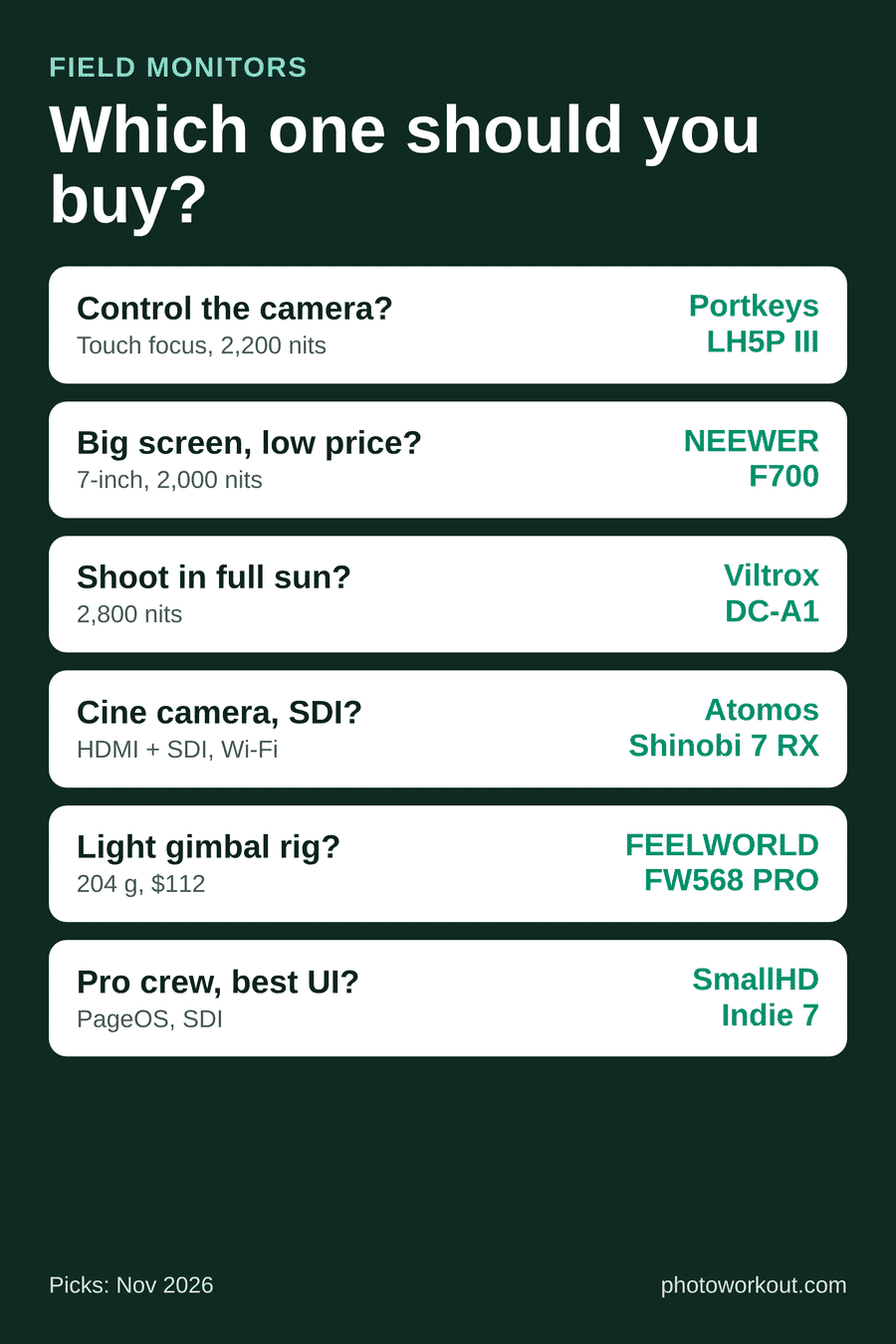
Portkeys LH5P III
NEEWER F700
Viltrox DC-A1
Atomos Shinobi 7 RX
SmallHD Indie 7
FEELWORLD FW568 PRO
Specifications come from manufacturers and current Amazon listings. Prices and availability were checked on Amazon on November 27, 2026.
Manufacturer Information
- Portkeys: LH5P III – LH5P III specifications and camera control
- Atomos: Atomos Introduces Shinobi 7 II – Shinobi 7 II announcement, September 11, 2026
- Atomos: Shinobi 7 II product page – Shinobi 7 II specifications
Independent Reviews and News
- Fstoppers: Best On-Camera Monitors in 2026 – Shinobi II, FW568 PRO, Viltrox DC-A1, NEEWER F700 and SmallHD Ultra 5 assessments
- CineD: Portkeys LH5P III Introduced – LH5P III features, price and camera control
- CineD: Sony DP7 and DP5 announced – Sony control monitor pricing and January 2027 availability
- RedShark News: Atomos Shinobi 7 II – Shinobi 7 II price and availability
- RedShark News: SmallHD Focus 504 – Focus 504 specifications and price
- Newsshooter: NEEWER F700U first look at NAB 2026 – F700U OLED monitor
Pricing and Availability
- Amazon.com product listings – Prices, stock, sellers and listed specifications verified November 27, 2026
Image Sources
- Portkeys (Amazon listing) – Featured image: Portkeys LH5P III on a gimbal
- Amazon product listings – Product images are pulled live from each Amazon listing
- PhotoWorkout – Brightness and price chart and field monitor picker graphic


Disclosure/Disclaimer: As an Amazon Associate, we earn from qualifying purchases. Certain content was provided "as is" from Amazon and is subject to change or removal at any time. Product prices and availability: Amazon prices are updated daily or are accurate as of the date/time indicated and are subject to change. Any price and availability information displayed on Amazon.com at the time of purchase will apply to the purchase of this product.