


- Tamron announced the 16-50mm f/2.8 A (Model B091) on October 14, 2026, a compact constant-aperture standard zoom for APS-C mirrorless cameras.
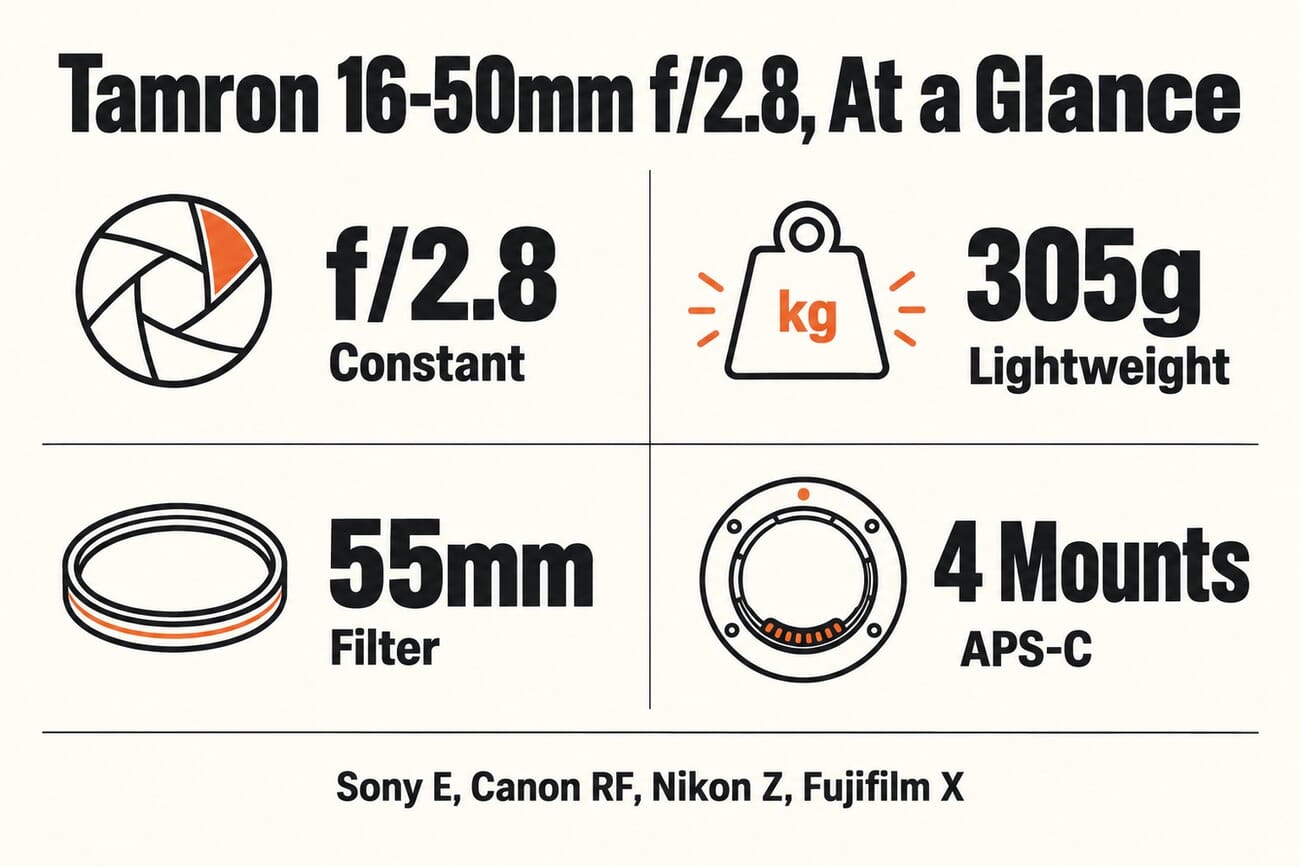
- It weighs about 305g, measures roughly 80mm long, takes 55mm filters, and focuses as close as 0.15m at the wide end. There is no built-in image stabilization.
- It launches for Sony E and Canon RF on October 29 at around $529 to $549, with Nikon Z following on November 19 and Fujifilm X on December 17.
- At 16mm it starts wider than most 17mm and 18mm rivals, and it is pitched squarely as a light, affordable upgrade over the variable-aperture kit lens your camera shipped with.
Tamron has a new answer for anyone tired of the slow, variable-aperture zoom that came bundled with their mirrorless camera. On October 14, 2026, the company announced the 16-50mm f/2.8 A (Model B091), a compact constant-f/2.8 standard zoom built for APS-C bodies. It is small, it is light, and at around $529 it costs a fraction of the big full-frame f/2.8 zooms, which is exactly the point.
The headline number is the weight: roughly 305g, light enough that it does not unbalance a small APS-C body. Pair that with a constant f/2.8 aperture and a usefully wide 16mm starting point, and Tamron has built what a lot of reviewers are already calling a kit-lens killer. Here is what it offers, where it fits, and when it lands on your mount.
What Tamron announced
The 16-50mm f/2.8 A covers a 16-50mm zoom range, which works out to roughly a 24-75mm full-frame equivalent on Sony, Nikon and Fujifilm bodies (those use a 1.5x crop), and closer to 25.6-80mm on Canon RF, where the crop factor is 1.6x. Either way, it is a classic everyday standard range: wide enough for interiors and landscapes, long enough for portraits.
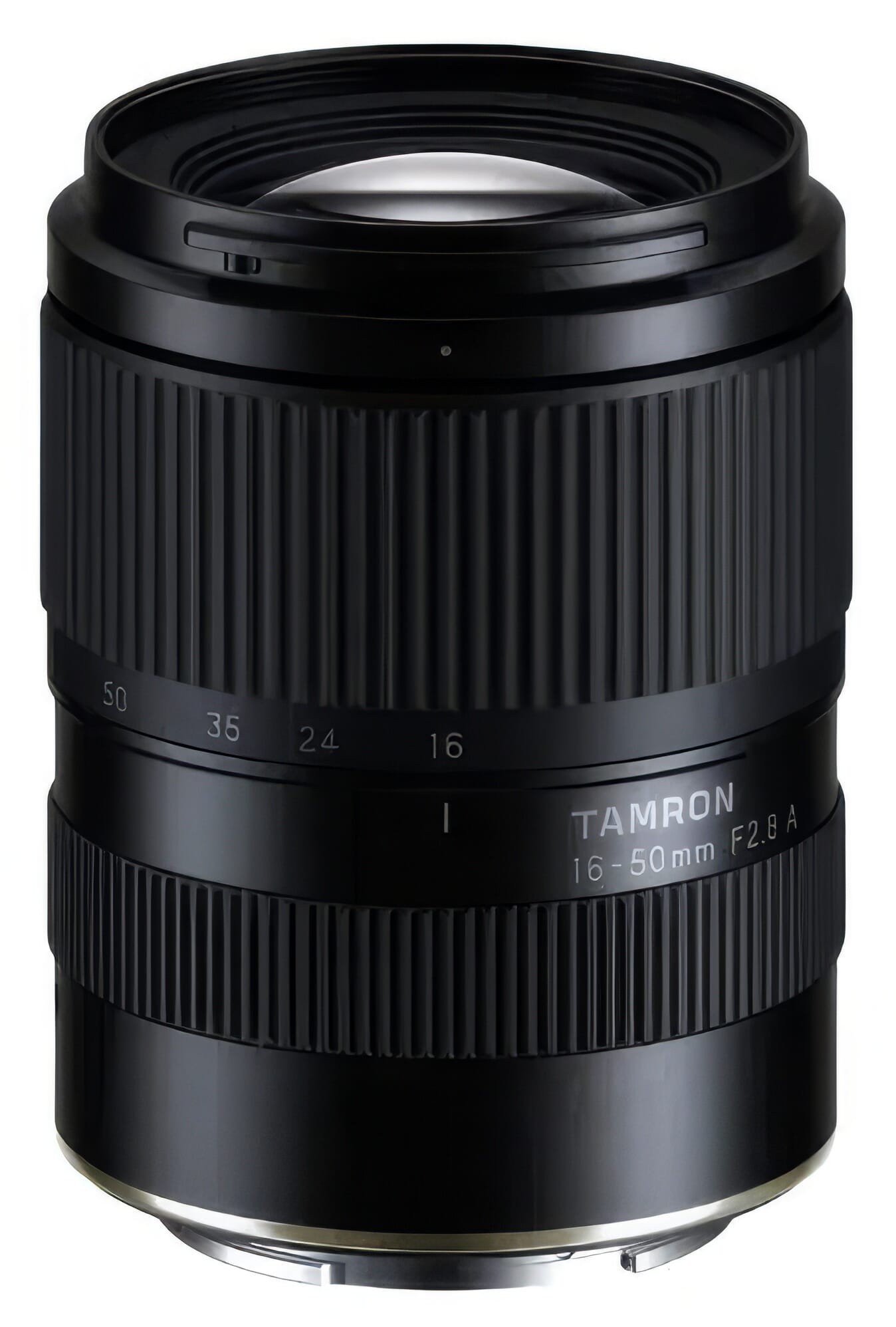
Physically it is tiny for an f/2.8 zoom: about 305g on the scale, roughly 80mm long, and threaded for inexpensive 55mm filters. It focuses as close as 0.15m at the wide end, which is genuinely useful for close-up and tabletop work. The one notable omission is image stabilization, there is no optical VC here, so you lean on your camera’s in-body stabilization instead. On most modern APS-C bodies with IBIS that is a fair trade for the smaller size and lower price.
Why it is a real kit-lens upgrade
Most APS-C cameras ship with a lens like the Sony E 16-50mm f/3.5-5.6 or a similar 18-55mm variable zoom. Those are convenient and cheap, but the sliding aperture means you lose light the moment you zoom in, and the optics are merely okay. If you have ever wondered why your kit-lens shots look flatter than you hoped, our review of the Sony 16-50mm kit lens walks through exactly where those lenses fall short.
A constant f/2.8 fixes the biggest problem. You get the same bright aperture at 16mm and at 50mm, which means more light in dim rooms, faster shutter speeds, and noticeably more background blur for portraits. Starting at 16mm rather than 17mm or 18mm also buys you a touch more width, which matters more than it sounds when you are shooting indoors or doing vlog-style pieces to camera. For most enthusiasts, stepping from a kit zoom to a constant-f/2.8 like this is the single most visible upgrade you can make short of changing cameras. If you are weighing where your next dollar goes, our guide to the best Tamron lenses puts this new zoom in context with the rest of the lineup.
Early hands-on impressions
Reviewers who got early units echo the same theme: this lens is remarkably small and light for a constant f/2.8, and the image quality holds up well for the price. In her hands-on review below, photographer Julia Trotti walks through how it handles in the field and who it is for, a useful watch before you pre-order.
The Canon RF angle
The most interesting mount on the list is Canon RF. For years Canon kept its RF mount closed to third parties, and native RF glass meant buying Canon. That has changed for APS-C: the 16-50mm f/2.8 joins Tamron’s own 17-70mm f/2.8 and Sigma’s 18-50mm f/2.8 as native RF-mount options for crop-sensor R-series cameras like the R7, R10 and R50. It is not the first third-party f/2.8 zoom for RF, but it is the smallest and lightest, and among the cheapest.
One important caveat remains, and it is the same one we flagged in our roundup of the best 24-70mm lenses for Canon: this third-party opening is for APS-C only. There is still no native RF full-frame third-party standard zoom, so if you shoot an R5, R6 or R8, the 16-50mm f/2.8 will only operate in cropped mode and is not the lens for you. On an APS-C Canon body, though, it is a welcome and overdue option.
Price and availability by mount
Tamron is staggering the rollout across the four mounts. Sony E and Canon RF come first, on October 29, at a launch price of around $529 to $549. Nikon Z follows on November 19, and Fujifilm X arrives on December 17. Pricing for the later mounts should land in the same ballpark. You can watch for pre-orders and current pricing at retailers like B&H Photo.
At that price the 16-50mm f/2.8 undercuts most of the competition while being smaller than all of it. The trade-offs are clear and honest: a shorter zoom range than Tamron’s own 17-70mm, and no stabilization. If you shoot a modern body with IBIS and value a lens you will actually want to carry, those are easy compromises to live with.

Frequently Asked Questions
Does the Tamron 16-50mm f/2.8 have image stabilization?
No. The 16-50mm f/2.8 A (B091) has no optical stabilization, so you rely on your camera’s in-body image stabilization. Most current APS-C mirrorless bodies include IBIS, which covers handheld stills and much casual video. If your body has no IBIS, you will need higher shutter speeds in low light.
What is the full-frame equivalent focal length?
On Sony E, Nikon Z and Fujifilm X (1.5x crop) it is roughly a 24-75mm equivalent. On Canon RF (1.6x crop) it is closer to 25.6-80mm. In practical terms it behaves like a standard everyday zoom on any of those systems.
Will it work on a full-frame Canon R5 or R6?
Only in cropped mode. The 16-50mm f/2.8 is an APS-C (RF-S) lens. Mounted on a full-frame RF body it will force a crop, using a fraction of the sensor. It is designed for APS-C Canon cameras like the R7, R10 and R50, not full-frame bodies.
When can I buy it?
Sony E and Canon RF versions ship on October 29, 2026, Nikon Z on November 19, and Fujifilm X on December 17. Launch pricing is around $529 to $549.
The bottom line
The Tamron 16-50mm f/2.8 A is not trying to be the sharpest or the most feature-packed standard zoom. It is trying to be the one you actually keep on your camera: small, light, bright, affordable, and available on four mounts. For APS-C shooters still using the kit lens, it is one of the easiest upgrades to recommend, and for Canon RF crop-sensor owners it is a genuinely new option that did not exist a couple of years ago. The missing stabilization is the only real asterisk, and on an IBIS body it barely registers.
Specs, pricing and availability verified against Tamron's official announcement at the time of publication.