


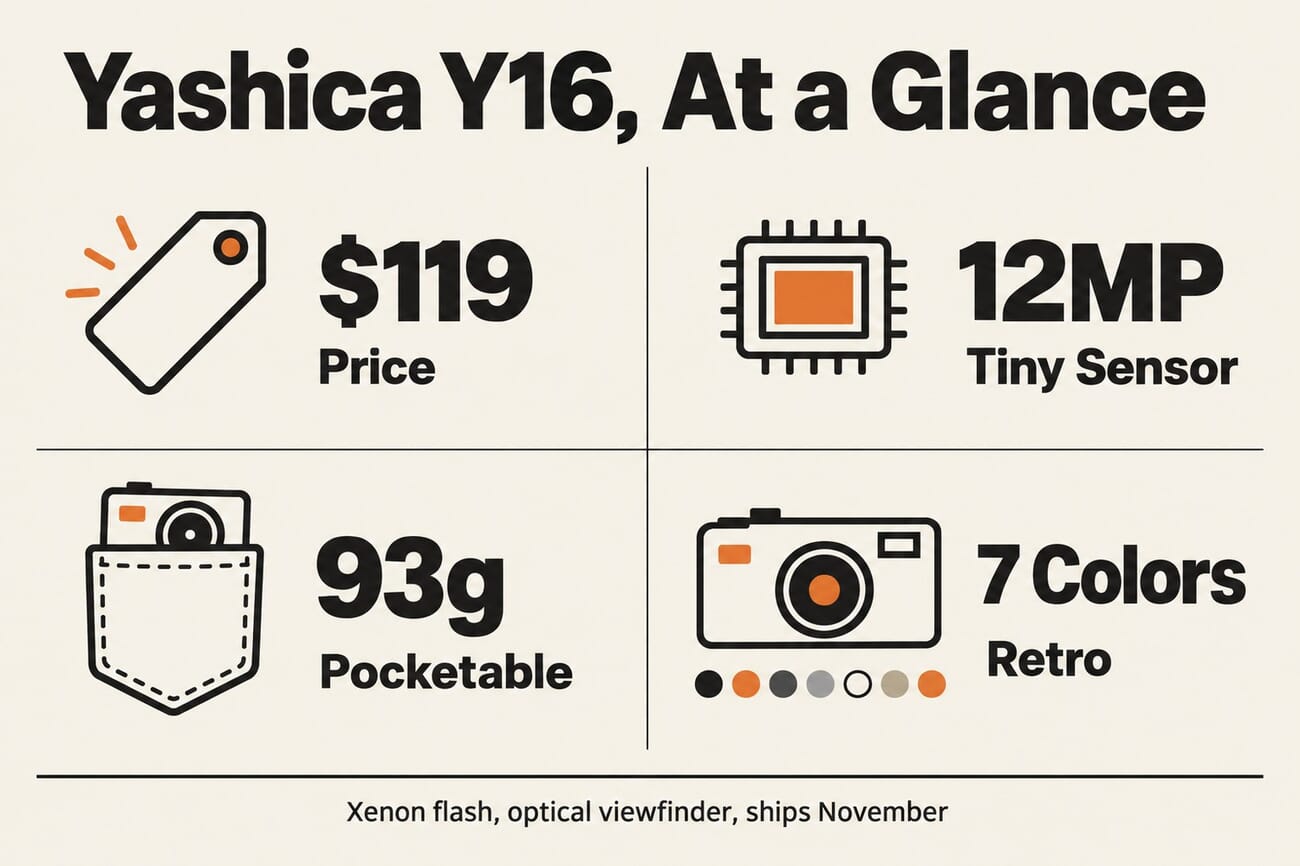
- Yashica announced the Y16, a digital recreation of its 1959 subminiature film camera, priced at $119 and shipping in late November 2026 in seven colors.
- It pairs a 12MP sensor of roughly 18mm² with a fixed 27mm-equivalent lens at about f/12, plus a real xenon flash (effective to around 2 meters), an optical viewfinder, a 1.45-inch screen, and eight creative filters.
- It is tiny, about 93g and 91 x 45 x 29mm, genuinely pocketable in a way most cameras are not.
- Image quality is intentionally modest next to a modern phone. The appeal is the retro form, the physical controls, and the flash look, not technical sharpness.
Yashica keeps mining its own history, and this time it reached all the way back to 1959. The company has announced the Y16, a palm-sized digital camera styled after its classic subminiature film model, priced at $119 and due to ship in late November 2026. It comes in seven colors, carries a real xenon flash, and weighs next to nothing. It is also, by design, not trying to take better photos than your phone.
That last part is the whole point. The Y16 is the latest entry in the retro-digicam wave that Gen Z has turned into one of the few growth stories in cameras, and Yashica is leaning hard into charm over specs. Here is exactly what it offers, where it fits, and who it is actually for.
What Yashica announced
The Y16 is a modern digital take on Yashica’s 1959 subminiature camera, shrunk down to a boxy little body that measures about 91 x 45 x 29mm and tips the scale at roughly 93g. Inside is a 12-megapixel sensor of around 18mm², which is small even by compact-camera standards, paired with a fixed 27mm-equivalent lens at about f/12. There is no autofocus system to speak of and no zoom; this is a point-and-shoot in the most literal sense.
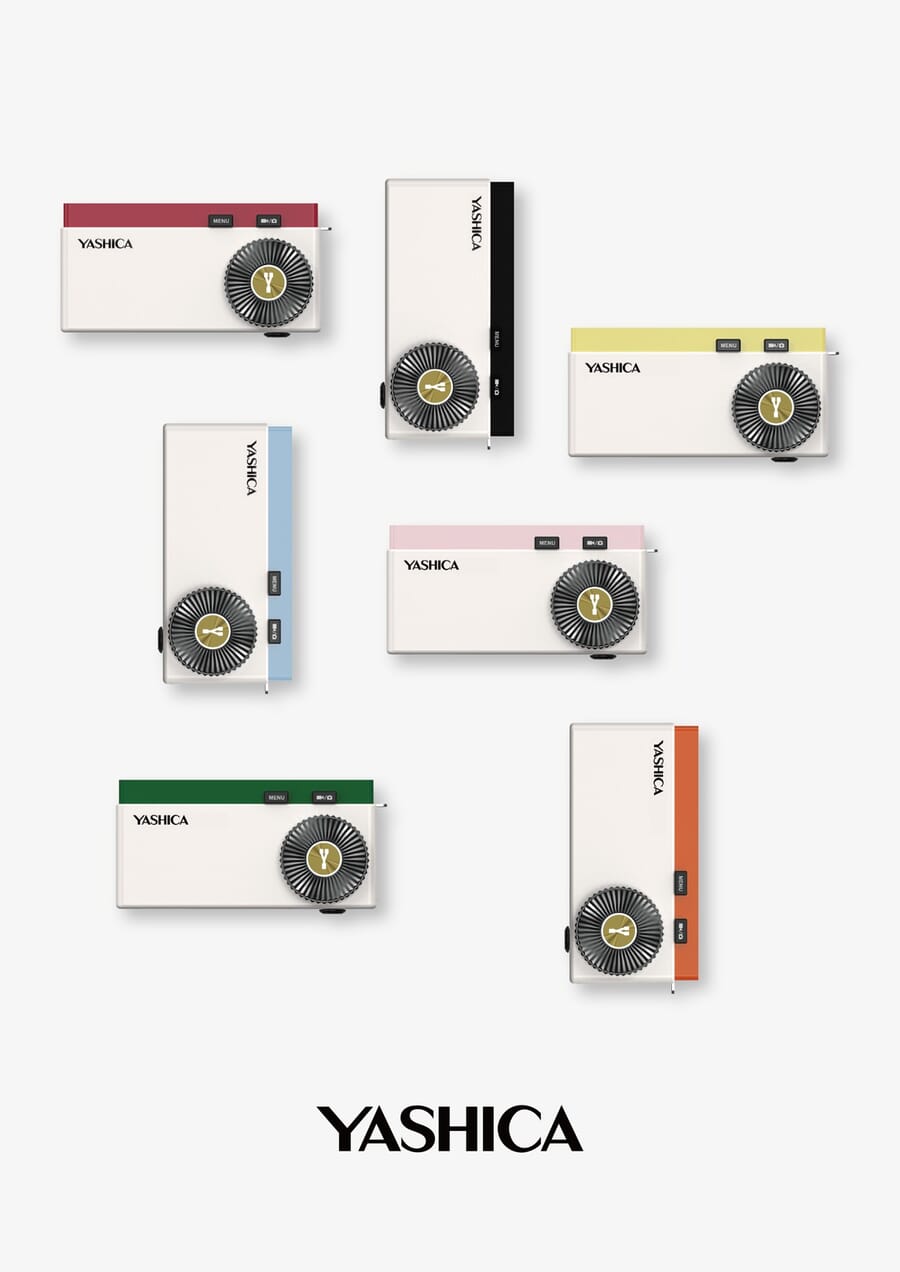
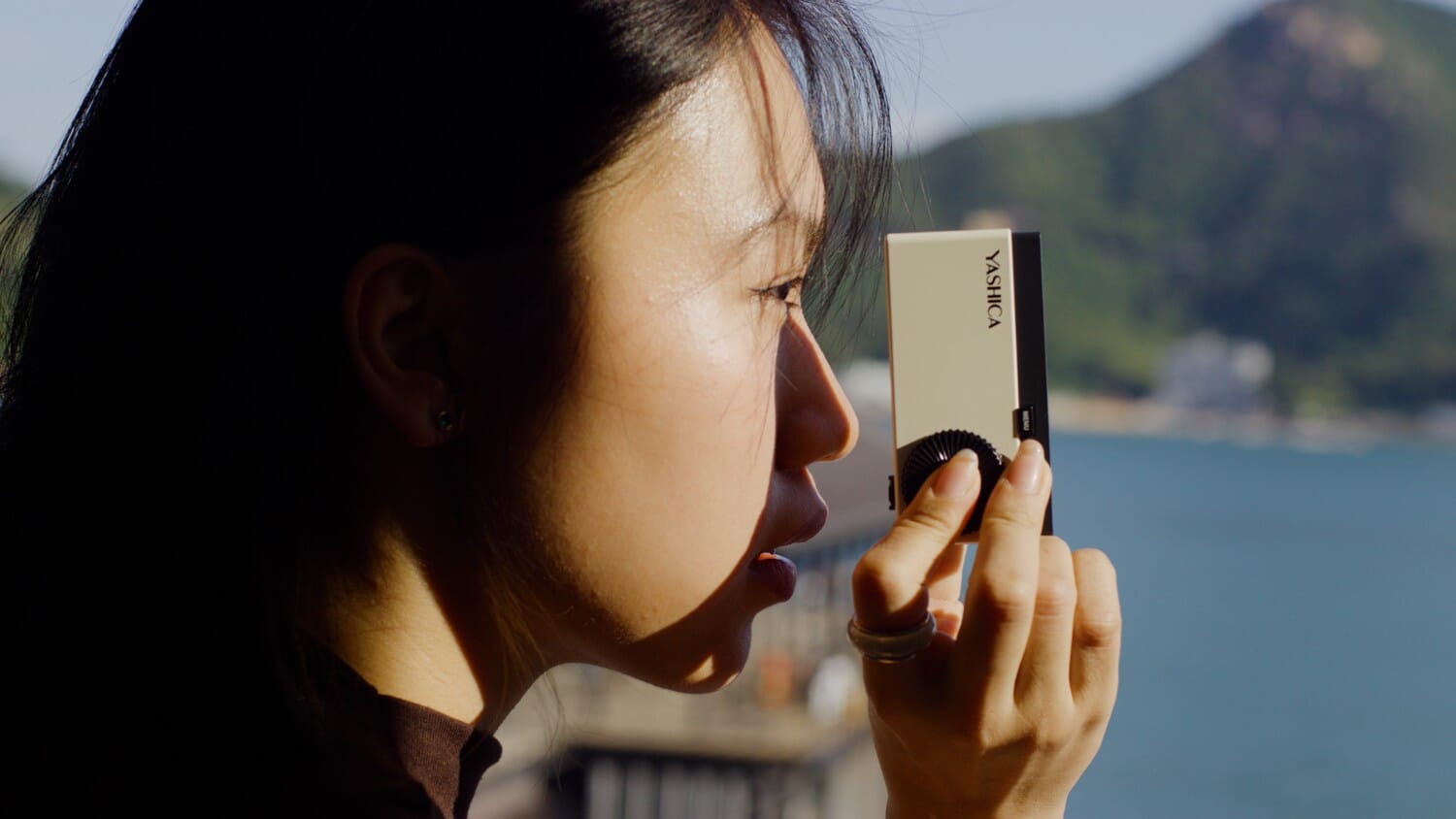
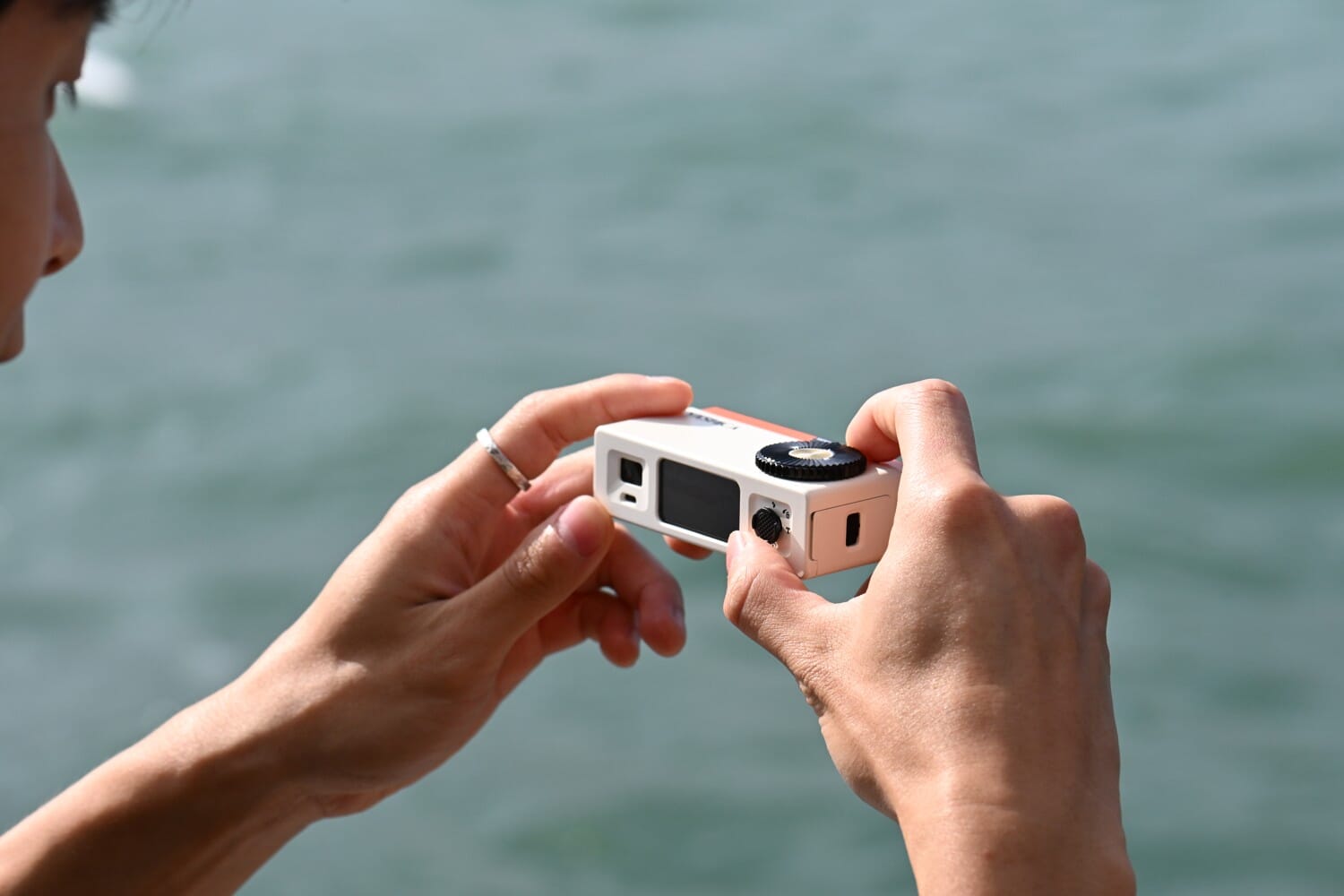
What it does have is character. There is a genuine xenon flash, the kind that gives that hard, nostalgic point-and-shoot pop, effective out to around two meters. There is an optical viewfinder for shooting at eye level, a small 1.45-inch rear screen, and eight built-in creative filters for baking a look into the shot. Yashica is offering it in seven colorways on a vintage-white body, which is clearly aimed at the same buyers who treat a camera as much as an accessory as a tool.
The catch: this is charm, not image quality
It is worth being blunt here, because it is where these cameras get oversold. A 12MP sensor this small behind an f/12 fixed-focus lens is not going to out-resolve, out-detail, or out-low-light a modern smartphone. It is not close. In good light you get soft, slightly lo-fi images with that unmistakable compact-camera flash look; in dim rooms you lean entirely on the xenon flash. If you are expecting crisp, phone-beating photos, the Y16 will disappoint you.
But that is not what it is for. The draw is the experience: a tangible object with physical buttons, an optical finder you hold to your eye, a flash that fires with intent, and a deliberately imperfect result that feels more like a memory than a file. It is the same appeal driving the whole budget-digicam surge, which we broke down in our guide to the best budget digicams Gen Z actually buys. Judged as a toy and a fashion object, the Y16 makes sense. Judged as a camera on a spec sheet, it does not.
How it fits the retro-digicam wave
Yashica has been here before. Earlier in 2026 it launched the Yashica Tank, a roughly $100 retro digital compact, and the Y16 slots in right alongside it as an even smaller, flash-forward option. The company is clearly building a lineup around nostalgia rather than chasing image quality, and the market is rewarding it: compacts and retro-styled bodies are one of the only parts of the camera business actually growing, powered by younger buyers who want a dedicated device for the film-ish aesthetic without the cost or hassle of real film.
It is not just Yashica. The wider industry has noticed the appetite for retro, from Nikon hinting at more heritage bodies to OM System reviving the PEN at the premium end. The Y16 is the cheap, cheerful, impulse-buy end of that same trend, the camera you grab because it is $119 and comes in your favorite color, not because you studied its MTF charts.
Price, colors, and availability
Yashica has set the Y16 at $119, with pre-orders open and first shipments expected in late November 2026. The seven color options are the headline differentiator, since the internals are the same across the range. At that price it undercuts most of the budget-compact competition and sits comfortably in impulse-buy, gift, or stocking-stuffer territory heading into the holidays, which is almost certainly the point of the timing.
If you want a sense of where $119 lands in the broader compact market, from genuinely capable pocket cameras to pure aesthetic plays, our roundup of the best budget compacts of 2026 is a useful reality check before you buy on looks alone.

Frequently Asked Questions
How much is the Yashica Y16 and when does it ship?
Yashica has priced the Y16 at $119. Pre-orders are open, and first shipments are expected in late November 2026. It is offered in seven colorways on a vintage-white body.
Does the Yashica Y16 take better photos than a phone?
No, and it is not meant to. Its 12MP sensor is tiny (around 18mm²) and the fixed lens is roughly f/12, so image quality is intentionally modest. A modern smartphone will out-resolve it easily. The Y16 is about the retro form, the physical controls, and the xenon-flash look, not technical sharpness.
Does it have a flash and a viewfinder?
Yes. The Y16 has a real xenon flash, effective to around two meters, plus an optical viewfinder and a small 1.45-inch rear screen. It also includes eight built-in creative filters.
How does the Y16 compare to the Yashica Tank?
Both are inexpensive retro digital compacts with 12MP sensors. The Tank (around $100) is the slightly more conventional pocket camera with a brighter f/2.0 lens and a flip screen, while the Y16 is smaller, flash-forward, and modeled on Yashica’s 1959 subminiature design. Choose the Tank for a bit more everyday flexibility and the Y16 for the smallest, most stylized option.
The bottom line
The Yashica Y16 is a $119 nostalgia object that happens to take pictures. If you go in expecting a capable camera, the tiny sensor and f/12 lens will let you down. If you go in wanting a tiny, charming, flash-popping retro toy in a color you like, it delivers exactly that, and the late-November timing makes it an easy holiday gift. It is the cheapest, most honest expression yet of the retro-digicam trend: all vibe, priced to match.
Specs, pricing and availability based on Yashica's Y16 announcement at the time of publication.