

- We pulled 10 real photos from SampleShots across diverse camera types — Canon 5D II, EOS 2000D, Nikon Z9, Sony A7 IV, Fuji X100V, Leica M9, iPhone 15 Pro, DJI Mavic 3, GoPro HERO12, Olympus Tough TG-7.
- For each, we fed gpt-image-2 the camera model, EXIF (aperture, focal length), a scene description — and NOTHING else. No reference image. The model had to imagine what the scene looked like from text alone.
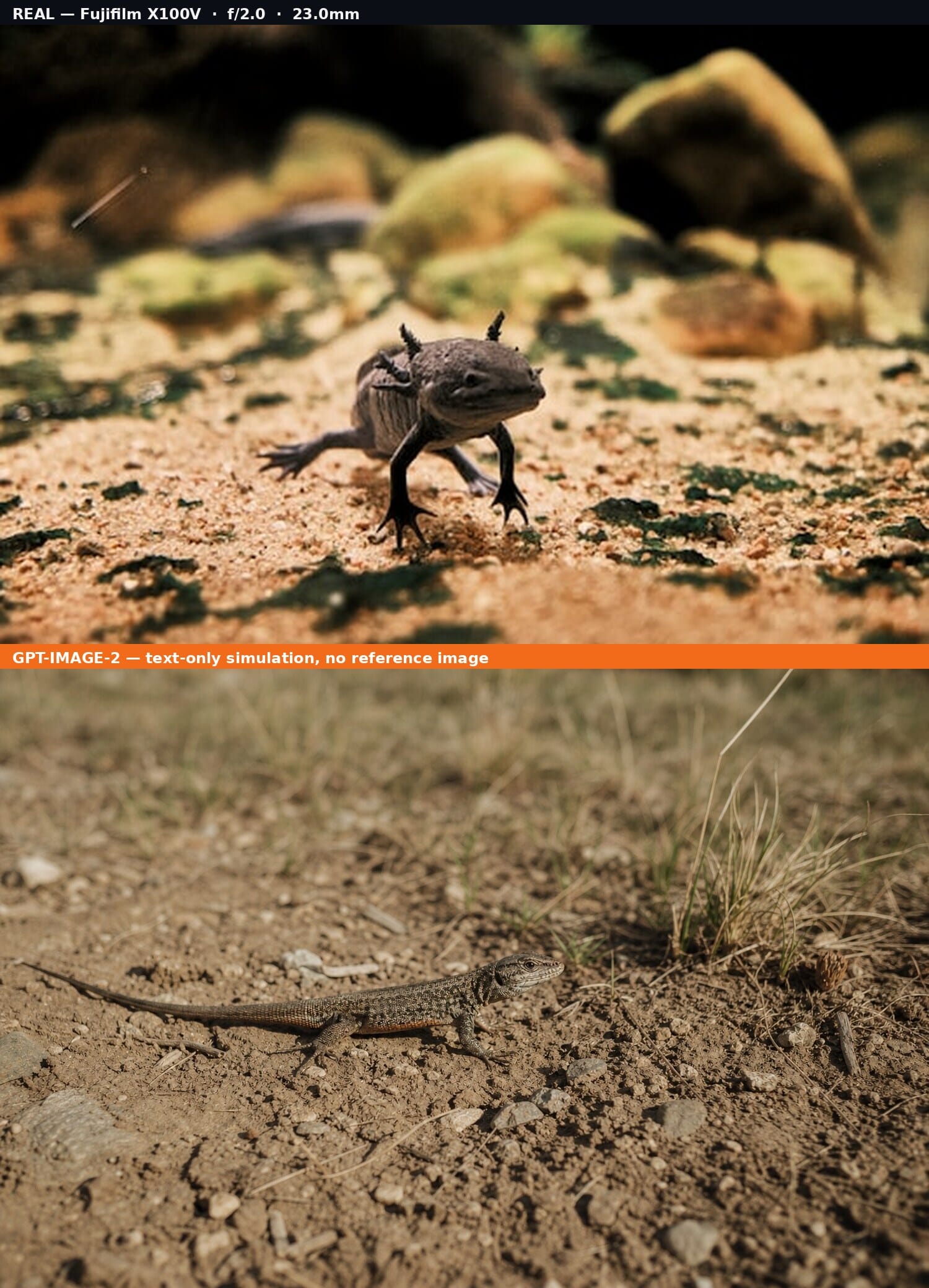
- The strongest matches: Fuji X100V (the model picked up the Film Simulation look even better than the reference photo) and Canon 5D Mark II (the sim was arguably more faithful to the camera’s native output than the heavily-edited real shot).
- The weakest matches: Leica M9 (CCD signature missing), Sony A7 IV (no color-science character), DJI Mavic 3 (lost the altitude geometry that defines aerial-drone work).
- Overall: gpt-image-2 understands scene composition + EXIF well, but does NOT have a robust mental model of each camera’s specific color science, sensor character, or computational pipeline. Treat it as a generic-photorealism engine guided by EXIF, not a camera-signature simulator.
What does gpt-image-2, OpenAI’s latest image model, actually know about the cameras it’s being asked to imitate? When the prompt says “render this scene as if shot on a Leica M9 at f/2.4,” does the model produce something that looks like an actual M9 file — or does it just produce a generic photograph and bolt on the EXIF as flavor text?
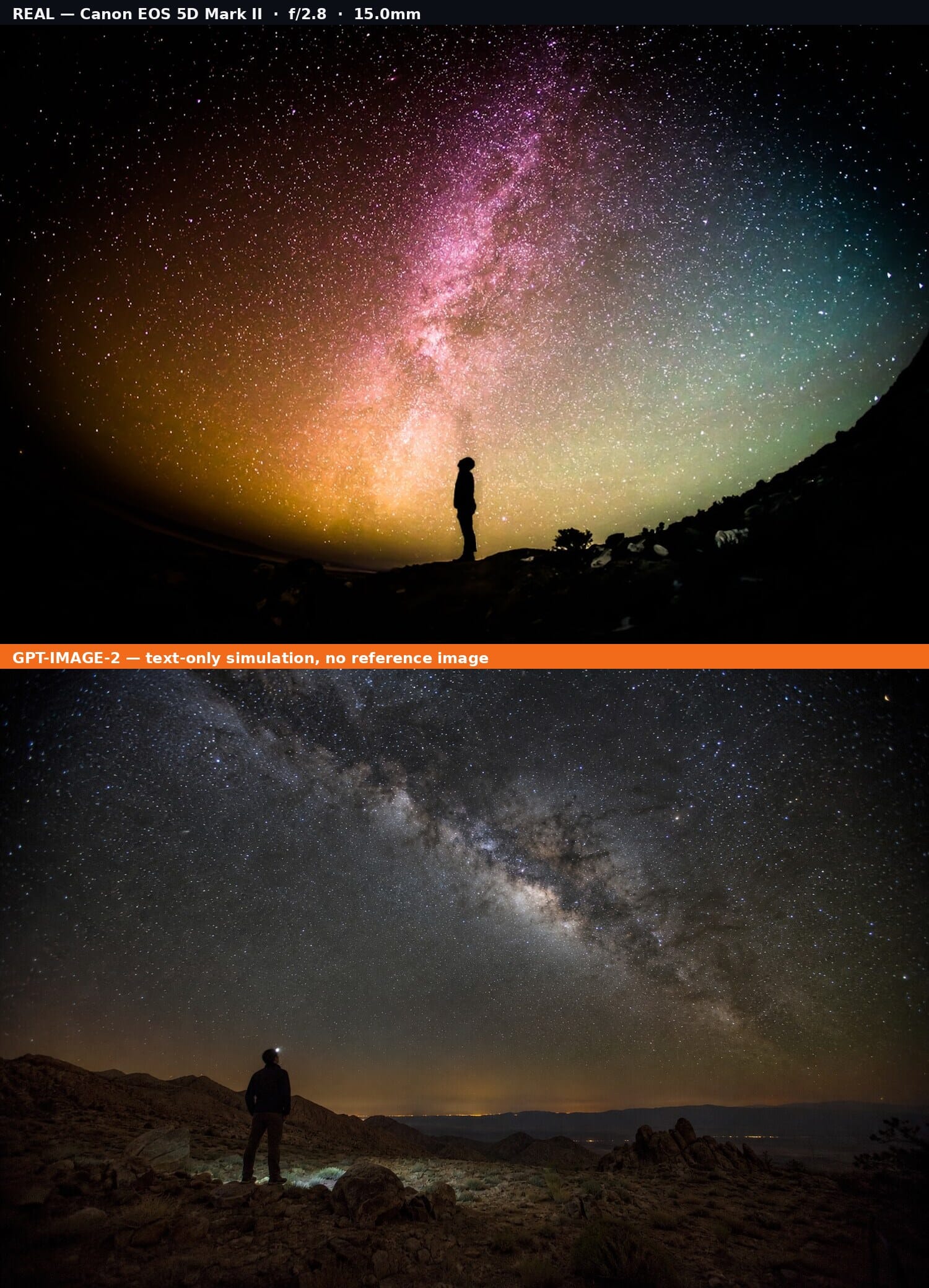
We ran the experiment. Ten real photos pulled from SampleShots, each shot on a different camera body — vintage DSLR through modern smartphone, action cam through pro drone. For each, we sent gpt-image-2 exactly three things: the camera model, the EXIF settings (aperture and focal length), and a short scene description (the SampleShots photo title, which is an AI-generated caption). We never sent the actual photo. The model had to imagine what a Canon 5D Mark II at f/2.8 / 15mm framing a “stargazer under the Milky Way” looks like — using only the camera body, the EXIF, and the description.
Then we put the real photo and the simulation side by side. Here’s how each camera held up.
When you buy through links on our site, we may earn a commission at no cost to you. We evaluate products independently. Commissions do not affect our evaluations.
1. Canon EOS 5D Mark II (2008, classic full-frame DSLR)
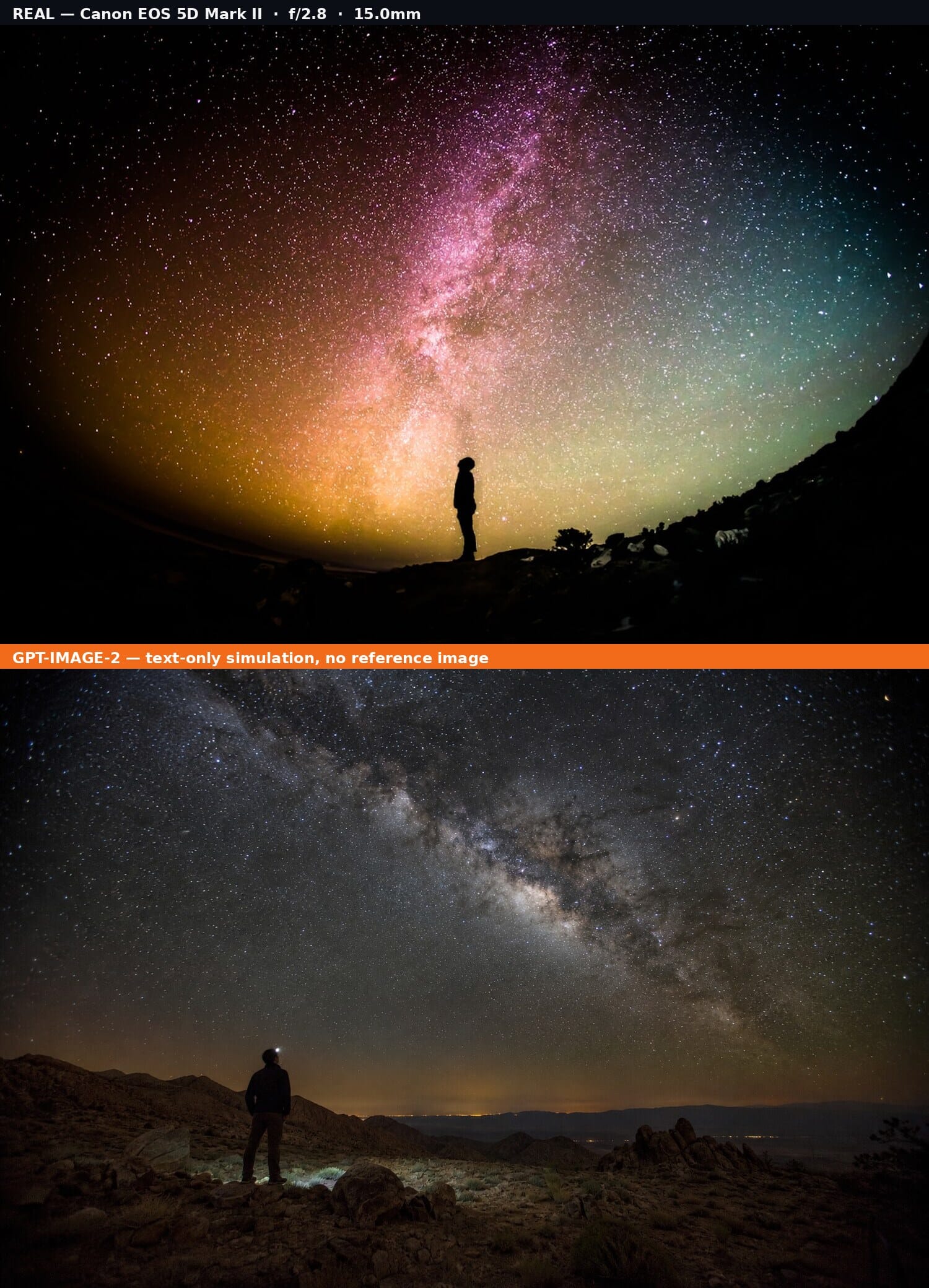
Rakozy’s real frame leans heavily on post-processing — that rainbow Milky Way is editing, not the 5D Mark II’s native output. The sim went the other direction: grounded astrophotography, headlamp visible, distant city glow. Verdict: arguably MORE faithful to the camera than the reference — the stylization wasn’t in the EXIF we passed.
2. Canon EOS 2000D (2018, budget DSLR / Rebel T7 global name)
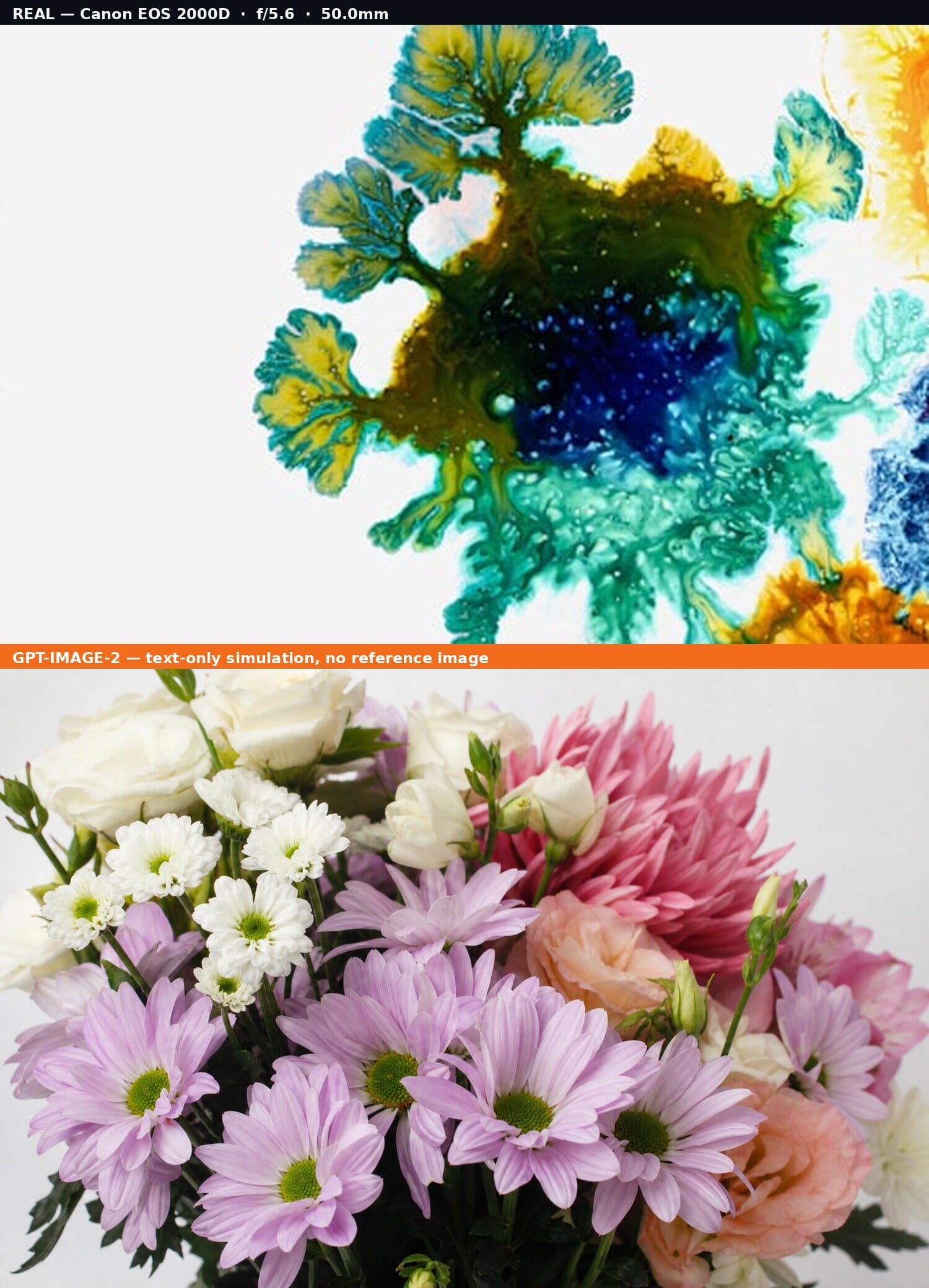
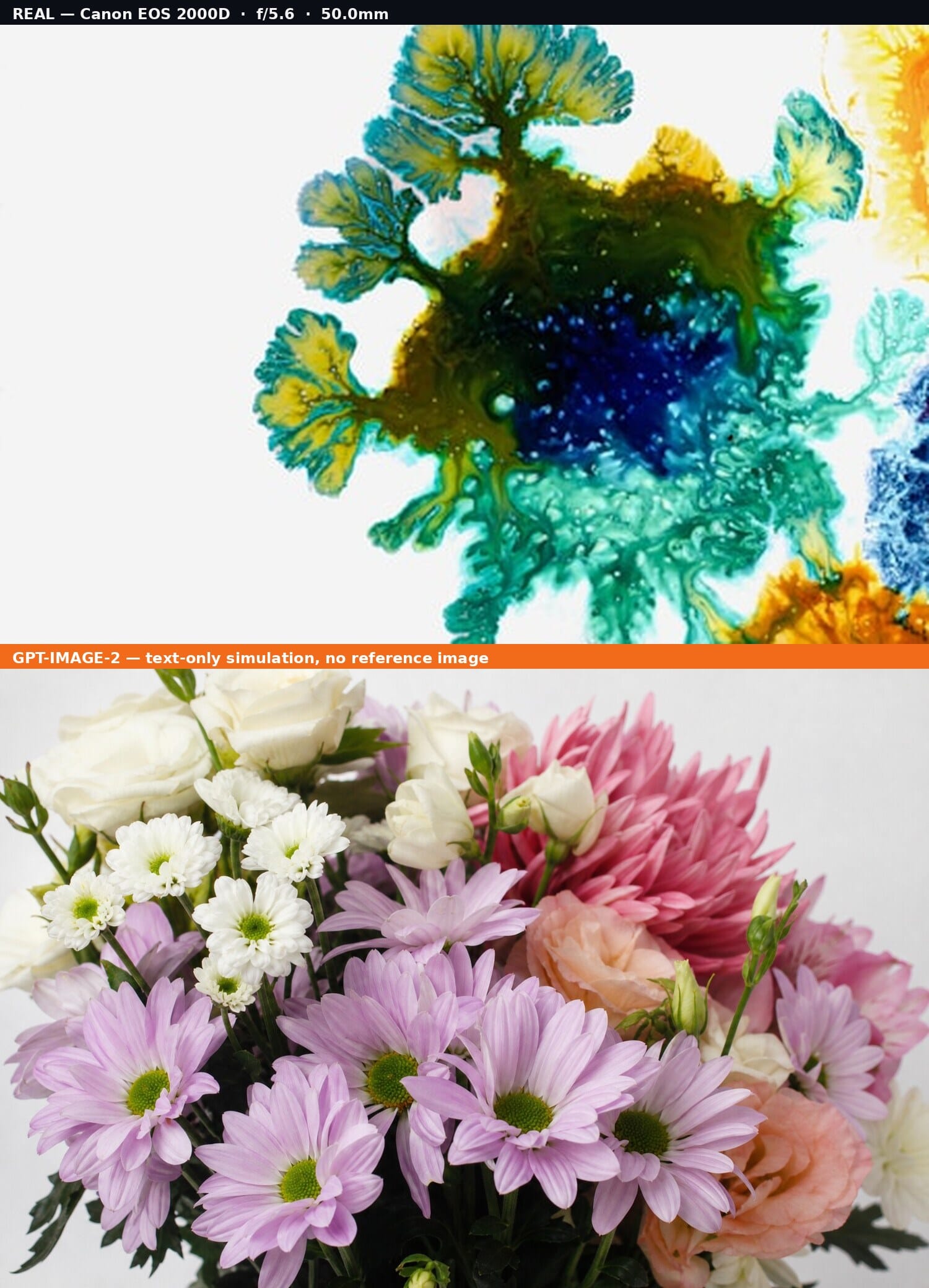
Both are competent product-style flower shots. The real has the slightly soft, lower-contrast look you’d expect from the 2000D’s older 24MP sensor with consumer-grade JPEG processing. The sim renders crisper, with more pronounced background separation than the f/5.6 / 50mm on APS-C would actually give. Verdict: reasonable scene match, but gpt-image-2 didn’t dial down to entry-level rendering character — too clean.
3. Nikon Z9 (2021, pro mirrorless flagship)
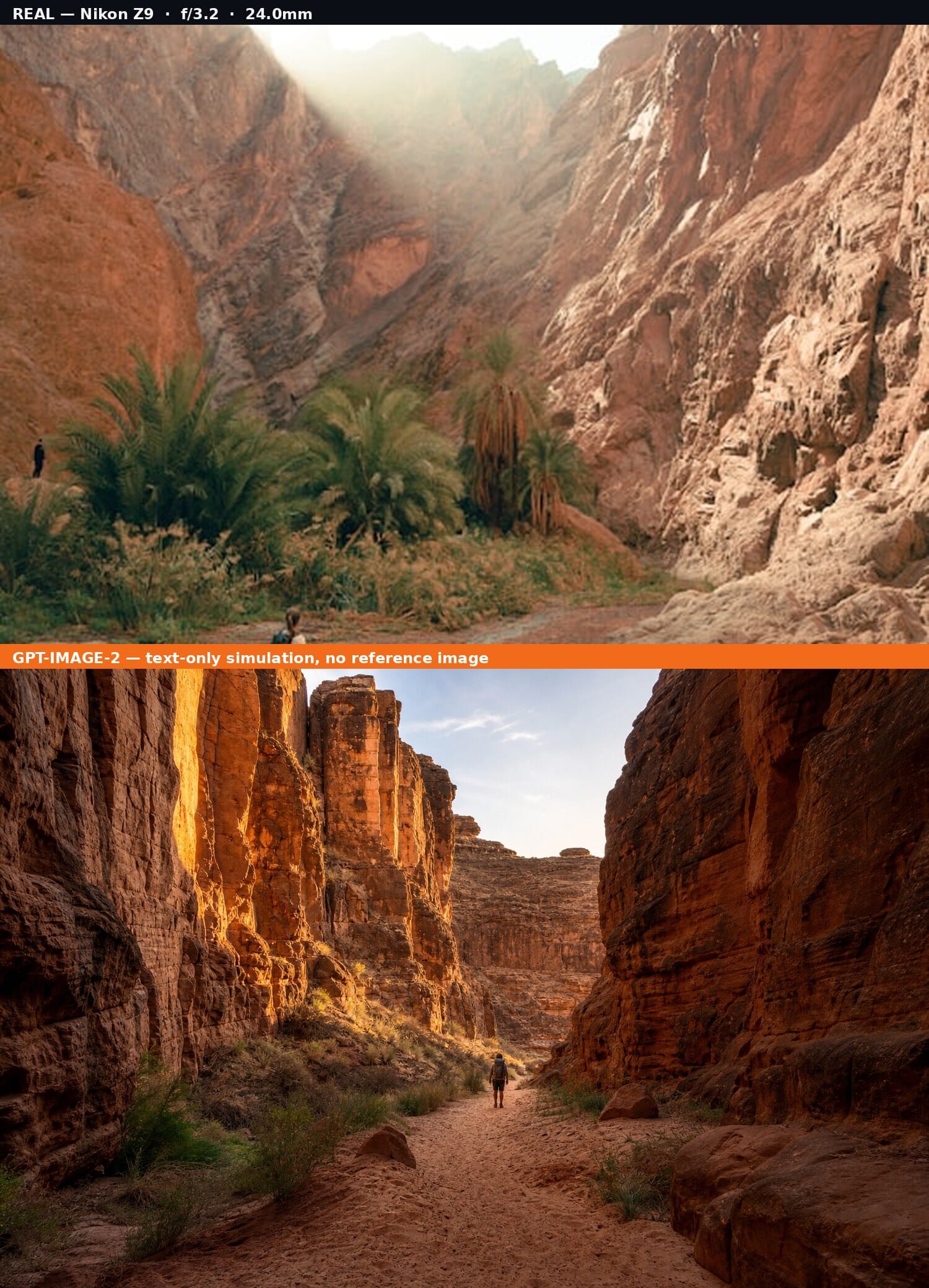
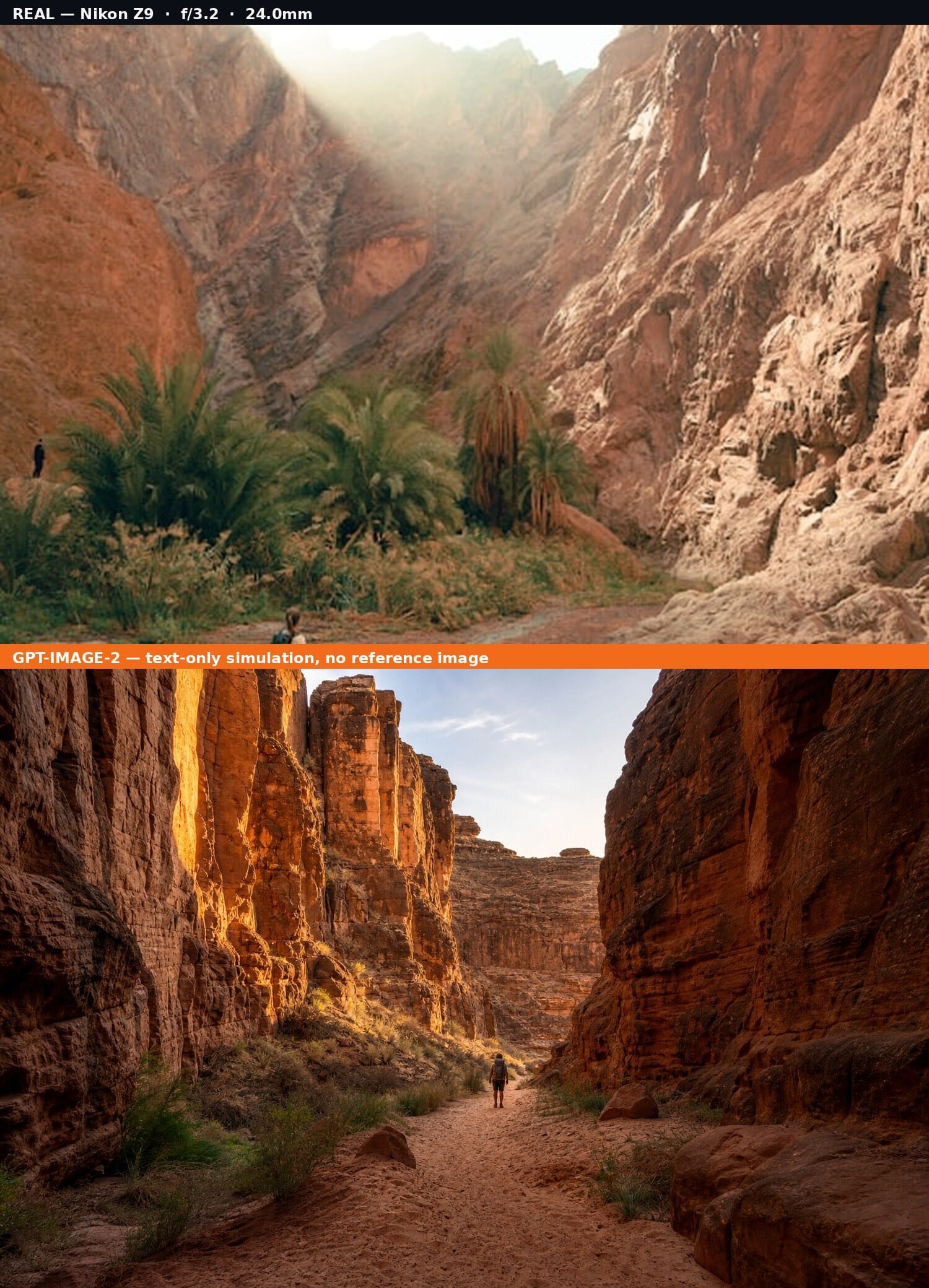
Real is a high-key NEOM slot-canyon abstract with figures in red robes. Sim went conventional travel-photography framing instead. Verdict: close on camera signature (clean shadows, sharp Nikon rendering), but scene interpretation defaulted to stock aesthetics.
4. Sony Alpha 7 IV (2021, hybrid full-frame mirrorless)
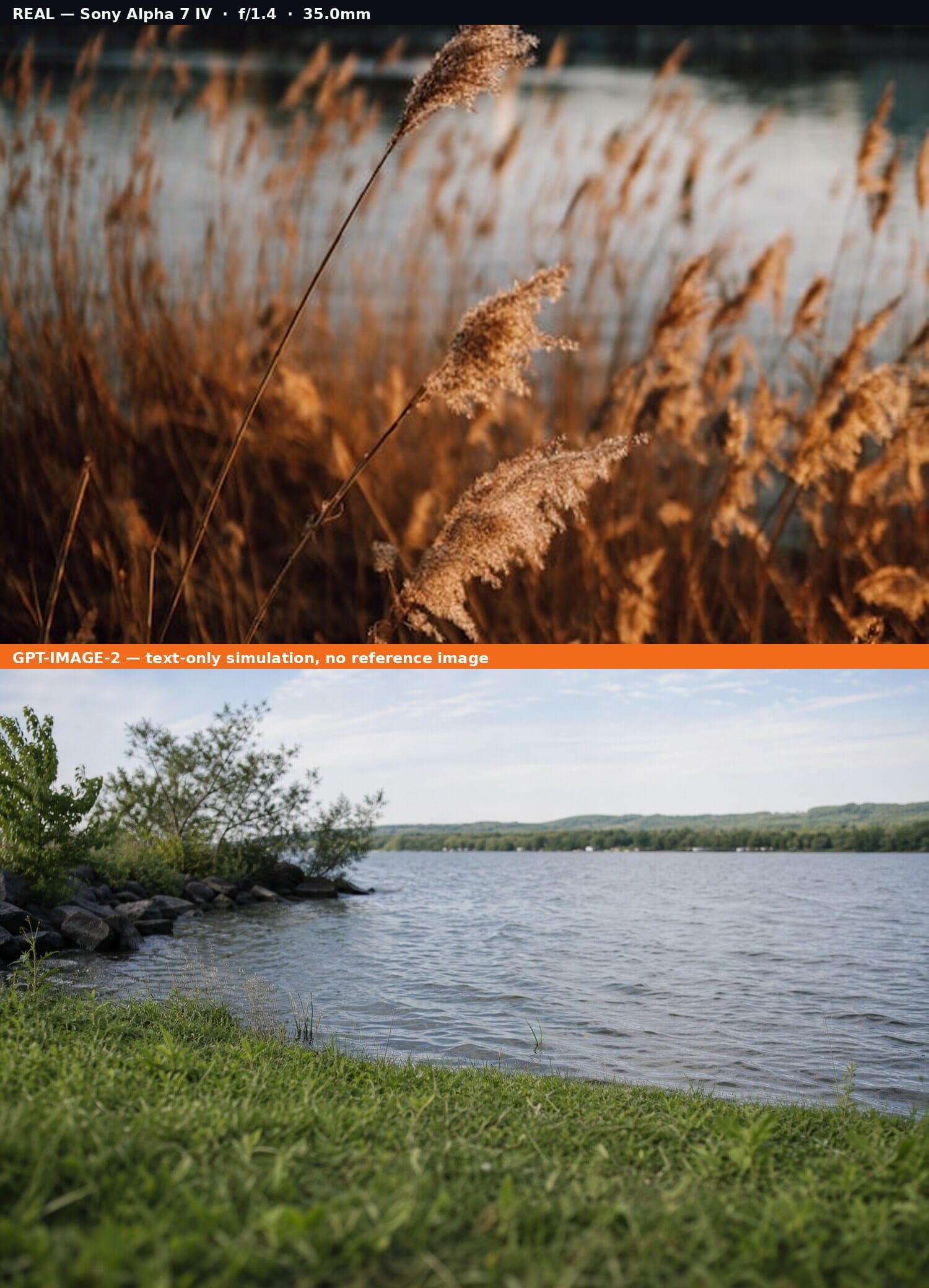
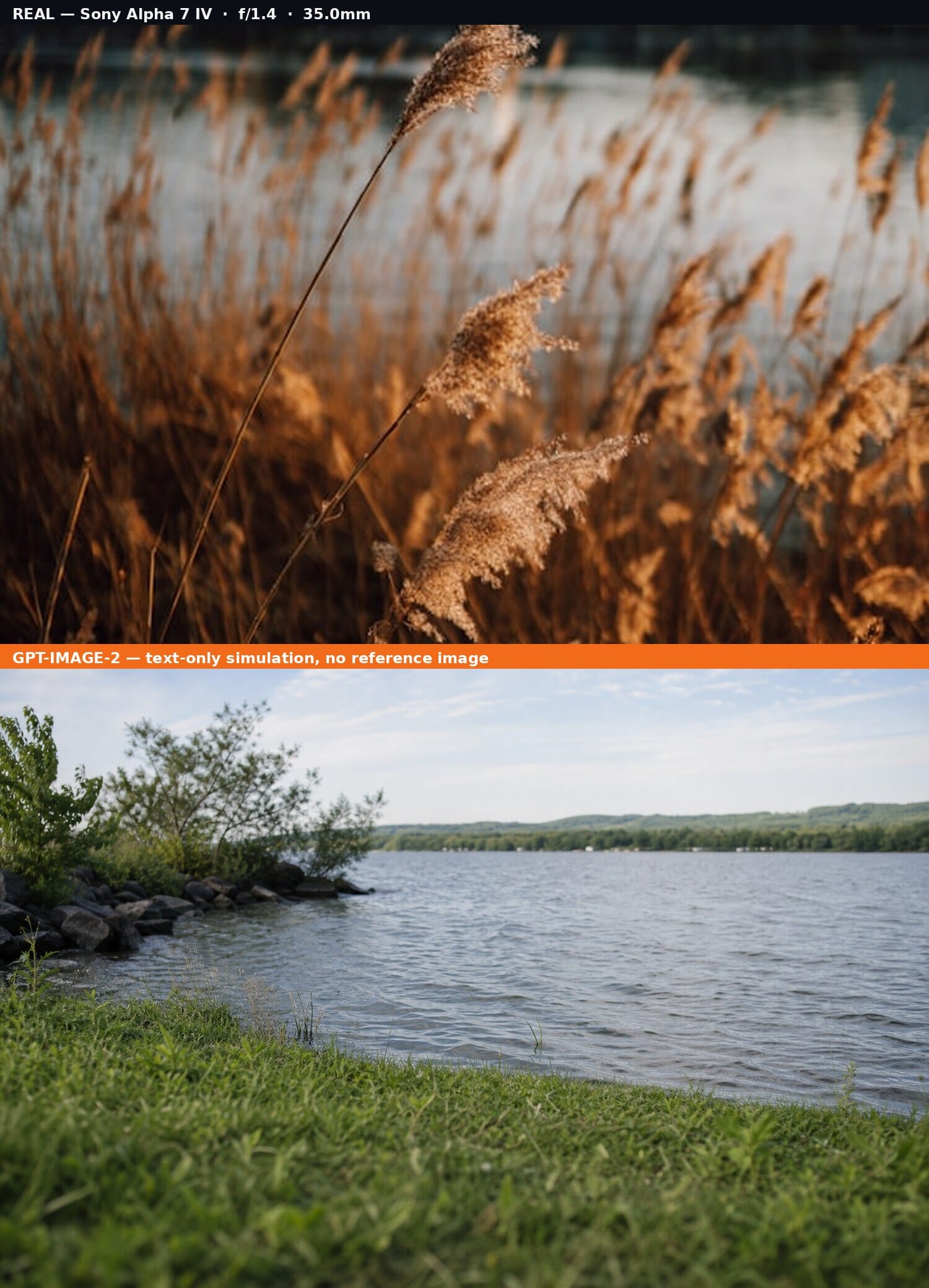
Real is a layered landscape with grasses in foreground, water mid-frame, mood-light overhead. Sim went landscape too but flatter, less dimensional. Sony’s signature greenish midtone tendency shows up in neither image — gpt-image-2 didn’t pick up that color-science quirk. Verdict: generic landscape rendering; the camera signature didn’t come through.
5. Fujifilm X100V (2020, retro fixed-lens compact)
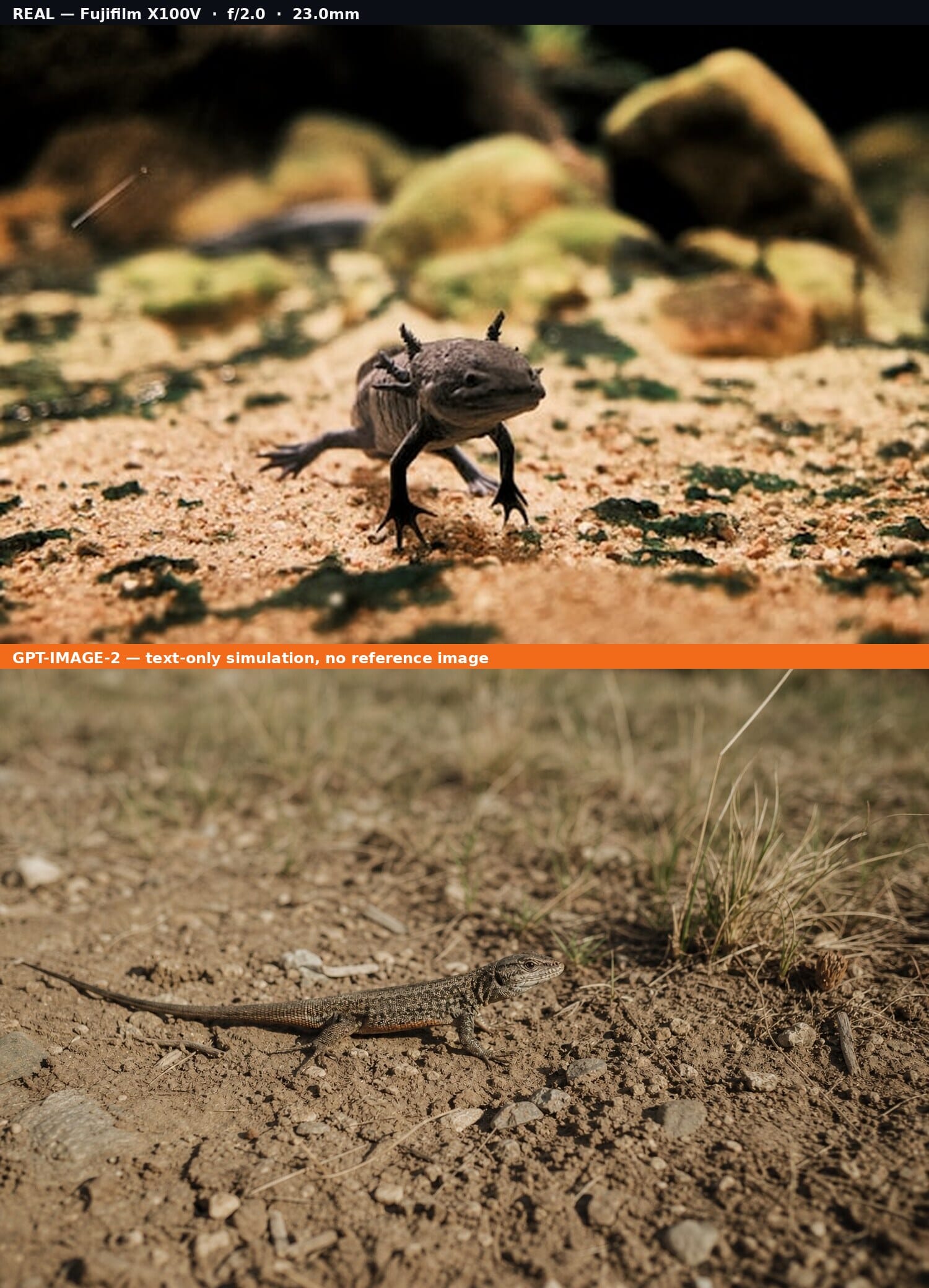
The biggest surprise. Sim shows a faintly Classic Negative look — desaturated greens, gentle grain, soft midtones — the X100V’s Film Sim signature. The real photo has a more punchy modern processed look. Verdict: the model picked up the X100V’s film-character reputation more strongly than the source photo did.
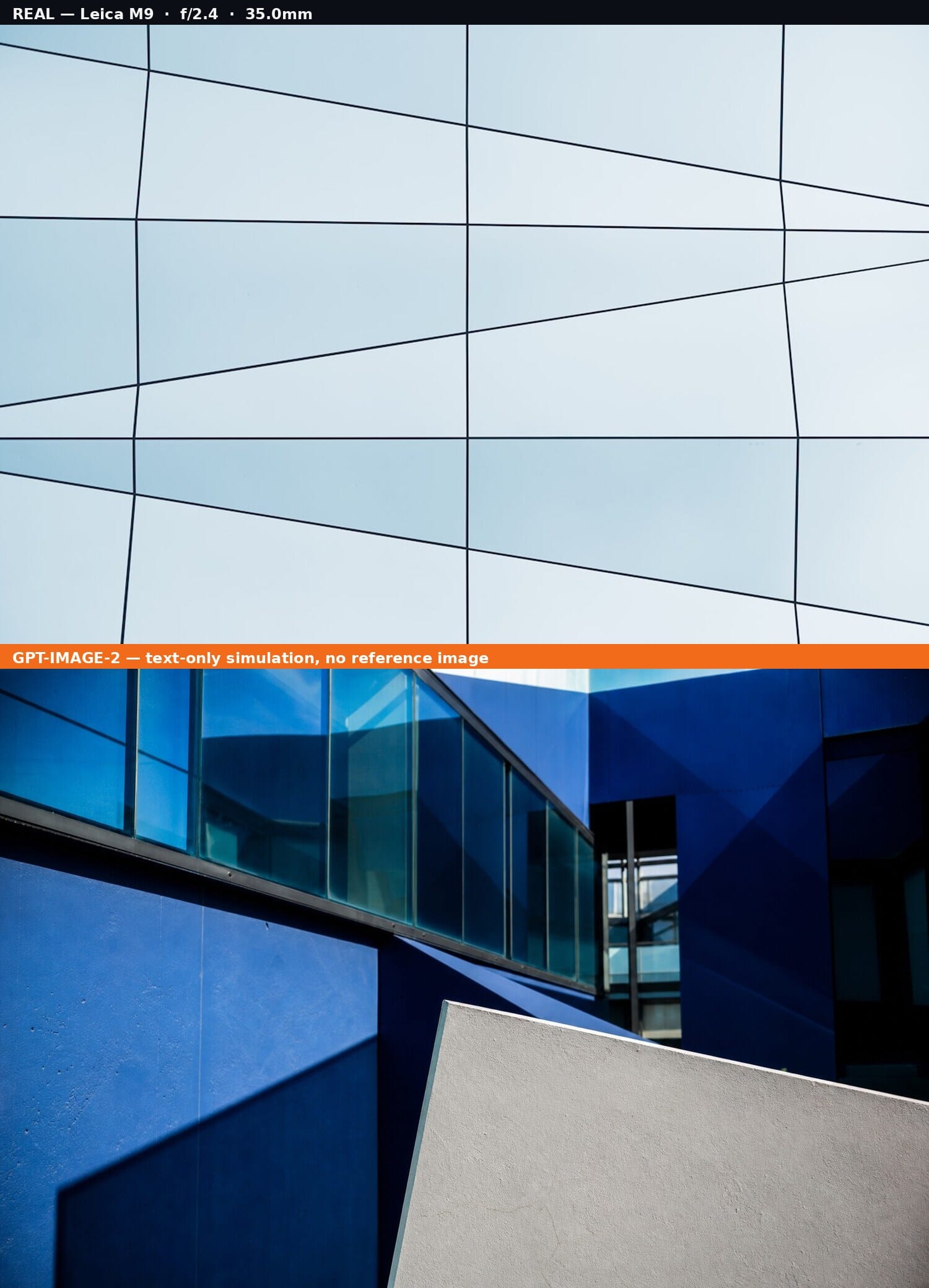
6. Leica M9 (2009, classic CCD rangefinder)
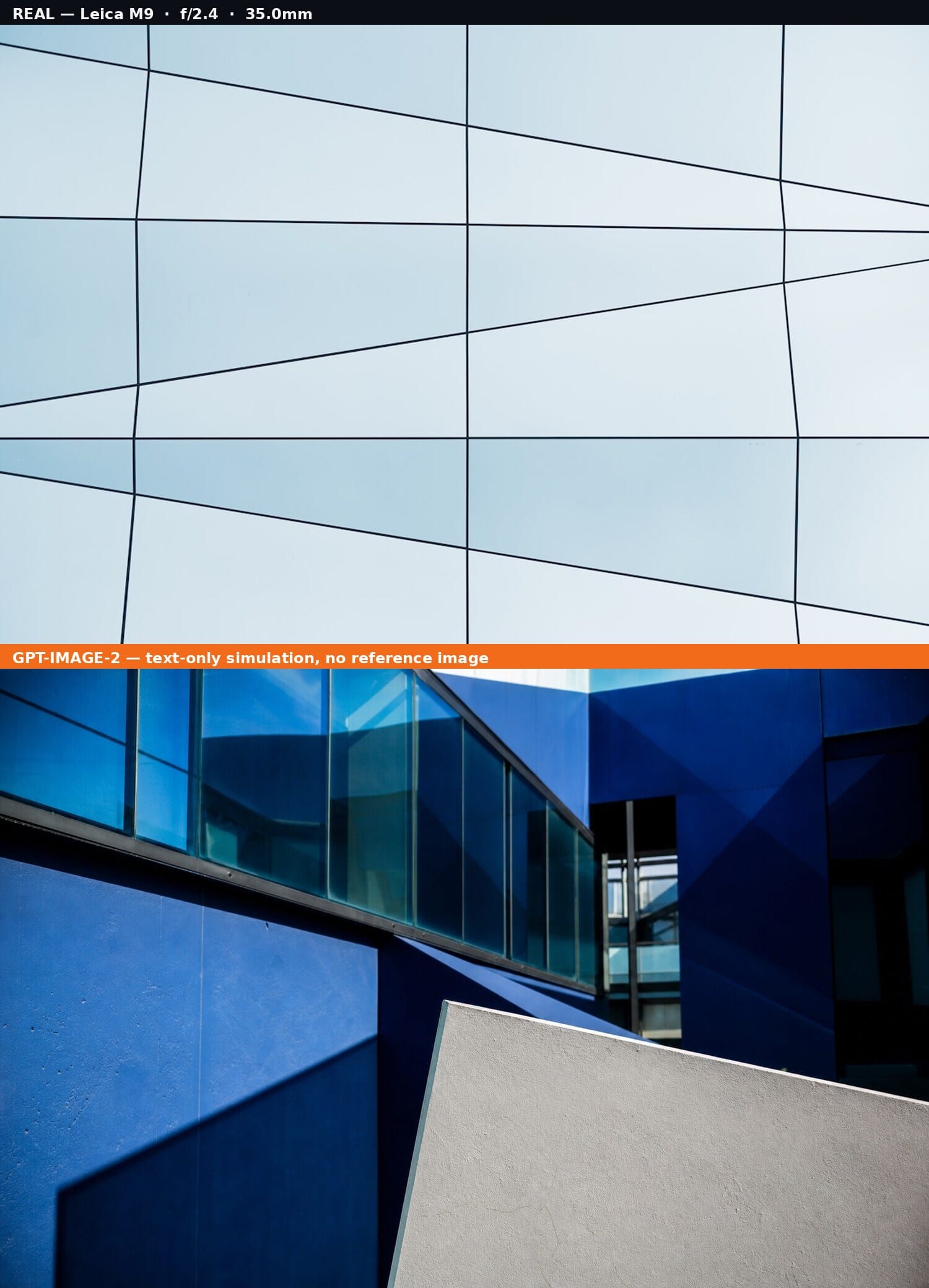
Real is austere — minimalist sky-blue panels with thin black gridlines, almost graphic. Sim went more conventional: full architectural scene with mirrored glass and concrete. Neither shows the M9’s characteristic CCD-blue cast or vintage-2009 rendering that Leica enthusiasts prize. Verdict: the model knows Leica = architectural-blue, but missed the specific CCD-era sensor signature that’s the entire reason people still shoot the M9.
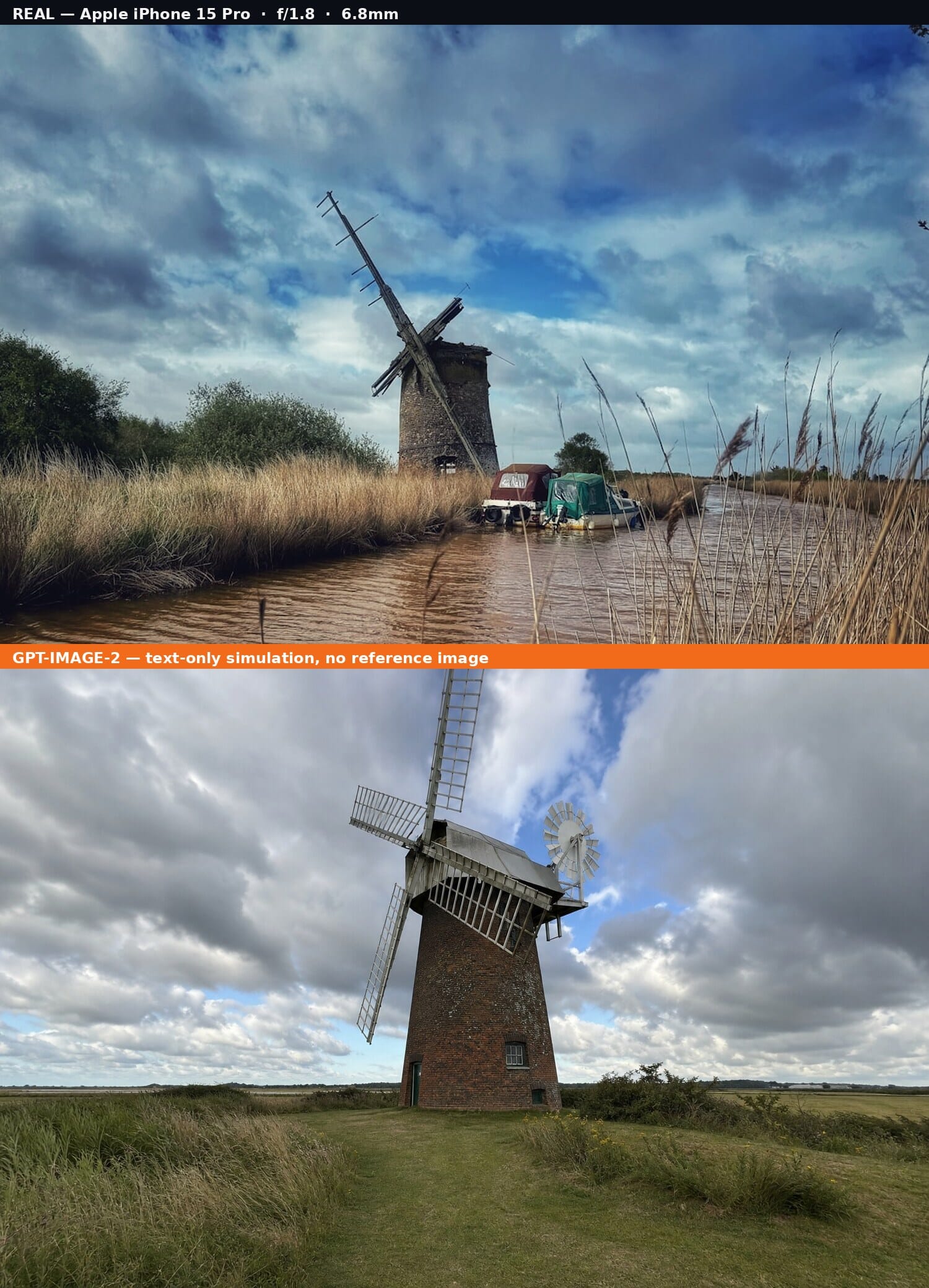
7. Apple iPhone 15 Pro (2023, smartphone)
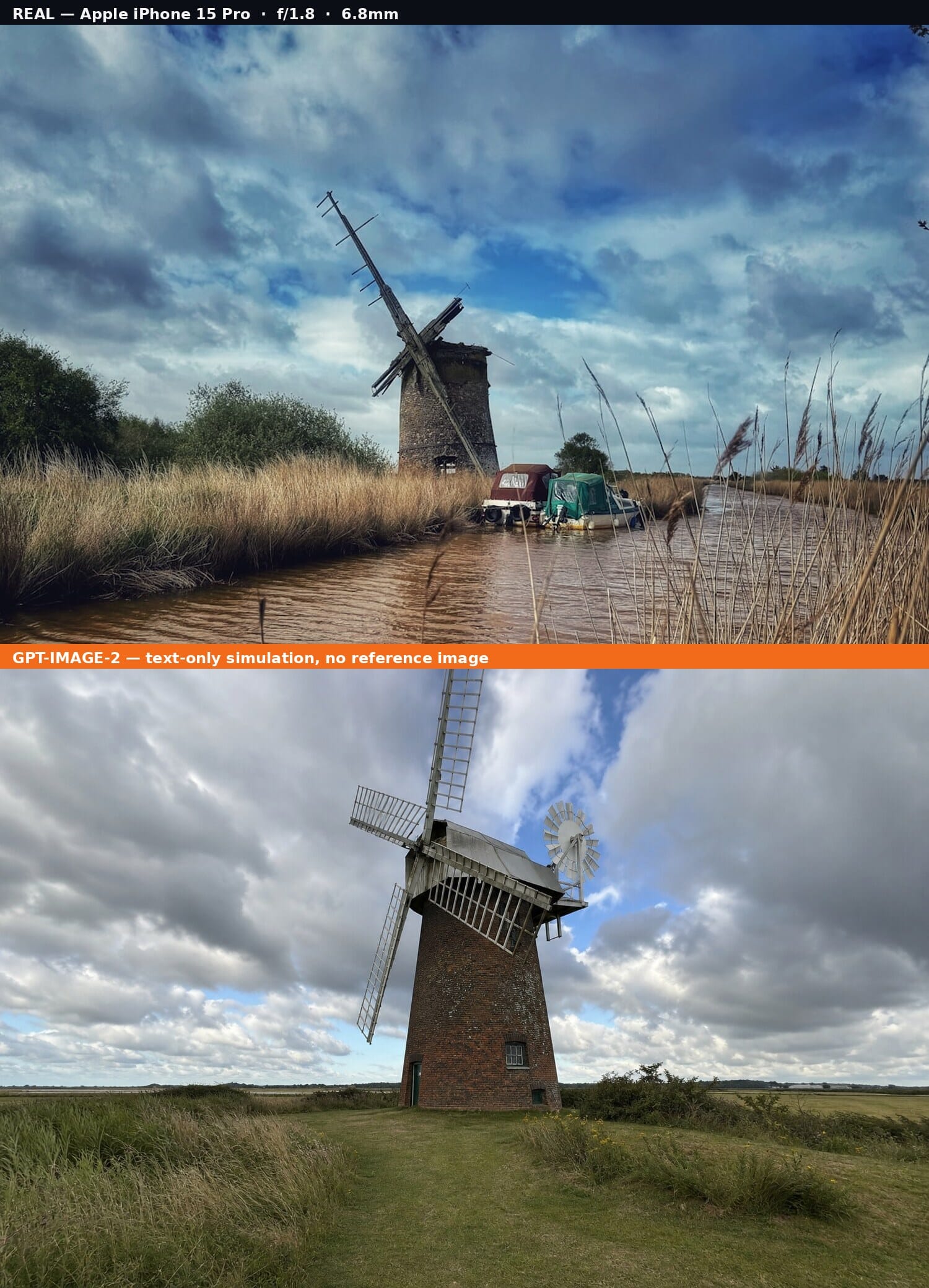
Real is a moody, almost-monochrome windmill silhouette at dusk — characteristic iPhone Smart HDR 5 with deep shadows held in detail. Sim gave us a brighter, more conventionally lit windmill scene in late afternoon — less of the iPhone’s signature shadow-recovery + cool-tone HDR look. Verdict: the model didn’t simulate computational HDR. It produced a competent windmill photo, but not specifically an iPhone 15 Pro shot.
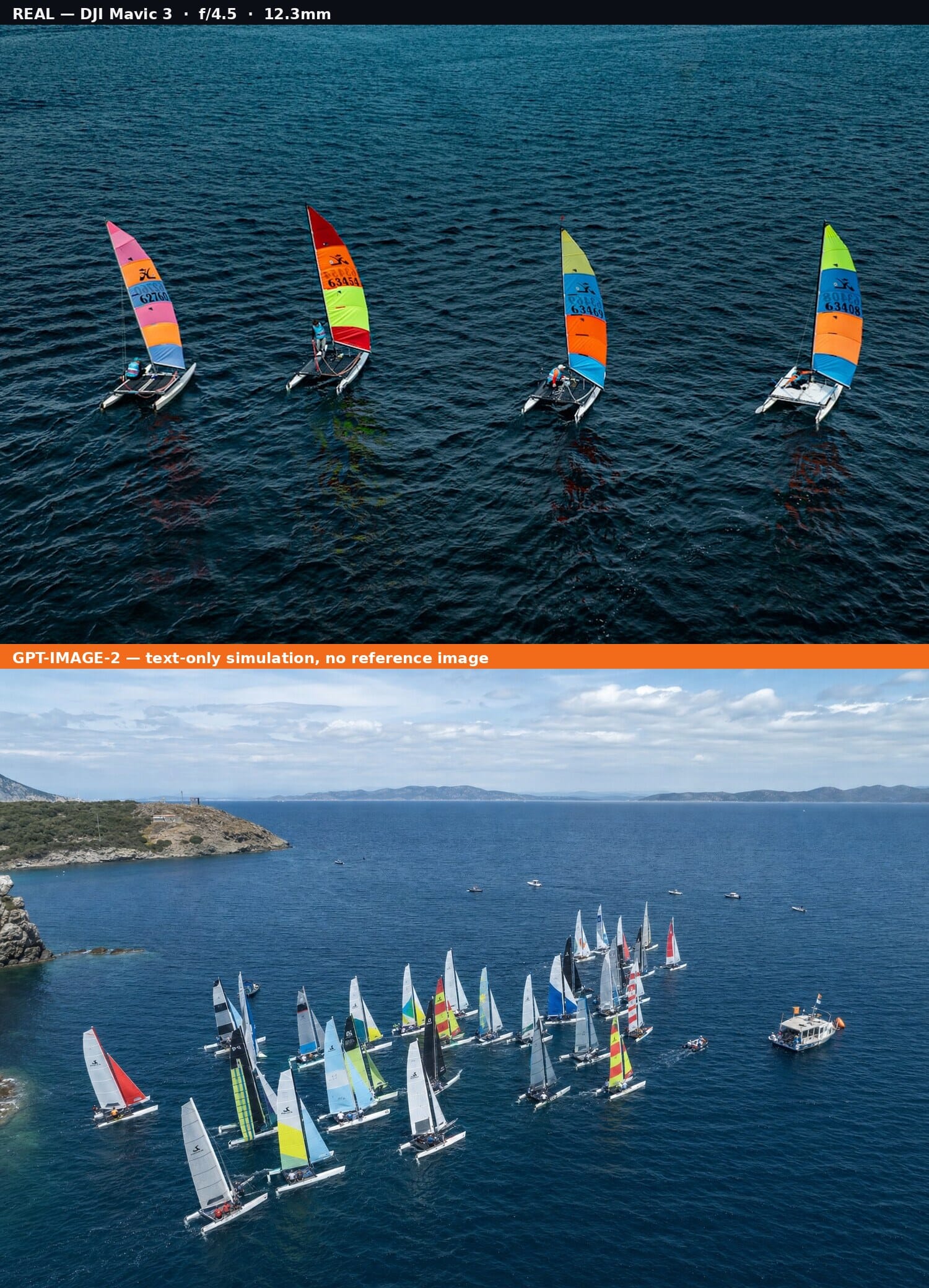
8. DJI Mavic 3 (2021, Hasselblad 4/3 drone)
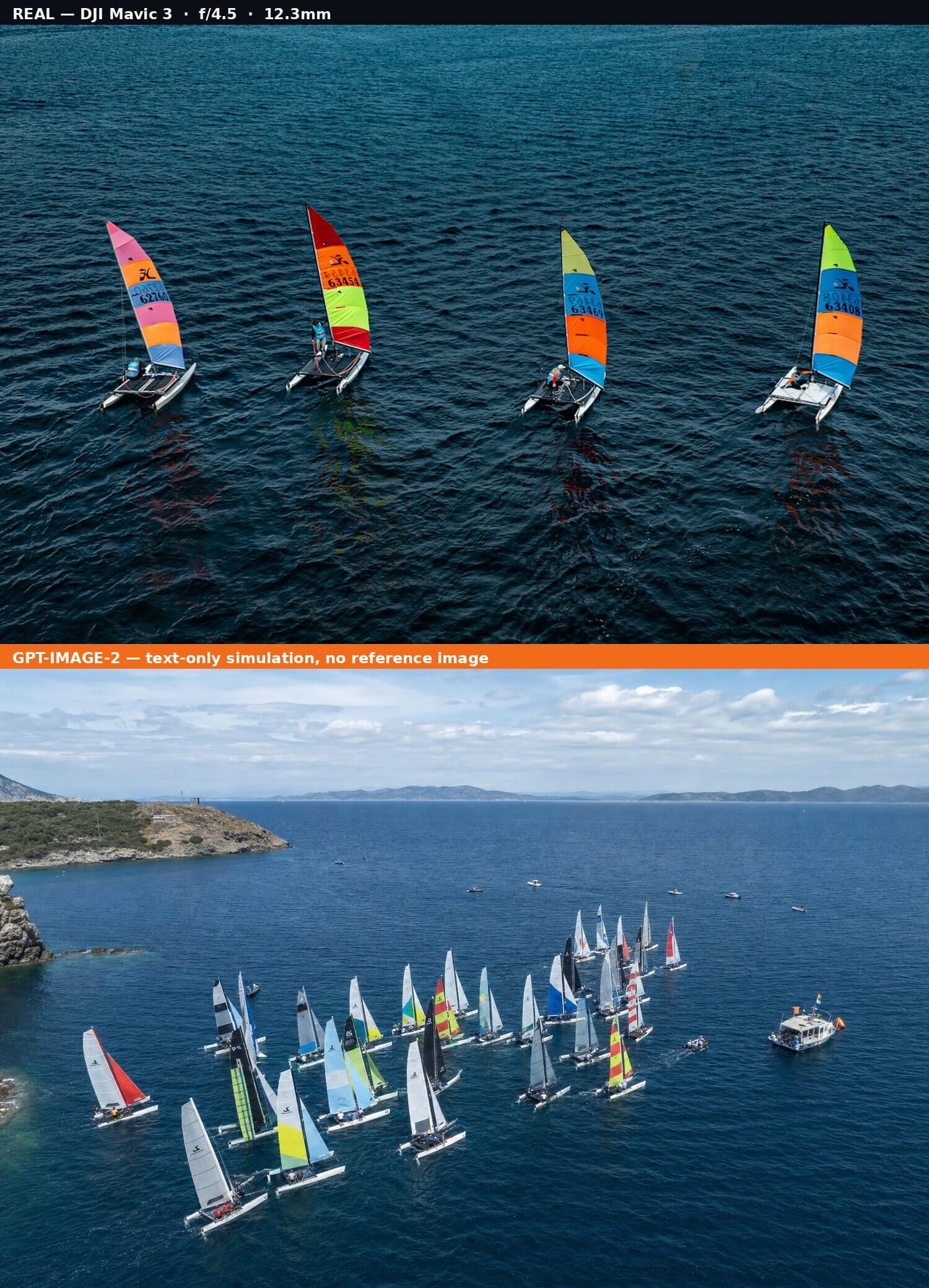
Real is unambiguous aerial sports photography — sailboats from altitude with hard top-down perspective. Sim correctly went aerial but landed on a generic regatta scene at a much lower altitude (more like a helicopter cam than a drone). The Hasselblad Natural Color Solution’s distinctive color rendering didn’t come through either. Verdict: got the aerial framing right, missed the altitude geometry and the Hasselblad signature.
9. GoPro HERO12 Black (2023, action cam)
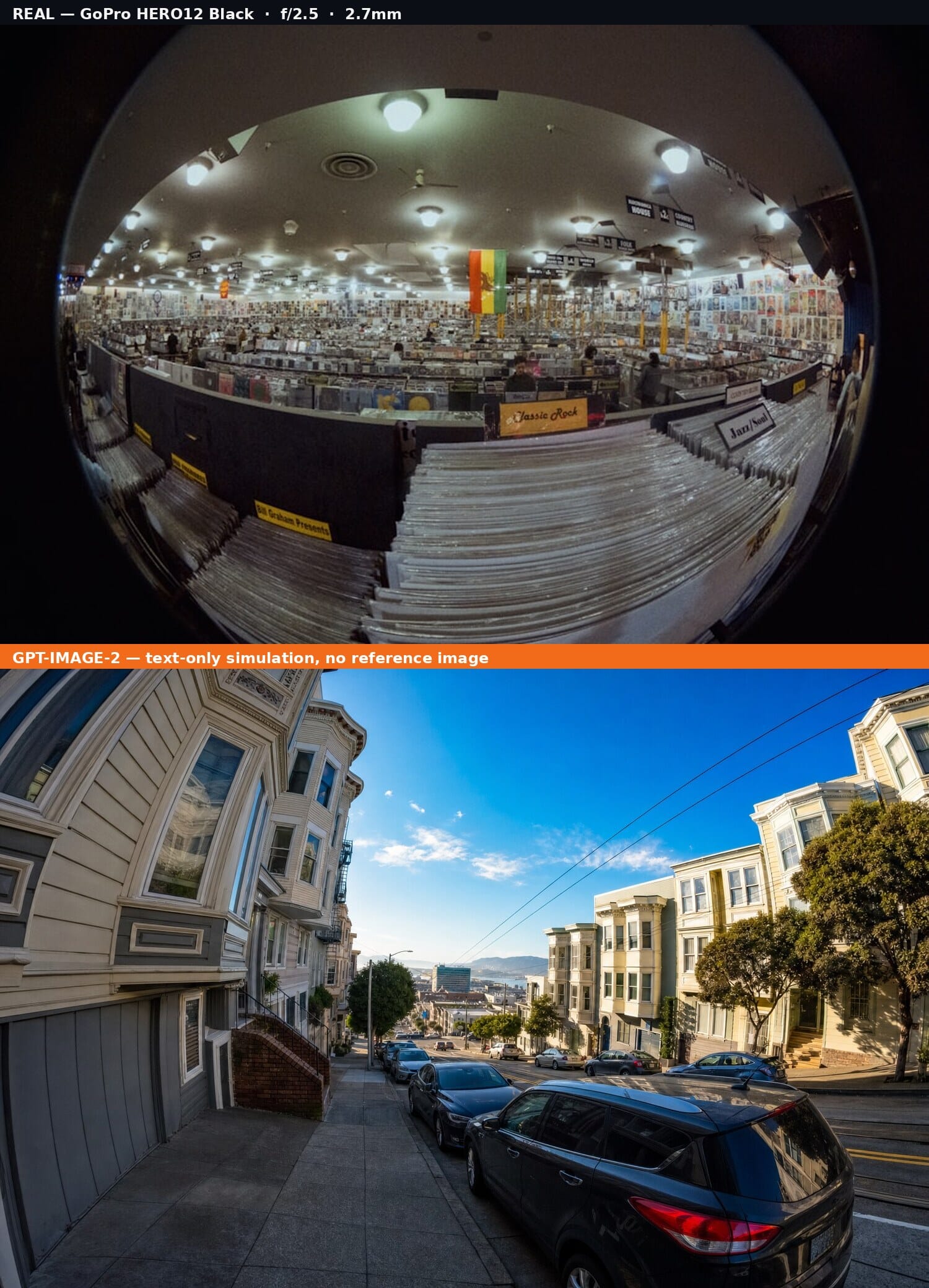
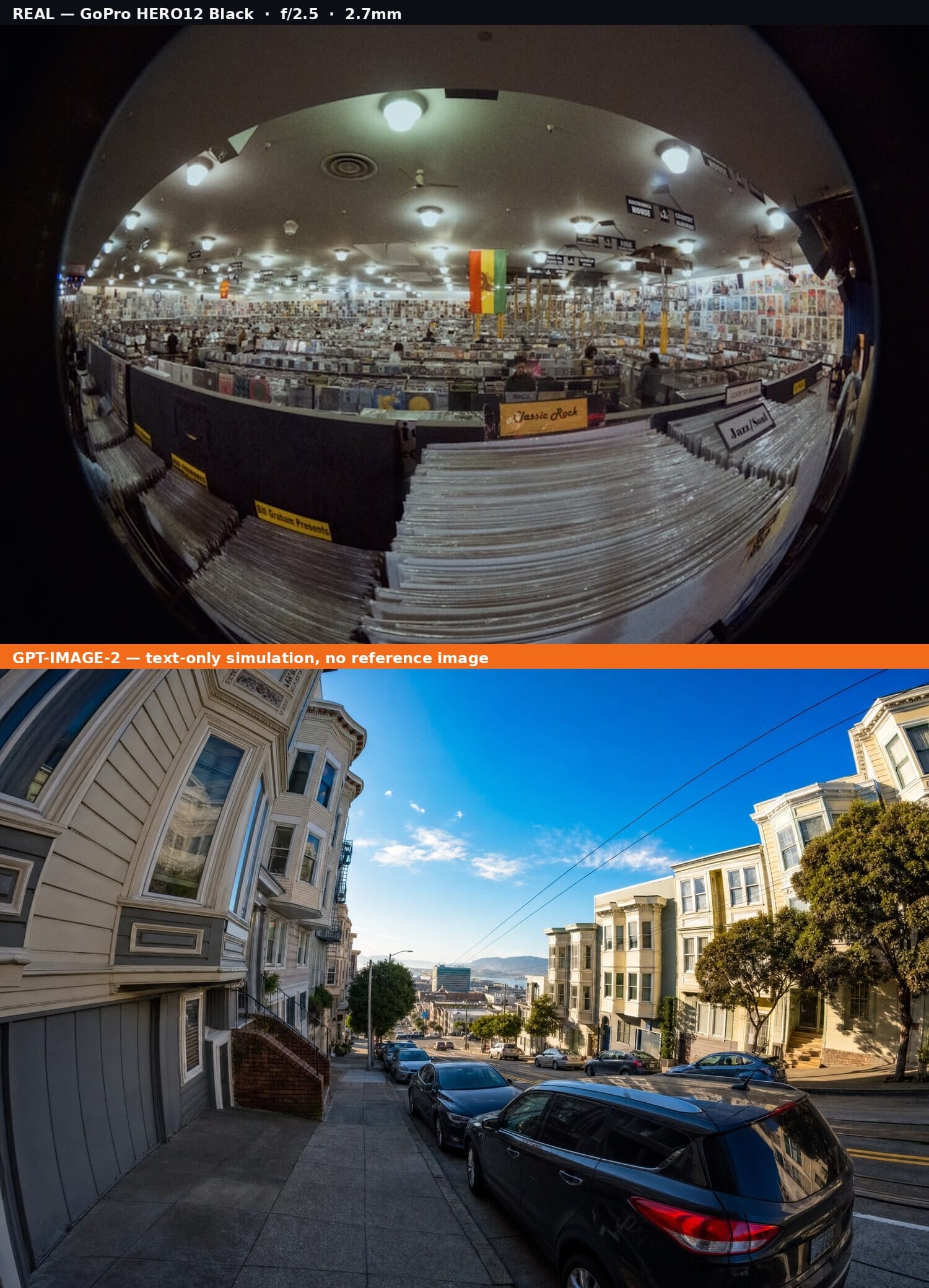
Real has the unmistakable GoPro look — ultra-wide fisheye distortion, deep depth of field, slightly punchy contrast, urban first-person framing. Sim captured the wide-angle character and the SF scene but produced cleaner, less distorted geometry than the actual GoPro 12 lens. Verdict: in the ballpark for action-cam framing, but missing the signature fisheye-bend that makes a GoPro shot recognizable in two seconds.
10. Olympus Tough TG-7 (2023, rugged compact / underwater macro)
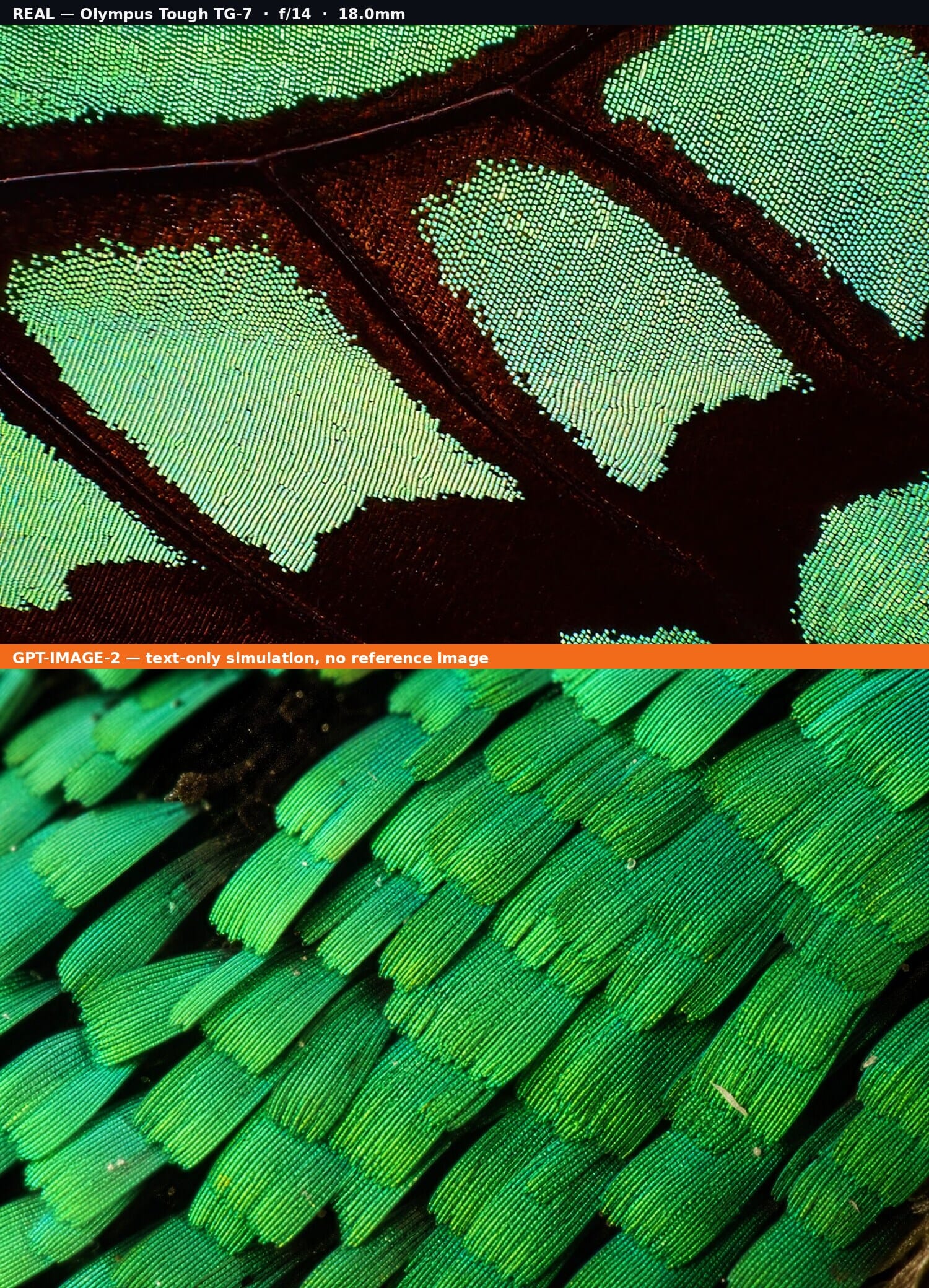
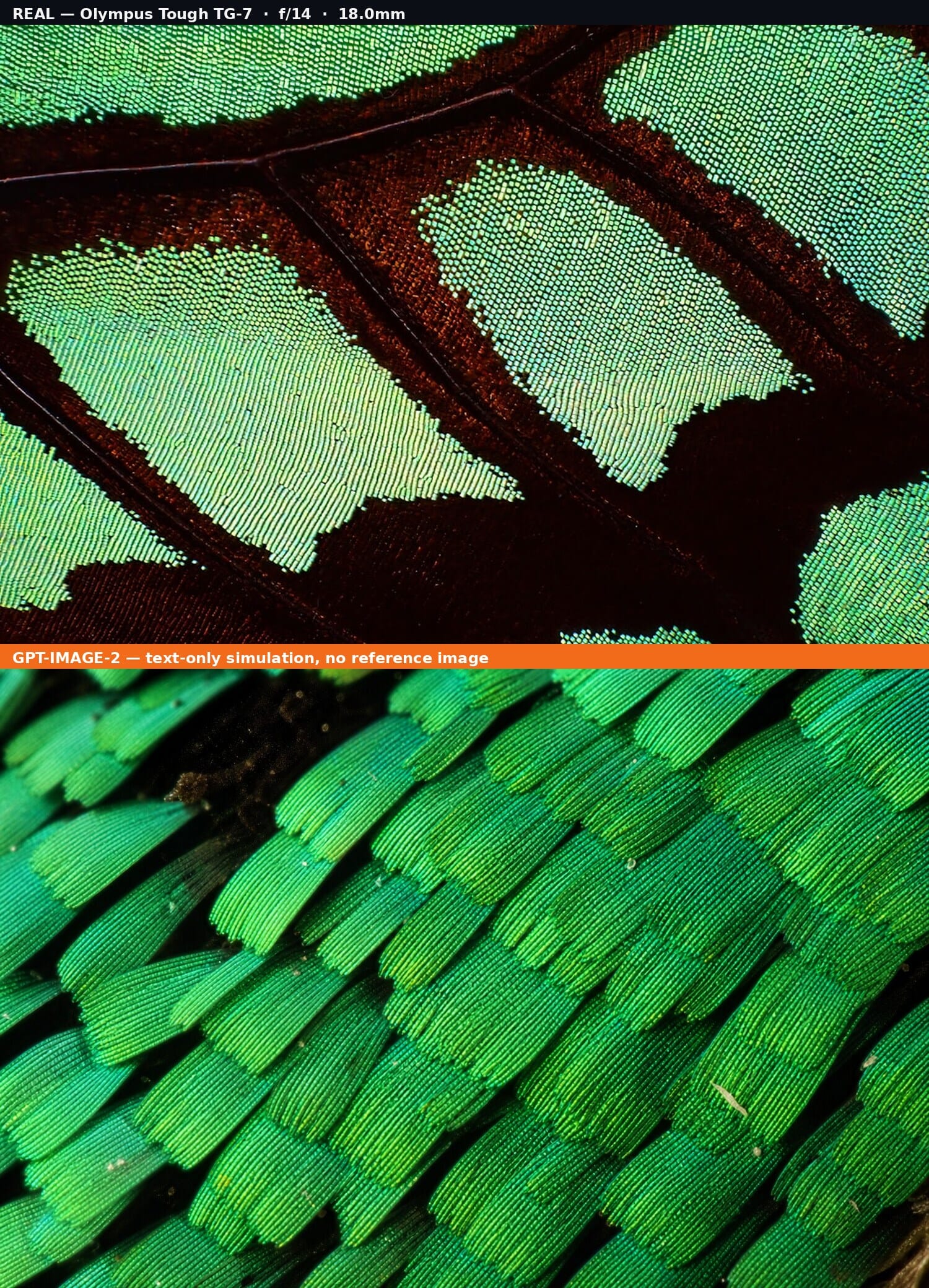
Real is the TG-7’s microscope mode at extreme close working distance — visible scale patterns, vivid emerald iridescence, the characteristic TG-7 microscope look. Sim gave us a competent macro butterfly-wing image but at a more conventional working distance, missing the TG-7’s signature 1:1 reproduction ratio and the unique focusing-stacked compositing that the camera’s microscope mode does in-body. Verdict: good macro understanding, but didn’t simulate the TG-7’s specific microscope-mode workflow.
What gpt-image-2 actually got right (and wrong)
Where it nails things: well-documented “looks”
Cameras with a heavily-discussed signature on the internet — the Fujifilm X100V’s Film Simulation modes, the GoPro’s fisheye distortion, the iPhone’s HDR aesthetic — show up in gpt-image-2’s training data enough that the model produces a recognizable simulation. The Fuji X100V test was the clearest win: the sim actually leaned harder into Classic Negative film-look than the reference photo did.
Where it falls apart: sensor-specific character
The model does NOT have a real understanding of:
- CCD vs CMOS rendering — the Leica M9’s distinctive CCD signature didn’t come through at all.
- Hasselblad Natural Color Solution — the Mavic 3’s Hasselblad-tuned color rendering was indistinguishable from any other aerial shot.
- Computational HDR pipelines — iPhone Smart HDR 5’s shadow-recovery + cool-tone signature didn’t appear in the sim.
- Sensor-size DOF physics — small-sensor cameras (TG-7, GoPro) got rendered with shallower DOF than they’d actually produce; large-sensor cameras occasionally got deeper DOF than they should.
- Color science quirks — Sony’s slight greenish midtones, Canon’s warm bias, Nikon’s clean shadows — none specifically simulated.
The practical verdict for photographers using AI image gen
If you’re using gpt-image-2 to generate concept images, product mockups, or editorial illustrations — and you want them to look like they came from a specific camera — passing the camera model and EXIF helps with composition, not with character. Tell the model “Canon 5D Mark II at f/2.8 15mm” and you’ll get ultra-wide, low-DOF night photography. You will NOT get something that feels distinctly like the 5D Mark II vs another full-frame body of the same era.
The honest assessment: gpt-image-2 is a photorealistic generator that can be steered by EXIF and camera-model hints, but isn’t a camera-signature simulator. Training data has enough “Fuji X100V → film look” association that some sims slip through, but the model doesn’t have an internal physics-of-sensors mental model. For closer camera-look matches, use the /v1/images/edits path with a real reference shot from that camera — we’ve been doing exactly that for product photography (Amazon press shots as references) and it works far better than text-only camera hints.
Test Methodology
- SampleShots — camera-by-camera example photo library – Source of all 10 real photos used in the test, with EXIF metadata (camera body, focal length, aperture, photographer credit).
- OpenAI gpt-image-2 (via OpenClaw CLI) – Model used for all 10 simulation generations. Text-only prompts, no reference images. Generated via OpenClaw CLI on PhotoWorkout's infrastructure with subscription-tier auth.