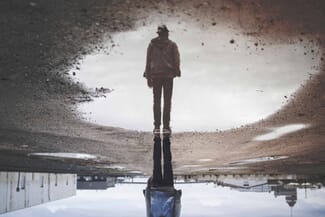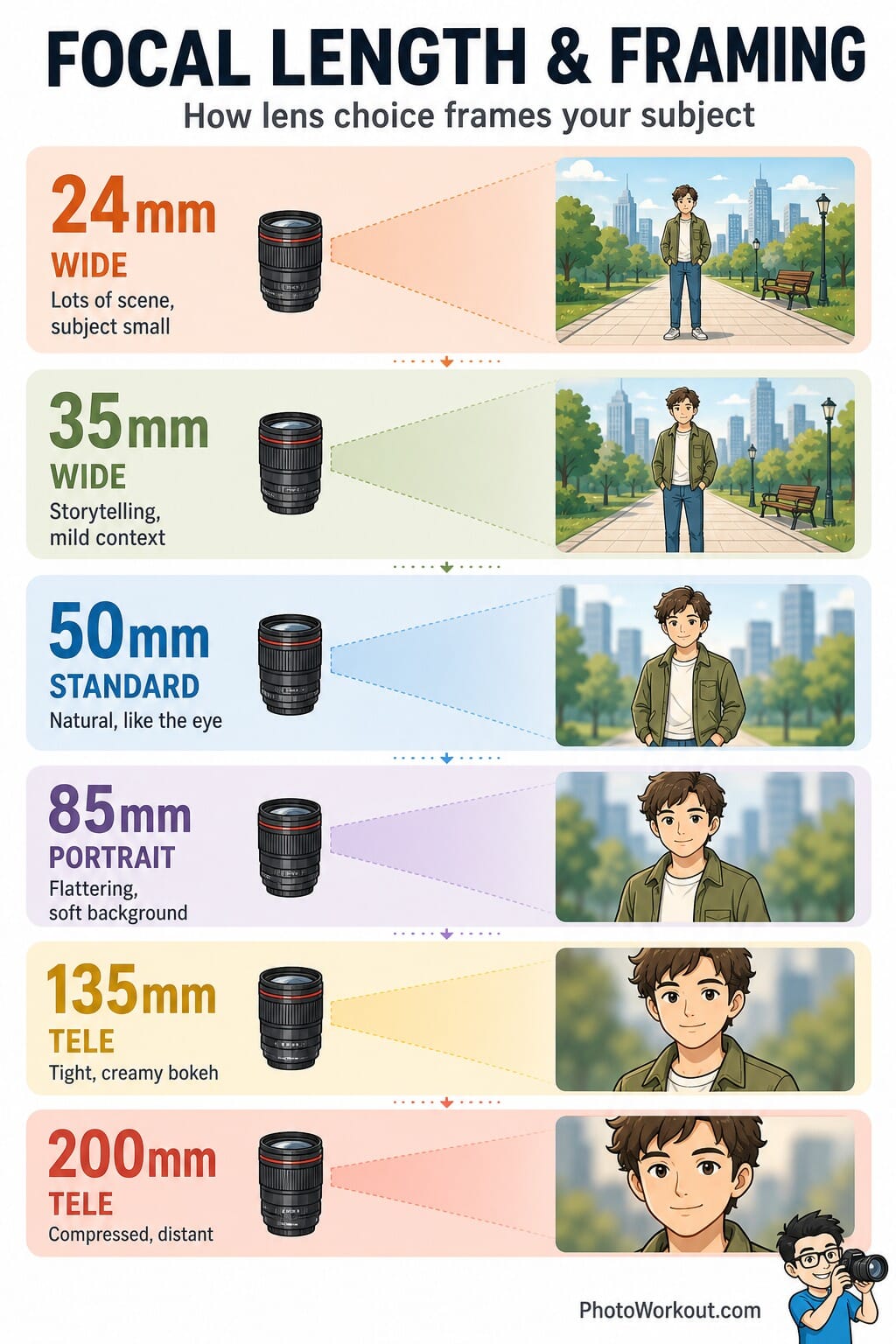


- Focal length controls two things at once: how much of the scene fits in the frame (angle of view) and how large your subject sits inside it.
- Wide lenses (24-35mm) pull in the surroundings for environmental, story-telling frames; short telephotos (85mm) isolate the subject with flattering compression and soft backgrounds.
- The flattering or distorted look of a face comes from how close you stand, not the lens itself. Distance creates perspective; focal length just sets the crop.
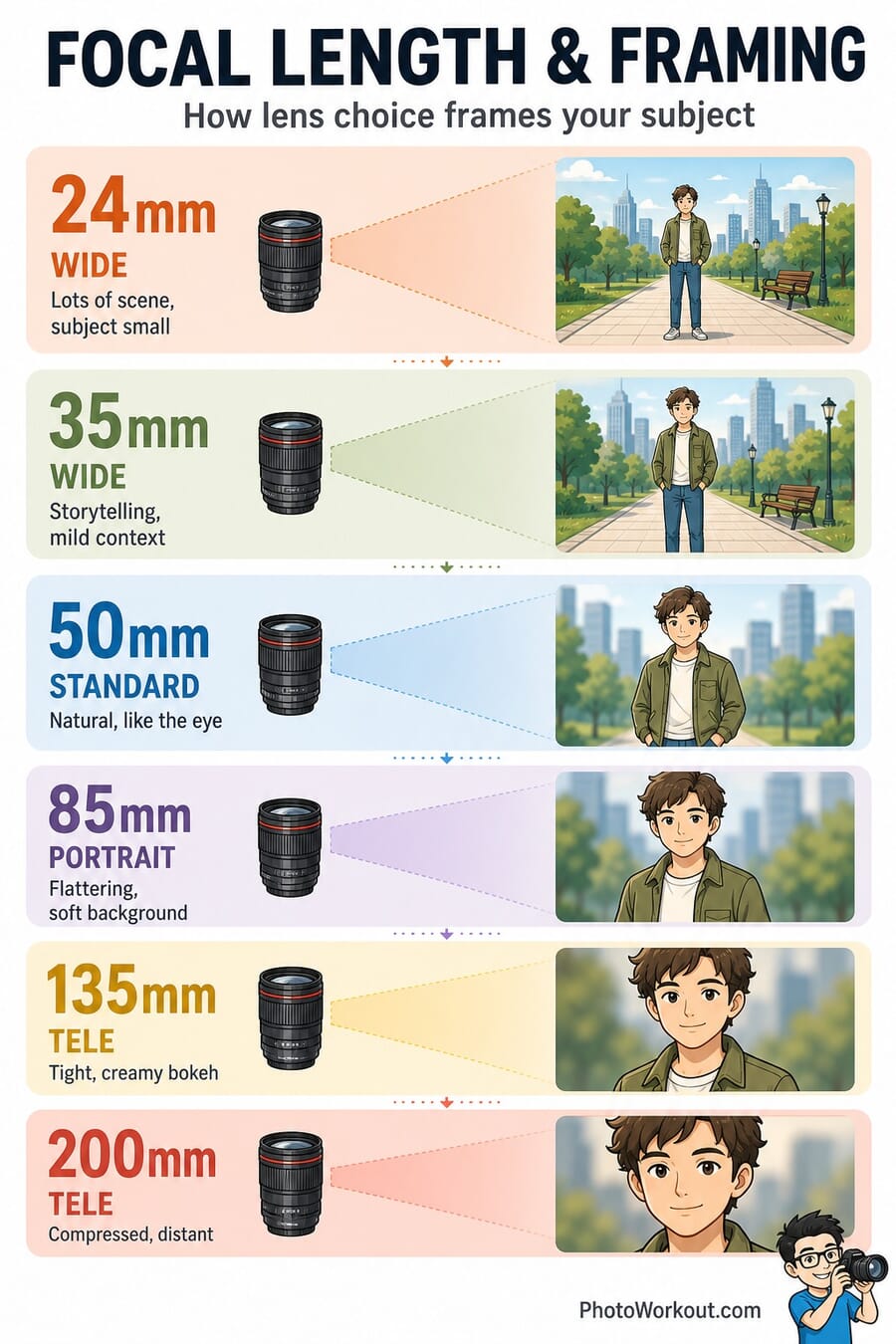
- For people: 50mm reads natural, 85mm is the classic portrait, 135-200mm gives tight, compressed candids. For context and groups, drop to 35mm or wider.
- Grab the 24-to-200mm cheat sheet below and save it. It maps every common focal length to the frame it produces.
Two photographers can stand in the same spot, point at the same person, and come home with completely different pictures. The difference is rarely the camera. It is the focal length on the front of it, the single number that decides how much of the world fits in the frame and how big the subject looms inside it.
Most beginners treat focal length as a zoom convenience, something to crank when the subject is too far away. It is much more than that. Swap a 35mm for an 85mm and the background falls away, the subject’s features relax into flattering proportions, and a busy scene collapses into a clean, intentional portrait. Understanding that relationship is the fastest way to stop taking snapshots and start framing on purpose.
This guide walks through every common focal length from 24mm to 200mm, what each one does to your frame, and how to choose the right one for the shot you are actually after. Every example photo below was shot at the focal length it illustrates. There is a printable cheat sheet near the end you can save to your phone.
What focal length actually changes in your frame
Focal length is measured in millimeters and printed on every lens. Technically it is the distance between the optical center of the lens and the camera’s sensor when focused at infinity, but the number you care about as a shooter is simpler: a shorter focal length sees a wider angle, and a longer focal length sees a narrower one and magnifies it.
Two things move together as that number climbs. First, the angle of view narrows, so less of the scene fits in the frame. Second, whatever remains gets magnified, so the subject grows. A 24mm lens swallows a whole room; a 200mm lens crops to a face from across the street. Everything in this guide flows from those two effects.
One caveat before the focal lengths below: they assume a full-frame camera. On an APS-C body, multiply by roughly 1.5x (1.6x on Canon) and on Micro Four Thirds by 2x to get the equivalent framing. A 50mm on APS-C frames like a 75mm, which is why a “nifty fifty” feels tighter on a crop sensor. If sensor size and lens mounts are still fuzzy, our guide to mirrorless lens mounts untangles it.
Wide angle (24-35mm): put your subject in a story
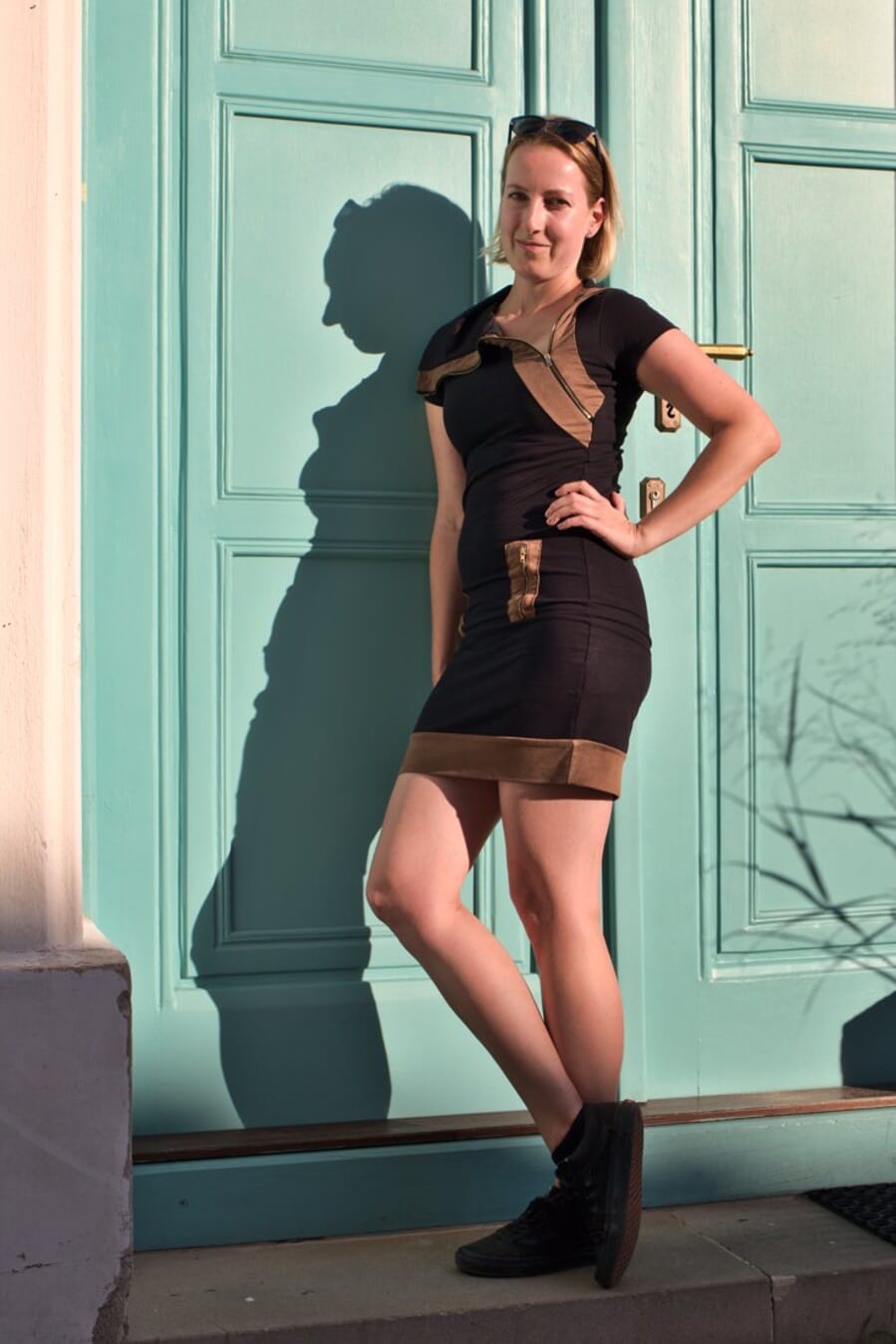
Wide lenses capture context. At 24-35mm you keep the street, the studio, the mountain ridge, or the messy workshop in the frame alongside your subject. That makes them the natural choice for environmental portraits, travel, events, and any photo where where matters as much as who.
The trade-off is distortion near the edges and an aggressive sense of depth. Step in close with a 24mm and the nearest feature, often a nose or an outstretched hand, balloons unnaturally. Used deliberately that exaggeration is a creative tool; the same effect powers forced-perspective shots. Used carelessly it just makes people look odd. Keep faces away from the frame edges, and for wider groups a 35mm is usually the safer floor than 24mm. When you need everyone in one shot without the funhouse look, the rules in our group-photo guide apply directly.
The 50mm standard: the frame that looks like real life
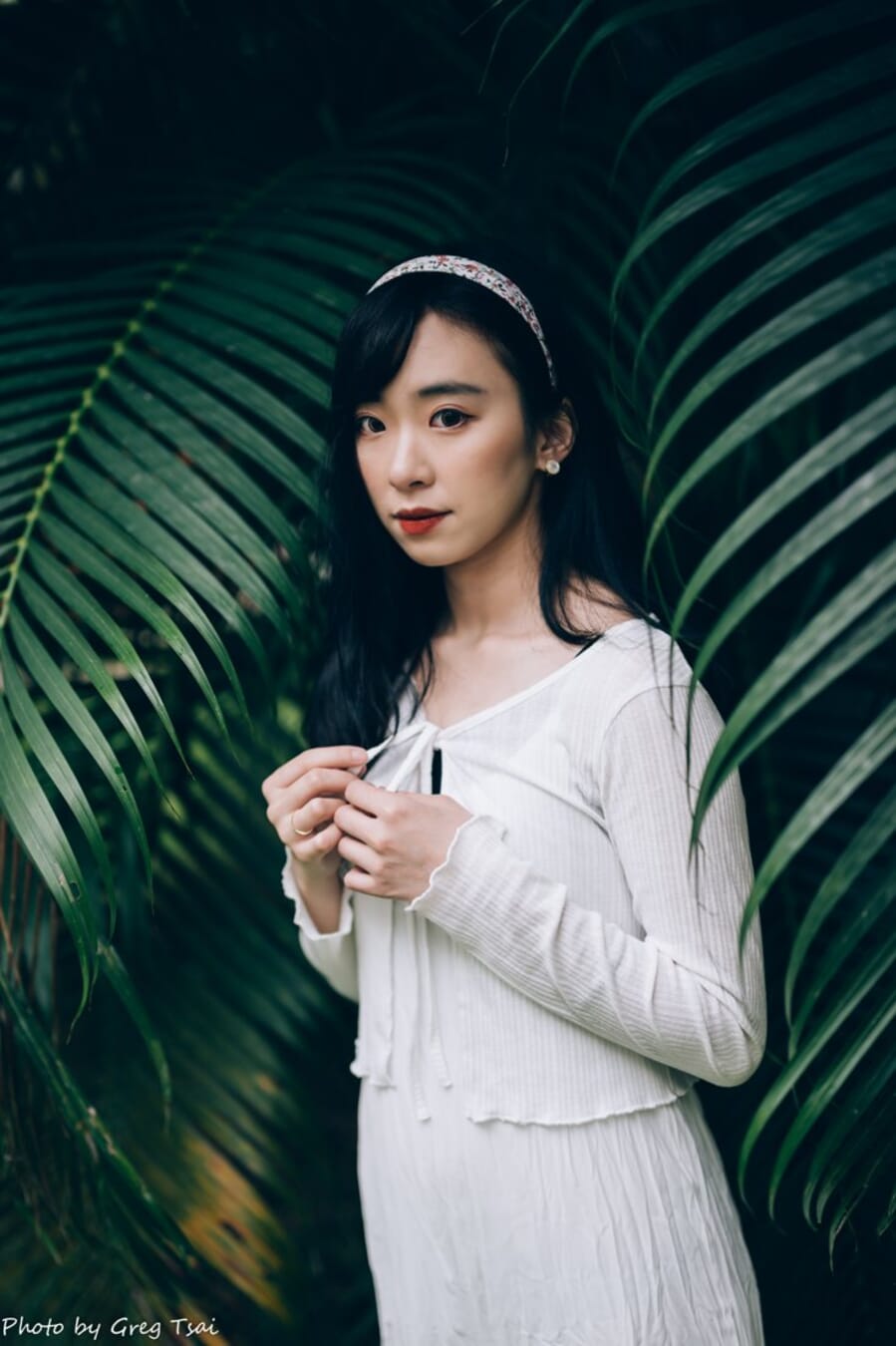
A 50mm lens on full frame renders perspective close to human central vision: nothing is stretched, nothing is squashed. That neutrality is exactly why it has been the default “standard” lens for decades and why so many photographers recommend a cheap, sharp 50mm prime as a first lens. It forces you to move your feet instead of zooming, which is the single best framing exercise there is.
In practice a 50mm is a versatile middle ground: tight enough for waist-up and half-body portraits, loose enough to grab a bit of environment when you step back. Pair it with a wide aperture and it still throws a pleasant background blur, though not as dramatically as the longer lenses below. If you want to understand why that blur appears and how to control it, our bokeh tutorial breaks it down.
85mm short telephoto: the portrait sweet spot
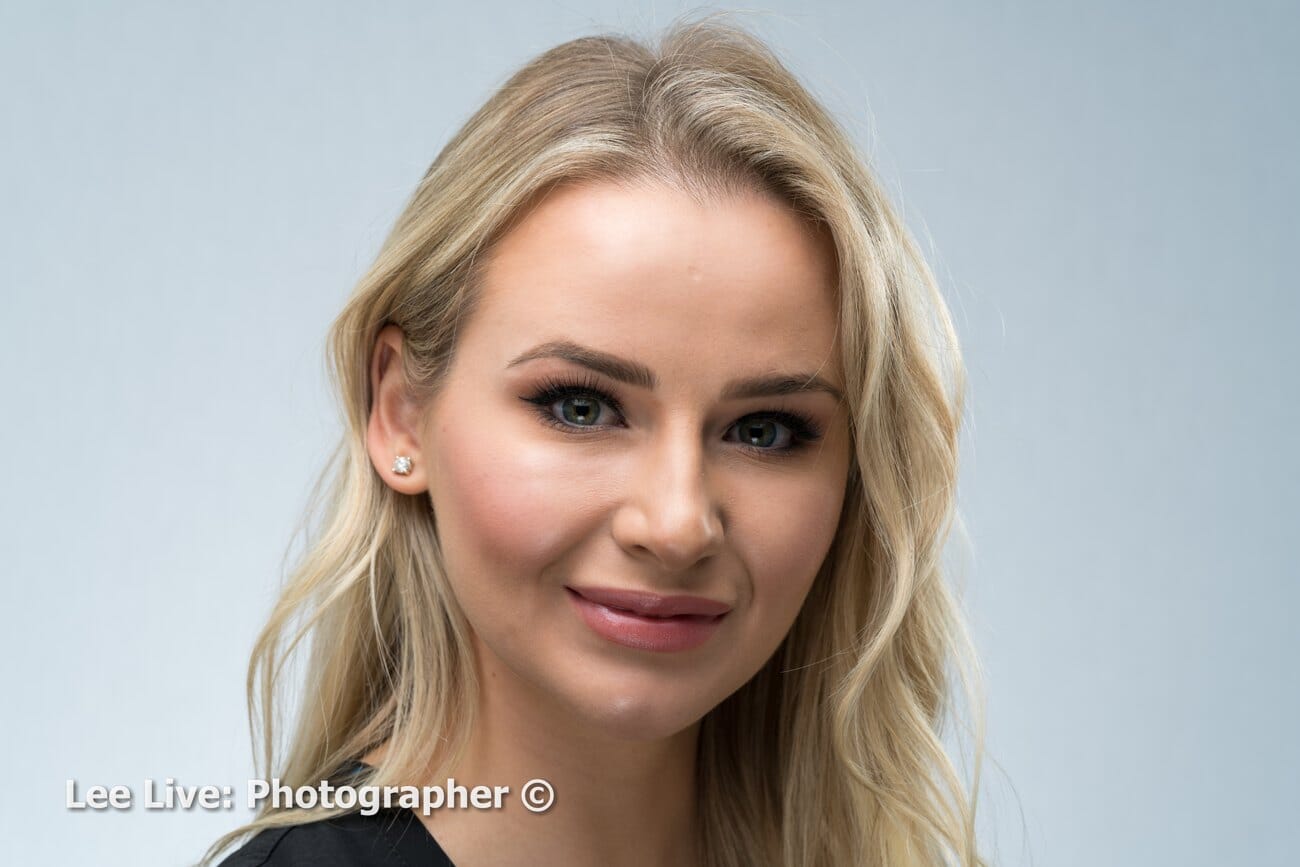
If there is one focal length built for faces, it is 85mm. From a comfortable few steps back it renders features in flattering proportion, gently compresses the face so noses and foreheads sit naturally, and separates the subject from a background that dissolves into smooth color. This is the look most people picture when they think “professional portrait.”
That separation does real work: it removes distractions and pushes every bit of attention onto the eyes. Combine that subject isolation with a thoughtful camera angle and you control not just what is in the frame but how the viewer feels about the person in it. The only cost is working distance. You need room to back up, which is why 85mm shines outdoors and in studios but fights you in a cramped apartment.
135-200mm telephoto: isolation, compression, and candids
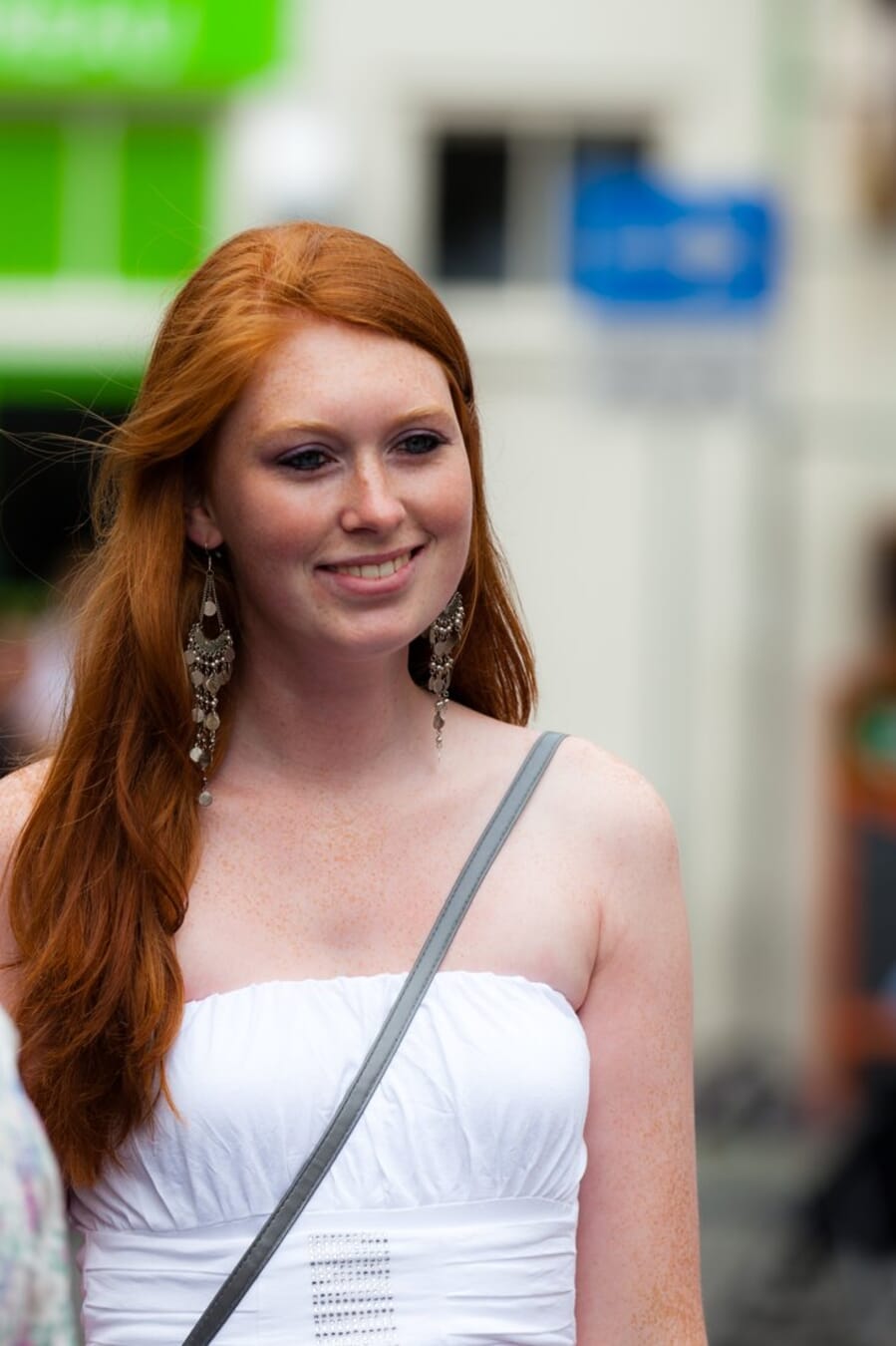
Past 100mm the effects intensify. A 135mm lens is a portrait specialist’s favorite for its even creamier background blur and slightly tighter crop, while 200mm reaches across a scene to pull tight, candid frames of people who do not know they are being photographed, exactly what you want for events, weddings, and street work where you do not want to intrude.
The signature look of these lengths is compression: the background appears to stack up close behind the subject, distant buildings or mountains loom larger than the eye expects, and layers of a scene flatten into one another. It is the reason a telephoto shot of a runner against a city skyline feels so cinematic. The catch is that long lenses demand distance and steady hands, a faster shutter speed or stabilization to stay sharp, and a lot of physical room between you and the subject.
The trick beginners miss: perspective comes from distance, not the lens
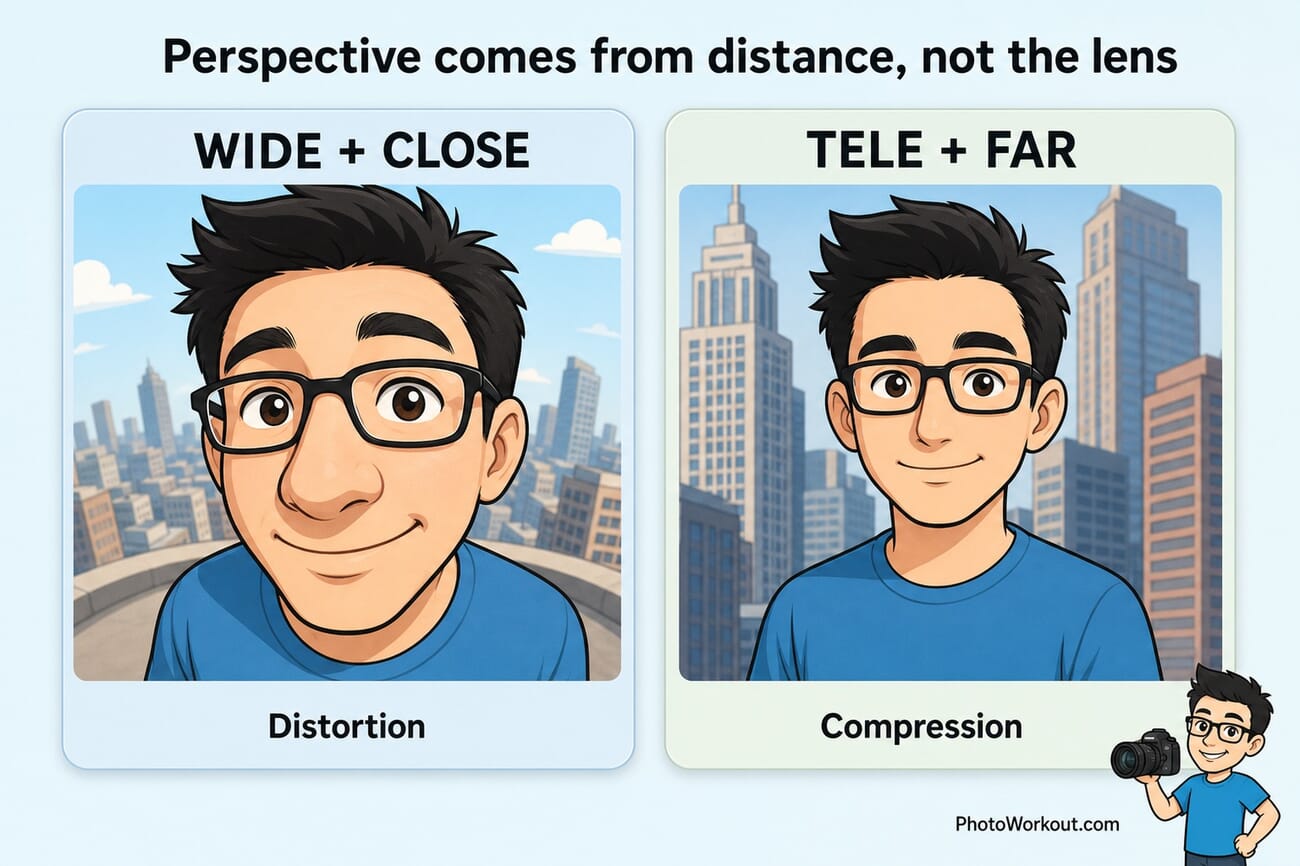
Here is the part that untangles everything above. The flattering or distorted shape of a face is not created by the lens. It is created by how far you stand from your subject. A wide lens only “distorts” because it lets you walk in close before the subject fills the frame, and at close range the nose is meaningfully nearer the camera than the ears, so it looks bigger. A telephoto only “flatters” because it forces you to step back, and from far away the whole face is roughly the same distance from the camera, so proportions even out.
The practical takeaway is liberating: choose your distance for the perspective you want on the subject, then choose the focal length that frames it correctly from there. Want flattering proportions and a compressed background? Stand back and reach for a longer lens. Want drama and a sense of depth? Move in close and go wide. The lens follows the decision; it does not make it.
How to choose the right focal length for the shot you want
Work backwards from the picture in your head. Decide first how much of the surroundings belong in the story and how you want the subject’s proportions to read, then let those two answers point you to a focal length.
- Environmental portrait or travel scene — 24-35mm, to keep the location in the frame.
- Everyday, walk-around, documentary — 50mm, for natural, true-to-life framing.
- Classic headshot or beauty portrait — 85mm, for flattering compression and soft separation.
- Tight candids, events, expressive close-ups — 135-200mm, for reach and a compressed, isolated look.
- Groups — 35-50mm from far enough back that no one sits at the distorted edge of the frame.
None of this is a rule you cannot break. Plenty of striking portraits are shot at 24mm and plenty of landscapes at 200mm. But knowing the default each focal length leans toward means you break the convention on purpose, which is the whole game.
Common framing mistakes to avoid
- Shooting faces too close with a wide lens. The number-one cause of unflattering portraits. Step back and zoom, or switch to a longer lens.
- Putting people at the edge of a wide frame. Edge distortion stretches whoever stands there. Keep faces toward the center.
- Zooming instead of moving. Zooming only changes the crop. Moving changes the perspective. They are not the same decision.
- Forgetting the crop factor. A 50mm frames like a 75mm on APS-C. Check your sensor before assuming a focal length will fit the room.
- Using a telephoto in a tight space. If you cannot back up far enough, the lens cannot frame the shot. Match the focal length to the room you have.
Keep the whole range in one place. Save the cheat sheet below to your phone and pull it up the next time you are deciding which lens to reach for.
Frequently Asked Questions
What is the best focal length for portraits?
85mm on full frame is the classic answer, because it flatters facial proportions and softly blurs the background from a comfortable working distance. 50mm is a flexible, affordable runner-up, and 135mm gives even tighter, more compressed results if you have the room to back up.
Does focal length change perspective?
Not directly. Perspective, meaning how the subject’s features and the background relate, is set by how far you stand from the subject. Focal length changes how much of the scene fits in the frame at that distance. The reason wide lenses look distorted and telephotos look flattering is that they push you to shoot from close or far, respectively.
What focal length is closest to the human eye?
A 50mm lens on a full-frame camera renders central perspective and magnification close to natural human vision, which is why it is called a standard lens. Some argue 43mm is technically closer, but 50mm is the practical, widely available choice.
How does crop factor affect focal length?
On a smaller sensor the same lens frames more tightly. Multiply the focal length by the crop factor to get the full-frame equivalent: about 1.5x on most APS-C cameras, 1.6x on Canon APS-C, and 2x on Micro Four Thirds. So a 50mm frames like a 75-80mm on APS-C.
Is a zoom or a prime better for learning framing?
A prime is the better teacher. With one fixed focal length you have to move your feet to change the frame, which builds an instinct for distance and perspective that a zoom lets you skip. A 35mm or 50mm prime is the usual starting point.
The bottom line
Focal length is not a zoom convenience; it is a framing decision. Each length leans toward a look: wide lenses tell a story with their surroundings, 50mm keeps things honest, and the telephoto range isolates and compresses for clean, flattering portraits. Decide how much context you want and how you want your subject to read, choose your distance for the right perspective, and let the focal length frame it from there. Master that order and the lens stops being a mystery and starts being a choice.
References
- Cambridge in Colour — Camera Lenses: Focal Length & Aperture – Technical primer on focal length, angle of view, and how lenses render a scene.
- Wikipedia — Angle of view (photography) – How focal length and sensor size determine how much of a scene a lens captures.
- Wikipedia — Perspective distortion – Why subject distance, not the lens, creates wide-angle distortion and telephoto compression.
Image Sources
- Featured photo (85mm) — barbasboth via SampleShots – Portrait used as the featured image.
- Wide environmental portrait (35mm) — Debarshi Ray via SampleShots – Illustrates 24-35mm framing.
- Standard portrait (50mm) — gregt99 via SampleShots – Illustrates natural 50mm framing.
- Short-telephoto headshot (85mm) — Lee Live via SampleShots – Illustrates 85mm subject isolation.
- Telephoto portrait (200mm) — Qsimple via SampleShots – Illustrates telephoto compression.
- Focal-length cheat sheet & perspective diagram — stylized PhotoWorkout illustrations – Original PhotoWorkout graphics.