


- Norway’s 2026 World Cup squad portrait — shot by David Yarrow with the players in full Viking gear on a shore near Oslo — has gone viral as one of the most cinematic team photos ever made.
- It works because it’s built on a single strong concept, layered depth, controlled eyelines, and dramatic natural light — not because it’s a tidy lineup.
- Those same principles scale down to any group photo: a sports team, a family, a wedding party, or a friend group.
- The shot is also a composite (Martin Ødegaard was added afterward) — a reminder that modern “group photos” are often assembled, and that’s a creative tool, not a cheat.
- The fixes for bad group photos are almost always the same: give it a reason to exist, stagger people for depth, control the light, and shoot a burst so you catch the one frame where everyone works.
Norway’s national soccer team just turned a routine obligation — the official squad photo — into the most talked-about image of the 2026 World Cup. Instead of the usual two rows of players on a pitch, photographer David Yarrow shot the squad in full Viking gear, with shields and weapons, on a rocky shore near Oslo, longships and steep green mountains behind them. PetaPixel asked whether it might be the greatest World Cup team photo ever taken. Whether or not it is, it’s a perfect case study in what separates a forgettable group shot from one people actually stop to look at.
Here’s the image that set off the conversation — Norway’s squad in full Viking dress, shot by David Yarrow:
View Norway’s Viking World Cup team photo by David Yarrow on Instagram
What Norway Actually Did
This wasn’t a snapshot. Yarrow — known for cinematic, larger-than-life portraits — built the image around a narrative: the Viking journey. “I like to take people outside of how they’re normally photographed,” he said. “I wanted to play on that sense of journey that goes back to the Vikings.” The Norwegian Football Federation leaned in deliberately, choosing the Viking story to signal “togetherness, team spirit, and standing united.”
It was also a production. The main shoot happened on a private beach near Oslo, with background elements composited in from Viking Valley in Gudvangen photographed the same day. Arsenal’s Martin Ødegaard, away at the Champions League final, was photographed separately and added in afterward. That’s worth saying out loud: a huge share of striking modern group photos are assembled from more than one frame — which is a tool you can use too, not a reason to feel cheated.
What Makes a Group Shot Actually Work
Strip away the Vikings and the budget, and the Norway photo follows the same handful of rules that make any group photo good. Here’s the breakdown.
1. Start with a concept, not a pose
The single biggest difference between a great group shot and a dull one is whether it’s about anything. “Everyone stand here and smile” produces a record; a concept produces a photograph. It doesn’t need a Viking budget — a shared color, a location that means something to the group, a single prop, or a simple idea (“everyone looking at the bride,” “the whole team mid-celebration”) is enough to give the frame a reason to exist.
2. Build depth — don’t line everyone up
A flat row of people reads as a list. Yarrow’s frame stacks players at different distances and heights, which creates depth and a sense of scale. For your own shots, stagger people front-to-back, mix standing and crouching, and use the environment (steps, a hillside, furniture) to put faces at different levels. A slight wedge or cluster almost always beats a straight line.
3. Control eyelines and expressions
In a big group, the photo fails the moment one person blinks, looks away, or smiles half a beat late — and with a dozen people, someone always will on any single frame. That’s why pros shoot a burst and often composite the best version of each face. Direct eyelines deliberately: either everyone to camera, or everyone to a single off-camera point. Mixed, wandering eyelines are what make casual group photos feel chaotic.
4. Use the light and the location
The Norway shot is lit by dramatic, directional daylight on an epic coastline — the setting does half the work. You don’t need a fjord, but you do need to think about light: put the group in open shade or backlight at golden hour rather than harsh overhead sun, keep the light even across faces so no one’s lost in shadow, and pick a background that supports the story instead of fighting it.

5. Posed, candid — or built
There’s no single “right” group photo. A posed shot gives you control and everyone looking their best; a candid catches real energy and connection but risks closed eyes and awkward moments. The Norway image is a third path: a posed, art-directed composite. For important group photos, the safest approach is to shoot both — a few controlled, posed frames and a burst of candid interaction — and, if you’re comfortable in an editor, swap the best face or two between frames.
How to Apply This to Your Own Group Photos
You don’t need a celebrity photographer to use what makes Norway’s photo work. A practical checklist for the next family gathering, team, or wedding party:
- Pick one simple idea. A theme, a location with meaning, or a single shared action. Decide before you raise the camera.
- Arrange for depth. Stagger heights and distances; cluster rather than line up. Put the most important person where the eye lands first.
- Shoot a burst. Hold the shutter for 5–10 frames so you can pick — or merge — the one where everyone’s eyes are open. This is the single highest-value habit in group photography.
- Mind the light. Open shade or golden-hour backlight beats midday sun. Keep faces evenly lit.
- Call it clearly. Tell people exactly where to look and when (“eyes here, big smile, on three”). Confusion is what ruins most group shots.
For the camera side of it, our guide to the best camera settings for portraits covers the aperture and focus choices that keep a whole group sharp, and our posing guides help if directing people is the part you find hardest.
Frequently Asked Questions
Who took Norway’s World Cup team photo?
British photographer David Yarrow, known for cinematic, unconventional portraits. He shot the Norwegian squad in Viking costume on a shore near Oslo for the 2026 FIFA World Cup, held in the United States.
Is the Norway team photo real or edited?
Both. The players were really photographed in Viking gear on location, but the image is a composite: some background was added from a second location, and Martin Ødegaard — away at the Champions League final — was photographed separately and inserted afterward.
What’s the most important tip for a good group photo?
Shoot a burst. With several people, someone will always blink or look away on any single frame, so firing 5–10 shots in a row dramatically raises your odds of one where everyone works — and lets you swap faces between frames if needed.
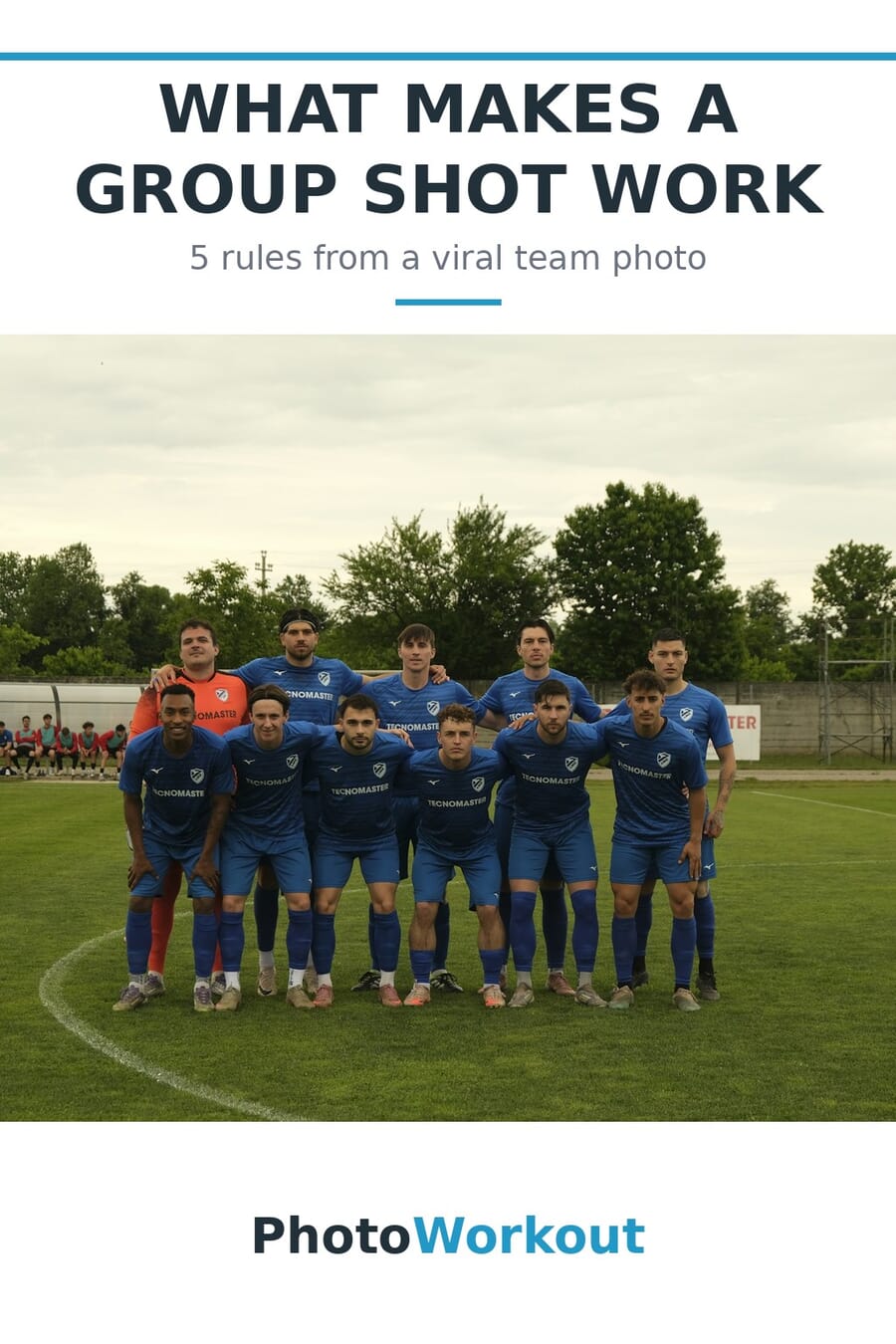
Featured image: the Henningsvær football pitch in Lofoten, Norway, by Ivars Utināns via SampleShots. Pinterest graphic: team photo by Mattia Revelant via SampleShots. The infographic is a stylized PhotoWorkout illustration. See Norway’s actual team photo at PetaPixel.
Primary Coverage
- PetaPixel — Did Norway Just Take the Greatest World Cup Team Photo Ever? – Report on the David Yarrow Viking team portrait
- David Yarrow Photography – The photographer’s official site
Image Sources
- Ivars Utināns — Henningsvær football pitch (featured) – via SampleShots
- Mattia Revelant — soccer team photo (pin) – via SampleShots
- PhotoWorkout illustration – The group-shot infographic is a stylized PhotoWorkout illustration