


- BenQ’s new MA270S is a 27-inch 5K glossy display built for Mac — a direct, hands-on-tested alternative to Apple’s Studio Display, for $999 versus Apple’s $1,599.
- For photographers, the spec that matters most is there: 99% DCI-P3 coverage on a sharp 5K panel, which is plenty for accurate color work.
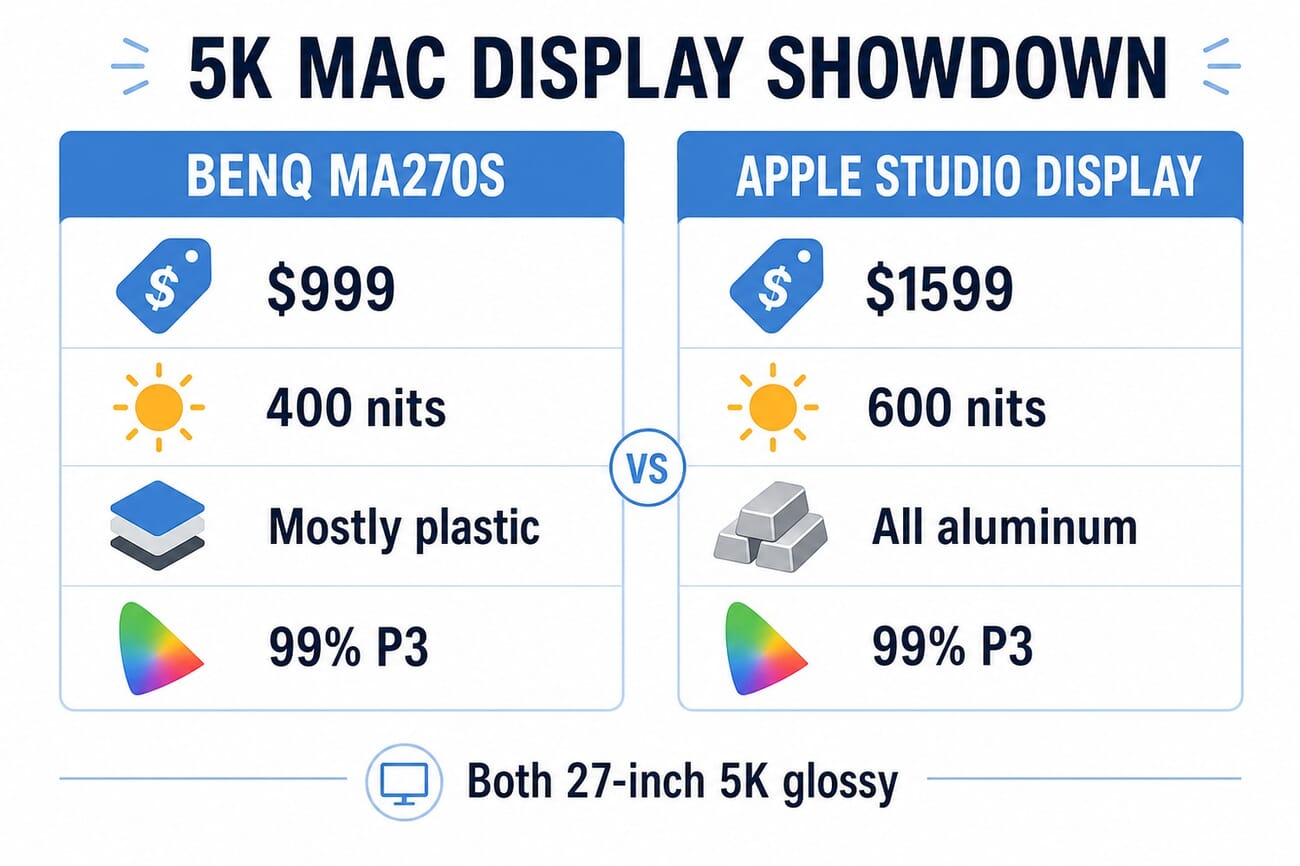
- The trade-offs versus the Studio Display: 400 nits instead of 600, and a mostly-plastic build instead of all-aluminum. For everyday SDR photo editing, neither is a dealbreaker.
- It’s a proper Mac hub too — four USB-C plus two USB-A and two HDMI, a height-adjustable stand with a silicone MacBook pad, a KVM switch, and a Display Pilot 2 app for keyboard brightness control.
- The catch is the glossy-only panel: punchy and sharp, but reflective in bright rooms. If you need HDR brightness, a premium metal build, or a matte option, the Studio Display still earns its premium.
Apple’s Studio Display is a lovely 5K monitor for Mac photographers — and at $1,599 it’s also a tough pill. So a named, hands-on-tested alternative is worth attention. 9to5Mac reports that BenQ — a brand with real color-monitor credentials — just launched the MA270S, a 27-inch 5K glossy display built specifically for Mac, at $999. That’s $600 less than the Studio Display for a similar panel. Here’s what photographers actually get, and where the compromises land.
When you buy through links on our site, we may earn a commission at no cost to you. We evaluate products independently. Commissions do not affect our evaluations.
What the BenQ MA270S Is
On paper it goes spec-for-spec with Apple where it counts. The MA270S is a 27-inch, 5K, glossy panel — the same size, resolution and finish as the Studio Display — with 400 nits of brightness, 99% DCI-P3 coverage, HDR400 support and a 70Hz refresh rate. Connectivity is generous: four USB-C ports plus two USB-A and two HDMI, so it doubles as a desktop hub. The stand swivels, tilts, pivots and adjusts for height, and includes a silicone pad to rest a MacBook on. There are built-in speakers, a KVM switch for sharing one keyboard and mouse between a Mac and a PC, and a Display Pilot 2 app that lets you control brightness and display settings from the keyboard.
Reviewer Michael Burkhardt calls it “one of the few 5K options on the market with a glossy finish” and says he’s “quite pleased with it” after weeks of daily use. It’s available now from BenQ (Amazon stock was sold out at launch).
How It Compares to the Apple Studio Display
Because both are 27-inch 5K glossy panels, this is a clean comparison. The headline is the $600 price gap. In exchange, the MA270S makes two concessions the 9to5Mac hands-on flags: it’s mostly plastic where the Studio Display is all aluminum, and it tops out at 400 nits versus Apple’s 600. Everything else — resolution, finish, P3 gamut — lines up closely, and the BenQ actually adds more ports and a KVM that the Studio Display lacks.
What Actually Matters for Photographers
Strip away the Mac-accessory polish and a photo editor cares about three things, and the MA270S handles them well.
Color and resolution
The 99% P3 coverage and 5K resolution are the real story: that’s a wide, accurate gamut and enough pixel density to judge fine detail and retouching at 1:1. For color-critical photo work, this is the spec that justifies a 5K display over a cheaper 4K one.
400 nits is fine — for most photo work
The Studio Display’s 600 nits sounds better, and it matters if you edit and export HDR images. But the vast majority of photography is still SDR, and 400 nits is comfortably bright for accurate SDR editing in a normally-lit room. Unless HDR is central to your workflow, you’re unlikely to miss the extra brightness.
The glossy question
Glossy panels render color and contrast with more “pop” and apparent sharpness, which many photographers love — but they also reflect. In a bright studio or a room with windows behind you, a glossy screen can be distracting in a way a matte panel isn’t. The Studio Display offers a nano-texture matte option (for extra money); the MA270S is glossy-only. If reflections are a problem in your space, factor that in. If your editing rig needs an upgrade beyond the screen, our best desktops for photo editing guide pairs well here.
Should Photographers Buy It?
For a Mac photographer who wants the sharpness of 5K and a wide, accurate P3 gamut without paying Apple’s $1,599, the MA270S is an easy recommendation — you save $600 and gain ports and a KVM, while giving up some brightness and a metal shell most people won’t miss. Stick with the Studio Display if you specifically need HDR brightness, the premium aluminum build, or a matte nano-texture finish for a bright room. And if your work is video-leaning or you want the absolute top tier, this week’s ASUS ProArt QD-OLED sits in a different (pricier) class. For straightforward, color-accurate 5K editing on a Mac, though, BenQ just made the math a lot easier.
Frequently Asked Questions
How much is the BenQ MA270S?
$999, available from BenQ’s website (Amazon stock was sold out at launch). That’s $600 less than Apple’s $1,599 Studio Display.
Is the BenQ MA270S good for photo editing?
Yes — it has 99% DCI-P3 coverage on a 27-inch 5K panel, which gives you a wide, accurate gamut and the resolution to judge fine detail. For SDR photo work its 400 nits is plenty; HDR-focused editors may prefer a brighter screen.
How is it different from the Apple Studio Display?
Same 27-inch 5K glossy panel and 99% P3 gamut, but the MA270S is $600 cheaper, mostly plastic instead of aluminum, and 400 nits instead of 600. It adds more ports and a KVM switch that the Studio Display doesn’t have.
Does it have a matte option?
No — the MA270S is glossy-only. The Apple Studio Display offers a nano-texture matte option at extra cost, which is worth considering if you work in a bright, reflective room.
The Bottom Line
The BenQ MA270S won’t topple the Studio Display on prestige, but it doesn’t need to. For $999 it delivers the two things a photographer actually wants from a Mac monitor — 5K sharpness and a 99% P3 gamut — and throws in a useful hub and KVM. Accept the glossy-only screen and slightly lower brightness, and it’s one of the most sensible 5K Mac displays you can buy right now.
Primary Coverage
- 9to5Mac — BenQ MA270S hands-on (27-inch 5K Mac monitor) – Specs, pricing and Studio Display comparison
Image Sources
- BenQ — MA270S product image (featured & pin) – Manufacturer product render, staged via Photoroom
- PhotoWorkout illustration – The spec-comparison infographic is a stylized PhotoWorkout illustration